


 |
市場調查報告書
商品編碼
1913350
醫用氣體設備市場機會、成長要素、產業趨勢分析及2026年至2035年預測Medical Gas Equipment Market Opportunity, Growth Drivers, Industry Trend Analysis, and Forecast 2026 - 2035 |
||||||

全球醫用氣體設備市場預計到 2025 年將達到 33 億美元,到 2035 年將達到 66 億美元,年複合成長率為 7.2%。
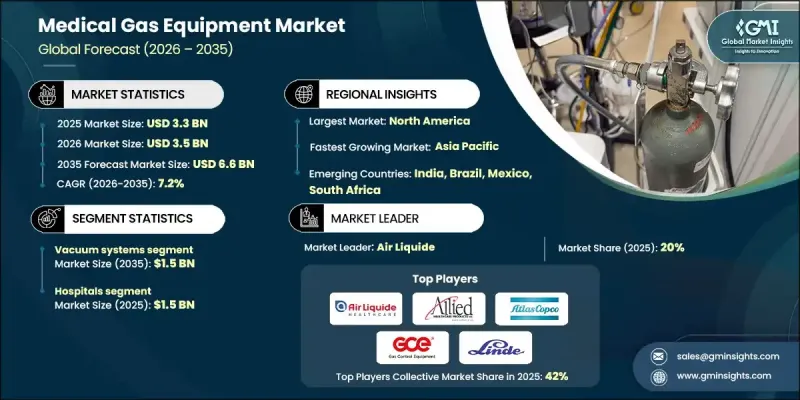
受醫用氣體技術進步、居家醫療和氧氣療法需求成長、政府扶持政策以及手術和加護病房(ICU) 收治人數增加等因素的推動,市場持續穩定擴張。攜帶式氧氣濃縮機和輕型氧氣瓶等技術創新使氧氣療法得以廣泛應用,居家醫療也朝著更經濟、便利和降低再入院率的方向發展。有利的報銷機制和以價值為導向的醫療保健模式的轉變進一步推動了對醫用氣體輸送系統、調節器和監測設備的需求。醫院和居家醫療機構越來越依賴這些系統來保障病人安全。此外,手術和 ICU 收治人數的增加使得可靠的醫用氣體基礎設施(用於麻醉、通氣和病患監測)變得至關重要,從而促進了市場成長。
| 市場覆蓋範圍 | |
|---|---|
| 開始年份 | 2025 |
| 預測年份 | 2026-2035 |
| 起始值 | 33億美元 |
| 預測金額 | 66億美元 |
| 複合年成長率 | 7.2% |
預計到 2025 年,真空系統市場規模將達到 7.457 億美元,到 2035 年將達到 15 億美元。這些系統對於手術室、加護病房和危重症監護環境中的抽吸應用至關重要,它們產生負壓以清除液體、分泌物和氣體,保持手術視野清晰,並輔助進行救生手術。
由於手術室、重症監護室、急診室和普通患者照護等區域對可靠的氣體供應系統有廣泛的需求,預計到2025年,醫院領域的市場規模將保持在15億美元。醫用氣體,包括氧氣、氧化亞氮、醫用空氣和真空系統,在維生系統、麻醉和呼吸治療中至關重要。手術量、重症監護室入院人數以及慢性呼吸系統疾病病例的增加,正在推動醫院對先進氣體基礎設施的需求。
預計2025年,美國醫用氣體設備市場規模將達12.8億美元。推動市場成長的主要因素包括醫療機構早期採用自動化和數位化技術,以及外科手術量和重症監護室(ICU)入院人數的增加。物聯網感測器、集中式控制面板和先進的警報系統能夠實現即時監控、預測性維護,並確保符合NFPA 99和FDA法規,進而提高營運效率和病患安全。
目錄
第1章調查方法和範圍
第2章執行摘要
第3章業界考察
- 生態系分析
- 產業影響因素
- 促進要素
- 加速醫用氣體設備的科技進步
- 居家醫療和氧氣療法成長
- 政府激勵措施增加
- 外科手術和加護病房(ICU)入院人數增加
- 產業潛在風險與挑戰
- 複雜而嚴格的監管流程
- 維護和合規負擔
- 市場機遇
- 新興市場的發展趨勢
- 促進要素
- 成長潛力分析
- 監管環境
- 北美洲
- 歐洲
- 亞太地區
- 技術進步
- 當前技術趨勢
- 新興技術
- 未來市場趨勢
- 波特五力分析
- PESTEL 分析
第4章 競爭情勢
- 介紹
- 公司市佔率分析
- 企業矩陣分析
- 主要市場公司的競爭分析
- 競爭定位矩陣
- 重大進展
- 併購
- 合作夥伴關係和合資企業
- 新產品發布
- 擴張計劃
第5章 2022-2035年按產品分類的市場估算與預測
- 歧管
- 經銷店
- 軟管組件和閥門
- 警報系統
- 圓柱
- 流量計
- 穩壓器
- 醫用空氣壓縮機
- 真空系統
- 其他產品
6. 依最終用途分類的市場估計與預測,2022-2035 年
- 醫院
- 診所
- 門診手術中心
- 其他最終用戶
第7章 2022-2035年各地區市場估算與預測
- 北美洲
- 美國
- 加拿大
- 歐洲
- 德國
- 英國
- 法國
- 西班牙
- 義大利
- 荷蘭
- 亞太地區
- 中國
- 印度
- 日本
- 澳洲
- 韓國
- 拉丁美洲
- 巴西
- 墨西哥
- 阿根廷
- 中東和非洲
- 沙烏地阿拉伯
- 南非
- 阿拉伯聯合大公國
第8章 公司簡介
- Allied Healthcare Products
- Air Liquide
- Amico Corporation
- Atlas Copco Group
- Dragerwerk
- GCE Group
- Gentec Corporation
- Linde
- Mediquip International
- Novair Medical
- Ohio Medical
- Precision UK
- Rotarex
- Silbermann Medical Gas Systems
- Taiyo Nippon Sanso Corporation
The Global Medical Gas Equipment Market was valued at USD 3.3 billion in 2025 and is estimated to grow at a CAGR of 7.2% to reach USD 6.6 billion by 2035.
The market is experiencing steady expansion, driven by advancements in medical gas technologies, rising demand for home healthcare and oxygen therapy, supportive government initiatives, and increasing surgical and ICU admissions. The shift toward home-based care, due to its affordability, convenience, and potential to reduce hospital readmissions, combined with innovations such as portable oxygen concentrators and lightweight cylinders, is making oxygen therapy widely accessible. Favorable reimbursement frameworks and the transition toward value-based care are further boosting demand for medical gas delivery systems, regulators, and monitoring equipment. Hospitals and home healthcare providers are increasingly relying on these systems to ensure patient safety. Additionally, the rising volume of surgical procedures and ICU admissions necessitates dependable medical gas infrastructure for anesthesia, ventilation, and patient monitoring, supporting market growth.
| Market Scope | |
|---|---|
| Start Year | 2025 |
| Forecast Year | 2026-2035 |
| Start Value | $3.3 Billion |
| Forecast Value | $6.6 Billion |
| CAGR | 7.2% |
The vacuum systems segment was valued at USD 745.7 million in 2025 and is anticipated to reach USD 1.5 billion by 2035. These systems are essential for suction applications in surgical theaters, intensive care units, and emergency care, creating negative pressure to remove fluids, secretions, and gases, maintaining a clear operative field, and supporting life-saving interventions.
The hospitals segment held USD 1.5 billion in 2025 owing to their extensive demand for reliable gas supply systems across operating rooms, ICUs, emergency wards, and general patient care areas. Medical gases, including oxygen, nitrous oxide, medical air, and vacuum systems, are critical for life support, anesthesia, and respiratory therapy. The increasing number of surgeries, ICU admissions, and chronic respiratory disease cases is driving the demand for advanced gas infrastructure in hospitals.
U.S. Medical Gas Equipment Market reached USD 1.28 billion in 2025. Growth is supported by rising surgical procedures and ICU admissions, alongside early adoption of automation and digital technologies in healthcare facilities. IoT-enabled sensors, centralized control panels, and advanced alarm systems allow real-time monitoring, predictive maintenance, and compliance with NFPA 99 and FDA regulations, enhancing operational efficiency and patient safety.
Key players operating in the Global Medical Gas Equipment Market include Allied Healthcare Products, Air Liquide, Amico Corporation, Atlas Copco Group, Dragerwerk, GCE Group, Gentec Corporation, Linde, Mediquip International, Novair Medical, Ohio Medical, Precision UK, Rotarex, Silbermann Medical Gas Systems, and Taiyo Nippon Sanso Corporation. Companies in the Global Medical Gas Equipment Market are employing several strategies to strengthen their market presence and competitive positioning. They are investing heavily in research and development to create innovative, compact, and energy-efficient equipment suitable for both hospitals and home healthcare. Strategic partnerships and acquisitions allow expansion into new geographies and access to complementary technologies.
Table of Contents
Chapter 1 Methodology and Scope
- 1.1 Market scope and definition
- 1.2 Research design
- 1.2.1 Research approach
- 1.2.2 Data collection methods
- 1.3 Data mining sources
- 1.3.1 Global
- 1.3.2 Regional/country
- 1.4 Base estimates and calculations
- 1.4.1 Base year calculation
- 1.4.2 Key trends for market estimation
- 1.5 Primary research and validation
- 1.5.1 Primary sources
- 1.6 Forecast model
- 1.7 Research assumptions and limitations
Chapter 2 Executive Summary
- 2.1 Industry 360° synopsis
- 2.2 Key market trends
- 2.2.1 Regional trends
- 2.2.2 Product trends
- 2.2.3 End Use trends
- 2.3 CXO perspectives: Strategic imperatives
- 2.3.1 Key decision points for industry executives
- 2.3.2 Critical success factors for market players
- 2.4 Future outlook and strategic recommendations
Chapter 3 Industry Insights
- 3.1 Industry ecosystem analysis
- 3.2 Industry impact forces
- 3.2.1 Growth drivers
- 3.2.1.1 Increasing technological advancements in medical gas equipment
- 3.2.1.2 Growth in home healthcare and oxygen therapy
- 3.2.1.3 Rising favorable initiatives undertaken by government organizations
- 3.2.1.4 Increasing surgical and ICU admissions
- 3.2.2 Industry pitfalls and challenges
- 3.2.2.1 Complex and stringent regulatory process
- 3.2.2.2 Maintenance and compliance burden
- 3.2.3 Market opportunities
- 3.2.3.1 Growing expansion in emerging markets
- 3.2.1 Growth drivers
- 3.3 Growth potential analysis
- 3.4 Regulatory landscape
- 3.4.1 North America
- 3.4.2 Europe
- 3.4.3 Asia Pacific
- 3.5 Technological advancements
- 3.5.1 Current technological trends
- 3.5.2 Emerging technologies
- 3.6 Future market trends
- 3.7 Porter's analysis
- 3.8 PESTEL analysis
Chapter 4 Competitive Landscape, 2025
- 4.1 Introduction
- 4.2 Company market share analysis
- 4.3 Company matrix analysis
- 4.4 Competitive analysis of major market players
- 4.5 Competitive positioning matrix
- 4.6 Key developments
- 4.6.1 Mergers and acquisitions
- 4.6.2 Partnerships and collaborations
- 4.6.3 New product launches
- 4.6.4 Expansion plans
Chapter 5 Market Estimates and Forecast, By Product, 2022 - 2035 ($ Mn)
- 5.1 Key trends
- 5.2 Manifolds
- 5.3 Outlets
- 5.4 Hose assemblies and valves
- 5.5 Alarm systems
- 5.6 Cylinders
- 5.7 Flowmeters
- 5.8 Regulators
- 5.9 Medical air compressors
- 5.10 Vacuum systems
- 5.11 Other products
Chapter 6 Market Estimates and Forecast, By End Use, 2022 - 2035 ($ Mn)
- 6.1 Key trends
- 6.2 Hospitals
- 6.3 Clinics
- 6.4 Ambulatory surgical centers
- 6.5 Other end users
Chapter 7 Market Estimates and Forecast, By Region, 2022 - 2035 ($ Mn)
- 7.1 Key trends
- 7.2 North America
- 7.2.1 U.S.
- 7.2.2 Canada
- 7.3 Europe
- 7.3.1 Germany
- 7.3.2 UK
- 7.3.3 France
- 7.3.4 Spain
- 7.3.5 Italy
- 7.3.6 Netherlands
- 7.4 Asia Pacific
- 7.4.1 China
- 7.4.2 India
- 7.4.3 Japan
- 7.4.4 Australia
- 7.4.5 South Korea
- 7.5 Latin America
- 7.5.1 Brazil
- 7.5.2 Mexico
- 7.5.3 Argentina
- 7.6 Middle East and Africa
- 7.6.1 Saudi Arabia
- 7.6.2 South Africa
- 7.6.3 UAE
Chapter 8 Company Profiles
- 8.1 Allied Healthcare Products
- 8.2 Air Liquide
- 8.3 Amico Corporation
- 8.4 Atlas Copco Group
- 8.5 Dragerwerk
- 8.6 GCE Group
- 8.7 Gentec Corporation
- 8.8 Linde
- 8.9 Mediquip International
- 8.10 Novair Medical
- 8.11 Ohio Medical
- 8.12 Precision UK
- 8.13 Rotarex
- 8.14 Silbermann Medical Gas Systems
- 8.15 Taiyo Nippon Sanso Corporation

 醫用氣體及設備市場:2026-2032年全球市場預測(依產品類型、設備類型、來源、應用、最終用戶及通路分類)
 醫用氣體市場規模、佔有率、趨勢和預測:按氣體類型、應用、最終用戶和地區分類,2026-2034年醫用氣體混合設備市場:按產品類型、最終用戶、應用和氣體類型分類-2026-2032年全球市場預測
 氧氣生產設備市場規模、佔有率和成長分析:按產品類型、技術、產能、純度、應用、最終用戶和地區分類 - 2026-2033 年產業預測
 2026年全球醫用氣體和設備市場報告
 醫用氣體經銷店市場分析及預測(至2035年):依類型、產品、服務、技術、組件、應用、材質、設備、最終使用者及安裝類型分類日本醫用氣體市場規模、佔有率、趨勢和預測:按氣體類型、應用、最終用戶和地區分類,2026-2034年
 全球醫用氣體市場-2026-2031年預測
 2026-2030年全球醫用氣體混合器市場
 醫用氣體及設備:市場佔有率分析、產業趨勢及統計、成長預測(2026-2031)