


 |
市場調查報告書
商品編碼
1913335
國防安全保障市場機會、成長要素、產業趨勢分析及2026年至2035年預測Homeland Security Market Opportunity, Growth Drivers, Industry Trend Analysis, and Forecast 2026 - 2035 |
||||||

全球國防安全保障市場預計到 2025 年將價值 6,201 億美元,到 2035 年將達到 1.11 兆美元,年複合成長率為 6.1%。
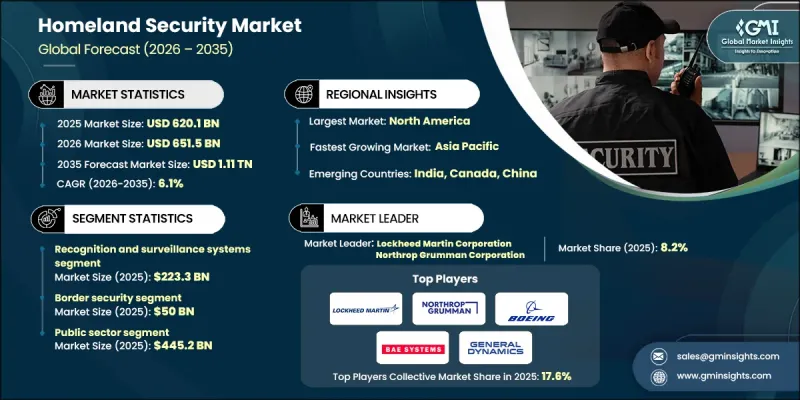
市場成長的促進因素包括:政府為保護公民免受跨境衝突侵害而不斷增加的投資、全球走私和人口販運活動的蔓延,以及自然災害發生頻率和種類的日益增加。對網路威脅日益成長的擔憂,以及加強邊境和移民管控的需求,進一步推動了市場需求。為降低風險,各國政府正投資建置先進的緊急管理系統、預警技術和抗災基礎設施。這催生了對災害防備解決方案、風險緩解技術和災後復原系統的強勁需求。國防安全保障部門擴大採用無人機技術進行監視和回應,而整合生物識別、感測器和臉部辨識技術的智慧邊防安全解決方案也日益普及。基於雲端的旅客身分驗證系統正在簡化邊境程序,縮短等待時間,提高處理效率。
| 市場覆蓋範圍 | |
|---|---|
| 開始年份 | 2025 |
| 預測年份 | 2026-2035 |
| 起始值 | 6201億美元 |
| 預測金額 | 1.11兆美元 |
| 複合年成長率 | 6.1% |
預計到2025年,識別與監控系統領域將成為最大的市場,市場規模將達到2,232億美元。日益嚴峻的全球安全情勢、人工智慧技術的進步以及無人機的廣泛應用正在推動該領域的普及。各公司正致力於開發生物識別工具、人工智慧分析技術以及先進的無人機監控系統,以應對不斷演變的全球威脅。
預計2025年,邊防安全市場規模將達到500億美元。移民執法力度加大、跨境犯罪日益猖獗以及技術創新正在推動對邊防安全解決方案的需求。各公司正投資於智慧監控系統、現代化邊境基礎設施、人工智慧威脅偵測以及一體化國際安全管理平台。
美國國防安全保障市場預計到2025年將達到2,009億美元。加強邊境保護、移民改革和聯邦網路安全措施等國家優先事項正在推動市場成長。各公司正在開發先進的人工智慧監控系統、符合聯邦標準的網路安全解決方案以及協助執法機關打擊恐怖主義和極端主義的設備。
目錄
第1章調查方法和範圍
第2章執行摘要
第3章業界考察
- 生態系分析
- 供應商情況
- 利潤率
- 成本結構
- 每個階段的附加價值
- 影響價值鏈的因素
- 中斷
- 生態系分析
- 產業影響因素
- 促進要素
- 政府投資以保護國家免受跨國衝突的影響
- 全球走私和人口販運案件日益增多。
- 自然災害的發生
- 優先考慮邊境和移民管理
- 網路威脅日益加劇
- 挑戰與困難
- 科技的快速發展
- 高昂的採購和維護成本
- 市場機遇
- 人工智慧和機器學習技術的應用
- 擴展網路安全基礎設施
- 促進要素
- 成長潛力分析
- 監管環境
- 北美洲
- 歐洲
- 亞太地區
- 拉丁美洲
- 中東和非洲
- 波特五力分析
- PESTEL 分析
- 科技與創新趨勢
- 當前技術趨勢
- 新興技術
- 新興經營模式
- 合規要求
- 永續性措施
- 消費者心理分析
- 專利和智慧財產權分析
- 地緣政治和貿易趨勢
第4章 競爭情勢
- 介紹
- 公司市佔率分析
- 按地區
- 北美洲
- 歐洲
- 亞太地區
- 拉丁美洲
- 中東和非洲
- 市場集中度分析
- 按地區
- 主要企業的競爭標竿分析
- 財務績效比較
- 收入
- 利潤率
- 研究與開發
- 產品系列比較
- 產品線的廣度
- 科技
- 創新
- 地理分佈比較
- 全球擴張分析
- 服務網路覆蓋
- 按地區分類的市場滲透率
- 競爭定位矩陣
- 領導企業
- 受讓人
- 追蹤者
- 小眾玩家
- 戰略展望矩陣
- 財務績效比較
- 2021-2024 年主要發展動態
- 併購
- 夥伴關係與合作
- 技術進步
- 擴張與投資策略
- 永續發展計劃
- 數位轉型計劃
- 新興/Start-Ups競賽的趨勢
5. 2022-2035年按證券類型分類的市場估計與預測
- 邊防安全
- 航空安全
- 海上安全
- 關鍵基礎設施安全
- 網路安全
- 大眾運輸安全
- 執法機關
- 化學、生物、放射性、核(CBRN)安全
- 其他
第6章 按技術分類的市場估計與預測,2022-2035年
- 識別和監控系統
- 基於人工智慧的解決方案
- 安全平台
- 其他
7. 依最終用途分類的市場估計與預測,2022-2035 年
- 公共部門
- 私部門
第8章 2022-2035年各地區市場估算與預測
- 北美洲
- 美國
- 加拿大
- 歐洲
- 德國
- 英國
- 法國
- 西班牙
- 義大利
- 荷蘭
- 亞太地區
- 中國
- 印度
- 日本
- 澳洲
- 韓國
- 拉丁美洲
- 巴西
- 墨西哥
- 阿根廷
- 中東和非洲
- 沙烏地阿拉伯
- 南非
- 阿拉伯聯合大公國
第9章:公司簡介
- 主要企業
- Lockheed Martin
- Raytheon Technologies
- BAE Systems
- Boeing
- 按地區分類的主要企業
- 北美洲
- General Dynamics
- Northrop Grumman
- Leidos
- 歐洲
- Thales Group
- Rohde &Schwarz
- Asia-Pacific
- Bharat Electronics Limited(BEL)
- Israel Aerospace Industries(IAI)
- 北美洲
- 顛覆者/小眾玩家
- CRFS
- IDEMIA
- SITA
- OPSWAT Inc.
- Amadeus IT Group SA
- Securitas Technology
- Elbit Systems Ltd.
- Exiger
The Global Homeland Security Market was valued at USD 620.1 billion in 2025 and is estimated to grow at a CAGR of 6.1% to reach USD 1.11 trillion by 2035.
The market's growth is driven by rising government investments aimed at safeguarding populations from cross-border conflicts, increasing global smuggling and trafficking activities, and the growing frequency and variety of natural disasters. Heightened concerns about cyber threats, coupled with the need for enhanced border and immigration controls, are further boosting demand. Governments are channeling funds into advanced emergency management systems, early warning technologies, and resilient infrastructure to mitigate risks. This has created strong demand for disaster preparedness solutions, risk reduction technologies, and recovery systems. The homeland security sector is also embracing drone technologies for surveillance and response, while smart border security solutions integrating biometrics, sensors, and facial recognition are becoming increasingly prevalent. Cloud-based traveler verification systems have streamlined border processes, reducing wait times and improving efficiency.
| Market Scope | |
|---|---|
| Start Year | 2025 |
| Forecast Year | 2026-2035 |
| Start Value | $620.1 Billion |
| Forecast Value | $1.11 Trillion |
| CAGR | 6.1% |
The recognition and surveillance systems segment accounted for USD 223.2 billion in 2025, emerging as the largest market. Rising global security concerns, advancements in AI, and the proliferation of drones are driving adoption. Companies are focusing on developing biometric recognition tools, AI-powered analytics, and sophisticated drone-based surveillance systems to address evolving global threats.
The border security segment reached USD 50 billion in 2025. Increasing immigration enforcement, rising transnational crime, and technological innovations are shaping demand for border security solutions. Firms are investing in intelligent surveillance systems, modernized border infrastructure, AI-enabled threat detection, and integrated international security management platforms.
U.S. Homeland Security Market generated USD 200.9 billion in 2025. National priorities, including enhanced border protection, immigration reform, and federal cybersecurity initiatives, are driving market growth. Companies are developing advanced AI surveillance systems, cybersecurity solutions aligned with federal standards, and devices that assist law enforcement in counterterrorism and anti-extremism operations.
Key players in the Global Homeland Security Market include Lockheed Martin, BAE Systems, Leidos, Northrop Grumman, Boeing, Raytheon Technologies, IDEMIA, Elbit Systems Ltd., General Dynamics, Exiger, Rohde & Schwarz, OPSWAT Inc., Israel Aerospace Industries (IAI), CRFS, Amadeus IT Group SA, Bharat Electronics Limited (BEL), Securitas Technology, and SITA. To strengthen their presence, the Global Homeland Security Market focuses on strategic R&D investments to introduce innovative technologies such as AI-driven analytics, drone-based surveillance, and integrated cybersecurity solutions. They expand their geographic footprint through regional offices and partnerships to cater to government contracts worldwide. Mergers and acquisitions are leveraged to gain access to complementary technologies and increase market share. Firms also prioritize compliance with global regulatory frameworks, ensuring their solutions meet international security standards. Collaborations with defense agencies, border authorities, and technology providers enhance credibility, while ongoing innovation in biometrics, IoT-enabled monitoring, and predictive risk management positions them competitively for long-term growth.
Table of Contents
Chapter 1 Methodology and scope
- 1.1 Market scope and definition
- 1.2 Research design
- 1.2.1 Research approach
- 1.2.2 Data collection methods
- 1.3 Data mining sources
- 1.3.1 Global
- 1.3.2 Regional/Country
- 1.4 Base estimates and calculations
- 1.4.1 Base year calculation
- 1.4.2 Key trends for market estimation
- 1.5 Primary research and validation
- 1.5.1 Primary sources
- 1.6 Forecast model
- 1.7 Research assumptions and limitations
Chapter 2 Executive summary
- 2.1 Industry 3600 synopsis
- 2.2 Key market trends
- 2.2.1 Security Type trend
- 2.2.2 Technology trends
- 2.2.3 End use trends
- 2.2.4 Regional trends
- 2.3 TAM Analysis, 2026-2035 (USD Billion)
- 2.4 CXO perspectives: Strategic imperatives
- 2.4.1 Executive decision points
- 2.4.2 critical success factors
- 2.5 Future outlook and strategic recommendations
Chapter 3 Industry insights
- 3.1 Industry ecosystem analysis
- 3.1.1 Supplier landscape
- 3.1.2 Profit margin
- 3.1.3 Cost structure
- 3.1.4 Value addition at each stage
- 3.1.5 Factor affecting the value chain
- 3.1.6 Disruptions
- 3.2 Industry ecosystem analysis
- 3.3 Industry impact forces
- 3.3.1 Growth drivers
- 3.3.1.1 Government investments in protecting countries from cross-border disputes
- 3.3.1.2 Rising cases of smuggling and trafficking globally
- 3.3.1.3 Occurrence of natural disasters
- 3.3.1.4 Focus on border & immigration control
- 3.3.1.5 Rising prevalence of cyber threats
- 3.3.2 Pitfalls and challenges
- 3.3.2.1 Rapid technological advancements
- 3.3.2.2 High procurement and maintenance costs
- 3.3.3 Market opportunities
- 3.3.3.1 Adoption of AI and machine learning technologies
- 3.3.3.2 Expansion of cybersecurity infrastructure
- 3.3.1 Growth drivers
- 3.4 Growth potential analysis
- 3.5 Regulatory landscape
- 3.5.1 North America
- 3.5.2 Europe
- 3.5.3 Asia Pacific
- 3.5.4 Latin America
- 3.5.5 Middle East & Africa
- 3.6 Porter's analysis
- 3.7 PESTEL analysis
- 3.8 Technology and Innovation landscape
- 3.8.1 Current technological trends
- 3.8.2 Emerging technologies
- 3.9 Emerging Business Models
- 3.10 Compliance Requirements
- 3.11 Sustainability Measures
- 3.12 Consumer Sentiment Analysis
- 3.13 Patent and IP analysis
- 3.14 Geopolitical and trade dynamics
Chapter 4 Competitive landscape, 2025
- 4.1 Introduction
- 4.2 Company market share analysis
- 4.2.1 By region
- 4.2.1.1 North America
- 4.2.1.2 Europe
- 4.2.1.3 Asia Pacific
- 4.2.1.4 Latin America
- 4.2.1.5 Middle East & Africa
- 4.2.2 Market concentration analysis
- 4.2.1 By region
- 4.3 Competitive benchmarking of key players
- 4.3.1 Financial performance comparison
- 4.3.1.1 Revenue
- 4.3.1.2 Profit margin
- 4.3.1.3 R&D
- 4.3.2 Product portfolio comparison
- 4.3.2.1 Product range breadth
- 4.3.2.2 Technology
- 4.3.2.3 Innovation
- 4.3.3 Geographic presence comparison
- 4.3.3.1 Global footprint analysis
- 4.3.3.2 Service network coverage
- 4.3.3.3 Market penetration by region
- 4.3.4 Competitive positioning matrix
- 4.3.4.1 Leaders
- 4.3.4.2 Challengers
- 4.3.4.3 Followers
- 4.3.4.4 Niche players
- 4.3.5 Strategic outlook matrix
- 4.3.1 Financial performance comparison
- 4.4 Key developments, 2021-2024
- 4.4.1 Mergers and acquisitions
- 4.4.2 Partnerships and collaborations
- 4.4.3 Technological advancements
- 4.4.4 Expansion and investment strategies
- 4.4.5 Sustainability initiatives
- 4.4.6 Digital transformation initiatives
- 4.5 Emerging/ startup competitors landscape
Chapter 5 Market estimates and forecast, by Security Type, 2022 - 2035 (USD Billion)
- 5.1 Key trends
- 5.2 Border security
- 5.3 Aviation security
- 5.4 Maritime security
- 5.5 Critical infrastructure security
- 5.6 Cyber security
- 5.7 Mass transport security
- 5.8 Law enforcement
- 5.9 CBRN (chemical, biological, radiological and nuclear) security
- 5.10 Others
Chapter 6 Market estimates and forecast, by Technology, 2022 - 2035 (USD Billion)
- 6.1 Key trends
- 6.2 Recognition and surveillance systems
- 6.3 AI-based solutions
- 6.4 Security platforms
- 6.5 Others
Chapter 7 Market estimates and forecast, by End Use, 2022 - 2035 (USD Billion)
- 7.1 Key trends
- 7.2 Public sector
- 7.3 Private sector
Chapter 8 Market estimates and forecast, by Region, 2022 - 2035 (USD Billion)
- 8.1 Key trends
- 8.2 North America
- 8.2.1 U.S.
- 8.2.2 Canada
- 8.3 Europe
- 8.3.1 Germany
- 8.3.2 UK
- 8.3.3 France
- 8.3.4 Spain
- 8.3.5 Italy
- 8.3.6 Netherlands
- 8.4 Asia Pacific
- 8.4.1 China
- 8.4.2 India
- 8.4.3 Japan
- 8.4.4 Australia
- 8.4.5 South Korea
- 8.5 Latin America
- 8.5.1 Brazil
- 8.5.2 Mexico
- 8.5.3 Argentina
- 8.6 Middle East and Africa
- 8.6.1 Saudi Arabia
- 8.6.2 South Africa
- 8.6.3 UAE
Chapter 9 Company profiles
- 9.1 Global Key Players
- 9.1.1 Lockheed Martin
- 9.1.2 Raytheon Technologies
- 9.1.3 BAE Systems
- 9.1.4 Boeing
- 9.2 Regional Key Players
- 9.2.1 North America
- 9.2.1.1 General Dynamics
- 9.2.1.2 Northrop Grumman
- 9.2.1.3 Leidos
- 9.2.2 Europe
- 9.2.2.1 Thales Group
- 9.2.2.2 Rohde & Schwarz
- 9.2.3 Asia-Pacific
- 9.2.3.1 Bharat Electronics Limited (BEL)
- 9.2.3.2 Israel Aerospace Industries (IAI)
- 9.2.1 North America
- 9.3 Disruptors / Niche Players
- 9.3.1 CRFS
- 9.3.2 IDEMIA
- 9.3.3 SITA
- 9.3.4 OPSWAT Inc.
- 9.3.5 Amadeus IT Group SA
- 9.3.6 Securitas Technology
- 9.3.7 Elbit Systems Ltd.
- 9.3.8 Exiger

 國防安全保障市場:2026-2032年全球市場預測(按解決方案、組件、部署模式、最終用戶和應用分類)國防安全保障與緊急管理市場:2026-2032年全球市場預測(依產品類型、技術、應用、最終用戶和部署模式分類)
 2026年全球國防安全保障市場報告2026年全球國防安全保障與緊急管理市場報告
 國防安全保障與緊急管理市場分析及預測(至2035年):按類型、產品類型、服務、技術、組件、應用、部署類型、最終用戶、解決方案和設備分類
 全球國防安全保障與緊急管理市場規模、佔有率、趨勢及成長分析報告(2026-2034年)
 國防安全保障與緊急管理市場-全球產業規模、佔有率、趨勢、機會、預測:垂直市場、解決方案、安裝、區域及競爭格局,2021-2031年
 國防安全保障市場規模、佔有率和成長分析(按解決方案、安裝類型、技術、最終用戶和地區分類)—2026-2033年產業預測
 國防安全保障與緊急管理市場規模、佔有率及成長分析(按技術、安裝方式、解決方案、垂直產業、最終用途和地區分類)—產業預測(2026-2033 年)
 國土安全與緊急管理市場、機會、成長動力、產業趨勢分析與預測,2024-2032