


 |
市場調查報告書
商品編碼
1913324
不織布濾材市場機會、成長要素、產業趨勢分析及2026年至2035年預測Nonwoven Filter Media Market Opportunity, Growth Drivers, Industry Trend Analysis, and Forecast 2026 - 2035 |
||||||

全球不織布濾材市場預計到 2025 年將達到 101 億美元,到 2035 年將達到 180 億美元,年複合成長率為 6%。
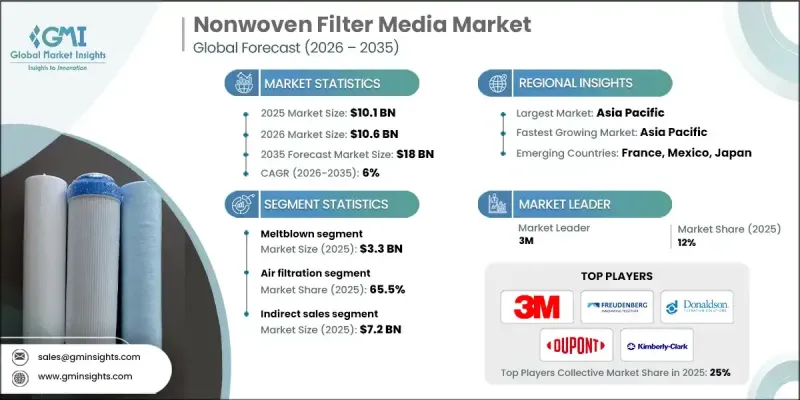
市場成長的促進因素包括加速的城市發展、交通和工業活動排放的增加,以及人口密集地區空氣品質問題日益嚴峻。人們對空氣污染物日益成長的關注促使政府、機構和私人企業加大對建築環境和工業系統高性能過濾技術的投資。同時,消費者對室內環境日益成長的關注也推動了住宅和商業建築對高性能過濾解決方案的需求。這些因素共同促使製造商開發效率更高、使用壽命更長、且針對特定應用場景的不織布濾材。環境保護和職業安全方面的監管壓力也進一步推動了此類產品的普及。工業領域對污染控制和合規性的重視程度日益提高,從而對可靠且擴充性的過濾材料產生了穩定的需求。材料科學和紡織工程的不斷進步使得不織布濾材在空氣和液體過濾系統中得到廣泛應用,從而支撐了預測期內市場的持續成長。
| 市場覆蓋範圍 | |
|---|---|
| 開始年份 | 2025 |
| 預測期 | 2026-2035 |
| 起始值 | 101億美元 |
| 預測金額 | 180億美元 |
| 複合年成長率 | 6% |
對品質和安全標準要求嚴格的行業越來越依賴先進的過濾結構來滿足監管要求並確保產品完整性。多層過濾結構用於解決顆粒物、沉積物和微生物控制等複雜的過濾需求,從而滿足市政和工業處理系統的穩定需求。
預計2025年,熔噴材料市場規模將達33億美元。由於其能夠形成具有高比表面積的超細纖維結構,熔噴材料在不織布濾材市場中佔據關鍵地位。這些特性使其在需要精確顆粒捕獲和氣流平衡的應用中,能夠實現高過濾效率和穩定的性能。
預計到2025年,空氣過濾領域將佔據65.5%的市場。不織布濾材在維持住宅、商業和工業環境中的室內空氣品質方面發揮核心作用。其低空氣阻力和高顆粒物捕獲效率有助於實現節能目標,同時符合不斷變化的環境和安全法規。
美國不織布濾材市場預計到2025年將達到22億美元,佔72.3%的市佔率。美國市場的強勁勢頭得益於健全的法規結構、持續的基礎設施建設以及醫療、工業和環保領域持續成長的需求。對先進纖維技術和永續材料的持續投資正在鞏固其長期成長。
目錄
第1章調查方法和範圍
第2章執行摘要
第3章業界考察
- 生態系分析
- 供應商情況
- 利潤率
- 每個階段的附加價值
- 影響價值鏈的因素
- 產業影響因素
- 促進要素
- 對空氣和水過濾的需求不斷成長
- 消費品中過濾應用日益增多
- 水資源短缺及對更好水處理的需求
- 產業潛在風險與挑戰
- 原料成本波動
- 惡劣環境下的效能限制
- 機會
- 永續性和生物基不織布
- 智慧過濾器和功能塗層
- 促進要素
- 成長潛力分析
- 未來市場趨勢
- 科技與創新趨勢
- 當前技術趨勢
- 新興技術
- 價格趨勢
- 按地區
- 依產品類型
- 監管環境
- 標準和合規要求
- 區域法規結構
- 認證標準
- 波特五力分析
- PESTEL 分析
第4章 競爭情勢
- 介紹
- 公司市佔率分析
- 按地區
- 企業矩陣分析
- 主要市場公司的競爭分析
- 競爭定位矩陣
- 重大進展
- 併購
- 夥伴關係與合作
- 新產品發布
- 擴張計劃
第5章 依產品類型分類的市場估算與預測,2022-2035年
- 粗梳
- 濕法成網
- 熔噴
- 紡粘
- 氣流成網
- 其他(針刺等)
6. 2022-2035年過濾介質市場估算與預測
- 空氣過濾
- 液體過濾
7. 依最終用途分類的市場估計與預測,2022-2035 年
- 商業的
- 工業的
- HVAC
- 運輸
- 水處理
- 食品/飲料
- 製造業
- 其他(醫療等)
第8章 按分銷管道分類的市場估算與預測,2022-2035年
- 直銷
- 間接銷售
第9章 2022-2035年各地區市場估算與預測
- 北美洲
- 美國
- 加拿大
- 歐洲
- 德國
- 英國
- 法國
- 義大利
- 西班牙
- 亞太地區
- 中國
- 日本
- 印度
- 澳洲
- 韓國
- 拉丁美洲
- 巴西
- 墨西哥
- 阿根廷
- 中東和非洲
- 南非
- 沙烏地阿拉伯
- 阿拉伯聯合大公國
第10章:公司簡介
- 3M
- Ahlstrom
- Americo
- Avintiv
- Camfil Group
- Donaldson
- DuPont
- Freudenberg Group
- Gessner
- Glatfelter
- Johns Manville
- Kimberly-Clark
- Mann+Hummel
- Mogul
- Sandler Group
The Global Nonwoven Filter Media Market was valued at USD 10.1 billion in 2025 and is estimated to grow at a CAGR of 6% to reach USD 18 billion by 2035.
Market expansion is driven by accelerating urban development, rising emissions from transportation and industrial activity, and increasing concerns related to air quality across populated regions. Growing awareness of airborne pollutants has encouraged governments, institutions, and private organizations to invest in advanced filtration technologies across built environments and industrial systems. At the same time, heightened consumer focus on indoor environmental conditions is supporting demand for high-performance filtration solutions used in residential and commercial settings. These combined factors are pushing manufacturers to develop nonwoven filter media that deliver higher efficiency, longer service life, and application-specific performance. Regulatory pressure surrounding environmental protection and occupational safety is further reinforcing adoption. Industries are increasingly prioritizing contamination control and compliance, which is driving steady demand for reliable and scalable filtration media. Continuous improvements in material science and fiber engineering are enabling broader deployment of nonwoven filter media across air and liquid filtration systems, supporting sustained market growth over the forecast period.
| Market Scope | |
|---|---|
| Start Year | 2025 |
| Forecast Year | 2026-2035 |
| Start Value | $10.1 Billion |
| Forecast Value | $18 Billion |
| CAGR | 6% |
Industries with strict quality and safety standards are increasingly relying on advanced filtration structures to meet regulatory requirements and ensure product integrity. Multi-layer filtration architectures are being adopted to address complex filtration needs related to particulates, sediments, and microbial control, supporting stable demand across municipal and industrial treatment systems.
The meltblown segment generated USD 3.3 billion in 2025. This segment is described as a critical category within the nonwoven filter media market due to its ability to deliver ultra-fine fiber structures with high surface area. These characteristics enable high filtration efficiency and consistent performance in applications that require precise particle retention and airflow balance.
The air filtration segment accounted for 65.5% share in 2025. Nonwoven filter media play a central role in maintaining indoor air quality across residential, commercial, and industrial environments. Their low airflow resistance and high particle capture efficiency support energy efficiency goals while aligning with evolving environmental and safety regulations.
United States Nonwoven Filter Media Market held 72.3% share and generated USD 2.2 billion in 2025. Market strength in the country is supported by strong regulatory frameworks, ongoing infrastructure upgrades, and sustained demand across healthcare, industrial, and environmental applications. Continued investment in advanced fiber technologies and sustainable materials is reinforcing long-term growth.
Key companies operating in the Global Nonwoven Filter Media Market include DuPont, 3M, Freudenberg Group, Mann+Hummel, Ahlstrom, Donaldson, Kimberly-Clark, Johns Manville, Camfil Group, Glatfelter, Sandler Group, Gessner, Avintiv, Americo, and Mogul. Companies in the Global Nonwoven Filter Media Market are strengthening their competitive position by investing in advanced material development and high-efficiency fiber technologies. Many manufacturers are focusing on lightweight, durable, and sustainable nonwoven structures to meet evolving regulatory and performance standards. Strategic expansion of production capacity and regional manufacturing footprints is helping firms improve supply reliability and reduce lead times. Partnerships with system integrators and end-use industries are supporting customized product development. Continuous research into environmentally responsible materials and recyclable solutions is gaining priority. Companies are also enhancing quality control and certification capabilities to meet strict compliance requirements.
Table of Contents
Chapter 1 Methodology and Scope
- 1.1 Market scope and definition
- 1.2 Research design
- 1.2.1 Research approach
- 1.2.2 Data collection methods
- 1.3 Data mining sources
- 1.3.1 Global
- 1.3.2 Regional/Country
- 1.4 Base estimates and calculations
- 1.4.1 Base year calculation
- 1.4.2 Key trends for market estimation
- 1.5 Primary research and validation
- 1.5.1 Primary sources
- 1.6 Forecast model
- 1.7 Research assumptions and limitations
Chapter 2 Executive Summary
- 2.1 Industry 360° synopsis
- 2.2 Key market trends
- 2.2.1 Regional
- 2.2.2 Product type
- 2.2.3 Filtration media
- 2.2.4 End use
- 2.2.5 Distribution channel
- 2.3 CXO perspectives: Strategic imperatives
- 2.3.1 Key decision points for industry executives
- 2.3.2 Critical success factors for market players
- 2.4 Future outlook and strategic recommendations
Chapter 3 Industry Insights
- 3.1 Industry ecosystem analysis
- 3.1.1 Supplier landscape
- 3.1.2 Profit margin
- 3.1.3 Value addition at each stage
- 3.1.4 Factor affecting the value chain
- 3.2 Industry impact forces
- 3.2.1 Growth drivers
- 3.2.1.1 Rising demand for air and water filtration
- 3.2.1.2 Increase in filtration applications in consumer goods
- 3.2.1.3 Water scarcity & need for better water treatment
- 3.2.2 Industry pitfalls & challenges
- 3.2.2.1 Volatility in raw material costs
- 3.2.2.2 Performance limitations under extreme conditions
- 3.2.3 Opportunities
- 3.2.3.1 Sustainability & bio-based nonwovens
- 3.2.3.2 Smart filters & functional coatings
- 3.2.1 Growth drivers
- 3.3 Growth potential analysis
- 3.4 Future market trends
- 3.5 Technology and innovation landscape
- 3.5.1 Current technological trends
- 3.5.2 Emerging technologies
- 3.6 Price trends
- 3.6.1 By region
- 3.6.2 By product type
- 3.7 Regulatory landscape
- 3.7.1 Standards and compliance requirements
- 3.7.2 Regional regulatory frameworks
- 3.7.3 Certification standards
- 3.8 Porter's analysis
- 3.9 PESTEL analysis
Chapter 4 Competitive Landscape, 2025
- 4.1 Introduction
- 4.2 Company market share analysis
- 4.2.1 By region
- 4.2.1.1 North America
- 4.2.1.2 Europe
- 4.2.1.3 Asia Pacific
- 4.2.1.4 Latin America
- 4.2.1.5 Middle East and Africa
- 4.2.1 By region
- 4.3 Company matrix analysis
- 4.4 Competitive analysis of major market players
- 4.5 Competitive positioning matrix
- 4.6 Key developments
- 4.6.1 Mergers & acquisitions
- 4.6.2 Partnerships & collaborations
- 4.6.3 New product launches
- 4.6.4 Expansion plans
Chapter 5 Market Estimates and Forecast, By Product Type, 2022 - 2035 (USD Billion) (Million Square Meters)
- 5.1 Key trends
- 5.2 Carded
- 5.3 Wetlaid
- 5.4 Meltblown
- 5.5 Spunbonded
- 5.6 Airlaid
- 5.7 Others (needlepunch etc.)
Chapter 6 Market Estimates and Forecast, By Filtration Media, 2022 - 2035 (USD Billion) (Million Square Meters)
- 6.1 Key trends
- 6.2 Air filtration
- 6.3 Liquid filtration
Chapter 7 Market Estimates and Forecast, By End Use, 2022 - 2035 (USD Billion) (Million Square Meters)
- 7.1 Key trends
- 7.2 Commercial
- 7.3 Industrial
- 7.4 HVAC
- 7.5 Transportation
- 7.6 Water Filtration
- 7.7 Food & Beverages
- 7.8 Manufacturing
- 7.9 Others (healthcare etc.)
Chapter 8 Market Estimates and Forecast, By Distribution Channel, 2022 - 2035 (USD Billion) (Million Square Meters)
- 8.1 Key trends
- 8.2 Direct sales
- 8.3 Indirect sales
Chapter 9 Market Estimates and Forecast, By Region, 2022 - 2035 (USD Billion) (Million Square Meters)
- 9.1 Key trends
- 9.2 North America
- 9.2.1 U.S.
- 9.2.2 Canada
- 9.3 Europe
- 9.3.1 Germany
- 9.3.2 UK
- 9.3.3 France
- 9.3.4 Italy
- 9.3.5 Spain
- 9.4 Asia Pacific
- 9.4.1 China
- 9.4.2 Japan
- 9.4.3 India
- 9.4.4 Australia
- 9.4.5 South Korea
- 9.5 Latin America
- 9.5.1 Brazil
- 9.5.2 Mexico
- 9.5.3 Argentina
- 9.6 Middle East and Africa
- 9.6.1 South Africa
- 9.6.2 Saudi Arabia
- 9.6.3 UAE
Chapter 10 Company Profiles
- 10.1 3M
- 10.2 Ahlstrom
- 10.3 Americo
- 10.4 Avintiv
- 10.5 Camfil Group
- 10.6 Donaldson
- 10.7 DuPont
- 10.8 Freudenberg Group
- 10.9 Gessner
- 10.10 Glatfelter
- 10.11 Johns Manville
- 10.12 Kimberly-Clark
- 10.13 Mann+Hummel
- 10.14 Mogul
- 10.15 Sandler Group

 2026-2030年全球不織布濾材市場
 不織布過濾器市場-2026-2032年全球市場預測
 不織布包裝市場規模、佔有率和成長分析:按產品類型、材料、技術、應用、最終用戶、分銷管道和地區分類-2026-2033年產業預測
 不織布濾材市場規模、佔有率和趨勢分析報告:按技術、應用、地區和細分市場分類(2026-2033 年)
 2026年全球不織布過濾材料市場報告美國不織布濾材市場規模、佔有率和趨勢分析報告:按介質類型、過濾類別、最終用途和細分市場預測(2026-2033 年)
 全球不織布過濾介質市場
 無紡布包裝市場機會、成長動力、產業趨勢分析及2025-2034年預測
 不織布濾材市場規模、佔有率、按類型、技術、分銷管道、應用、地區分類的成長分析 - 2025-2032 年產業預測