


 |
市場調查報告書
商品編碼
1913307
汽車襯套市場機會、成長要素、產業趨勢分析及預測(2026年至2035年)Automotive Bushing Market Opportunity, Growth Drivers, Industry Trend Analysis, and Forecast 2026 - 2035 |
||||||

全球汽車襯套市場預計到 2025 年將達到 1,668 億美元,到 2035 年將達到 2,761 億美元,年複合成長率為 5.2%。
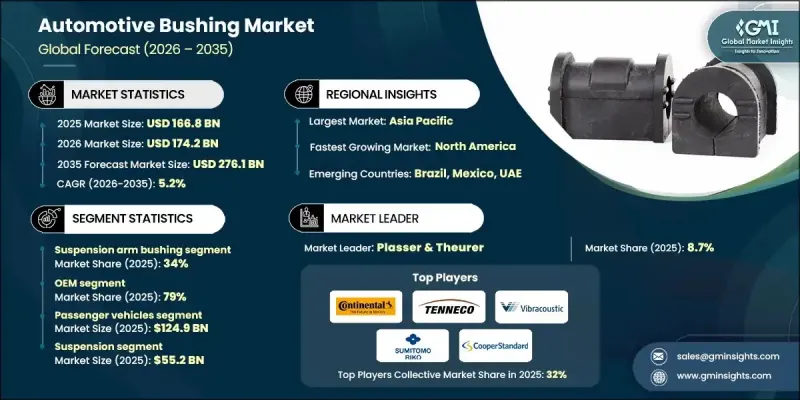
市場擴張的驅動力在於消費者對所有汽車平臺在提升駕駛舒適性、降低噪音和振動以及增強耐用性方面日益成長的需求。加速向電動化出行和先進車輛架構的轉型也推動了對精密工程襯套解決方案的需求。汽車製造商和供應商高度重視可靠性、安全性和長期性能,並將襯套視為懸吊、底盤和動力傳動系統系統中的關鍵部件。材料科學、數位化設計和系統整合領域的持續進步正在重塑產品開發,從而延長使用壽命、最佳化性能並改善車輛整體動態性能。隨著全球乘用車、商用車和電動車產量的成長,成熟汽車市場和新興汽車市場對先進的整合式襯套解決方案的需求持續成長。
| 市場覆蓋範圍 | |
|---|---|
| 開始年份 | 2025 |
| 預測年份 | 2026-2035 |
| 起始值 | 1668億美元 |
| 預測金額 | 2761億美元 |
| 複合年成長率 | 5.2% |
2025年,懸吊臂襯套市佔率佔比達到34%,預計2026年至2035年將以4.6%的複合年成長率成長。此細分市場佔據主導地位,主要歸功於其在車輛穩定性、乘坐舒適性和隔振方面發揮的關鍵作用。各類車輛對懸吊臂襯套的強勁需求持續推動著其應用,因為這些部件對於在各種駕駛條件下保持轉向精度、車輪定位一致性和懸吊系統完整性至關重要。
預計到2025年,OEM(整車製造商)市佔率將達到79%,並在2035年之前以5.5%的複合年成長率成長。 OEM佔據主導地位的原因在於其高產量以及襯套與新車平台的直接整合。製造商依賴這些零件來滿足性能標準、耐久性要求和法規要求,因此OEM供應在價值和數量方面都是最大的貢獻者。
預計到2025年,中國汽車襯套市場將佔據42%的市場佔有率,市場規模將達到309億美元。中國在該領域的主導地位得益於大規模的汽車製造基地和電動車生產的快速成長。強勁的國內需求和先進汽車系統的日益普及,持續鞏固中國在區域市場的主導地位。
目錄
第1章調查方法和範圍
第2章執行摘要
第3章業界考察
- 生態系分析
- 供應商情況
- 利潤率
- 成本結構
- 每個過程都增加了價值
- 影響價值鏈的因素
- 中斷
- 產業影響因素
- 促進要素
- 全球汽車產量增加
- 電動和混合動力汽車的快速普及
- 更著重於降低乘坐舒適性和噪音、振動與聲振粗糙度(NVH)。
- 襯套材料和設計的進步。
- 產業潛在風險與挑戰
- 原物料價格波動
- 先進襯套解決方案高成本
- 市場機遇
- 售後市場更換需求不斷成長
- 配備智慧感測器的襯套
- 售後市場擴張與車輛現代化
- 輕量材料及先進複合材料
- 促進要素
- 成長潛力分析
- 監管環境
- 北美洲
- 美國機動車輛安全標準(FMVSS)
- 加拿大機動車輛安全標準(CMVSS)
- 歐洲
- 德國TUV和BaFin合規性
- 法國DGITM指南
- 英國車輛認證機構(VCA)規章
- 義大利國土、基礎設施和交通部合規要求
- 亞太地區
- 中國工業和資訊化部(工信部)指南
- 國土交通省標準
- 韓國國土交通部(MOLIT)法規
- 印度公路運輸部和公路部 (MoRTH) 和印度標準協會 (BIS) 指南
- 拉丁美洲
- 巴西 DENATRAN 和 ANFAVEA 法規
- 墨西哥SCT和NOM標準
- 中東和非洲
- 阿拉伯聯合大公國道路和交通管理局 (RTA) 指南
- 沙烏地阿拉伯運輸總局(GAT)規章
- 北美洲
- 波特五力分析
- PESTEL 分析
- 科技與創新趨勢
- 當前技術趨勢
- 自動化和機器人技術
- 人工智慧和機器學習
- 物聯網 (IoT)
- 新興技術
- 超連網汽車系統
- 面向組裝的機器人即服務 (RaaS)
- 人工智慧驅動的預測性維護和動態資源分配
- 當前技術趨勢
- 價格趨勢
- 按地區
- 依產品
- 成本細分分析
- 專利分析
- 永續性和環境方面
- 永續努力
- 減少廢棄物策略
- 生產中的能源效率
- 環保舉措
- 碳足跡考量
- 使用案例場景
- OEM和一級供應商的採購和選擇標準
- 材料選擇和性能權衡分析
- 電動和混合動力汽車對襯套設計的影響
- 決定是自行生產還是外包以及垂直整合策略
第4章 競爭情勢
- 介紹
- 公司市佔率分析
- 北美洲
- 歐洲
- 亞太地區
- 拉丁美洲
- 中東和非洲
- 主要市場公司的競爭分析
- 競爭定位矩陣
- 戰略展望矩陣
- 重大進展
- 併購
- 夥伴關係與合作
- 新產品發布
- 企業擴張計畫和資金籌措
第5章 按類型分類的市場估算與預測,2022-2035年
- 懸臂襯套
- 引擎支架
- 副車架襯套
- 懸掛支架
- 液壓襯套
- 阻尼器頂部安裝座
第6章 依車輛類型分類的市場估計與預測,2022-2035年
- 搭乘用車
- 掀背車車
- 轎車
- SUV
- 商用車輛
- 輕型商用車(LCV)
- 中型商用車(MCV)
- 重型商用車(HCV)
第7章 按應用領域分類的市場估算與預測,2022-2035年
- 暫停
- 引擎
- 底盤
- 傳播
- 排氣
- 內部的
第8章 按銷售管道分類的市場估算與預測,2022-2035年
- OEM
- 售後市場
第9章 2022-2035年各地區市場估算與預測
- 北美洲
- 美國
- 加拿大
- 歐洲
- 英國
- 德國
- 法國
- 義大利
- 西班牙
- 比利時
- 荷蘭
- 瑞典
- 亞太地區
- 中國
- 印度
- 日本
- 澳洲
- 新加坡
- 韓國
- 越南
- 印尼
- 馬來西亞
- 拉丁美洲
- 巴西
- 墨西哥
- 阿根廷
- 中東和非洲
- 阿拉伯聯合大公國
- 南非
- 沙烏地阿拉伯
第10章:公司簡介
- Global Player
- BOGE Rubber &Plastics
- Continental
- Cooper-Standard
- Dana
- Federal-Mogul Motorparts
- MAHLE
- NTN
- Sumitomo Riko
- Tenneco
- Vibracoustic
- Regional Player
- Aisin Seiki
- Anchor Rubber
- GMB
- Hengst
- JTEKT
- Koyo Seiko
- Mobis
- NSK
- Reydel Automotive
- Toyoda Gosei
- 新興企業
- Jatco Bushing Solutions
- Lydall Performance Materials
- Minda Industries
- Sona BLW Precision Forgings
- Thor Automotive Components
The Global Automotive Bushing Market was valued at USD 166.8 billion in 2025 and is estimated to grow at a CAGR of 5.2% to reach USD 276.1 billion by 2035.
Market expansion is driven by increased demand for improved driving comfort, reduced noise and vibration, and higher durability across vehicle platforms. The accelerating shift toward electrified mobility and advanced vehicle architectures is further increasing the need for precision-engineered bushing solutions. Automakers and component suppliers are placing strong emphasis on reliability, safety, and long-term performance, positioning bushings as critical elements within suspension, chassis, and powertrain systems. Continuous progress in material science, digital design, and system integration is reshaping product development, enabling improved lifespan, optimized performance, and better overall vehicle dynamics. As global production volumes rise across passenger, commercial, and electrified vehicles, demand for advanced and integrated bushing solutions continues to strengthen across both mature and emerging automotive markets.
| Market Scope | |
|---|---|
| Start Year | 2025 |
| Forecast Year | 2026-2035 |
| Start Value | $166.8 Billion |
| Forecast Value | $276.1 Billion |
| CAGR | 5.2% |
The suspension arm bushing segment held 34% share in 2025 and is expected to grow at a CAGR of 4.6% from 2026 to 2035. This segment holds a dominant position due to its essential role in vehicle stability, ride quality, and vibration isolation. Strong demand across multiple vehicle categories continues to support adoption, as these components are critical for maintaining handling accuracy, alignment consistency, and suspension system integrity under varying operating conditions.
The OEM segment held 79% share in 2025 and is forecast to grow at a CAGR of 5.5% through 2035. OEM dominance is supported by high production volumes and direct integration of bushings into new vehicle platforms. Manufacturers rely on these components to meet performance standards, durability requirements, and regulatory expectations, making OEM supply the largest contributor in both value and volume terms.
China Automotive Bushing Market held 42% share and generated USD 30.9 billion in 2025. The country's leadership is driven by its large-scale vehicle manufacturing base and rapid expansion of electrified vehicle production. Strong domestic demand and widespread adoption of advanced vehicle systems continue to reinforce China's dominant regional position.
Key companies operating in the Global Automotive Bushing Market include Continental, Vibracoustic, Tenneco, Cooper-Standard, Sumitomo Riko, MAHLE, Dana, NTN, BOGE Rubber & Plastics, and Federal-Mogul Motorparts. Companies in the Automotive Bushing Market are strengthening their competitive position through material innovation, platform-specific design, and closer collaboration with vehicle manufacturers. Leading players are investing in advanced engineering capabilities to improve durability, comfort, performance, and weight efficiency. Strategic partnerships with OEMs help suppliers align product development with next-generation vehicle platforms. Expansion of global manufacturing footprints is being used to support regional demand and improve supply reliability.
Table of Contents
Chapter 1 Methodology & Scope
- 1.1 Market scope and definition
- 1.2 Research design
- 1.2.1 Research approach
- 1.2.2 Data collection methods
- 1.3 Data mining sources
- 1.3.1 Global
- 1.3.2 Regional/Country
- 1.4 Base estimates and calculations
- 1.4.1 Base year calculation
- 1.4.2 Key trends for market estimation
- 1.5 Primary research and validation
- 1.5.1 Primary sources
- 1.6 Forecast
- 1.7 Research assumptions and limitations
Chapter 2 Executive Summary
- 2.1 Industry 3600 synopsis, 2022 - 2035
- 2.2 Key market trends
- 2.2.1 Regional
- 2.2.2 Type
- 2.2.3 Vehicle
- 2.2.4 Application
- 2.2.5 Sales Channel
- 2.3 TAM Analysis, 2026-2035
- 2.4 CXO perspectives: Strategic imperatives
- 2.4.1 Executive decision points
- 2.4.2 Critical success factors
- 2.5 Future outlook and strategic recommendations
Chapter 3 Industry Insights
- 3.1 Industry ecosystem analysis
- 3.1.1 Supplier Landscape
- 3.1.2 Profit Margin
- 3.1.3 Cost structure
- 3.1.4 Value addition at each stage
- 3.1.5 Factor affecting the value chain
- 3.1.6 Disruptions
- 3.2 Industry impact forces
- 3.2.1 Growth drivers
- 3.2.1.1 Rising global vehicle production
- 3.2.1.2 Rapid adoption of electric and hybrid vehicles
- 3.2.1.3 Increasing focus on ride comfort and NVH reduction
- 3.2.1.4 Advancements in bushing materials and designs
- 3.2.2 Industry pitfalls and challenges
- 3.2.2.1 Raw material price fluctuations
- 3.2.2.2 High cost of advanced bushing solutions
- 3.2.3 Market opportunities
- 3.2.3.1 Growing aftermarket replacement demand
- 3.2.3.2 Smart and sensor-enabled bushings
- 3.2.3.3 Aftermarket expansion and vehicle fleet modernization
- 3.2.3.4 Lightweight materials and advanced composites
- 3.2.1 Growth drivers
- 3.3 Growth potential analysis
- 3.4 Regulatory landscape
- 3.4.1 North America
- 3.4.1.1 U.S. Federal Motor Vehicle Safety Standards (FMVSS)
- 3.4.1.2 Canada Motor Vehicle Safety Standards (CMVSS)
- 3.4.2 Europe
- 3.4.2.1 Germany TUV & BaFin Compliance
- 3.4.2.2 France DGITM Guidelines
- 3.4.2.3 UK Vehicle Certification Agency (VCA) Regulations
- 3.4.2.4 Italy Ministry of Infrastructure & Transport Compliance
- 3.4.3 Asia Pacific
- 3.4.3.1 China MIIT Guidelines
- 3.4.3.2 Japan MLIT Standards
- 3.4.3.3 South Korea MOLIT Regulations
- 3.4.3.4 India Ministry of MoRTH & BIS Guidelines
- 3.4.4 Latin America
- 3.4.4.1 Brazil DENATRAN & ANFAVEA Regulations
- 3.4.4.2 Mexico SCT & NOM Standards
- 3.4.5 Middle East and Africa
- 3.4.5.1 UAE Roads & Transport Authority (RTA) Guidelines
- 3.4.5.2 Saudi Arabia General Authority for Transport (GAT) Regulations
- 3.4.1 North America
- 3.5 Porter's analysis
- 3.6 PESTEL analysis
- 3.7 Technology and Innovation Landscape
- 3.7.1 Current technological trends
- 3.7.1.1 Automation & robotics
- 3.7.1.2 AI & machine learning
- 3.7.1.3 Internet of things (IoT)
- 3.7.2 Emerging technologies
- 3.7.2.1 Hyper-connected vehicle systems
- 3.7.2.2 Robotics-as-a-service (RaaS) for assembly
- 3.7.2.3 AI-driven predictive maintenance & dynamic resource allocation
- 3.7.1 Current technological trends
- 3.8 Price trends
- 3.8.1 By region
- 3.8.2 By product
- 3.9 Cost breakdown analysis
- 3.10 Patent analysis
- 3.11 Sustainability and Environmental Aspects
- 3.11.1 Sustainable practices
- 3.11.2 Waste reduction strategies
- 3.11.3 Energy efficiency in production
- 3.11.4 Eco-friendly initiatives
- 3.11.5 Carbon footprint considerations
- 3.12 Use case scenarios
- 3.13 OEM & Tier-1 procurement and selection criteria
- 3.14 Material selection & performance trade-off analysis
- 3.15 EV & hybrid vehicle impact on bushing design
- 3.16 Make-vs-buy & vertical integration strategies
Chapter 4 Competitive Landscape, 2025
- 4.1 Introduction
- 4.2 Company market share analysis
- 4.2.1 North America
- 4.2.2 Europe
- 4.2.3 Asia Pacific
- 4.2.4 Latin America
- 4.2.5 Middle East & Africa
- 4.3 Competitive analysis of major market players
- 4.4 Competitive positioning matrix
- 4.5 Strategic outlook matrix
- 4.6 Key developments
- 4.6.1 Mergers & acquisitions
- 4.6.2 Partnerships & collaborations
- 4.6.3 New product launches
- 4.6.4 Expansion plans and funding
Chapter 5 Market Estimates & Forecast, By Type, 2022 - 2035 ($ Bn, Units)
- 5.1 Key trends
- 5.2 Suspension arm bushing
- 5.3 Engine mounts
- 5.4 Subframe bushing
- 5.5 Suspension mounts
- 5.6 Hydro bushing
- 5.7 Damper top mounts
Chapter 6 Market Estimates & Forecast, By Vehicle, 2022 - 2035 ($ Bn, Units)
- 6.1 Key trends
- 6.2 Passenger vehicles
- 6.2.1 Hatchbacks
- 6.2.2 Sedans
- 6.2.3 SUV
- 6.3 Commercial vehicles
- 6.3.1 Light commercial vehicles (LCV)
- 6.3.2 Medium commercial vehicles (MCV)
- 6.3.3 Heavy commercial vehicles (HCV)
Chapter 7 Market Estimates & Forecast, By Application, 2022 - 2035 ($ Bn, Units)
- 7.1 Key trends
- 7.2 Suspension
- 7.3 Engine
- 7.4 Chassis
- 7.5 Transmission
- 7.6 Exhaust
- 7.7 Interior
Chapter 8 Market Estimates & Forecast, By Sales Channel, 2022 - 2035 ($ Bn, Units)
- 8.1 Key trends
- 8.2 OEM
- 8.3 Aftermarket
Chapter 9 Market Estimates & Forecast, By Region, 2022 - 2035 ($ Bn, Units)
- 9.1 Key trends
- 9.2 North America
- 9.2.1 US
- 9.2.2 Canada
- 9.3 Europe
- 9.3.1 UK
- 9.3.2 Germany
- 9.3.3 France
- 9.3.4 Italy
- 9.3.5 Spain
- 9.3.6 Belgium
- 9.3.7 Netherlands
- 9.3.8 Sweden
- 9.4 Asia Pacific
- 9.4.1 China
- 9.4.2 India
- 9.4.3 Japan
- 9.4.4 Australia
- 9.4.5 Singapore
- 9.4.6 South Korea
- 9.4.7 Vietnam
- 9.4.8 Indonesia
- 9.4.9 Malaysia
- 9.5 Latin America
- 9.5.1 Brazil
- 9.5.2 Mexico
- 9.5.3 Argentina
- 9.6 MEA
- 9.6.1 UAE
- 9.6.2 South Africa
- 9.6.3 Saudi Arabia
Chapter 10 Company Profiles
- 10.1 Global Player
- 10.1.1 BOGE Rubber & Plastics
- 10.1.2 Continental
- 10.1.3 Cooper-Standard
- 10.1.4 Dana
- 10.1.5 Federal-Mogul Motorparts
- 10.1.6 MAHLE
- 10.1.7 NTN
- 10.1.8 Sumitomo Riko
- 10.1.9 Tenneco
- 10.1.10 Vibracoustic
- 10.2 Regional Player
- 10.2.1 Aisin Seiki
- 10.2.2 Anchor Rubber
- 10.2.3 GMB
- 10.2.4 Hengst
- 10.2.5 JTEKT
- 10.2.6 Koyo Seiko
- 10.2.7 Mobis
- 10.2.8 NSK
- 10.2.9 Reydel Automotive
- 10.2.10 Toyoda Gosei
- 10.3 Emerging Players
- 10.3.1 Jatco Bushing Solutions
- 10.3.2 Lydall Performance Materials
- 10.3.3 Minda Industries
- 10.3.4 Sona BLW Precision Forgings
- 10.3.5 Thor Automotive Components

 汽車襯套市場:按材質、安裝位置、製造流程、應用、車輛類型和銷售管道分類-2026-2032年全球市場預測
 2026年全球汽車襯套市場報告
 全球汽車襯套市場規模、佔有率、趨勢和成長分析報告(2026-2034年)汽車襯套市場規模、佔有率、成長及全球產業分析:按類型、應用和地區的洞察,2026-2034年預測
 汽車襯套市場 - 全球產業規模、佔有率、趨勢、機會及預測(按車輛類型、應用類型、地區和競爭格局分類,2021-2031年)
 汽車襯套技術市場規模、佔有率和成長分析(按車輛類型、材質、應用和地區分類)-2026-2033年產業預測
 汽車襯套市場規模、佔有率和成長分析(按懸吊類型、車輛類型、電動車類型、應用、材質和地區分類)-2026-2033年產業預測
 汽車襯套市場規模、佔有率、趨勢分析報告:按車型、應用、地區、細分市場預測,2025-2030
 汽車襯套市場,按材料類型、按車輛類型、按銷售管道、按應用、按國家和地區 - 2025 年至 2032 年全球行業分析、市場規模、市場佔有率和預測
 全球汽車套管市場評估:依類型、應用、最終用戶、地區、機會、預測(2017-2031)