

 |
市場調查報告書
商品編碼
1913284
食品烹飪設備市場機會、成長要素、產業趨勢分析及2026年至2035年預測Food Preparation Appliances Market Opportunity, Growth Drivers, Industry Trend Analysis, and Forecast 2026 - 2035 |
||||||

全球食品加工設備市場預計到 2025 年將達到 239 億美元,到 2035 年將達到 371 億美元,年複合成長率為 4.5%。
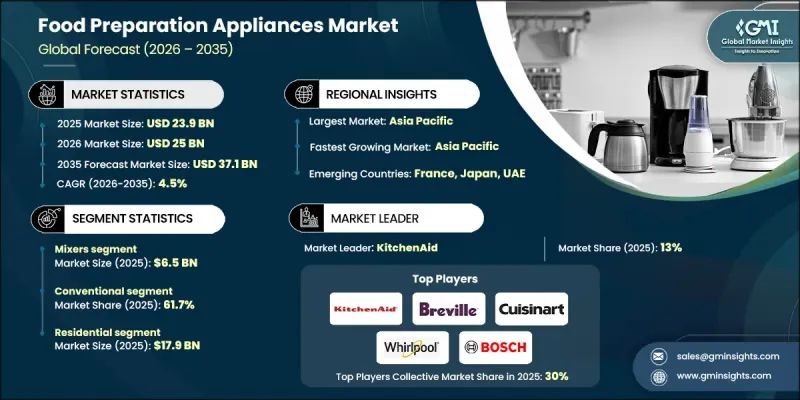
都市區和半都市區消費者日程繁忙,他們尋求能夠減少日常膳食準備所需時間和精力的解決方案。食品加工電器透過簡化廚房操作、加快複雜的烹飪過程並保持穩定的品質,滿足了這項需求。人們對自動化廚房解決方案日益成長的依賴,反映了生活方式向以效率為導向的轉變。技術進步進一步推動了需求,數位化電器支援遠端控制、定時烹飪以及與智慧家居環境的無縫整合。智慧功能的應用,以及不斷擴展的智慧家庭生態系統,提高了消費者對易用性的期望。以便利性為導向的創新仍然是關鍵的成長動力,而時間效率正在影響全球市場的購買行為,使烹飪電器成為現代家庭的必備品。
| 市場覆蓋範圍 | |
|---|---|
| 開始年份 | 2025 |
| 預測年份 | 2026-2035 |
| 起始值 | 239億美元 |
| 預測金額 | 371億美元 |
| 複合年成長率 | 4.5% |
自動化、直覺且互聯的家用電器正在重新定義用戶與它們的互動方式,用戶可以透過行動平台和語音系統進行控制。這種技術融合增強了消費者的參與度,並促進了智慧生活環境的廣泛普及。對使用者友善設計的持續關注不斷提升了產品價值感知,從而推動了市場的持續成長。
2025年,攪拌機憑藉其廣泛的功能和穩定的性能,在家用和商用都佔據了較大的市場佔有率。這些電器能夠滿足各種烹飪需求,是所有技能水平人群的必備之選。它們能夠可靠地完成從簡單到複雜的食譜,因此一直備受歡迎,並成為廚房中不可或缺的核心投資。
預計到2025年,住宅市場規模將達到179億美元,佔據整體市場最大佔有率。人們對便利性和更高品質生活方式的日益成長的期望,推動了家庭對食品加工電器的強勁需求。都市區消費者越來越依賴這些解決方案來簡化日常事務、提高效率並獲得均勻的烹飪效果。對易用性和可靠性能的重視,持續加速了住宅領域的普及,從而增強了該領域的長期成長前景。
預計到2025年,德國食品加工設備市場將佔據22.7%的市場佔有率,並在2035年之前以4.4%的複合年成長率成長。該地區市場呈現高度飽和和激烈的競爭態勢,這主要受消費者對高階設計、節能和永續製造的需求所驅動。環保意識對購買決策有顯著的影響,推動了採用環保材料製造和最佳化能耗的設備被廣泛採用。此外,人們對家庭烹飪的重視以及日益增強的健康意識也進一步支撐了全部區域的市場需求。
目錄
第1章調查方法和範圍
第2章執行摘要
第3章業界考察
- 生態系分析
- 供應商情況
- 利潤率
- 每個階段的附加價值
- 影響價值鏈的因素
- 產業影響因素
- 促進要素
- 方便省時
- 都市化和可支配收入
- 智慧與物聯網整合
- 產業潛在風險與挑戰
- 系統整合中的複雜性
- 供應鏈中斷
- 機會
- 擴展智慧家庭設備的生態系統
- 多功能緊湊型產品
- 促進要素
- 成長潛力分析
- 未來市場趨勢
- 科技與創新趨勢
- 當前技術趨勢
- 新興技術
- 價格趨勢
- 按地區
- 依產品類型
- 監管環境
- 標準和合規要求
- 區域法規結構
- 認證標準
- 波特五力分析
- PESTEL 分析
- 消費行為分析
- 購買模式
- 偏好分析
- 消費行為的區域差異
- 電子商務如何影響購買決策
第4章 競爭情勢
- 介紹
- 公司市佔率分析
- 按地區
- 企業矩陣分析
- 主要市場公司的競爭分析
- 競爭定位矩陣
- 重大進展
- 併購
- 夥伴關係與合作
- 新產品發布
- 擴張計劃
第5章 依產品類型分類的市場估算與預測,2022-2035年
- 傳單
- 氣炸鍋
- 油炸鍋
- 其他
- 研磨機
- 混合器
- 榨汁機
- 食品加工機
- 其他(食品烘乾機等)
第6章 依功能分類的市場估計與預測,2022-2035年
- 傳統的
- 聰明的
- Wi-Fi
- Bluetooth
- 其他技巧(例如 Zigbee 技術)
第7章 2022-2035年按價格分類的市場估計與預測
- 低價位
- 中價位
- 高價位範圍
第8章 依最終用戶分類的市場估算與預測,2022-2035年
- 住宅
- 商業的
9. 2022-2035年按分銷管道分類的市場估算與預測
- 線上
- 電子商務
- 公司網站
- 離線
- 專賣店
- 個人商店
- 其他
第10章 2022-2035年各地區市場估計與預測
- 北美洲
- 美國
- 加拿大
- 歐洲
- 德國
- 英國
- 法國
- 義大利
- 西班牙
- 亞太地區
- 中國
- 日本
- 印度
- 澳洲
- 韓國
- 拉丁美洲
- 巴西
- 墨西哥
- 阿根廷
- 中東和非洲
- 南非
- 沙烏地阿拉伯
- 阿拉伯聯合大公國
第11章:公司簡介
- Bajaj Electricals
- Black+Decker
- Breville
- Cuisinart
- Havells India
- Kenwood
- KitchenAid
- Morphy Richards
- Panasonic
- Philips
- Robert Bosch
- Samsung Electronics
- Tefal
- V-Guard Industries
- Whirlpool
The Global Food Preparation Appliances Market was valued at USD 23.9 billion in 2025 and is estimated to grow at a CAGR of 4.5% to reach USD 37.1 billion by 2035.
Consumers across urban and semi-urban regions manage demanding schedules and seek solutions that reduce the effort and time required for daily meal preparation. Food preparation appliances address this need by simplifying kitchen tasks and enabling faster execution of complex cooking processes while maintaining consistent output quality. The growing reliance on automated kitchen solutions reflects a broader lifestyle shift toward productivity-focused living. Technological advancements further enhance demand, as digitally enabled appliances support remote operation, scheduling, and seamless integration into connected households. The adoption of intelligent features aligns with the expanding smart home ecosystem and reinforces consumer expectations for ease of use. Convenience-driven innovation remains a central growth catalyst, and time efficiency continues to shape purchasing behavior across global markets, positioning food preparation appliances as essential components of contemporary households.
| Market Scope | |
|---|---|
| Start Year | 2025 |
| Forecast Year | 2026-2035 |
| Start Value | $23.9 Billion |
| Forecast Value | $37.1 Billion |
| CAGR | 4.5% |
Appliances equipped with automated functions, intuitive controls, and connectivity features redefine user interaction by allowing operation through mobile platforms and voice-enabled systems. This technological integration strengthens consumer engagement and supports the broader adoption of smart living environments. The focus on user-friendly design continues to elevate perceived value and drives sustained market momentum.
The mixers segment held a significant share in 2025 owing to their broad functionality and consistent performance across household and professional settings. These appliances support a wide range of food preparation needs, making them indispensable for individuals with varying culinary skill levels. Their ability to deliver reliable results across simple and advanced recipes sustains their popularity and positions them as core kitchen investments.
In 2025, the residential segment accounts for USD 17.9 billion, representing the largest share of the overall market. Rising expectations for convenience and lifestyle enhancement fuel strong household demand for food preparation appliances. Urban consumers increasingly rely on these solutions to streamline daily routines, improve efficiency, and achieve uniform preparation outcomes. The emphasis on ease of use and dependable performance continues to accelerate residential adoption and reinforces long-term growth prospects within this segment.
Germany Food Preparation Appliances Market held a 22.7% share in 2025 and is forecast to grow at a CAGR of 4.4% throughout 2035. The regional market reflects high saturation and intense competition, driven by consumer demand for premium design, energy efficiency, and sustainable manufacturing. Environmental responsibility strongly influences purchasing decisions, encouraging the adoption of appliances produced with eco-conscious materials and optimized energy consumption. Cultural appreciation for home-based cooking and an increasing focus on wellness further sustain demand across the region.
Key participants operating in the Global Food Preparation Appliances Market include Samsung Electronics, Philips, Whirlpool, Robert Bosch, KitchenAid, Panasonic, Black+Decker, Breville, Tefal, Kenwood, Morphy Richards, Cuisinart, Bajaj Electricals, Havells India, and V-Guard Industries. Companies in the Global Food Preparation Appliances Market strengthen their market position through continuous product innovation, strategic portfolio expansion, and investment in smart technology integration. Manufacturers focus on enhancing energy efficiency, durability, and user-centric design to align with evolving consumer preferences. Many brands prioritize sustainability by adopting environmentally responsible materials and improving manufacturing processes. Strategic partnerships, regional expansion, and strong after-sales support help improve brand visibility and customer retention.
Table of Contents
Chapter 1 Methodology and Scope
- 1.1 Market scope and definition
- 1.2 Research design
- 1.2.1 Research approach
- 1.2.2 Data collection methods
- 1.3 Data mining sources
- 1.3.1 Global
- 1.3.2 Regional/Country
- 1.4 Base estimates and calculations
- 1.4.1 Base year calculation
- 1.4.2 Key trends for market estimation
- 1.5 Primary research and validation
- 1.5.1 Primary sources
- 1.6 Forecast model
- 1.7 Research assumptions and limitations
Chapter 2 Executive Summary
- 2.1 Industry 3600 synopsis
- 2.2 Key market trends
- 2.2.1 Regional
- 2.2.2 Product type
- 2.2.3 Function
- 2.2.4 Price
- 2.2.5 End user
- 2.2.6 Distribution channel
- 2.3 CXO perspectives: Strategic imperatives
- 2.3.1 Key decision points for industry executives
- 2.3.2 Critical success factors for market players
- 2.4 Future outlook and strategic recommendations
Chapter 3 Industry Insights
- 3.1 Industry ecosystem analysis
- 3.1.1 Supplier landscape
- 3.1.2 Profit margin
- 3.1.3 Value addition at each stage
- 3.1.4 Factor affecting the value chain
- 3.2 Industry impact forces
- 3.2.1 Growth drivers
- 3.2.1.1 Convenience & time-saving
- 3.2.1.2 Urbanization & disposable income
- 3.2.1.3 Smart & IoT integration
- 3.2.2 Industry pitfalls & challenges
- 3.2.2.1 Complexity in system integration
- 3.2.2.2 Supply chain disruptions
- 3.2.3 Opportunities
- 3.2.3.1 Smart appliance ecosystem expansion
- 3.2.3.2 Multi-function and compact products
- 3.2.1 Growth drivers
- 3.3 Growth potential analysis
- 3.4 Future market trends
- 3.5 Technology and innovation landscape
- 3.5.1 Current technological trends
- 3.5.2 Emerging technologies
- 3.6 Price trends
- 3.6.1 By Region
- 3.6.2 By Product type
- 3.7 Regulatory landscape
- 3.7.1 Standards and compliance requirements
- 3.7.2 Regional regulatory frameworks
- 3.7.3 Certification standards
- 3.8 Porter's analysis
- 3.9 PESTEL analysis
- 3.10 Consumer behavior analysis
- 3.10.1 Purchasing patterns
- 3.10.2 Preference analysis
- 3.10.3 Regional variations in consumer behavior
- 3.10.4 Impact of e-commerce on buying decisions
Chapter 4 Competitive Landscape, 2025
- 4.1 Introduction
- 4.2 Company market share analysis
- 4.2.1 By region
- 4.2.1.1 North America
- 4.2.1.2 Europe
- 4.2.1.3 Asia Pacific
- 4.2.1.4 Latin America
- 4.2.1.5 Middle East and Africa
- 4.2.1 By region
- 4.3 Company matrix analysis
- 4.4 Competitive analysis of major market players
- 4.5 Competitive positioning matrix
- 4.6 Key developments
- 4.6.1 Mergers & acquisitions
- 4.6.2 Partnerships & collaborations
- 4.6.3 New product launches
- 4.6.4 Expansion plans
Chapter 5 Market Estimates and Forecast, By Product Type, 2022 - 2035 (USD Billion) (Thousand Units)
- 5.1 Key trends
- 5.2 Fryers
- 5.2.1 Air fryers
- 5.2.2 Deep fryers
- 5.2.3 Others
- 5.3 Grinders
- 5.4 Mixers
- 5.5 Juicers
- 5.6 Food Processors
- 5.7 Others (Food Dehydrators etc.)
Chapter 6 Market Estimates and Forecast, By Function, 2022 - 2035 (USD Billion) (Thousand Units)
- 6.1 Key trends
- 6.2 Conventional
- 6.3 Smart
- 6.3.1 Wi-Fi
- 6.3.2 Bluetooth
- 6.3.3 Others (Zigbee technology, etc.)
Chapter 7 Market Estimates and Forecast, By Price, 2022 - 2035 (USD Billion) (Thousand Units)
- 7.1 Key trends
- 7.2 Low
- 7.3 Medium
- 7.4 High
Chapter 8 Market Estimates and Forecast, By End User, 2022 - 2035 (USD Billion) (Thousand Units)
- 8.1 Key trends
- 8.2 Residential
- 8.3 Commercial
Chapter 9 Market Estimates and Forecast, By Distribution Channel, 2022 - 2035 (USD Billion) (Thousand Units)
- 9.1 Key trends
- 9.2 Online
- 9.2.1 E-commerce
- 9.2.2 Company websites
- 9.3 Offline
- 9.3.1 Specialty stores
- 9.3.2 Individual stores
- 9.3.3 Others
Chapter 10 Market Estimates and Forecast, By Region, 2022 - 2035 (USD Billion) (Thousand Units)
- 10.1 Key trends
- 10.2 North America
- 10.2.1 U.S.
- 10.2.2 Canada
- 10.3 Europe
- 10.3.1 Germany
- 10.3.2 UK
- 10.3.3 France
- 10.3.4 Italy
- 10.3.5 Spain
- 10.4 Asia Pacific
- 10.4.1 China
- 10.4.2 Japan
- 10.4.3 India
- 10.4.4 Australia
- 10.4.5 South Korea
- 10.5 Latin America
- 10.5.1 Brazil
- 10.5.2 Mexico
- 10.5.3 Argentina
- 10.6 Middle East and Africa
- 10.6.1 South Africa
- 10.6.2 Saudi Arabia
- 10.6.3 UAE
Chapter 11 Company Profiles
- 11.1 Bajaj Electricals
- 11.2 Black+Decker
- 11.3 Breville
- 11.4 Cuisinart
- 11.5 Havells India
- 11.6 Kenwood
- 11.7 KitchenAid
- 11.8 Morphy Richards
- 11.9 Panasonic
- 11.10 Philips
- 11.11 Robert Bosch
- 11.12 Samsung Electronics
- 11.13 Tefal
- 11.14 V-Guard Industries
- 11.15 Whirlpool


