


 |
市場調查報告書
商品編碼
1892910
雷射技術市場機會、成長促進因素、產業趨勢分析及預測(2026-2035年)Laser Technology Market Opportunity, Growth Drivers, Industry Trend Analysis, and Forecast 2026 - 2035 |
||||||

2025年全球雷射技術市場價值為240億美元,預計2035年將以6.8%的複合年成長率成長至453億美元。
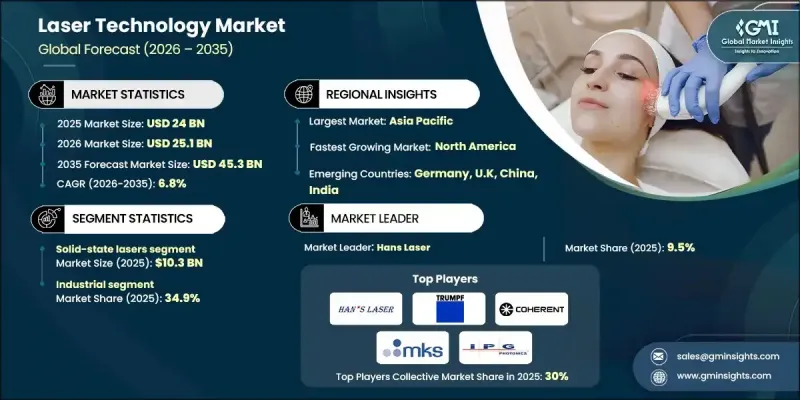
隨著雷射技術在製造業、電信、國防、醫療保健、汽車和消費性電子等領域成為不可或缺的工具,該產業的成長速度正在加快。雷射技術的精度、速度以及增強自動化能力,使其應用範圍不斷擴大,尤其是在對一致性和準確性要求極高的生產環境中。不斷成長的工業工作負載和對先進製造流程日益成長的興趣,持續推動對雷射系統的需求。同時,醫療保健、通訊和安全相關應用領域正在經歷顯著的數位轉型,進一步提升了對高性能雷射平台的需求。雷射設計的進步,加上研發投入,正在為工業加工、診斷和專業應用帶來新的能力。對尖端光學技術的日益依賴,凸顯了未來十年該市場強勁的發展前景。
| 市場範圍 | |
|---|---|
| 起始年份 | 2025 |
| 預測年份 | 2026-2035 |
| 起始值 | 240億美元 |
| 預測值 | 453億美元 |
| 複合年成長率 | 6.8% |
2025年,固態雷射市場規模達103億美元,預計2035年將達到199億美元。由於其高功率效率、耐用性以及適用於從醫療到科學分析和國防技術等各種應用,固態雷射仍然是應用最廣泛的解決方案之一。它們能夠支援高精度任務,因此在需要可靠、精確光學性能的環境中不可或缺。
預計到2025年,工業領域將佔據34.9%的市場佔有率,這反映了雷射在切割、打標、焊接、表面處理、鑽孔和積層製造等領域的廣泛應用。紡織、汽車、金屬加工和航太等行業高度依賴雷射系統來實現高度可控、可重複且高效的操作,因此工業應用成為雷射技術最大的消費群體。
2024年,美國雷射技術市佔率預計將達到74.9%,主要得益於先進製造業和國防創新領域的大量投資。聯邦政府的各項措施和研究項目加速了雷射技術在精密加工、製造和能源系統領域的應用。醫療保健和美容醫學領域的成長也推動了市場發展,這主要得益於對微創手術需求的不斷成長以及醫用雷射設備核准範圍的擴大。醫院和診所正持續引入雷射平台,以支援現代診斷、外科手術和皮膚科服務。
目錄
第1章:方法論與範圍
第2章:執行概要
第3章:行業洞察
- 產業生態系分析
- 供應商格局
- 利潤率
- 每個階段的價值增加
- 影響價值鏈的因素
- 產業影響因素
- 成長促進因素
- 各行業應用日益廣泛
- 對精度和效率的需求
- 通訊技術的日益普及
- 產業陷阱與挑戰
- 技術複雜性
- 認知度和接受度有限
- 機會
- 醫療和美容應用領域的成長
- 工業自動化和智慧製造領域的拓展
- 成長促進因素
- 成長潛力分析
- 未來市場趨勢
- 技術與創新格局
- 當前技術趨勢
- 新興技術
- 價格趨勢
- 按類型
- 按地區
- 監管環境
- 標準和合規要求
- 區域監理框架
- 認證標準
- 貿易統計
- 主要進口國
- 主要出口國
- 差距分析
- 風險評估與緩解
- 波特的分析
- PESTEL 分析
第4章:競爭格局
- 介紹
- 公司市佔率分析
- 按地區
- 公司矩陣分析
- 主要市場參與者的競爭分析
- 競爭定位矩陣
- 關鍵進展
- 併購
- 合作夥伴關係與合作
- 新產品發布
- 擴張計劃
第5章:市場估算與預測:依類型分類,2022-2035年
- 固態雷射
- 氣體雷射
- 液態雷射
- 其他
第6章:市場估算與預測:依配置分類,2022-2035年
- 固定的
- 移動
- 混合
- 機架整合系統
第7章:市場估算與預測:依功率範圍分類,2022-2035年
- 低功率(<1千瓦)
- 中等功率(1-10千瓦)
- 高功率(>10千瓦)
第8章:市場估算與預測:依波長分類,2022-2035年
- 紅外線的
- 可見的
- 紫外線
第9章:市場估算與預測:依應用領域分類,2022-2035年
- 雷射加工
- 光通訊
- 光電裝置
- 其他
第10章:市場估計與預測:依最終用途分類,2022-2035年
- 電信
- 工業的
- 半導體與電子
- 商業的
- 航太
- 其他
第11章:市場估計與預測:按地區分類,2022-2035年
- 北美洲
- 美國
- 加拿大
- 歐洲
- 德國
- 法國
- 英國
- 義大利
- 西班牙
- 亞太地區
- 中國
- 印度
- 日本
- 韓國
- 澳洲
- 拉丁美洲
- 巴西
- 墨西哥
- 阿根廷
- MEA
- 南非
- 沙烏地阿拉伯
- 阿拉伯聯合大公國
第12章:公司簡介
- AIDA
- Amada Press System
- Beckwood Press
- Bliss-Bret
- Bruderer
- Isgec Heavy Engineering
- Komatsu
- Macrodyne Technologies
- Nidec Minster
- Schuler Group
- Shieh Yih Machinery Industry
- SMS Group
- Stamtec
- Sutherland Presses
- Yangli Group
The Global Laser Technology Market was valued at USD 24 billion in 2025 and is estimated to grow at a CAGR of 6.8% to reach USD 45.3 billion by 2035.
Growth in this industry is accelerating as lasers become essential tools across manufacturing, telecommunications, defense, healthcare, automotive, and consumer electronics. Their precision, speed, and ability to enhance automation have supported wider adoption, particularly in production environments where consistency and accuracy are critical. Expanding industrial workloads and rising interest in advanced fabrication processes continue to drive demand for laser-based systems. At the same time, healthcare, communications, and security-related applications are all experiencing significant digital transformation, further boosting the need for high-performance laser platforms. Advancements in laser design, combined with investments in research, are enabling new capabilities for industrial processing, diagnostics, and specialized applications. This increasing reliance on sophisticated optical technologies underscores the market's strong outlook over the next decade.
| Market Scope | |
|---|---|
| Start Year | 2025 |
| Forecast Year | 2026-2035 |
| Start Value | $24 Billion |
| Forecast Value | $45.3 Billion |
| CAGR | 6.8% |
The solid-state lasers segment generated USD 10.3 billion in 2025 and is forecast to reach USD 19.9 billion by 2035. These lasers remain among the most widely used solutions due to their high power efficiency, durability, and suitability for diverse applications ranging from medical treatments to scientific analysis and defense technologies. Their ability to support precision-driven tasks makes them indispensable in environments that require reliable and accurate optical performance.
The industrial sector held a 34.9% share in 2025, reflecting the extensive role of lasers in cutting, marking, welding, surface treatment, drilling, and additive manufacturing. Industries such as textiles, automotive, metalworking, and aerospace depend heavily on laser systems for highly controlled, repeatable, and efficient operations, making industrial applications the largest consumer group for laser-based technologies.
U.S. Laser Technology Market held 74.9% share in 2024, supported by substantial investment in advanced manufacturing and defense-focused innovation. Federal initiatives and research programs have accelerated adoption across precision machining, fabrication, and energy systems. Growth in healthcare and aesthetic medicine also contributes to the market, with rising demand for minimally invasive procedures and expanded approvals for medical laser devices. Hospitals and clinics are consistently incorporating laser platforms to support modern diagnostics, surgical treatment, and dermatology services.
Key companies participating in the Global Laser Technology Market include AIDA, Beckwood Press, Bliss-Bret, Amada Press System, Bruderer, Komatsu, Nidec Minster, Macrodyne Technologies, Schuler Group, Shieh Yih Machinery Industry, SMS Group, Stamtec, Sutherland Presses, Yangli Group, and Isgec Heavy Engineering. Companies in the Global Laser Technology Market are adopting targeted strategies to reinforce their market position and expand global reach. Many are focusing on product innovation by developing lasers with higher power efficiency, improved beam quality, and compact architectures suitable for emerging industrial and medical applications. Strategic partnerships with manufacturing firms, research institutions, and technology integrators help accelerate the commercialization of next-generation laser systems. Firms are also investing in automation-ready platforms to support Industry 4.0 initiatives, enhancing compatibility with robotics, AI-driven monitoring, and smart factory environments.
Table of Contents
Chapter 1 Methodology & Scope
- 1.1 Market scope and definition
- 1.2 Research design
- 1.2.1 Research approach
- 1.2.2 Data collection methods
- 1.3 Data mining sources
- 1.3.1 Global
- 1.3.2 Regional/Country
- 1.4 Base estimates and calculations
- 1.4.1 Base year calculation
- 1.4.2 Key trends for market estimation
- 1.5 Primary research and validation
- 1.5.1 Primary sources
- 1.6 Forecast model
- 1.7 Research assumptions and limitations
Chapter 2 Executive Summary
- 2.1 Industry 3600 synopsis
- 2.2 Key market trends
- 2.2.1 Regional
- 2.2.2 Type
- 2.2.3 Configuration
- 2.2.4 Application
- 2.2.5 Power Range
- 2.2.6 Wavelength
- 2.2.7 End Use
- 2.3 CXO perspectives: Strategic imperatives
- 2.3.1 Key decision points for industry executives
- 2.3.2 Critical success factors for market players
- 2.4 Future outlook and strategic recommendations
Chapter 3 Industry Insights
- 3.1 Industry ecosystem analysis
- 3.1.1 Supplier landscape
- 3.1.2 Profit margin
- 3.1.3 Value addition at each stage
- 3.1.4 Factor affecting the value chain
- 3.2 Industry impact forces
- 3.2.1 Growth drivers
- 3.2.1.1 Increasing applications across industries
- 3.2.1.2 Demand for precision and efficiency
- 3.2.1.3 Rising use in communication technology
- 3.2.2 Industry pitfalls & challenges
- 3.2.2.1 Technical complexity
- 3.2.2.2 Limited awareness and adoption
- 3.2.3 Opportunities
- 3.2.3.1 Growth in medical & aesthetic applications
- 3.2.3.2 Expansion in industrial automation & smart manufacturing
- 3.2.1 Growth drivers
- 3.3 Growth potential analysis
- 3.4 Future market trends
- 3.5 Technology and innovation landscape
- 3.5.1 Current technological trends
- 3.5.2 Emerging technologies
- 3.6 Price trends
- 3.6.1 By Type
- 3.6.2 By Region
- 3.7 Regulatory landscape
- 3.7.1 Standards and compliance requirements
- 3.7.2 Regional regulatory frameworks
- 3.7.3 Certification standards
- 3.8 Trade statistics
- 3.8.1 Major importing countries
- 3.8.2 Major exporting countries
- 3.9 Gap analysis
- 3.10 Risk assessment and mitigation
- 3.11 Porter's analysis
- 3.12 PESTEL analysis
Chapter 4 Competitive Landscape, 2025
- 4.1 Introduction
- 4.2 Company market share analysis
- 4.2.1 By region
- 4.2.1.1 North America
- 4.2.1.2 Europe
- 4.2.1.3 Asia Pacific
- 4.2.1.4 Latin America
- 4.2.1.5 Middle East and Africa
- 4.2.1 By region
- 4.3 Company matrix analysis
- 4.4 Competitive analysis of major market players
- 4.5 Competitive positioning matrix
- 4.6 Key developments
- 4.6.1 Mergers & acquisitions
- 4.6.2 Partnerships & collaborations
- 4.6.3 New product launches
- 4.6.4 Expansion plans
Chapter 5 Market Estimates & Forecast, By Type, 2022-2035 (USD Million) (Thousand Units)
- 5.1 Key trends
- 5.2 Solid-state lasers
- 5.3 Gas lasers
- 5.4 Liquid lasers
- 5.5 Others
Chapter 6 Market Estimates & Forecast, By Configuration, 2022-2035 (USD Million) (Thousand Units)
- 6.1 Key trends
- 6.2 Fixed
- 6.3 Moving
- 6.4 Hybrid
- 6.5 Rack-integrated systems
Chapter 7 Market Estimates & Forecast, By Power range, 2022-2035 (USD Million) (Thousand Units)
- 7.1 Key trends
- 7.2 Low Power (<1 kW)
- 7.3 Medium Power (1-10 kW)
- 7.4 High Power (>10 kW)
Chapter 8 Market Estimates & Forecast, By Wavelength, 2022-2035 (USD Million) (Thousand Units)
- 8.1 Key trends
- 8.2 Infrared
- 8.3 Visible
- 8.4 Ultraviolet
Chapter 9 Market Estimates & Forecast, By Application, 2022-2035 (USD Million) (Thousand Units)
- 9.1 Key trends
- 9.2 Laser processing
- 9.3 Optical communication
- 9.4 Optoelectronic devices
- 9.5 Others
Chapter 10 Market Estimates & Forecast, By End Use, 2022-2035 (USD Million) (Thousand Units)
- 10.1 Key trends
- 10.2 Telecommunication
- 10.3 Industrial
- 10.4 Semiconductor & Electronics
- 10.5 Commercial
- 10.6 Aerospace
- 10.7 Others
Chapter 11 Market Estimates & Forecast, By Region, 2022-2035 (USD Million) (Thousand Units)
- 11.1 Key trends
- 11.2 North America
- 11.2.1 U.S.
- 11.2.2 Canada
- 11.3 Europe
- 11.3.1 Germany
- 11.3.2 France
- 11.3.3 UK
- 11.3.4 Italy
- 11.3.5 Spain
- 11.4 Asia Pacific
- 11.4.1 China
- 11.4.2 India
- 11.4.3 Japan
- 11.4.4 South Korea
- 11.4.5 Australia
- 11.5 Latin America
- 11.5.1 Brazil
- 11.5.2 Mexico
- 11.5.3 Argentina
- 11.6 MEA
- 11.6.1 South Africa
- 11.6.2 Saudi Arabia
- 11.6.3 UAE
Chapter 12 Company Profiles
- 12.1 AIDA
- 12.2 Amada Press System
- 12.3 Beckwood Press
- 12.4 Bliss-Bret
- 12.5 Bruderer
- 12.6 Isgec Heavy Engineering
- 12.7 Komatsu
- 12.8 Macrodyne Technologies
- 12.9 Nidec Minster
- 12.10 Schuler Group
- 12.11 Shieh Yih Machinery Industry
- 12.12 SMS Group
- 12.13 Stamtec
- 12.14 Sutherland Presses
- 12.15 Yangli Group

 雷射技術市場:按類型、技術、波長和應用分類-全球預測,2026-2032年
 全球雷射技術市場規模、佔有率、趨勢和成長分析報告(2026-2034)
 雷射技術市場分析及預測(至2035年):類型、產品類型、服務、技術、應用、組件、最終用戶、設備、製程、功能
 2026年全球雷射技術市場報告
 雷射技術市場-全球產業規模、佔有率、趨勢、機會及預測(依雷射類型、應用、產業、地區及競爭格局分類),2021-2031年
 雷射技術市場規模、佔有率和成長分析(按類型、產品類型、應用、產業垂直領域、組成和地區分類)-2026-2033年產業預測雷射技術市場:未來預測(2025-2030)全球雷射技術市場規模:按類型、應用、產業、地區、範圍和預測