


 |
市場調查報告書
商品編碼
1892904
摩托車安全氣囊夾克市場機會、成長促進因素、產業趨勢分析及預測(2026-2035年)Motorcycle Airbag Jacket Market Opportunity, Growth Drivers, Industry Trend Analysis, and Forecast 2026 - 2035 |
||||||

2025 年全球摩托車安全氣囊外套市場價值為 7.653 億美元,預計到 2035 年將以 6.8% 的複合年成長率成長至 15 億美元。
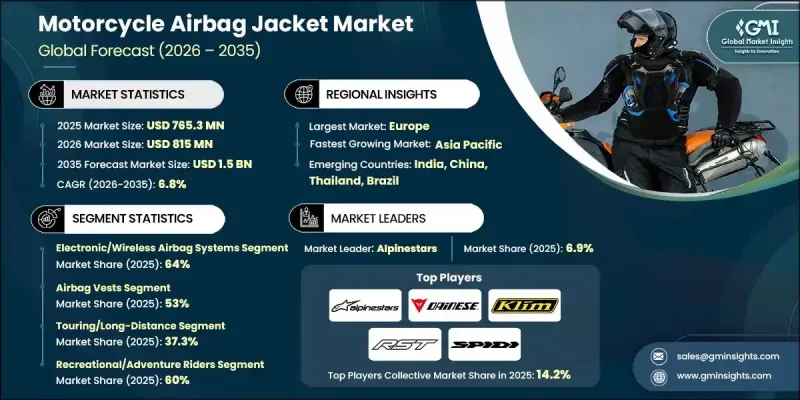
摩托車普及率的提高和日益嚴格的安全法規推動了市場成長,尤其是在歐洲和亞太地區,這兩個地區由於摩托車使用率高且防護裝備法規嚴格,因此處於領先地位。氣囊背心正日益被納入強制性防護裝備計劃,而亞太地區在全球摩托車市場佔據的顯著佔有率進一步刺激了市場需求。互聯安全系統的技術創新,例如即時監控和警報功能,正在提升騎乘者的安全性和產品信譽度。衝擊吸收和展開可靠性的標準化測試方法也增強了消費者的信心。在高階和通勤摩托車市場,隨著人們對碰撞保護意識的提高以及全球騎乘群體安全意識的增強,氣囊背心市場正在蓬勃發展。
| 市場範圍 | |
|---|---|
| 起始年份 | 2025 |
| 預測年份 | 2026-2035 |
| 起始值 | 7.653億美元 |
| 預測值 | 15億美元 |
| 複合年成長率 | 6.8% |
到 2025 年,電子和無線安全氣囊系統市佔率將達到 64%,預計到 2035 年將以 7.8% 的複合年成長率成長。電子系統可在毫秒內快速激活,並利用多個感測器提高精度,因此深受尋求更高保護的騎士的青睞。
2025年,氣囊背心市佔率達到53%,預計2026年至2035年將以7.4%的複合年成長率成長。背心之所以受歡迎,是因為它允許騎車者穿著普通夾克,同時又能提供額外的保護。 2024年,全球銷售超過230萬件,這主要得益於通勤者和培訓機構對經濟實惠的安全解決方案的需求。
美國摩托車氣囊夾克市場佔86.2%的佔有率,預計到2025年市場規模將達到1.748億美元。人們對碰撞保護意識的提高、長途騎行的增加以及探險和旅行摩托車手的廣泛採用,是推動市場成長的主要因素。在賽車組織強制執行的安全標準的推動下,專業賽車手和特技車手也擴大使用電子氣囊系統。國家級賽車賽事也進一步促進了高階產品的市場滲透。
目錄
第1章:方法論
第2章:執行概要
第3章:行業洞察
- 產業生態系分析
- 供應商格局
- 利潤率分析
- 成本結構
- 每個階段的價值增加
- 影響價值鏈的因素
- 中斷
- 產業影響因素
- 成長促進因素
- 摩托車事故率上升
- 優質安全設備的需求日益成長
- 城市通勤二輪車的擴張
- 感測和充氣系統的技術升級
- 產業陷阱與挑戰
- 產品成本高,購買力有限
- 發展中地區消費者意識較低
- 市場機遇
- 電子安全氣囊系統與互聯平台的融合日益增強
- 摩托車旅遊與探險運動的發展
- 擴大騎手培訓計劃
- 成長潛力分析
- 監管環境
- 北美洲
- 歐洲
- 亞太地區
- 拉丁美洲
- 中東和非洲
- 波特的分析
- PESTEL 分析
- 技術與創新格局
- 當前技術趨勢
- 新興技術
- 價格趨勢
- 按國家/地區
- 依產品
- 生產統計
- 生產中心
- 消費中心
- 進出口
- 成本細分分析
- 原料成本
- 按地區分類的直接人工成本
- 工廠營運成本及水電費
- 設備及機械折舊
- 品質控制和測試成本
- 專利與智慧財產權格局
- 主要專利持有人
- 技術授權模式
- 專利申請趨勢(2022-2025)
- 專利地理分佈
- 新興智慧財產權機遇
- 永續性和環境方面
- 永續實踐
- 減少廢棄物策略
- 生產中的能源效率
- 環保舉措
- 碳足跡考量
- 研發投資分析
- 產業研發支出趨勢
- 公司特定研發重點領域
- 大學與研究機構合作
- 政府資助的研究項目
- 最終使用者行為分析
- 購買決策因素
- 職業摩托車騎士的行為
- 休閒/探險騎乘者的行為
- 日常通勤行為
第4章:競爭格局
- 介紹
- 公司市佔率分析
- 北美洲
- 歐洲
- 亞太地區
- 拉丁美洲
- MEA
- 主要市場參與者的競爭分析
- 競爭定位矩陣
- 戰略展望矩陣
- 關鍵進展
- 併購
- 合作夥伴關係與合作
- 新產品發布
- 擴張計劃和資金
第5章:市場估計與預測:依技術分類,2022-2035年
- 電子/無線安全氣囊系統
- 機械/繫繩式安全氣囊系統
第6章:市場估算與預測:依產品分類,2022-2035年
- 安全氣囊夾克
- 安全氣囊背心
- 安全氣囊套裝
第7章:市場估算與預測:依應用領域分類,2022-2035年
- 公路/街道騎行
- 越野/探險騎行
- 賽車/賽道用途
- 旅遊/長途
第8章:市場估算與預測:依最終用途分類,2022-2035年
- 職業摩托車手
- 休閒/探險騎行者
- 日常通勤者
第9章:市場估算與預測:依配銷通路分類,2022-2035年
- 離線
- 線上
第10章:市場估計與預測:依地區分類,2022-2035年
- 北美洲
- 美國
- 加拿大
- 歐洲
- 德國
- 英國
- 法國
- 義大利
- 西班牙
- 俄羅斯
- 北歐
- 荷蘭
- 瑞典
- 亞太地區
- 中國
- 印度
- 日本
- 澳洲
- 韓國
- 新加坡
- 泰國
- 印尼
- 越南
- 拉丁美洲
- 巴西
- 墨西哥
- 阿根廷
- MEA
- 南非
- 沙烏地阿拉伯
- 阿拉伯聯合大公國
- 土耳其
第11章:公司簡介
- 全球參與者
- Alpinestars
- Autoliv
- Dainese
- Helite
- Honda Motor
- Klim
- Mugen Denko
- Rev'It!
- 區域玩家
- Bering Moto
- BMW Motorrad
- Clover IT
- Furygan
- Held
- Ixon
- RST
- Spidi
- Tucano Urbano
- Motoairbag
- 新興參與者/顛覆者
- Forcefield
- GIMOTO SRL
- Icon
- In&motion
- Macna
- Point Two Air Vests
The Global Motorcycle Airbag Jacket Market was valued at USD 765.3 million in 2025 and is estimated to grow at a CAGR of 6.8% to reach USD 1.5 billion by 2035.
Growth is driven by rising motorcycle adoption and stricter safety regulations, particularly in Europe and the Asia Pacific, which are leading regions due to their extensive motorcycle usage and stringent protective gear laws. Airbag jackets are increasingly integrated into mandatory protective gear programs, while the Asia Pacific's significant share of the global motorcycle market further boosts demand. Technological innovations in connected safety systems, such as real-time monitoring and alerts, are enhancing rider safety and product credibility. Standardized testing methods for impact absorption and deployment reliability are also strengthening consumer confidence. The market is witnessing adoption across both premium and commuter segments, supported by growing awareness of crash protection and safety-conscious riding communities worldwide.
| Market Scope | |
|---|---|
| Start Year | 2025 |
| Forecast Year | 2026-2035 |
| Start Value | $765.3 Million |
| Forecast Value | $1.5 Billion |
| CAGR | 6.8% |
The electronic and wireless airbag systems segment held a 64% share in 2025, expected to grow at a CAGR of 7.8% through 2035. Electronic systems offer rapid activation within milliseconds and improved accuracy using multiple sensors, making them highly preferred among riders seeking enhanced protection.
The airbag vests segment held a 53% share in 2025 and is growing at a CAGR of 7.4% from 2026 to 2035. Vests are popular as they allow riders to wear standard jackets while adding an extra layer of protection. In 2024, over 2.3 million units were sold globally, supported by commuters and training programs adopting affordable safety solutions.
U.S. Motorcycle Airbag Jacket Market held 86.2% share, generating USD 174.8 million in 2025. Rising awareness of crash protection, increased long-distance riding, and adoption among adventure and touring motorcyclists are driving market growth. Professional racers and stunt riders are also increasingly using electronic airbag systems, encouraged by safety standards enforced by racing organizations. National motorsport events further support premium product penetration.
Key players operating in the Motorcycle Airbag Jacket Market include Alpinestars, Dainese, Furygan, Held, Helite, Ixon, Klim, Mugen Denko, RST, and Spidi. To strengthen their presence, companies are focusing on continuous innovation in electronic airbag systems to enhance activation speed, reliability, and sensor accuracy. Expanding distribution through online and offline channels improves accessibility, while collaborations with OEMs and motorcycle clubs increase adoption rates. Investment in R&D ensures compliance with evolving safety regulations and standards, while marketing campaigns target both commuter and premium segments. Brands are also emphasizing sustainable materials, customization options, and affordable product lines to attract a wider consumer base and build long-term loyalty.
Table of Contents
Chapter 1 Methodology
- 1.1 Market scope and definition
- 1.2 Research design
- 1.2.1 Research approach
- 1.2.2 Data collection methods
- 1.3 Data mining sources
- 1.3.1 Global
- 1.3.2 Regional/Country
- 1.4 Base estimates and calculations
- 1.4.1 Base year calculation
- 1.4.2 Key trends for market estimation
- 1.5 Primary research and validation
- 1.5.1 Primary sources
- 1.6 Forecast model
- 1.7 Research assumptions and limitations
Chapter 2 Executive Summary
- 2.1 Industry 360° synopsis, 2022 - 2035
- 2.2 Key market trends
- 2.2.1 Regional
- 2.2.2 Technology
- 2.2.3 Product
- 2.2.4 Application
- 2.2.5 End Use
- 2.2.6 Distribution Channel
- 2.3 TAM Analysis, 2026-2035
- 2.4 CXO perspectives: Strategic imperatives
- 2.4.1 Executive decision points
- 2.4.2 Critical success factors
- 2.5 Future outlook and strategic recommendations
Chapter 3 Industry Insights
- 3.1 Industry ecosystem analysis
- 3.1.1 Supplier landscape
- 3.1.2 Profit margin analysis
- 3.1.3 Cost structure
- 3.1.4 Value addition at each stage
- 3.1.5 Factor affecting the value chain
- 3.1.6 Disruptions
- 3.2 Industry impact forces
- 3.2.1.1 Growth drivers
- 3.2.1.2 Rising motorcycle accident rates
- 3.2.1.3 Growing demand for premium safety gear
- 3.2.1.4 Expansion of urban commuting on two wheelers
- 3.2.1.5 Technology upgrades in sensing and inflation systems
- 3.2.2 Industry pitfalls and challenges
- 3.2.2.1 High product cost and limited affordability
- 3.2.2.2 Low consumer awareness in developing regions
- 3.2.3 Market opportunities
- 3.2.3.1 Rising integration of electronic airbag systems with connected platforms
- 3.2.3.2 Growth of motorcycle tourism and adventure sports
- 3.2.3.3 Expansion of rider training programs
- 3.3 Growth potential analysis
- 3.4 Regulatory landscape
- 3.4.1 North America
- 3.4.2 Europe
- 3.4.3 Asia Pacific
- 3.4.4 Latin America
- 3.4.5 Middle East & Africa
- 3.5 Porter's analysis
- 3.6 PESTEL analysis
- 3.7 Technology and innovation landscape
- 3.7.1 Current technological trends
- 3.7.2 Emerging technologies
- 3.8 Price trends
- 3.8.1 By Country
- 3.8.2 By Product
- 3.9 Production statistics
- 3.9.1 Production hubs
- 3.9.2 Consumption hubs
- 3.9.3 Export and import
- 3.10 Cost breakdown analysis
- 3.10.1 Raw material costs
- 3.10.2 Direct labor costs by region
- 3.10.3 Factory overhead & utilities
- 3.10.4 Equipment & machinery depreciation
- 3.10.5 Quality control & testing costs
- 3.11 Patent & IP landscape
- 3.11.1 Key patent holders
- 3.11.2 Technology licensing models
- 3.11.3 Patent filing trends (2022-2025)
- 3.11.4 Geographic patent distribution
- 3.11.5 Emerging IP opportunities
- 3.12 Sustainability and environmental aspects
- 3.12.1 Sustainable practices
- 3.12.2 Waste reduction strategies
- 3.12.3 Energy efficiency in production
- 3.12.4 Eco-friendly Initiatives
- 3.12.5 Carbon footprint considerations
- 3.13 R&D Investment Analysis
- 3.13.1 Industry R&D Spending Trends
- 3.13.2 Company-Specific R&D Focus Areas
- 3.13.3 University & Research Institution Partnerships
- 3.13.4 Government-Funded Research Programs
- 3.14 End use behavior analysis
- 3.14.1 Purchase decision factors
- 3.14.2 Professional motorcyclist behavior
- 3.14.3 Recreational/adventure rider behavior
- 3.14.4 Daily commuter behavior
Chapter 4 Competitive Landscape, 2025
- 4.1 Introduction
- 4.2 Company market share analysis
- 4.2.1 North America
- 4.2.2 Europe
- 4.2.3 Asia Pacific
- 4.2.4 LATAM
- 4.2.5 MEA
- 4.3 Competitive analysis of major market players
- 4.4 Competitive positioning matrix
- 4.5 Strategic outlook matrix
- 4.6 Key developments
- 4.6.1 Mergers & acquisitions
- 4.6.2 Partnerships & collaborations
- 4.6.3 New Product Launches
- 4.6.4 Expansion Plans and funding
Chapter 5 Market Estimates & Forecast, By Technology, 2022 2035 (USD Mn, Units)
- 5.1 Key trends
- 5.2 Electronic/Wireless Airbag Systems
- 5.3 Mechanical/Tethered Airbag Systems
Chapter 6 Market Estimates & Forecast, By Product, 2022 - 2035 (USD Mn, Units)
- 6.1 Key trends
- 6.2 Airbag Jackets
- 6.3 Airbag Vests
- 6.4 Airbag Suits
Chapter 7 Market Estimates & Forecast, By Application, 2022 - 2035 (USD Mn, Units)
- 7.1 Key trends
- 7.2 On-Road/Street Riding
- 7.3 Off-Road/Adventure Riding
- 7.4 Racing/Track Use
- 7.5 Touring/Long-Distance
Chapter 8 Market Estimates & Forecast, By End Use, 2022 - 2035 (USD Mn, Units)
- 8.1 Key trends
- 8.2 Professional Motorcyclists
- 8.3 Recreational/Adventure Riders
- 8.4 Daily Commuters
Chapter 9 Market Estimates & Forecast, By Distribution Channel, 2022 - 2035 (USD Mn, Units)
- 9.1 Key trends
- 9.2 Offline
- 9.3 Online
Chapter 10 Market Estimates & Forecast, By Region, 2022 - 2035 (USD Mn, Units)
- 10.1 Key trends
- 10.2 North America
- 10.2.1 US
- 10.2.2 Canada
- 10.3 Europe
- 10.3.1 Germany
- 10.3.2 UK
- 10.3.3 France
- 10.3.4 Italy
- 10.3.5 Spain
- 10.3.6 Russia
- 10.3.7 Nordics
- 10.3.8 Netherlands
- 10.3.9 Sweden
- 10.4 Asia Pacific
- 10.4.1 China
- 10.4.2 India
- 10.4.3 Japan
- 10.4.4 Australia
- 10.4.5 South Korea
- 10.4.6 Singapore
- 10.4.7 Thailand
- 10.4.8 Indonesia
- 10.4.9 Vietnam
- 10.5 Latin America
- 10.5.1 Brazil
- 10.5.2 Mexico
- 10.5.3 Argentina
- 10.6 MEA
- 10.6.1 South Africa
- 10.6.2 Saudi Arabia
- 10.6.3 UAE
- 10.6.4 Turkey
Chapter 11 Company Profiles
- 11.1 Global Players
- 11.1.1 Alpinestars
- 11.1.2 Autoliv
- 11.1.3 Dainese
- 11.1.4 Helite
- 11.1.5 Honda Motor
- 11.1.6 Klim
- 11.1.7 Mugen Denko
- 11.1.8 Rev'It!
- 11.2 Regional Players
- 11.2.1 Bering Moto
- 11.2.2 BMW Motorrad
- 11.2.3 Clover IT
- 11.2.4 Furygan
- 11.2.5 Held
- 11.2.6 Ixon
- 11.2.7 RST
- 11.2.8 Spidi
- 11.2.9 Tucano Urbano
- 11.2.10 Motoairbag
- 11.3 Emerging Players/Disruptors
- 11.3.1 Forcefield
- 11.3.2 GIMOTO SRL
- 11.3.3 Icon
- 11.3.4 In&motion
- 11.3.5 Macna
- 11.3.6 Point Two Air Vests

 摩托車安全氣囊市場分析及預測(至2035年):類型、產品類型、技術、組件、應用、材料類型、展開方式、最終用戶、安裝方式
 2026-2030年全球摩托車安全氣囊外套市場
 摩托車安全氣囊市場 - 全球產業規模、佔有率、趨勢、機會、預測:按組件、塗層、纖維類型、地區和競爭格局分類,2021-2031年
 摩托車安全氣囊市場規模、佔有率及成長分析(依產品類型、技術、部署方式、最終用戶、通路及地區分類)-2026-2033年產業預測
 摩托車安全氣囊外套市場規模、佔有率和成長分析(按產品類型、驅動方式、材料、最終用戶和地區分類)—2026-2033年產業預測
 全球人體安全氣囊穿戴裝置市場報告、績效及預測(2020-2031年)
 人體安全氣囊穿戴裝置:全球市場佔有率和排名、總收入和需求預測(2025-2031年)
 全球摩托車安全氣囊外套市場
 2030 年摩托車安全氣囊市場預測:按產品類型、零件、塗層、技術、應用和地區分類的全球分析
 全球摩托車安全氣囊外套市場:成長、未來展望與競爭分析(2024-2032 年)