


 |
市場調查報告書
商品編碼
1892866
OTR輪胎市場機會、成長促進因素、產業趨勢分析及2026-2035年預測OTR Tire Market Opportunity, Growth Drivers, Industry Trend Analysis, and Forecast 2026 - 2035 |
||||||

2025年全球工程機械輪胎市場價值為49.6億美元,預計2035年將以7.4%的複合年成長率成長至98.9億美元。
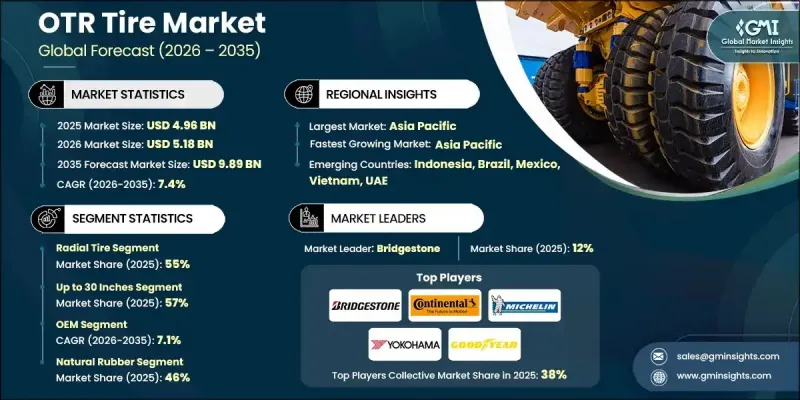
全球採礦和採石作業的持續擴張,帶動了重型機械(如運輸卡車、裝載機和推土機)使用量的增加,從而推動了市場成長。全球對礦物和金屬開採的需求不斷成長,也帶動了對堅固耐用的非公路(OTR)輪胎的需求,這類輪胎需要能夠承受高負載、適應惡劣環境並長時間連續運行。對包括道路、橋樑、能源項目、工業區和城市發展在內的基礎設施項目的投資,進一步提升了對工程機械的需求,而工程機械又依賴耐用的非公路輪胎。農業現代化以及曳引機、收割機和先進機械的普及,推動了對專用農業非公路輪胎的需求,這類輪胎具有卓越的牽引力、減少土壤壓實並延長使用壽命,從而支持新興市場和發達市場高效的大規模農業生產。
| 市場範圍 | |
|---|---|
| 起始年份 | 2025 |
| 預測年份 | 2026-2035 |
| 起始值 | 49.6億美元 |
| 預測值 | 98.9億美元 |
| 複合年成長率 | 7.4% |
2025年,子午線輪胎市佔率達到55%,預計2026年至2035年將以7%的複合年成長率成長。子午線輪胎因其胎面壽命長、行駛平穩等優點,在越野和乘用車領域備受青睞。其獨特的鋼絲帶束層設計,簾線方向垂直於行駛方向,確保了輪胎擁有更佳的牽引力、穩定性、燃油效率和散熱性能。
2025 年, OEM部門的市佔率為 44%,預計到 2034 年將以 7.1% 的複合年成長率成長。 OEMOEM使製造商能夠直接了解新機械的輪胎需求,反映建築、採礦和農業的趨勢,並提供有關新車產量和技術整合的見解。
預計到2025年,美國非公路輪胎市場規模將達到12.2億美元。採礦和建築業是非公路輪胎的主要需求方,車隊營運商傾向於選擇耐用且燃油效率高的子午線輪胎和混合配方輪胎。基礎設施建設,包括高速公路和城市項目,以及輪胎翻新、再生輪胎材料和節能設計等永續發展舉措,都推動了市場成長,這些舉措提高了營運效率並符合環保標準。
目錄
第1章:方法論
第2章:執行概要
第3章:行業洞察
- 產業生態系分析
- 供應商格局
- 利潤率
- 成本結構
- 每個階段的價值增加
- 影響價值鏈的因素
- 中斷
- 產業影響因素
- 成長促進因素
- 採礦和採石活動的擴張
- 基礎建設發展和建設成長
- 農業機械化
- 轉向採用子午線輪胎
- 產業陷阱與挑戰
- 原物料價格波動
- 過熱和過載導致的高故障率
- 市場機遇
- 新興礦業市場的成長
- 採礦和建築設備的自動化
- 港口和物料搬運業務的擴張
- 售後市場更換需求成長
- 成長促進因素
- 成長潛力分析
- 監管環境
- 全球的
- 安全與性能標準
- 環境與永續發展法規
- 進出口法規及關稅
- 採礦和建築工地規章
- 北美洲
- 歐洲
- 亞太地區
- 拉丁美洲
- 中東和非洲
- 全球的
- 波特的分析
- PESTEL 分析
- 技術與創新格局
- 當前技術趨勢
- 專有技術(MASTERCORE、V.PLY、LSW、NRF)
- 數位輪胎監測系統(TPMS)
- 智慧輪胎技術
- 先進材料與化合物
- 新興技術
- 無氣自主
- 人工智慧、區塊鏈、3D列印、自癒
- 電動和混合動力設備輪胎技術
- 當前技術趨勢
- 定價分析
- 按輪胎結構類型定價
- 價格以輪胎尺寸和輪圈直徑計算
- 按應用領域定價
- OEM價格與售後市場價格對比
- 區域定價分析
- 生產統計
- 生產中心
- 消費中心
- 進出口
- 成本細分分析
- 製造成本結構
- 原料成本分析
- 製造和生產成本
- 物流和配送成本
- 研發投資分配
- 專利分析
- 永續性和環境方面
- 永續實踐
- 減少廢棄物策略
- 生產中的能源效率
- 環保舉措
- 碳足跡考量
- 最終使用者行為與消費分析
- 最終用戶細分框架
- 採礦業使用者行為
- 建築業使用者行為
- 農業部門使用者行為
- 港口和物料搬運用戶行為
- 購買影響者和決策者
- 風險評估與緩解框架
- 供應鏈風險
- 金融和經濟風險
- 監理與合規風險
- 營運風險
- 技術與創新風險
- OTR 生命週期分析
- 生命週期分析框架
- 原料提取階段
- 製造階段生命週期影響
- 配送與物流階段
- 生命週期成本分析(LCCA)
- 生命週期績效指標
第4章:競爭格局
- 介紹
- 公司市佔率分析
- 北美洲
- 歐洲
- 亞太地區
- 拉丁美洲
- MEA
- 主要市場參與者的競爭分析
- 競爭定位矩陣
- 戰略展望矩陣
- 關鍵進展
- 併購
- 合作夥伴關係與合作
- 新產品發布
- 擴張計劃和資金
第5章:市場估價與預測:依輪胎類型分類,2022-2035年
- 子午線輪胎
- 斜交輪胎
- 實心輪胎
第6章:市場估算與預測:以輪圈尺寸分類,2022-2035年
- 最大可達 30 英寸
- 31-50英寸
- 超過 51 英寸
第7章:市場估算與預測:依設備類型分類,2022-2035年
- 自卸卡車
- 鉸接式自卸車
- 剛性自卸卡車
- 裝載機
- 挖掘裝載機
- 履帶式裝載機
- 滑移裝載機
- 挖土機
- 履帶式挖土機
- 小型挖土機
- 輪式挖土機
- 瀝青攤舖工
- 履帶式推土機
- 平地機
- RTLT-伸縮式
- 農業曳引機
- 其他
第8章:市場估算與預測:依產業分類,2022-2035年
- 建造
- 礦業
- 農業
- 林業
- 工業的
- 港口與物流
- 其他
第9章:市場估算與預測:依材料分類,2022-2035年
- 天然橡膠
- 合成橡膠
- 混合/複合輪胎
第10章:市場估價與預測:依配銷通路分類,2022-2035年
- OEM
- 售後市場
第11章:市場估計與預測:按地區分類,2022-2035年
- 北美洲
- 美國
- 加拿大
- 歐洲
- 德國
- 英國
- 法國
- 義大利
- 西班牙
- 北歐
- 俄羅斯
- 波蘭
- 羅馬尼亞
- 亞太地區
- 中國
- 印度
- 日本
- 韓國
- 澳新銀行
- 越南
- 印尼
- 拉丁美洲
- 巴西
- 墨西哥
- 阿根廷
- MEA
- 南非
- 沙烏地阿拉伯
- 阿拉伯聯合大公國
第12章:公司簡介
- 全球公司
- Balkrishna Industries
- Bridgestone
- Continental
- Double Coin
- Goodyear Tire & Rubber Company
- Linglong Tire
- Michelin
- Pirelli
- Sumitomo Rubber Industries
- Titan International
- Triangle Tyre
- Yokohama Rubber Company
- Zhongce Rubber
- 區域玩家
- Aeolus Tyre
- Apollo Tyres
- CEAT
- Guizhou Tyre
- JK Tyre & Industries
- Magna Tyres
- MRF
- Sailun
- Techking Tires
- Vipal Rubber
- 新興玩家
- Kal Tire Mining Tire
- OTR Engineered Solutions
- Revvo Technologies
- RubberJet
- The SMART Tire
The Global OTR Tire Market was valued at USD 4.96 billion in 2025 and is estimated to grow at a CAGR of 7.4% to reach USD 9.89 billion by 2035.
Market growth is driven by the rising use of heavy-duty machinery, such as haul trucks, loaders, and dozers, due to the ongoing expansion of mining and quarrying operations worldwide. Increasing global demand for mineral and metal extraction has fueled the need for robust off-the-road (OTR) tires capable of handling high load capacities, enduring abrasive conditions, and operating continuously for long hours. Investments in infrastructure projects, including roads, bridges, energy initiatives, industrial zones, and urban developments, have further boosted the demand for construction equipment, which in turn relies on durable OTR tires. The modernization of agriculture and adoption of tractors, harvesters, and advanced machinery are driving demand for specialized agricultural OTR tires that provide excellent traction, reduce soil compaction, and offer extended wear life, supporting efficient large-scale farming across both emerging and developed markets.
| Market Scope | |
|---|---|
| Start Year | 2025 |
| Forecast Year | 2026-2035 |
| Start Value | $4.96 Billion |
| Forecast Value | $9.89 Billion |
| CAGR | 7.4% |
The radial tire segment held a 55% share in 2025 and is projected to grow at a CAGR of 7% from 2026 to 2035. Radial tires are preferred in off-road and automotive applications for their long tread life and smoother ride. The design, featuring steel belts with cords oriented perpendicular to the travel direction, ensures improved traction, stability, fuel efficiency, and heat dissipation.
The OEM segment held a 44% share in 2025 and is expected to grow at a CAGR of 7.1% through 2034. OEM channels provide manufacturers with direct access to tire requirements for new machinery, reflecting trends in construction, mining, and agriculture, and offering insights into production volumes and technological integration in new vehicles.
U.S. OTR Tire Market reached USD 1.22 billion in 2025. Mining and construction sectors dominate demand for off-the-road tires, with fleet operators favoring radial and mixed-compound designs for durability and fuel efficiency. Growth is supported by infrastructure development, including highways and urban projects, and sustainability initiatives such as retreading, recycled tire materials, and energy-efficient designs that enhance operational efficiency and compliance with environmental standards.
Leading players operating in the OTR Tire Market include Titan International, The Goodyear Tire & Rubber Company, Bridgestone, Sumitomo Rubber, Yokohama Rubber Company, Michelin, Triangle, Pirelli, Continental, and Balkrishna Industries. Companies in the OTR Tire Market are adopting several strategies to strengthen their market position. They are investing in research and development to create longer-lasting, high-performance tires suitable for extreme conditions. Strategic partnerships with construction, mining, and agricultural equipment manufacturers help ensure OEM adoption. Geographic expansion into emerging markets increases sales opportunities, while sustainability initiatives, such as energy-efficient tire designs and retreading programs, meet regulatory requirements and environmental demands.
Table of Contents
Chapter 1 Methodology
- 1.1 Market scope and definition
- 1.2 Research design
- 1.2.1 Research approach
- 1.2.2 Data collection methods
- 1.3 Data mining sources
- 1.3.1 Global
- 1.3.2 Regional/Country
- 1.4 Base estimates and calculations
- 1.4.1 Base year calculation
- 1.4.2 Key trends for market estimation
- 1.5 Primary research and validation
- 1.5.1 Primary sources
- 1.6 Forecast model
- 1.7 Research assumptions and limitations
Chapter 2 Executive Summary
- 2.1 Industry 360° synopsis
- 2.2 Key market trends
- 2.2.1 Regional
- 2.2.2 Tire
- 2.2.3 Equipment
- 2.2.4 Rim size
- 2.2.5 Industry
- 2.2.6 Material
- 2.2.7 Distribution channel
- 2.3 TAM analysis, 2026-2035
- 2.4 CXO perspectives: Strategic imperatives
- 2.4.1 Executive decision points
- 2.4.2 Critical success factors
- 2.5 Future outlook
- 2.6 Strategic recommendations
Chapter 3 Industry Insights
- 3.1 Industry ecosystem analysis
- 3.1.1 Supplier landscape
- 3.1.2 Profit margin
- 3.1.3 Cost structure
- 3.1.4 Value addition at each stage
- 3.1.5 Factor affecting the value chain
- 3.1.6 Disruptions
- 3.2 Industry impact forces
- 3.2.1 Growth drivers
- 3.2.1.1 Expansion of mining and quarrying activities
- 3.2.1.2 Infrastructure development and construction growth
- 3.2.1.3 Agricultural mechanization
- 3.2.1.4 Shift toward radial tire adoption
- 3.2.2 Industry pitfalls and challenges
- 3.2.2.1 Raw material price volatility
- 3.2.2.2 High failure rates from heat and overloading
- 3.2.3 Market opportunities
- 3.2.3.1 Growth in emerging mining markets
- 3.2.3.2 Automation in mining and construction equipment
- 3.2.3.3 Expansion in port and material handling operations
- 3.2.3.4 Aftermarket replacement demand growth
- 3.2.1 Growth drivers
- 3.3 Growth potential analysis
- 3.4 Regulatory landscape
- 3.4.1 Global
- 3.4.1.1 Safety & performance standards
- 3.4.1.2 Environmental & sustainability regulations
- 3.4.1.3 Import/export regulations & tariffs
- 3.4.1.4 Mining & construction site regulations
- 3.4.2 North America
- 3.4.3 Europe
- 3.4.4 Asia Pacific
- 3.4.5 Latin America
- 3.4.6 Middle East & Africa
- 3.4.1 Global
- 3.5 Porter's analysis
- 3.6 PESTEL analysis
- 3.7 Technology and innovation landscape
- 3.7.1 Current technological trends
- 3.7.1.1 Proprietary technologies (MASTERCORE, V.PLY, LSW, NRF)
- 3.7.1.2 Digital tire monitoring systems (TPMS)
- 3.7.1.3 Intelligent tire technologies
- 3.7.1.4 Advanced materials & compounds
- 3.7.2 Emerging technologies
- 3.7.2.1 Airless autonomous
- 3.7.2.2 AI, Blockchain, 3D Printing, self-healing
- 3.7.2.3 Electric & hybrid equipment tire technologies
- 3.7.1 Current technological trends
- 3.8 Pricing analysis
- 3.8.1.1 Pricing by tire construction type
- 3.8.1.2 Pricing by tire size & rim diameter
- 3.8.1.3 Pricing by application segment
- 3.8.1.4 OEM vs aftermarket pricing
- 3.8.1.5 Regional pricing analysis
- 3.9 Production statistics
- 3.9.1 Production hubs
- 3.9.2 Consumption hubs
- 3.9.3 Export and import
- 3.10 Cost breakdown analysis
- 3.10.1 Manufacturing cost structure
- 3.10.2 Raw material cost analysis
- 3.10.3 Manufacturing & production costs
- 3.10.4 Logistics & distribution costs
- 3.10.5 R&D investment allocation
- 3.11 Patent analysis
- 3.12 Sustainability and environmental aspects
- 3.12.1 Sustainable practices
- 3.12.2 Waste reduction strategies
- 3.12.3 Energy efficiency in production
- 3.12.4 Eco-friendly initiatives
- 3.12.5 Carbon footprint considerations
- 3.13 End use behavior & consumption analysis
- 3.13.1 End use segmentation framework
- 3.13.2 Mining sector user behavior
- 3.13.3 Construction sector user behavior
- 3.13.4 Agriculture sector user behavior
- 3.13.5 Port & material handling user behavior
- 3.13.6 Purchase influencers & decision makers
- 3.14 Risk assessment & mitigation framework
- 3.14.1 Supply chain risks
- 3.14.2 Financial & economic risks
- 3.14.3 Regulatory & compliance risks
- 3.14.4 Operational risks
- 3.14.5 Technology & innovation risks
- 3.15 OTR lifecycle analysis
- 3.15.1 Lifecycle analysis framework
- 3.15.2 Raw material extraction phase
- 3.15.3 Manufacturing phase lifecycle impact
- 3.15.4 Distribution & logistics phase
- 3.15.5 Lifecycle cost analysis (LCCA)
- 3.15.6 Lifecycle performance metrics
Chapter 4 Competitive Landscape, 2025
- 4.1 Introduction
- 4.2 Company market share analysis
- 4.2.1 North America
- 4.2.2 Europe
- 4.2.3 Asia Pacific
- 4.2.4 LATAM
- 4.2.5 MEA
- 4.3 Competitive analysis of major market players
- 4.4 Competitive positioning matrix
- 4.5 Strategic outlook matrix
- 4.6 Key developments
- 4.6.1 Mergers & acquisitions
- 4.6.2 Partnerships & collaborations
- 4.6.3 New product launches
- 4.6.4 Expansion plans and funding
Chapter 5 Market Estimates & Forecast, By Tire, 2022 - 2035 ($Mn, Units)
- 5.1 Key trends
- 5.2 Radial tire
- 5.3 Bias tire
- 5.4 Solid tire
Chapter 6 Market Estimates & Forecast, By Rim Size, 2022 - 2035 ($Mn, Units)
- 6.1 Key trends
- 6.2 Up to 30 inches
- 6.3 31-50 inches
- 6.4 Above 51 inches
Chapter 7 Market Estimates & Forecast, By Equipment, 2022 - 2035 ($Mn, Units)
- 7.1 Key trends
- 7.2 Dump trucks
- 7.2.1 Articulated dump trucks
- 7.2.2 Rigid dump trucks
- 7.3 Loaders
- 7.3.1 Backhoe loaders
- 7.3.2 Crawler loaders
- 7.3.3 Skid-steer loaders
- 7.4 Excavators
- 7.4.1 Crawler excavators
- 7.4.2 Mini excavators
- 7.4.3 Wheeled excavators
- 7.5 Asphalt finishers
- 7.6 Crawler dozer
- 7.7 Motor graders
- 7.8 RTLT-telescopic
- 7.9 Agriculture tractors
- 7.10 Others
Chapter 8 Market Estimates & Forecast, By Industry, 2022 - 2035 ($Mn, Units)
- 8.1 Key trends
- 8.2 Construction
- 8.3 Mining
- 8.4 Agriculture
- 8.5 Forestry
- 8.6 Industrial
- 8.7 Ports & logistics
- 8.8 Others
Chapter 9 Market Estimates & Forecast, By Material, 2022 - 2035 ($Mn, Units)
- 9.1 Key trends
- 9.2 Natural rubber
- 9.3 Synthetic rubber
- 9.4 Mixed/compound tires
Chapter 10 Market Estimates & Forecast, By Distribution Channel, 2022 - 2035 ($Mn, Units)
- 10.1 Key trends
- 10.2 OEM
- 10.3 Aftermarket
Chapter 11 Market Estimates & Forecast, By Region, 2022 - 2035 ($Mn, Units)
- 11.1 Key trends
- 11.2 North America
- 11.2.1 US
- 11.2.2 Canada
- 11.3 Europe
- 11.3.1 Germany
- 11.3.2 UK
- 11.3.3 France
- 11.3.4 Italy
- 11.3.5 Spain
- 11.3.6 Nordics
- 11.3.7 Russia
- 11.3.8 Poland
- 11.3.9 Romania
- 11.4 Asia Pacific
- 11.4.1 China
- 11.4.2 India
- 11.4.3 Japan
- 11.4.4 South Korea
- 11.4.5 ANZ
- 11.4.6 Vietnam
- 11.4.7 Indonesia
- 11.5 Latin America
- 11.5.1 Brazil
- 11.5.2 Mexico
- 11.5.3 Argentina
- 11.6 MEA
- 11.6.1 South Africa
- 11.6.2 Saudi Arabia
- 11.6.3 UAE
Chapter 12 Company Profiles
- 12.1 Global companies
- 12.1.1 Balkrishna Industries
- 12.1.2 Bridgestone
- 12.1.3 Continental
- 12.1.4 Double Coin
- 12.1.5 Goodyear Tire & Rubber Company
- 12.1.6 Linglong Tire
- 12.1.7 Michelin
- 12.1.8 Pirelli
- 12.1.9 Sumitomo Rubber Industries
- 12.1.10 Titan International
- 12.1.11 Triangle Tyre
- 12.1.12 Yokohama Rubber Company
- 12.1.13 Zhongce Rubber
- 12.2 Regional players
- 12.2.1 Aeolus Tyre
- 12.2.2 Apollo Tyres
- 12.2.3 CEAT
- 12.2.4 Guizhou Tyre
- 12.2.5 JK Tyre & Industries
- 12.2.6 Magna Tyres
- 12.2.7 MRF
- 12.2.8 Sailun
- 12.2.9 Techking Tires
- 12.2.10 Vipal Rubber
- 12.3 Emerging players
- 12.3.1 Kal Tire Mining Tire
- 12.3.2 OTR Engineered Solutions
- 12.3.3 Revvo Technologies
- 12.3.4 RubberJet
- 12.3.5 The SMART Tire

 OTR輪胎市場 - 全球產業規模、佔有率、趨勢、機會、預測(按輪胎類型、應用類型、地區和競爭格局分類),2021-2031年
 越野輪胎市場報告:按車輛類型、輪胎類型、應用、銷售管道、輪圈尺寸和地區分類(2026-2034 年)
 越野輪胎市場:按車輛類型、輪胎類型、應用和地區分類。
 2026年全球工程機械輪胎市場報告
 OTR輪胎市場:2026-2032年全球市場預測(按產品類型、輪胎尺寸、載重能力、車輛類型、應用和銷售管道)
 非公路用輪胎(OTR)市場規模、佔有率、成長及全球產業分析:按類型、應用和地區的洞察,2026-2034年的預測
 越野輪胎市場分析及預測(至2035年):依類型、產品類型、服務、技術、應用、材質、最終用戶、功能、安裝方式分類全球工程機械輪胎市場規模、佔有率、趨勢和成長分析報告(2026-2034)日本越野輪胎市場規模、佔有率、趨勢和預測:按車輛類型、輪胎類型、分銷管道、輪圈尺寸、應用和地區分類,2026-2034年
 越野高性能車輛市場規模、佔有率和成長分析(按車輛類型、應用、燃料類型、分銷管道和地區分類)-2026-2033年產業預測