


 |
市場調查報告書
商品編碼
1892862
非那雄胺市場機會、成長促進因素、產業趨勢分析及預測(2026-2035年)Finasteride Market Opportunity, Growth Drivers, Industry Trend Analysis, and Forecast 2026 - 2035 |
||||||

2025 年全球非那雄胺市值為 1.308 億美元,預計到 2035 年將以 2.4% 的複合年成長率成長至 1.658 億美元。
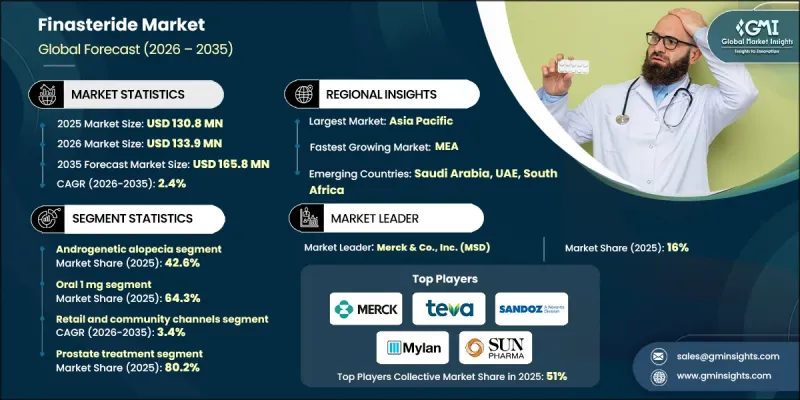
儘管面臨同類藥物的競爭以及低價學名藥的壓力,非那雄胺仍保持穩定成長。這一成長主要得益於新核准適應症的出現、醫學界更廣泛的認可以及處方率的提高。雖然美國、加拿大和西歐等成熟市場已接近飽和,成長有限,但東亞和印度的需求仍持續上升。收入水準的提高、個人形象支出的增加、對良性前列腺增生(BPH)和雄激素性脫髮的認知不斷提高以及專科醫療服務的可及性改善等因素,都在推動這一趨勢。預計這種強勁且持續的需求將在未來幾年內保持,從而支撐市場的長期穩定。
| 市場範圍 | |
|---|---|
| 起始年份 | 2025 |
| 預測年份 | 2026-2035 |
| 起始值 | 1.308億美元 |
| 預測值 | 1.658億美元 |
| 複合年成長率 | 2.4% |
2025年,雄性禿市佔率為42.6%,預計到2035年將以2%的複合年成長率成長。非那雄胺主要用於治療良性前列腺增生症(BPH)和雄性禿。 BPH多見於老年男性,形成了一個穩定的患者群體,主要透過泌尿科和初級保健進行管理。男性型禿髮影響較年輕的患者,推動了北美、歐洲和亞洲地區皮膚科、遠端皮膚科和直接面對消費者的管道對非那雄胺的推廣應用。
到2025年,零售和社區通路市場佔有率將達到61%,預計到2035年將以3.4%的複合年成長率成長。處方非那雄胺仍主要透過傳統零售和社區管道銷售,包括獨立藥房和連鎖藥局。醫院藥局為住院治療和專科醫生主導的治療提供支持,尤其是在泌尿科領域;而城市地區的皮膚科和毛髮科診所通常是主要的處方機構和決策者。
2025年北美非那雄胺市場規模為3,410萬美元,預計2035年將達4,350萬美元。該地區的成長得益於良性前列腺增生症(BPH)處方量的穩定、學名藥的廣泛普及、較高的診斷率、強大的泌尿科和皮膚科醫療網路,以及遠程皮膚科在脫髮治療中的日益普及。然而,由於健保政策和學名藥的競爭,價格成長仍然受到限制。
目錄
第1章:方法論與範圍
第2章:執行概要
第3章:行業洞察
- 產業生態系分析
- 供應商格局
- 利潤率
- 每個階段的價值增加
- 影響價值鏈的因素
- 中斷
- 產業影響因素
- 成長促進因素
- 男性老化族群中良性前列腺增生症負擔日益加重
- 越來越注重脫髮療程的美容效果
- 擴大低成本學名藥的取得途徑
- 產業陷阱與挑戰
- 安全隱患與黑盒子式警告
- 強大的學名藥競爭和報銷壓力
- 市場機遇
- 拓展數位化處方和電子藥局管道
- 米諾地爾與新藥的合併治療方案
- 成長促進因素
- 成長潛力分析
- 監管環境
- 北美洲
- 歐洲
- 亞太地區
- 拉丁美洲
- 中東和非洲
- 波特的分析
- PESTEL 分析
- 價格趨勢
- 按地區
- 透過治療應用
- 未來市場趨勢
- 技術與創新格局
- 當前技術趨勢
- 新興技術
- 專利格局
- 貿易統計(HS編碼)(註:僅提供重點國家的貿易統計資料)
- 主要進口國
- 主要出口國
- 永續性和環境方面
- 永續實踐
- 減少廢棄物策略
- 生產中的能源效率
- 環保舉措
- 碳足跡考量
第4章:競爭格局
- 介紹
- 公司市佔率分析
- 按地區
- 北美洲
- 歐洲
- 亞太地區
- 拉丁美洲
- MEA
- 按地區
- 公司矩陣分析
- 主要市場參與者的競爭分析
- 競爭定位矩陣
- 關鍵進展
- 併購
- 合作夥伴關係與合作
- 新產品發布
- 擴張計劃
第5章:市場估計與預測:依治療應用分類,2022-2035年
- 雄性禿(雄性禿)
- 良性攝護腺增生(BPH)
- 女性型禿頭(部分病例)
- 多毛症和其他雄性激素介導的疾病
- 其他
第6章:市場估算與預測:依劑量強度分類,2022-2035年
- 口服 1 毫克
- 口服 5 毫克
- 局部用量≤0.1%
- 局部用藥 > 0.1% 至 0.25%
- 局部用藥濃度 > 0.25% 至 0.5% 以上
第7章:市場估算與預測:依配銷通路分類,2022-2035年
- 零售和社區通路
- 社區藥房
- 連鎖藥局
- 網上藥局(合法持牌)
- 制度管道
- 醫院藥房
- 專科診所(泌尿科、皮膚科、毛髮科)
- 直接面對消費者(DTC)模式
- 其他
第8章:市場估算與預測:依應用領域分類,2022-2035年
- 攝護腺治療
- 攝護腺增生
- 攝護腺癌
- 荷爾蒙療法(跨性別女性)
- 頭髮護理
- 頭皮脫髮
- 毛髮過多
第9章:市場估計與預測:依地區分類,2022-2035年
- 北美洲
- 美國
- 加拿大
- 歐洲
- 德國
- 英國
- 法國
- 西班牙
- 義大利
- 歐洲其他地區
- 亞太地區
- 中國
- 印度
- 日本
- 澳洲
- 韓國
- 亞太其他地區
- 拉丁美洲
- 巴西
- 墨西哥
- 阿根廷
- 拉丁美洲其他地區
- 中東和非洲
- 沙烏地阿拉伯
- 南非
- 阿拉伯聯合大公國
- 中東和非洲其他地區
第10章:公司簡介
- Merck & Co., Inc. (MSD)
- Teva Pharmaceutical Industries Ltd.
- Sandoz (Novartis division)
- Mylan (Viatris Inc.)
- Sun Pharmaceutical Industries Ltd.
- Dr. Reddy's Laboratories Ltd.
- Cipla Ltd.
- Aurobindo Pharma Ltd.
- Lupin Ltd.
- Torrent Pharmaceuticals Ltd.
- Hikma Pharmaceuticals plc
- Apotex Inc.
The Global Finasteride Market was valued at USD 130.8 million in 2025 and is estimated to grow at a CAGR of 2.4% to reach USD 165.8 million by 2035.
Despite facing competition from other drugs in its class and pressure from lower-priced generics, finasteride continues to experience steady growth. This expansion is driven by newly approved indications, broader acceptance in the medical community, and increasing prescription rates. While mature markets in the US, Canada, and Western Europe have reached near-saturation, showing limited growth, demand in Eastern Asia and India continues to rise. Factors such as higher income levels, increased spending on personal appearance, growing awareness of benign prostatic hyperplasia (BPH) and androgenetic alopecia, and better access to specialist care are fueling this trend. This strong and sustained demand is expected to continue over the coming years, supporting long-term market stability.
| Market Scope | |
|---|---|
| Start Year | 2025 |
| Forecast Year | 2026-2035 |
| Start Value | $130.8 Million |
| Forecast Value | $165.8 Million |
| CAGR | 2.4% |
The androgenetic alopecia segment held 42.6% share in 2025 and is expected to grow at a CAGR of 2% through 2035. Finasteride is primarily prescribed for BPH and androgenetic alopecia. BPH is prevalent among older men, creating a stable patient base primarily managed through urology and primary care. Male pattern hair loss, affecting younger patients, has fueled adoption through dermatology, tele-dermatology, and direct-to-consumer programs across North America, Europe, and Asia.
The retail and community channel segment held a 61% share in 2025 and is anticipated to grow at a CAGR of 3.4% through 2035. Prescription finasteride continues to be dispensed mainly via traditional retail and community channels, including independent pharmacies and chain drug stores. Hospital pharmacies support inpatient care and specialist-initiated therapy, particularly in urology, while dermatology and trichology clinics in urban areas often serve as primary prescribers and influencers.
North America Finasteride Market accounted for USD 34.1 million in 2025, and is expected to reach USD 43.5 million by 2035. Growth in the region is supported by stable BPH prescriptions, widespread generic availability, high diagnostic rates, robust urology and dermatology networks, and the expanding use of tele-dermatology for hair loss. Price growth, however, remains constrained due to reimbursement policies and generic competition.
Key players operating in the Global Finasteride Market include Merck & Co., Inc. (MSD), Teva Pharmaceutical Industries Ltd., Sandoz (Novartis division), Mylan (Viatris Inc.), Sun Pharmaceutical Industries Ltd., Dr. Reddy's Laboratories Ltd., Cipla Ltd., Aurobindo Pharma Ltd., Lupin Ltd., Torrent Pharmaceuticals Ltd., Hikma Pharmaceuticals plc, and Apotex Inc. Companies in the Global Finasteride Market are adopting multiple strategies to strengthen their presence and expand market share. They are launching new generic formulations to increase accessibility and compete on price while maintaining quality standards. Strategic partnerships and licensing agreements with regional manufacturers help widen distribution networks and penetrate emerging markets. Investments in marketing, physician education, and telemedicine platforms enhance awareness and adoption, particularly for androgenetic alopecia treatment.
Table of Contents
Chapter 1 Methodology & Scope
- 1.1 Market scope and definition
- 1.2 Research design
- 1.2.1 Research approach
- 1.2.2 Data collection methods
- 1.3 Data mining sources
- 1.3.1 Global
- 1.3.2 Regional/Country
- 1.4 Base estimates and calculations
- 1.4.1 Base year calculation
- 1.4.2 Key trends for market estimation
- 1.5 Primary research and validation
- 1.5.1 Primary sources
- 1.6 Forecast model
- 1.7 Research assumptions and limitations
Chapter 2 Executive Summary
- 2.1 Industry 3600 synopsis
- 2.2 Key market trends
- 2.2.1 Regional
- 2.2.2 Therapeutic application
- 2.2.3 Dosage strength
- 2.2.4 Distribution channel
- 2.2.5 Application
- 2.3 TAM Analysis, 2026-2035
- 2.4 CXO perspectives: Strategic imperatives
- 2.4.1 Executive decision points
- 2.4.2 Critical success factors
- 2.5 Future Outlook and Strategic Recommendations
Chapter 3 Industry Insights
- 3.1 Industry ecosystem analysis
- 3.1.1 Supplier landscape
- 3.1.2 Profit margin
- 3.1.3 Value addition at each stage
- 3.1.4 Factor affecting the value chain
- 3.1.5 Disruptions
- 3.2 Industry impact forces
- 3.2.1 Growth drivers
- 3.2.1.1 Rising BPH burden in aging male populations
- 3.2.1.2 Increasing aesthetic focus on hair-loss treatment
- 3.2.1.3 Widening access to low-cost generics
- 3.2.2 Industry pitfalls and challenges
- 3.2.2.1 Safety concerns and black-box style warnings
- 3.2.2.2 Strong generic competition and reimbursement pressure
- 3.2.3 Market opportunities
- 3.2.3.1 Expansion of digital prescribing and e-pharmacy channels
- 3.2.3.2 Combination regimens with minoxidil and new agents
- 3.2.1 Growth drivers
- 3.3 Growth potential analysis
- 3.4 Regulatory landscape
- 3.4.1 North America
- 3.4.2 Europe
- 3.4.3 Asia Pacific
- 3.4.4 Latin America
- 3.4.5 Middle East & Africa
- 3.5 Porter's analysis
- 3.6 PESTEL analysis
- 3.7 Price trends
- 3.7.1 By region
- 3.7.2 By Therapeutic application
- 3.8 Future market trends
- 3.9 Technology and Innovation landscape
- 3.9.1 Current technological trends
- 3.9.2 Emerging technologies
- 3.10 Patent Landscape
- 3.11 Trade statistics (HS code) (Note: the trade statistics will be provided for key countries only)
- 3.11.1 Major importing countries
- 3.11.2 Major exporting countries
- 3.12 Sustainability and environmental aspects
- 3.12.1 Sustainable practices
- 3.12.2 Waste reduction strategies
- 3.12.3 Energy efficiency in production
- 3.12.4 Eco-friendly initiatives
- 3.13 Carbon footprint consideration
Chapter 4 Competitive Landscape, 2025
- 4.1 Introduction
- 4.2 Company market share analysis
- 4.2.1 By region
- 4.2.1.1 North America
- 4.2.1.2 Europe
- 4.2.1.3 Asia Pacific
- 4.2.1.4 LATAM
- 4.2.1.5 MEA
- 4.2.1 By region
- 4.3 Company matrix analysis
- 4.4 Competitive analysis of major market players
- 4.5 Competitive positioning matrix
- 4.6 Key developments
- 4.6.1 Mergers & acquisitions
- 4.6.2 Partnerships & collaborations
- 4.6.3 New Product Launches
- 4.6.4 Expansion Plans
Chapter 5 Market Estimates and Forecast, By Therapeutic Application, 2022-2035 (USD Million) (Kilo Tons)
- 5.1 Key trends
- 5.2 Androgenetic alopecia (male pattern hair loss)
- 5.3 Benign prostatic hyperplasia (BPH)
- 5.4 Female pattern hair loss (selected cases)
- 5.5 Hirsutism and other androgen-mediated conditions
- 5.6 Others
Chapter 6 Market Estimates and Forecast, By Dosage Strength, 2022-2035 (USD Million) (Kilo Tons)
- 6.1 Key trends
- 6.2 Oral 1 mg
- 6.3 Oral 5 mg
- 6.4 Topical ≤ 0.1%
- 6.5 Topical > 0.1% to 0.25%
- 6.6 Topical > 0.25% to 0.5% and above
Chapter 7 Market Estimates and Forecast, By Distribution Channel, 2022-2035 (USD Million) (Kilo Tons)
- 7.1 Key trends
- 7.2 Retail and community channels
- 7.2.1 Community pharmacies
- 7.2.2 Chain drugstores
- 7.2.3 Online pharmacies (legally licensed)
- 7.3 Institutional channels
- 7.3.1 Hospital pharmacies
- 7.3.2 Specialty clinics (urology, dermatology, trichology)
- 7.3.3 Direct-to-consumer (DTC) models
- 7.4 Others
Chapter 8 Market Estimates and Forecast, By Application, 2022-2035 (USD Million) (Kilo Tons)
- 8.1 Key trends
- 8.2 Prostate Treatment
- 8.2.1 Prostate Enlargement
- 8.2.2 Prostate Cancer
- 8.2.3 Hormone therapy (Transgender Women)
- 8.3 Hair Treatment
- 8.3.1 Scalp Hair Loss
- 8.3.2 Excessive Hair Growth
Chapter 9 Market Estimates and Forecast, By Region, 2022-2035 (USD Million) (Kilo Tons)
- 9.1 Key trends
- 9.2 North America
- 9.2.1 U.S.
- 9.2.2 Canada
- 9.3 Europe
- 9.3.1 Germany
- 9.3.2 UK
- 9.3.3 France
- 9.3.4 Spain
- 9.3.5 Italy
- 9.3.6 Rest of Europe
- 9.4 Asia Pacific
- 9.4.1 China
- 9.4.2 India
- 9.4.3 Japan
- 9.4.4 Australia
- 9.4.5 South Korea
- 9.4.6 Rest of Asia Pacific
- 9.5 Latin America
- 9.5.1 Brazil
- 9.5.2 Mexico
- 9.5.3 Argentina
- 9.5.4 Rest of Latin America
- 9.6 Middle East and Africa
- 9.6.1 Saudi Arabia
- 9.6.2 South Africa
- 9.6.3 UAE
- 9.6.4 Rest of Middle East and Africa
Chapter 10 Company Profiles
- 10.1 Merck & Co., Inc. (MSD)
- 10.2 Teva Pharmaceutical Industries Ltd.
- 10.3 Sandoz (Novartis division)
- 10.4 Mylan (Viatris Inc.)
- 10.5 Sun Pharmaceutical Industries Ltd.
- 10.6 Dr. Reddy’s Laboratories Ltd.
- 10.7 Cipla Ltd.
- 10.8 Aurobindo Pharma Ltd.
- 10.9 Lupin Ltd.
- 10.10 Torrent Pharmaceuticals Ltd.
- 10.11 Hikma Pharmaceuticals plc
- 10.12 Apotex Inc.
