


 |
市場調查報告書
商品編碼
1892856
癌症診斷市場機會、成長促進因素、產業趨勢分析及預測(2026-2035年)Cancer Diagnostics Market Opportunity, Growth Drivers, Industry Trend Analysis, and Forecast 2026 - 2035 |
||||||

2025 年全球癌症診斷市場價值為 1,717 億美元,預計到 2035 年將以 9.1% 的複合年成長率成長至 4,089 億美元。
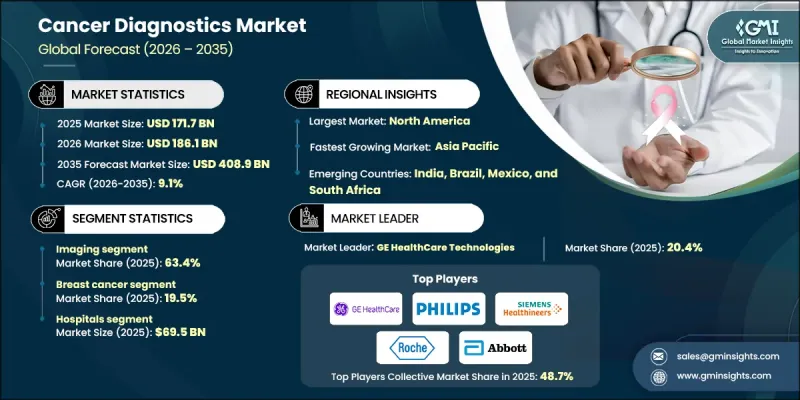
癌症發生率的上升以及能夠精準檢測疾病的先進診斷技術的日益普及推動了市場擴張。癌症診斷涵蓋了旨在識別癌症類型、分期和位置的多種技術、流程和檢測方法,從而支持早期治療並改善預後。個人化醫療的創新,特別是生物標記驅動的方法,正在改變癌症的檢測、監測和治療方案的選擇。諸如液體活體組織切片等非侵入性方法能夠即時監測治療反應並早期發現腫瘤,從而推動了醫療機構對這些技術的採用。先進的影像技術、人工智慧輔助診斷工具和實驗室檢測技術進一步提高了診斷的準確性和可靠性,促進了這些技術在全球醫院和診斷中心的廣泛應用。這些技術的整合也加速了臨床研究和治療方案的最佳化,從而支持了整體市場成長。
| 市場範圍 | |
|---|---|
| 起始年份 | 2025 |
| 預測年份 | 2026-2035 |
| 起始值 | 1717億美元 |
| 預測值 | 4089億美元 |
| 複合年成長率 | 9.1% |
到2025年,影像領域將佔據63.4%的市場。癌症病例的不斷增加推動了對診斷影像的需求,這對於早期發現和精準治療方案的發展至關重要。 PET-CT、MRI和人工智慧輔助成像等創新技術正在提高診斷精度,從而促進影像技術在全球的應用。
預計到2025年,醫院板塊的收入將達到695億美元。該板塊的成長主要得益於醫院數量的增加、城市化進程的加快以及操作先進診斷系統的熟練人員的湧現。此外,醫院還提供包括影像、活體組織切片和液體活體組織切片平台在內的先進技術,從而支持全面的癌症診斷並改善患者的治療效果。
預計到2025年,北美癌症診斷市佔率將達到40.5%。高癌症發病率、強勁的研究投入以及先進的醫療基礎設施正在推動市場擴張。製藥公司、生技公司和研究機構正大力投資創新診斷解決方案,進一步促進了該地區的成長。
目錄
第1章:方法論與範圍
第2章:執行概要
第3章:行業洞察
- 產業生態系分析
- 產業影響因素
- 成長促進因素
- 全球癌症發生率不斷上升
- 政府和其他組織開展了多項舉措,以提高公眾對疾病的認知。
- 發展中國家的診斷實驗室數量不斷增加
- 癌症診斷技術進步
- 產業陷阱與挑戰
- 診斷影像系統需要高額的資本投入和高昂的成本。
- 高輻射暴露帶來的風險會影響CT掃描儀的使用。
- 市場機遇
- 新興市場的區域擴張
- 人工智慧與數位病理學的融合
- 成長促進因素
- 成長潛力分析
- 監管環境
- 北美洲
- 歐洲
- 亞太地區
- 技術格局
- 當前技術趨勢
- 新興技術
- 專利分析
- 2025年定價分析
- 未來市場趨勢
- 波特的分析
- PESTEL 分析
第4章:競爭格局
- 介紹
- 公司市佔率分析
- 全球的
- 北美洲
- 歐洲
- 亞太地區
- 公司矩陣分析
- 主要市場參與者的競爭分析
- 競爭定位矩陣
- 關鍵發展
- 併購
- 夥伴關係與合作
- 新產品發布
- 擴張計劃
第5章:市場估算與預測:依應用領域分類,2022-2035年
- 腫瘤生物標記檢測
- 影像
- 超音波和放射學
- 乳房X光檢查
- 核磁共振掃描
- PET掃描
- CT掃描
- SPECT 和其他影像技術
- 活體組織切片
- 液體活體組織切片
- 免疫組織化學
- 原位雜合技術
第6章:市場估計與預測:依癌症類型分類,2022-2035年
- 膀胱癌
- 乳癌
- 結腸癌和直腸癌
- 子宮內膜癌
- 腎癌
- 白血病
- 肝癌和肺癌
- 黑色素瘤
- 非何杰金氏淋巴瘤
- 胰腺癌
- 攝護腺癌
- 甲狀腺癌
- 其他癌症類型
第7章:市場估算與預測:依最終用途分類,2022-2035年
- 醫院
- 診斷實驗室
- 診斷影像中心
- 癌症研究機構
第8章:市場估算與預測:依地區分類,2022-2035年
- 北美洲
- 美國
- 加拿大
- 歐洲
- 德國
- 英國
- 法國
- 義大利
- 西班牙
- 荷蘭
- 亞太地區
- 中國
- 印度
- 日本
- 澳洲
- 韓國
- 拉丁美洲
- 巴西
- 墨西哥
- 阿根廷
- 中東和非洲
- 沙烏地阿拉伯
- 南非
- 阿拉伯聯合大公國
第9章:公司簡介
- Abbott Laboratories
- Becton, Dickinson and Company
- Biocare Medical
- Biocartis
- Biomerieux
- Bio-Rad Laboratories
- Danaher Corporation
- Exact Sciences Corporation
- F-Hoffmann-La Roche
- GE HealthCare Technologies
- Guardant Health
- Hologic
- Koninklijke Philips
- QIAGEN
- Siemens Healthineers
- Sysmex Corporation
- Thermo Fisher Scientific
The Global Cancer Diagnostics Market was valued at USD 171.7 billion in 2025 and is estimated to grow at a CAGR of 9.1% to reach USD 408.9 billion by 2035.
Market expansion is fueled by the rising prevalence of cancer and the growing adoption of advanced diagnostic technologies that enable precise disease detection. Cancer diagnostics encompass a wide range of technologies, processes, and tests designed to identify the type, stage, and location of cancer, supporting early treatment and better outcomes. Innovations in personalized medicine, particularly biomarker-driven approaches, are transforming detection, monitoring, and therapy selection. Non-invasive methods such as liquid biopsies allow real-time monitoring of treatment responses and early detection of tumors, driving adoption among healthcare providers. Advanced imaging, AI-assisted diagnostic tools, and lab-based testing techniques are further enhancing accuracy and reliability, encouraging widespread uptake in hospitals and diagnostic centers globally. The integration of these technologies is also accelerating clinical research and treatment optimization, supporting overall market growth.
| Market Scope | |
|---|---|
| Start Year | 2025 |
| Forecast Year | 2026-2035 |
| Start Value | $171.7 Billion |
| Forecast Value | $408.9 Billion |
| CAGR | 9.1% |
The imaging segment held a 63.4% share in 2025. The rising number of cancer cases is increasing demand for diagnostic imaging, which is essential for early detection and precise treatment planning. Innovations such as PET-CT, MRI, and AI-assisted imaging are improving accuracy, boosting the adoption of imaging technologies worldwide.
The hospitals segment generated USD 69.5 billion in 2025. The growth of this segment is driven by increasing hospital numbers, urbanization, and the availability of skilled personnel to operate advanced diagnostic systems. Hospitals also offer access to advanced technologies, including imaging, biopsies, and liquid biopsy platforms, supporting comprehensive cancer diagnostics and improved patient outcomes.
North America Cancer Diagnostics Market held a 40.5% share in 2025. High cancer prevalence, coupled with strong research initiatives and advanced healthcare infrastructure, is driving market expansion. Pharmaceutical companies, biotechnology firms, and research institutions are heavily investing in innovative diagnostic solutions, further supporting growth in the region.
Key players in the Global Cancer Diagnostics Market include Guardant Health, Abbott Laboratories, Thermo Fisher Scientific, Biocare Medical, Bio-Rad Laboratories, Biomerieux, Danaher Corporation, Siemens Healthineers, Hologic, QIAGEN, GE HealthCare Technologies, Becton Dickinson and Company, Biocartis, F. Hoffmann-La Roche, and Koninklijke Philips.
Companies in the Global Cancer Diagnostics Market are implementing multiple strategies to strengthen their market presence and competitive positioning. They are investing heavily in R&D to develop next-generation diagnostic solutions, including AI-assisted imaging, liquid biopsy platforms, and biomarker-focused tests. Strategic collaborations, partnerships, and acquisitions help expand geographic reach and technological capabilities. Firms are also enhancing product portfolios by introducing innovative, high-precision diagnostic tools that improve early detection and treatment monitoring. Additionally, companies are targeting emerging markets, optimizing manufacturing processes, and offering comprehensive customer support and training to increase adoption in hospitals and diagnostic centers, while maintaining strong regulatory compliance and supply chain efficiency.
Table of Contents
Chapter 1 Methodology and Scope
- 1.1 Market scope and definitions
- 1.2 Research design
- 1.2.1 Research approach
- 1.2.2 Data collection methods
- 1.3 Data mining sources
- 1.3.1 Global
- 1.3.2 Regional/country
- 1.4 Base estimates and calculations
- 1.4.1 Base year calculation
- 1.4.2 Key trends for market estimation
- 1.5 Primary research and validation
- 1.5.1 Primary sources
- 1.6 Forecast model
- 1.7 Research assumptions and limitations
Chapter 2 Executive Summary
- 2.1 Industry 3600 synopsis
- 2.2 Key market trends
- 2.2.1 Regional trends
- 2.2.2 Application trends
- 2.2.3 Cancer type trends
- 2.2.4 End use trends
- 2.3 CXO perspectives: Strategic imperatives
- 2.3.1 Key decision points for industry executives
- 2.3.2 Critical success factors for market players
- 2.4 Future outlook and strategic recommendations
Chapter 3 Industry Insights
- 3.1 Industry ecosystem analysis
- 3.2 Industry impact forces
- 3.2.1 Growth drivers
- 3.2.1.1 Rising prevalence of cancer globally
- 3.2.1.2 Several initiatives undertaken by government and other organizations to spread disease awareness
- 3.2.1.3 Growing number of diagnostic laboratories in developing countries
- 3.2.1.4 Technology advancements in cancer diagnostics
- 3.2.2 Industry pitfalls and challenges
- 3.2.2.1 High capital investment coupled with high costs associated with diagnostic imaging systems
- 3.2.2.2 Risk related with high radiation exposure affecting use of CT scanner
- 3.2.3 Market opportunities
- 3.2.3.1 Regional expansion in emerging markets
- 3.2.3.2 Integration of AI and digital pathology
- 3.2.1 Growth drivers
- 3.3 Growth potential analysis
- 3.4 Regulatory landscape
- 3.4.1 North America
- 3.4.2 Europe
- 3.4.3 Asia Pacific
- 3.5 Technology landscape
- 3.5.1 Current technological trends
- 3.5.2 Emerging technologies
- 3.6 Patent analysis
- 3.7 Pricing analysis, 2025
- 3.8 Future market trends
- 3.9 Porter's analysis
- 3.10 PESTEL analysis
Chapter 4 Competitive Landscape, 2025
- 4.1 Introduction
- 4.2 Company market share analysis
- 4.2.1 Global
- 4.2.2 North America
- 4.2.3 Europe
- 4.2.4 Asia Pacific
- 4.3 Company matrix analysis
- 4.4 Competitive analysis of major market players
- 4.5 Competitive positioning matrix
- 4.6 Key development
- 4.6.1 Mergers and acquisitions
- 4.6.2 Partnerships and collaborations
- 4.6.3 New product launches
- 4.6.4 Expansion plans
Chapter 5 Market Estimates and Forecast, By Application, 2022 - 2035 ($ Mn)
- 5.1 Key trends
- 5.2 Tumor biomarkers tests
- 5.3 Imaging
- 5.3.1 Ultrasound and radiology
- 5.3.2 Mammography
- 5.3.3 MRI scan
- 5.3.4 PET scan
- 5.3.5 CT scan
- 5.3.6 SPECT and other imaging
- 5.4 Biopsy
- 5.5 Liquid biopsy
- 5.6 Immunohistochemistry
- 5.7 In situ hybridization
Chapter 6 Market Estimates and Forecast, By Cancer Type, 2022 - 2035 ($ Mn)
- 6.1 Key trends
- 6.2 Bladder cancer
- 6.3 Breast cancer
- 6.4 Colon and rectal cancer
- 6.5 Endometrial cancer
- 6.6 Kidney cancer
- 6.7 Leukemia
- 6.8 Liver and lung cancer
- 6.9 Melanoma
- 6.10 Non-Hodgkin lymphoma
- 6.11 Pancreatic cancer
- 6.12 Prostate cancer
- 6.13 Thyroid cancer
- 6.14 Other cancer types
Chapter 7 Market Estimates and Forecast, By End Use, 2022 - 2035 ($ Mn)
- 7.1 Key trends
- 7.2 Hospitals
- 7.3 Diagnostic laboratories
- 7.4 Diagnostic imaging centers
- 7.5 Cancer research institutes
Chapter 8 Market Estimates and Forecast, By Region, 2022 - 2035 ($ Mn)
- 8.1 Key trends
- 8.2 North America
- 8.2.1 U.S.
- 8.2.2 Canada
- 8.3 Europe
- 8.3.1 Germany
- 8.3.2 UK
- 8.3.3 France
- 8.3.4 Italy
- 8.3.5 Spain
- 8.3.6 Netherlands
- 8.4 Asia Pacific
- 8.4.1 China
- 8.4.2 India
- 8.4.3 Japan
- 8.4.4 Australia
- 8.4.5 South Korea
- 8.5 Latin America
- 8.5.1 Brazil
- 8.5.2 Mexico
- 8.5.3 Argentina
- 8.6 Middle East and Africa
- 8.6.1 Saudi Arabia
- 8.6.2 South Africa
- 8.6.3 UAE
Chapter 9 Company Profiles
- 9.1 Abbott Laboratories
- 9.2 Becton, Dickinson and Company
- 9.3 Biocare Medical
- 9.4 Biocartis
- 9.5 Biomerieux
- 9.6 Bio-Rad Laboratories
- 9.7 Danaher Corporation
- 9.8 Exact Sciences Corporation
- 9.9 F-Hoffmann-La Roche
- 9.10 GE HealthCare Technologies
- 9.11 Guardant Health
- 9.12 Hologic
- 9.13 Koninklijke Philips
- 9.14 QIAGEN
- 9.15 Siemens Healthineers
- 9.16 Sysmex Corporation
- 9.17 Thermo Fisher Scientific

 癌症診斷市場:按技術、癌症類型和最終用戶分類-2026年至2032年全球市場預測
 癌症診斷市場報告:按產品、技術、應用、最終用戶和地區分類(2026-2034 年)癌症影像系統市場:按產品類型、應用、技術和最終用戶分類-2026-2032年全球市場預測
 癌症診斷市場規模、佔有率、成長及全球產業分析:按類型、應用和地區分類,並預測至2026-2034年
 非侵入性癌症診斷:各種技術和全球市場
 2026年全球癌症診斷市場報告2026年全球體外癌症診斷市場報告腫瘤檢測服務市場按服務、模式、技術平台和最終用戶分類,全球預測,2026-2032年非侵入性癌症檢測市場按產品類型、技術、癌症類型和最終用戶分類 - 全球預測 2026-2032日本癌症診斷市場報告(按產品、技術、應用、最終用戶和地區分類,2026-2034年)