


 |
市場調查報告書
商品編碼
1892853
機器人噴漆房市場機會、成長促進因素、產業趨勢分析及預測(2026-2035年)Robotic Paint Booth Market Opportunity, Growth Drivers, Industry Trend Analysis, and Forecast 2026 - 2035 |
||||||

2025 年全球機器人噴漆房市場價值為 7.375 億美元,預計到 2035 年將以 3.6% 的複合年成長率成長至 10.3 億美元。
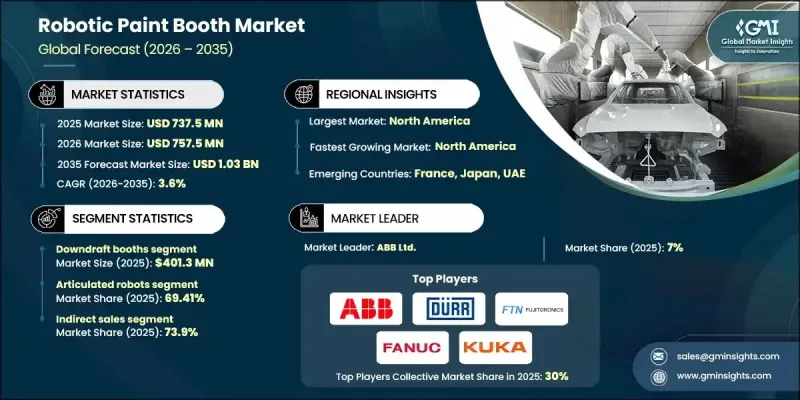
對客製化產品日益成長的需求以及向高通量、彈性製造的轉變,促使生產設施優先考慮精度、塗層品質的一致性和生產週期的最佳化。隨著製造商不斷擴展和升級其營運,以應對更廣泛的色域、特殊的表面處理流程和更短的生產週期,對自動化噴塗系統的需求也迅速成長。機器人噴塗室正成為保持塗層性能均勻性和應對日益複雜的生產流程的關鍵。智慧輸送系統、整合視覺技術和先進的回饋控制系統的應用,使得噴塗環境的自動化進程正在加速,這些技術能夠即時監控和調整塗層參數。這些創新有助於企業提高物料輸送效率、減少材料浪費,並透過限制工人直接接觸揮發性有機化合物來提升安全性。智慧製造的持續發展正在推動機器人平台的應用,以確保可重複性、精確度和符合環保要求。
| 市場範圍 | |
|---|---|
| 起始年份 | 2025 |
| 預測年份 | 2026-2035 |
| 起始值 | 7.375億美元 |
| 預測值 | 10.3億美元 |
| 複合年成長率 | 3.6% |
預計到2025年,下吸式噴漆房市場規模將達到4.013億美元,憑藉其垂直氣流設計,最大限度地減少過噴和污染,仍將保持領先地位。其可控的氣流,結合過濾式頂棚和專用排氣系統,透過在整個塗裝週期內保持穩定的氣流模式,確保了塗裝品質的一致性。
到2025年,關節型機器人市佔率將達到69.41%,並繼續保持其主導機器人類型的地位。這類機器人具有高度靈活性,可進行多軸運動,專為在複雜且不規則的表面上執行精確、可重複的任務而設計。其伺服驅動機構和專用控制器使其能夠在長時間執行高要求的塗裝作業的同時,保持最佳性能。
預計到2025年,美國機器人噴漆房市場將佔據83%的佔有率,市場規模將達到2.258億美元。對更高性能塗裝的強勁需求,以及汽車、航太和一般製造業等產業對先進塗裝技術的需求,持續推動市場成長。隨著企業優先考慮材料節約、環境、社會和治理(ESG)合規以及減少與嚴格的揮發性有機化合物(VOC)法規相關的排放,多軸機器人噴塗系統的應用正在不斷擴展。
目錄
第1章:方法論與範圍
第2章:執行概要
第3章:行業洞察
- 產業生態系分析
- 供應商格局
- 利潤率
- 每個階段的價值增加
- 影響價值鏈的因素
- 產業影響因素
- 成長促進因素
- 擴大客製化和電動車製造
- 工業4.0和數位孿生技術的應用
- 全球都在推動減少揮發性有機化合物(VOC)排放和ESG合規性
- 產業陷阱與挑戰
- 高額前期資本投入
- 系統整合和編程的複雜性
- 機會
- 高效永續的應用技術
- 人工智慧驅動的路徑規劃和視覺系統成長潛力分析
- 成長促進因素
- 未來市場趨勢
- 技術與創新格局
- 當前技術趨勢
- 新興技術
- 價格趨勢
- 按地區
- 按類型
- 監管環境
- 標準和合規要求
- 區域監理框架
- 認證標準
- 波特的分析
- PESTEL 分析
第4章:競爭格局
- 介紹
- 公司市佔率分析
- 按地區
- 公司矩陣分析
- 主要市場參與者的競爭分析
- 競爭定位矩陣
- 關鍵進展
- 併購
- 合作夥伴關係與合作
- 新產品發布
- 擴張計劃
第5章:市場估算與預測:依產品分類,2022-2035年
- 下吸式展位
- 側吸式起居室
- 交叉氣流展位
- 其他
第6章:市場估算與預測:依機器人類型分類,2022-2035年
- 關節機器人
- 笛卡兒機器人
第7章:市場估計與預測:依營運方式分類,2022-2035年
- 自動噴漆室
- 半自動噴漆房
第8章:市場估算與預測:依應用領域分類,2022-2035年
- 汽車
- 航太與國防
- 家具
- 電子
- 其他
第9章:市場估算與預測:依配銷通路分類,2022-2035年
- 直銷
- 間接銷售
第10章:市場估計與預測:依地區分類,2022-2035年
- 北美洲
- 美國
- 加拿大
- 歐洲
- 德國
- 英國
- 法國
- 義大利
- 西班牙
- 亞太地區
- 中國
- 日本
- 印度
- 澳洲
- 韓國
- 拉丁美洲
- 巴西
- 墨西哥
- 阿根廷
- 中東和非洲
- 南非
- 沙烏地阿拉伯
- 阿拉伯聯合大公國
第11章:公司簡介
- ABB Ltd.
- Blowtherm
- Durr Group
- Effort Intelligence Equipment Co. Ltd.
- Eisenmann SE
- Fanuc Corporation
- Fujitoronics-RSA
- GIFFIN
- Kawasaki Heavy Industry Co. Ltd.
- KUKA AG
- Robotic Paint Group Ltd.
- SAIMA Meccanica SpA
- Staubli International AG
- TKS Industrial Company
- Yaskawa Electric Corporation
The Global Robotic Paint Booth Market was valued at USD 737.5 million in 2025 and is estimated to grow at a CAGR of 3.6% to reach USD 1.03 billion by 2035.
Rising demand for customized products and the shift toward high-throughput, flexible manufacturing have pushed production facilities to prioritize accuracy, consistent coating quality, and cycle-time optimization. As manufacturers continue expanding and upgrading their operations to handle broader color palettes, specialized finishes, and shorter production timelines, the need for automated painting systems is rapidly increasing. Robotic paint booths are becoming essential for maintaining uniform coating performance and managing growing production complexity. Automation in painting environments is accelerating with the use of intelligent conveyor systems, integrated vision technology, and advanced feedback controls to monitor and adjust coating parameters in real time. These innovations help companies improve transfer efficiency, reduce material waste, and enhance worker safety by limiting direct exposure to volatile organic compounds. The ongoing push toward smart manufacturing is reinforcing the adoption of robotic platforms that ensure repeatability, precision, and compliance with environmental requirements.
| Market Scope | |
|---|---|
| Start Year | 2025 |
| Forecast Year | 2026-2035 |
| Start Value | $737.5 Million |
| Forecast Value | $1.03 Billion |
| CAGR | 3.6% |
The downdraft booths segment generated USD 401.3 million in 2025, remaining the leading configuration due to their vertical airflow design that minimizes overspray and contamination. Their controlled air movement, combined with filtered ceilings and specialized exhaust systems, supports consistent finish quality by maintaining stable airflow patterns throughout the coating cycle.
The articulated robots segment accounted for 69.41% share in 2025, maintaining its position as the dominant robotic type. These robots offer high flexibility with multiple axes of movement and are engineered for precise, repeatable tasks across detailed and irregular surfaces. Their servo-driven mechanisms and specialized controllers allow them to perform demanding coating operations for extended periods while sustaining optimal performance.
U.S. Robotic Paint Booth Market held 83% share in 2025, generating USD 225.8 million. Strong interest in enhanced finishing capabilities, combined with demand for sophisticated coating technologies in sectors such as automotive, aerospace, and general manufacturing, continues to accelerate growth. Adoption of multi-axis robotic painting systems is expanding as organizations prioritize material savings, ESG compliance, and reduced emissions linked to strict VOC regulations.
Key participants in the Global Robotic Paint Booth Market include ABB Ltd., Durr Group, Eisenmann SE, KUKA AG, Kawasaki Heavy Industry Co. Ltd., Fanuc Corporation, Yaskawa Electric Corporation, GIFFIN, Staubli International AG, TKS Industrial Company, Blowtherm, SAIMA Meccanica S.p.A., Effort Intelligence Equipment Co. Ltd., Robotic Paint Group Ltd., and Fujitoronics-RSA. Companies in the Robotic Paint Booth Market rely on a mix of innovation, partnerships, and customer-focused strategies to expand their competitive presence. Many firms are advancing their robotic platforms with smarter control systems, energy-efficient components, and enhanced integration capabilities to support next-generation automated plants. Collaboration with coating material suppliers, automation integrators, and OEM manufacturers helps streamline system compatibility and accelerate deployment. Businesses are also expanding global service networks to provide rapid maintenance, training, and lifecycle support, ensuring reliable long-term performance for end users. Additionally, companies are strengthening their portfolios with customizable booth designs and modular robotic systems that address varied production needs. Investments in R&D, along with digital tools for predictive monitoring and process optimization, further reinforce their market foothold.
Table of Contents
Chapter 1 Methodology and Scope
- 1.1 Market scope and definition
- 1.2 Research design
- 1.2.1 Research approach
- 1.2.2 Data collection methods
- 1.3 Data mining sources
- 1.3.1 Global
- 1.3.2 Regional/Country
- 1.4 Base estimates and calculations
- 1.4.1 Base year calculation
- 1.4.2 Key trends for market estimation
- 1.5 Primary research and validation
- 1.5.1 Primary sources
- 1.6 Forecast model
- 1.7 Research assumptions and limitations
Chapter 2 Executive Summary
- 2.1 Industry 3600 synopsis
- 2.2 Key market trends
- 2.2.1 Regional
- 2.2.2 Product
- 2.2.3 Robot type
- 2.2.4 Operation
- 2.2.5 Application
- 2.2.6 Distribution channel
- 2.2.7 CXO perspectives: Strategic imperatives
- 2.2.8 Key decision points for industry executives
- 2.2.9 Critical success factors for market players
- 2.3 Future outlook and strategic recommendations
Chapter 3 Industry Insights
- 3.1 Industry ecosystem analysis
- 3.1.1 Supplier landscape
- 3.1.2 Profit margin
- 3.1.3 Value addition at each stage
- 3.1.4 Factor affecting the value chain
- 3.2 Industry impact forces
- 3.2.1 Growth drivers
- 3.2.1.1 Expansion of customization & EV manufacturing
- 3.2.1.2 Adoption of Industry 4.0 & digital twins
- 3.2.1.3 Global push for VOC reduction & ESG compliance
- 3.2.2 Industry pitfalls & challenges
- 3.2.2.1 High upfront capital investment
- 3.2.2.2 Complexity of system integration & programming
- 3.2.3 Opportunities
- 3.2.3.1 High-efficiency & sustainable application technology
- 3.2.3.2 AI-driven path planning & vision systems growth potential analysis
- 3.2.1 Growth drivers
- 3.3 Future market trends
- 3.4 Technology and innovation landscape
- 3.4.1 Current technological trends
- 3.4.2 Emerging technologies
- 3.5 Price trends
- 3.5.1 By region
- 3.5.2 By type
- 3.6 Regulatory landscape
- 3.6.1 Standards and compliance requirements
- 3.6.2 Regional regulatory frameworks
- 3.6.3 Certification standards
- 3.7 Porter's analysis
- 3.8 PESTEL analysis
Chapter 4 Competitive Landscape, 2024
- 4.1 Introduction
- 4.2 Company market share analysis
- 4.2.1 By region
- 4.2.1.1 North America
- 4.2.1.2 Europe
- 4.2.1.3 Asia Pacific
- 4.2.1.4 Latin America
- 4.2.1.5 Middle East and Africa
- 4.2.1 By region
- 4.3 Company matrix analysis
- 4.4 Competitive analysis of major market players
- 4.5 Competitive positioning matrix
- 4.6 Key developments
- 4.6.1 Mergers & acquisitions
- 4.6.2 Partnerships & collaborations
- 4.6.3 New product launches
- 4.6.4 Expansion plans
Chapter 5 Market Estimates and Forecast, By Product, 2022 - 2035 (USD Million) (Thousand Units)
- 5.1 Key trends
- 5.2 Downdraft booth
- 5.3 Sidedraft booth
- 5.4 Crossdraft booth
- 5.5 Others
Chapter 6 Market Estimates and Forecast, By Robot Type, 2022 - 2035 (USD Million) (Thousand Units)
- 6.1 Key trends
- 6.2 Articulated robots
- 6.3 Cartesian robots
Chapter 7 Market Estimates and Forecast, By Operation, 2022 - 2035 (USD Million) (Thousand Units)
- 7.1 Key trends
- 7.2 Automatic paint booth
- 7.3 Semi-automatic paint booth
Chapter 8 Market Estimates and Forecast, By Application, 2022 - 2035 (USD Million) (Thousand Units)
- 8.1 Key trends
- 8.2 Automotive
- 8.3 Aerospace & defense
- 8.4 Furniture
- 8.5 Electronics
- 8.6 Others
Chapter 9 Market Estimates and Forecast, By Distribution Channel, 2022 - 2035 (USD Million) (Thousand Units)
- 9.1 Key trends
- 9.2 Direct sales
- 9.3 Indirect sales
Chapter 10 Market Estimates and Forecast, By Region, 2022 - 2035 (USD Million) (Thousand Units)
- 10.1 Key trends
- 10.2 North America
- 10.2.1 U.S.
- 10.2.2 Canada
- 10.3 Europe
- 10.3.1 Germany
- 10.3.2 UK
- 10.3.3 France
- 10.3.4 Italy
- 10.3.5 Spain
- 10.4 Asia Pacific
- 10.4.1 China
- 10.4.2 Japan
- 10.4.3 India
- 10.4.4 Australia
- 10.4.5 South Korea
- 10.5 Latin America
- 10.5.1 Brazil
- 10.5.2 Mexico
- 10.5.3 Argentina
- 10.6 Middle East and Africa
- 10.6.1 South Africa
- 10.6.2 Saudi Arabia
- 10.6.3 UAE
Chapter 11 Company Profiles
- 11.1 ABB Ltd.
- 11.2 Blowtherm
- 11.3 Durr Group
- 11.4 Effort Intelligence Equipment Co. Ltd.
- 11.5 Eisenmann SE
- 11.6 Fanuc Corporation
- 11.7 Fujitoronics-RSA
- 11.8 GIFFIN
- 11.9 Kawasaki Heavy Industry Co. Ltd.
- 11.10 KUKA AG
- 11.11 Robotic Paint Group Ltd.
- 11.12 SAIMA Meccanica S.p.A.
- 11.13 Staubli International AG
- 11.14 TKS Industrial Company
- 11.15 Yaskawa Electric Corporation

 機器人噴漆房市場:按類型、塗料類型、自動化程度和應用分類 - 全球市場預測 2026-2032
 機器人噴漆房市場報告:按類型、產品類型、組件、分銷、應用和地區分類(2026-2034 年)噴漆房市場:按類型、技術、塗料類型、氣流配置和終端用戶產業分類-2026-2032年全球預測工業噴漆房市場:依噴漆房類型、過濾器類型、操作模式、噴塗系統和最終用途產業分類-2026-2032年全球預測
 機器人噴漆房市場 - 全球產業規模、佔有率、趨勢、機會、預測:按類型、應用、最終用戶、地區和競爭對手分類,2021-2031年
 機器人噴漆房市場規模、佔有率、成長及全球產業分析:依類型、應用和地區劃分的洞察與預測(2026-2034)
 機器人噴漆房市場規模、佔有率和成長分析(按組件、類型、產品類型、分銷、應用和地區分類)—產業預測(2026-2033 年)
 全球機器人噴漆房市場 2024-2031
 2024-2028年全球機器人噴漆房市場