


 |
市場調查報告書
商品編碼
1892835
芳綸纖維市場機會、成長促進因素、產業趨勢分析及預測(2026-2035年)Aramid Fiber Market Opportunity, Growth Drivers, Industry Trend Analysis, and Forecast 2026 - 2035 |
||||||

2025年全球芳綸纖維市場價值為45億美元,預計2035年將以4.8%的複合年成長率成長至71億美元。
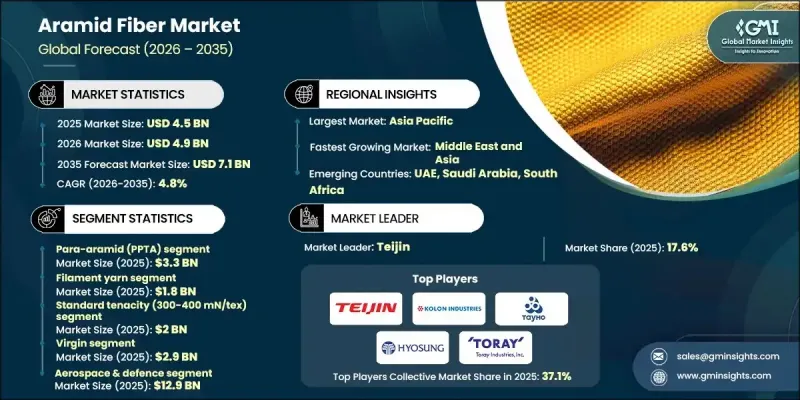
芳綸纖維是一種高性能合成纖維,以其卓越的強度、熱穩定性以及耐磨性和耐熱性而聞名。這些纖維廣泛應用於航太、軍事、個人防護裝備和工業製造等領域,在這些領域,耐用性和安全性至關重要。芳綸纖維分為對位芳綸(PPTA)和間位芳綸(PMIA),每種都有獨特的性能,可滿足特定的工業需求。近年來,聚合物化學和纖維紡絲技術的進步提高了纖維的強度,同時降低了斷裂伸長率,從而獲得了強度更高、用途更廣的材料。此外,回收技術的創新使得生產環保芳綸纖維成為可能,從而解決了永續發展問題。奈米複合材料和混合材料等新興技術進一步拓展了芳綸纖維在輕型裝甲、航太和高性能工業產品等領域的應用,使其成為全球先進製造業不可或缺的材料。
| 市場範圍 | |
|---|---|
| 起始年份 | 2025 |
| 預測年份 | 2026-2035 |
| 起始值 | 45億美元 |
| 預測值 | 71億美元 |
| 複合年成長率 | 4.8% |
2025年,對位芳綸(PPTA)市場規模預計將達到33億美元,這主要得益於其輕質高強的特性在防護裝備、汽車零件和工業增強材料領域的應用需求。纖維加工和複合材料整合技術的不斷進步,正推動其在多個行業的應用範圍不斷擴大。
預計到2025年,長絲紗線市場規模將達18億美元。其持續的強度和均勻性使其成為繩索、電纜和產業用紡織品的理想材料;而短纖維則廣泛應用於非織造布和防護服,具有柔韌性好、易於加工的特點。市場對輕質高性能紡織品日益成長的關注,持續推動上述各類產品的需求成長。
2025年,美國芳綸纖維市場規模預計將達到8.5億美元,這主要得益於強勁的國防開支、先進的航太製造業以及軍用裝備和工業安全應用領域對材料的高需求。北美地區由於對高性能纖維應用的持續投資,仍然是其關鍵市場。
目錄
第1章:方法論與範圍
第2章:執行概要
第3章:行業洞察
- 產業生態系分析
- 供應商格局
- 利潤率
- 每個階段的價值增加
- 影響價值鏈的因素
- 中斷
- 產業影響因素
- 成長促進因素
- 航太和國防領域的需求不斷成長
- 個人防護裝備的需求不斷成長
- 技術進步
- 產業陷阱與挑戰
- 高昂的生產成本
- 來自替代纖維的競爭
- 市場機遇
- 拓展再生能源業務
- 先進複合材料
- 汽車輕量化趨勢
- 成長促進因素
- 成長潛力分析
- 監管環境
- 北美洲
- 歐洲
- 亞太地區
- 拉丁美洲
- 中東和非洲
- 波特的分析
- PESTEL 分析
- 技術與創新格局
- 當前技術趨勢
- 新興技術
- 價格趨勢
- 按地區
- 依產品類型
- 未來市場趨勢
- 技術與創新格局
- 當前技術趨勢
- 新興技術
- 專利格局
- 貿易統計(HS編碼)(註:僅提供重點國家的貿易統計資料)
- 主要進口國
- 主要出口國
- 永續性和環境方面
- 永續實踐
- 減少廢棄物策略
- 生產中的能源效率
- 環保舉措
- 碳足跡考量
第4章:競爭格局
- 介紹
- 公司市佔率分析
- 按地區
- 北美洲
- 歐洲
- 亞太地區
- 拉丁美洲
- MEA
- 按地區
- 公司矩陣分析
- 主要市場參與者的競爭分析
- 競爭定位矩陣
- 關鍵進展
- 併購
- 合作夥伴關係與合作
- 新產品發布
- 擴張計劃
第5章:市場估算與預測:依產品類型分類,2022-2035年
- 對位芳綸(PPTA)
- 間位芳綸(PMIA)
- 共聚醯亞胺
第6章:市場估算與預測:以實物形式分類,2022-2035年
- 長絲
- 短纖維
- 紡紗
- 混紡纖維
第7章:市場估算與預測:依性能等級分類,2022-2035年
- 標準韌性(300-400 mN/tex)
- 高韌性(400-500+ mN/tex)
第8章:市場估算與預測:依來源分類,2022-2035年
- 原生芳綸纖維
- 再生芳綸纖維
第9章:市場估算與預測:依最終用途產業分類,2022-2035年
- 航太與國防
- 汽車
- 石油和天然氣
- 再生能源
- 電信
- 建造
- 海洋與造船
- 個人防護裝備
- 工業製造
- 其他
第10章:市場估計與預測:依地區分類,2022-2035年
- 北美洲
- 美國
- 加拿大
- 墨西哥
- 歐洲
- 德國
- 英國
- 法國
- 西班牙
- 義大利
- 歐洲其他地區
- 亞太地區
- 中國
- 印度
- 日本
- 澳洲
- 韓國
- 亞太其他地區
- 拉丁美洲
- 巴西
- 墨西哥
- 阿根廷
- 拉丁美洲其他地區
- 中東和非洲
- 沙烏地阿拉伯
- 南非
- 阿拉伯聯合大公國
- 中東和非洲其他地區
第11章:公司簡介
- Aramid HPM SL
- Beijing Landingji Engineering Tech Co. Ltd.
- China National Bluestar (Group) Co. Ltd.
- Guangdong Charming Chemical Co. Ltd.
- Henan Longsheng New Material Technology Co. Ltd.
- Huvis Corporation
- Hyosung Advanced Materials
- Jiangsu Shino New Materials Technology Co. Ltd.
- Jiaxing Newtex Composites Co. Ltd.
- Kermel
- Kolon Industries Inc.
- Ningxia Eppen Biotech Co. Ltd.
- SRO Aramid
- Sinopec Yizheng Chemical Fibre Co. Ltd.
- Taekwang Industrial Co. Ltd.
- Teijin Aramid BV
- Toray Industries Inc.
- X-FIPER New Material Co. Ltd.
- Yantai Tayho Advanced Materials Co. Ltd.
The Global Aramid Fiber Market was valued at USD 4.5 billion in 2025 and is estimated to grow at a CAGR of 4.8% to reach USD 7.1 billion by 2035.
Aramid fibers are high-performance synthetic fibers known for their exceptional strength, thermal stability, and resistance to abrasion and heat. These fibers are widely used in aerospace, military applications, personal protective equipment, and industrial manufacturing, where durability and safety are critical. Aramid fibers are divided into para-aramid (PPTA) and meta-aramid (PMIA), each offering unique properties tailored to specific industrial needs. Recent advancements in polymer chemistry and fiber spinning technologies have enhanced fiber tenacity while reducing elongation, resulting in stronger and more versatile materials. Additionally, innovations in recycling have allowed the production of eco-friendly aramid fibers, addressing sustainability concerns. Emerging technologies such as nanocomposites and hybrid materials are further expanding applications in lightweight armor, aerospace, and high-performance industrial products, making aramid fibers an essential material in advanced manufacturing sectors globally.
| Market Scope | |
|---|---|
| Start Year | 2025 |
| Forecast Year | 2026-2035 |
| Start Value | $4.5 Billion |
| Forecast Value | $7.1 Billion |
| CAGR | 4.8% |
The para-aramid (PPTA) segment generated USD 3.3 billion in 2025, driven by demand for its lightweight, high-strength properties in protective gear, automotive components, and industrial reinforcements. The continuous improvements in fiber processing and composite integration are increasing its applicability across multiple industries.
The filament yarn segment reached USD 1.8 billion in 2025. Its continuous strength and uniformity make it ideal for ropes, cables, and technical textiles, while staple fibers are widely used in nonwoven fabrics and protective wear, offering flexibility and ease of manufacture. The growing focus on lightweight, high-performance textiles continues to sustain demand across these forms.
U.S. Aramid Fiber Market accounted for USD 850 million in 2025, supported by strong defense spending, advanced aerospace manufacturing, and high demand for materials used in military gear and industrial safety applications. North America remains a key market due to consistent investment in high-performance fiber applications.
Key players in the Global Aramid Fiber Market include Teijin Aramid B.V., Toray Industries Inc., Kolon Industries Inc., Huvis Corporation, Aramid HPM S.L., SRO Aramid, Hyosung Advanced Materials, X-FIPER New Material Co. Ltd., Jiangsu Shino New Materials Technology Co. Ltd., Beijing Landingji Engineering Tech Co. Ltd., Guangdong Charming Chemical Co. Ltd., Henan Longsheng New Material Technology Co. Ltd., Jiaxing Newtex Composites Co. Ltd., Kermel, Ningxia Eppen Biotech Co. Ltd., Sinopec Yizheng Chemical Fibre Co. Ltd., China National Bluestar (Group) Co. Ltd., and Taekwang Industrial Co. Ltd. Companies in the Aramid Fiber Market are strengthening their presence by investing in research and development to enhance fiber performance, durability, and thermal stability. Strategic partnerships with defense, aerospace, and industrial clients enable adoption in high-value applications. Firms are also expanding production capacities, optimizing manufacturing processes, and integrating recycling technologies to address sustainability.
Table of Contents
Chapter 1 Methodology & Scope
- 1.1 Market scope and definition
- 1.2 Research design
- 1.2.1 Research approach
- 1.2.2 Data collection methods
- 1.3 Data mining sources
- 1.3.1 Global
- 1.3.2 Regional/Country
- 1.4 Base estimates and calculations
- 1.4.1 Base year calculation
- 1.4.2 Key trends for market estimation
- 1.5 Primary research and validation
- 1.5.1 Primary sources
- 1.6 Forecast model
- 1.7 Research assumptions and limitations
Chapter 2 Executive Summary
- 2.1 Industry 360° synopsis
- 2.2 Key market trends
- 2.2.1 Product Type
- 2.2.2 Physical Form
- 2.2.3 Performance grade
- 2.2.4 Source
- 2.2.5 End use Industry
- 2.2.6 Regional
- 2.3 TAM Analysis, 2025-2035
- 2.4 CXO perspectives: Strategic imperatives
- 2.4.1 Executive decision points
- 2.4.2 Critical success factors
- 2.5 Future outlook and strategic recommendations
Chapter 3 Industry Insights
- 3.1 Industry ecosystem analysis
- 3.1.1 Supplier landscape
- 3.1.2 Profit margin
- 3.1.3 Value addition at each stage
- 3.1.4 Factor affecting the value chain
- 3.1.5 Disruptions
- 3.2 Industry impact forces
- 3.2.1 Growth drivers
- 3.2.1.1 Increasing demand in aerospace & defence
- 3.2.1.2 Rising need for personal protective equipment
- 3.2.1.3 Technological advancements
- 3.2.2 Industry pitfalls and challenges
- 3.2.2.1 High production costs
- 3.2.2.2 Competition from alternative fibers
- 3.2.3 Market opportunities
- 3.2.3.1 Expansion into renewable energy
- 3.2.3.2 Advanced composite materials
- 3.2.3.3 Automotive lightweighting trends
- 3.2.1 Growth drivers
- 3.3 Growth potential analysis
- 3.4 Regulatory landscape
- 3.4.1 North America
- 3.4.2 Europe
- 3.4.3 Asia Pacific
- 3.4.4 Latin America
- 3.4.5 Middle East & Africa
- 3.5 Porter's analysis
- 3.6 PESTEL analysis
- 3.7 Technology and innovation landscape
- 3.7.1 Current technological trends
- 3.7.2 Emerging technologies
- 3.8 Price trends
- 3.8.1 By region
- 3.8.2 By product type
- 3.9 Future market trends
- 3.10 Technology and innovation landscape
- 3.10.1 Current technological trends
- 3.10.2 Emerging technologies
- 3.11 Patent landscape
- 3.12 Trade statistics (HS code)( Note: the trade statistics will be provided for key countries only)
- 3.12.1 Major importing countries
- 3.12.2 Major exporting countries
- 3.13 Sustainability and environmental aspects
- 3.13.1 Sustainable practices
- 3.13.2 Waste reduction strategies
- 3.13.3 Energy efficiency in production
- 3.13.4 Eco-friendly initiatives
- 3.14 Carbon footprint consideration
Chapter 4 Competitive Landscape, 2025
- 4.1 Introduction
- 4.2 Company market share analysis
- 4.2.1 By region
- 4.2.1.1 North America
- 4.2.1.2 Europe
- 4.2.1.3 Asia Pacific
- 4.2.1.4 LATAM
- 4.2.1.5 MEA
- 4.2.1 By region
- 4.3 Company matrix analysis
- 4.4 Competitive analysis of major market players
- 4.5 Competitive positioning matrix
- 4.6 Key developments
- 4.6.1 Mergers & acquisitions
- 4.6.2 Partnerships & collaborations
- 4.6.3 New product launches
- 4.6.4 Expansion plans
Chapter 5 Market Estimates and Forecast, By Product Type, 2022-2035 (USD Billion) (Kilo Tons)
- 5.1 Key trends
- 5.2 Para-aramid (PPTA)
- 5.3 Meta-aramid (PMIA)
- 5.4 Copolyimide
Chapter 6 Market Estimates and Forecast, By Physical Form, 2022-2035 (USD Billion) (Kilo Tons)
- 6.1 Key trends
- 6.2 Filament yarn
- 6.3 Staple fiber
- 6.4 Spun yarn
- 6.5 Blended fibers
Chapter 7 Market Estimates and Forecast, By Performance Grade, 2022-2035 (USD Billion) (Kilo Tons)
- 7.1 Key trends
- 7.2 Standard tenacity (300-400 mN/tex)
- 7.3 High tenacity (400-500+ mN/tex)
Chapter 8 Market Estimates and Forecast, By Source, 2022-2035 (USD Billion) (Kilo Tons)
- 8.1 Key trends
- 8.2 Virgin aramid fiber
- 8.3 Recycled aramid fiber
Chapter 9 Market Estimates and Forecast, By End Use Industry, 2022-2035 (USD Billion) (Kilo Tons)
- 9.1 Key trends
- 9.2 Aerospace & defense
- 9.3 Automotive
- 9.4 Oil & gas
- 9.5 Renewable energy
- 9.6 Telecommunications
- 9.7 Construction
- 9.8 Marine & shipbuilding
- 9.9 Personal protection equipment
- 9.10 Industrial manufacturing
- 9.11 Others
Chapter 10 Market Estimates and Forecast, By Region, 2022-2035 (USD Billion) (Kilo Tons)
- 10.1 Key trends
- 10.2 North America
- 10.2.1 U.S.
- 10.2.2 Canada
- 10.2.3 Mexico
- 10.3 Europe
- 10.3.1 Germany
- 10.3.2 UK
- 10.3.3 France
- 10.3.4 Spain
- 10.3.5 Italy
- 10.3.6 Rest of Europe
- 10.4 Asia Pacific
- 10.4.1 China
- 10.4.2 India
- 10.4.3 Japan
- 10.4.4 Australia
- 10.4.5 South Korea
- 10.4.6 Rest of Asia Pacific
- 10.5 Latin America
- 10.5.1 Brazil
- 10.5.2 Mexico
- 10.5.3 Argentina
- 10.5.4 Rest of Latin America
- 10.6 Middle East and Africa
- 10.6.1 Saudi Arabia
- 10.6.2 South Africa
- 10.6.3 UAE
- 10.6.4 Rest of Middle East and Africa
Chapter 11 Company Profiles
- 11.1 Aramid HPM S.L
- 11.2 Beijing Landingji Engineering Tech Co. Ltd.
- 11.3 China National Bluestar (Group) Co. Ltd.
- 11.4 Guangdong Charming Chemical Co. Ltd.
- 11.5 Henan Longsheng New Material Technology Co. Ltd.
- 11.6 Huvis Corporation
- 11.7 Hyosung Advanced Materials
- 11.8 Jiangsu Shino New Materials Technology Co. Ltd.
- 11.9 Jiaxing Newtex Composites Co. Ltd.
- 11.10 Kermel
- 11.11 Kolon Industries Inc.
- 11.12 Ningxia Eppen Biotech Co. Ltd.
- 11.13 SRO Aramid
- 11.14 Sinopec Yizheng Chemical Fibre Co. Ltd.
- 11.15 Taekwang Industrial Co. Ltd.
- 11.16 Teijin Aramid B.V.
- 11.17 Toray Industries Inc.
- 11.18 X-FIPER New Material Co. Ltd.
- 11.19 Yantai Tayho Advanced Materials Co. Ltd.

 間位芳香聚醯胺纖維市場:依產品類型、終端用途產業及應用分類-2026-2032年全球市場預測
 2026-2030全球醯胺纖維市場
 全球醯胺纖維市場規模、佔有率、趨勢和成長分析報告(2026-2034年)
 2026全球醯胺纖維市場報告
 醯胺纖維市場-全球產業規模、佔有率、趨勢、機會、預測:按類型、應用、區域和競爭格局分類,2021-2031年防切割纖維市場:依纖維類型、應用、終端用戶產業和銷售管道-全球預測,2026-2032年
 醯胺纖維市場規模、佔有率和趨勢分析報告:按產品、應用、地區和細分市場預測(2026-2033 年)
 間位芳香聚醯胺纖維市場規模、佔有率和成長分析(按等級、應用、纖維類型、終端用戶產業和地區分類)-2026-2033年產業預測
 全球芳綸纖維市場(至 2035 年):依產品、生產流程、形態、銷售通路、環境因素、應用領域、最終用戶、公司、主要地區、產業趨勢及預測
 橡膠輸送帶用醯胺纖維:全球市佔率及排名、總收入及需求預測(2025-2031年)