


 |
市場調查報告書
商品編碼
1892832
收割機市場機會、成長促進因素、產業趨勢分析及預測(2026-2035年)Harvester Market Opportunity, Growth Drivers, Industry Trend Analysis, and Forecast 2026 - 2035 |
||||||

2025 年全球收割機市場價值為 412 億美元,預計到 2035 年將以 7.5% 的複合年成長率成長至 846 億美元。
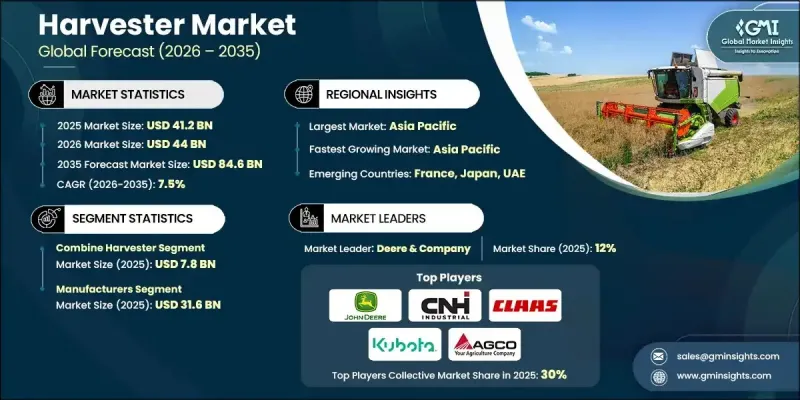
人們日益關注永續農業實踐,這推動了配備節能引擎和低排放技術的環保收割機的普及。包括精準農業工具和智慧收割系統在內的持續技術進步,正在提升生產力、燃油效率和作業效率。製造商正積極推出新型號,以滿足現代農業不斷變化的需求,而全球糧食需求的成長正在重塑現代農業。大型商業農場和合約農業供應商正在投資高產能機械,以確保快速且有效率的收割,減少因天氣變化造成的損失,並維持主糧作物的品質。創新、技術整合以及對新鮮農產品日益成長的需求,共同推動全球市場的擴張。
| 市場範圍 | |
|---|---|
| 起始年份 | 2025 |
| 預測年份 | 2026-2035 |
| 起始值 | 412億美元 |
| 預測值 | 846億美元 |
| 複合年成長率 | 7.5% |
2025年,聯合收割機市場規模預計將達78億美元。聯合收割機仍然是商業糧食生產中最有價值、最不可或缺的機械,能夠在一次作業中完成收割、脫粒和揚穀。其高效快速的特性使大型農場能夠迅速完成收割,最大限度地降低天氣風險,並保持最佳的糧食品質。
到 2025 年,製造商部門的規模將達到 316 億美元。製造商對定價、售後支援和專有精準農業技術的整合保持著強大的控制力,從而培養品牌忠誠度,提供融資方案,並為複雜的大馬力機器提供專業的操作員培訓。
預計到2025年,亞太地區收割機市佔率將達到36.9%。該地區的成長得益於快速的機械化進程、政府對小型機械的補貼以及對高效收割主要糧食作物的需求。中國、印度和日本等國正在投資現代化農業設備,包括履帶式聯合收割機、小型動力耕耘機和先進的電動機械,這些投資也得到了政府旨在推動農業現代化的各項舉措的支持。
目錄
第1章:方法論與範圍
第2章:執行概要
第3章:行業洞察
- 產業生態系分析
- 供應商格局
- 利潤率
- 每個階段的價值增加
- 影響價值鏈的因素
- 產業影響因素
- 成長促進因素
- 電子商務拓展與倉儲自動化
- 全球人口成長與糧食需求
- 勞動成本上升和勞動短缺
- 精準農業(農業4.0)的進展
- 產業陷阱與挑戰
- 初始投資成本高
- 缺乏熟練的操作人員/技術人員
- 機會
- 租賃模式的拓展
- 特種/電動能量採集器的開發
- 成長促進因素
- 成長潛力分析
- 未來市場趨勢
- 技術與創新格局
- 當前技術趨勢
- 新興技術
- 價格趨勢
- 按地區
- 按類型
- 監管環境
- 標準和合規要求
- 區域監理框架
- 認證標準
- 波特的分析
- PESTEL 分析
第4章:競爭格局
- 介紹
- 公司市佔率分析
- 按地區
- 公司矩陣分析
- 主要市場參與者的競爭分析
- 競爭定位矩陣
- 關鍵進展
- 併購
- 合作夥伴關係與合作
- 新產品發布
- 擴張計劃
第5章:市場估算與預測:依類型分類,2022-2035年
- 聯合收割機
- 飼料收割機
- 拖曳式青貯收割機
- 自走式青貯飼料收割機
- 拖曳式青貯收割機
- 懸掛式青貯收割機
- 懸掛式青貯收割機
- 甜菜收割機
- 馬鈴薯收割機
- 釀酒葡萄收割機
- 牧草收割機
- 市政割草機
第6章:市場估算與預測:依銷售管道分類,2022-2035年
- 製造商
- 經銷商
第7章:市場估計與預測:依地區分類,2022-2035年
- 北美洲
- 美國
- 加拿大
- 歐洲
- 德國
- 英國
- 法國
- 義大利
- 西班牙
- 亞太地區
- 中國
- 日本
- 印度
- 澳洲
- 韓國
- 拉丁美洲
- 巴西
- 墨西哥
- 阿根廷
- 中東和非洲
- 南非
- 沙烏地阿拉伯
- 阿拉伯聯合大公國
第8章:公司簡介
- Anhui Heli
- BYD Company
- Clark Material Handling Company
- Combilift
- Crown Equipment
- Doosan Corporation Industrial Vehicle
- Hangcha Group
- Hyster-Yale Materials Handling
- Hyundai Heavy Industries
- Jungheinrich AG
- KION Group AG
- Komatsu
- Manitou Group
- Mitsubishi Logisnext
- Toyota Industries
The Global Harvester Market was valued at USD 41.2 billion in 2025 and is estimated to grow at a CAGR of 7.5% to reach USD 84.6 billion by 2035.
The increasing focus on sustainable farming practices is driving the adoption of eco-friendly harvesters with energy-efficient engines and low-emission technologies. Continuous technological advancements, including precision agriculture tools and smart harvesting systems, are enhancing productivity, fuel efficiency, and operational effectiveness. Manufacturers are actively launching new models to meet the evolving needs of modern agriculture, which is being reshaped by rising global food demand. Large-scale commercial farms and contract farming providers are investing in high-capacity machines to ensure rapid and efficient harvesting, reducing losses caused by unpredictable weather and maintaining the quality of staple crops. This combination of innovation, technological integration, and growing demand for fresh produce is propelling market expansion globally.
| Market Scope | |
|---|---|
| Start Year | 2025 |
| Forecast Year | 2026-2035 |
| Start Value | $41.2 Billion |
| Forecast Value | $84.6 Billion |
| CAGR | 7.5% |
In 2025, the combine harvesters segment generated USD 7.8 billion. Combine harvesters remain the most valuable and essential machinery for commercial grain production, capable of reaping, threshing, and winnowing crops in a single operation. Their efficiency and speed allow large farms to complete harvests promptly, minimizing weather-related risks and maintaining optimal grain quality.
The manufacturers segment reached USD 31.6 billion in 2025. Manufacturers maintain strong control over pricing, after-sales support, and the integration of proprietary precision farming technologies, fostering brand loyalty, providing financing options, and offering specialized operator training for complex, high-horsepower machines.
Asia Pacific Harvester Market held a 36.9% share in 2025. The region's growth is fueled by rapid mechanization, government subsidies for small machinery, and the need for efficient harvesting of key staple crops. Countries like China, India, and Japan are investing in modernized farming equipment, including track-based combinations, compact power tillers, and advanced electric machinery, supported by government initiatives aimed at farm modernization.
Key players in the Global Harvester Market include Komatsu, Clark Material Handling Company, Crown Equipment, Mitsubishi Logisnext, Anhui Heli, Toyota Industries, Jungheinrich AG, KION Group AG, Doosan Corporation Industrial Vehicle, Hangcha Group, Hyster-Yale Materials Handling, Manitou Group, BYD Company, and Combilift. Companies in the Global Harvester Market are strengthening their position through continuous innovation, launching energy-efficient and technologically advanced machines that meet modern agriculture demands. Strategic R&D investments enable the development of precision farming solutions, smart harvesting systems, and electric-powered machinery. Firms are expanding their global distribution networks, providing financing solutions, after-sales support, and operator training programs to enhance customer loyalty. Collaborations with governments and agricultural agencies help promote mechanization and the adoption of eco-friendly harvesters.
Table of Contents
Chapter 1 Methodology and Scope
- 1.1 Market scope and definition
- 1.2 Research design
- 1.2.1 Research approach
- 1.2.2 Data collection methods
- 1.3 Data mining sources
- 1.3.1 Global
- 1.3.2 Regional/Country
- 1.4 Base estimates and calculations
- 1.4.1 Base year calculation
- 1.4.2 Key trends for market estimation
- 1.5 Primary research and validation
- 1.5.1 Primary sources
- 1.6 Forecast model
- 1.7 Research assumptions and limitations
Chapter 2 Executive Summary
- 2.1 Industry 3600 synopsis
- 2.2 Key market trends
- 2.2.1 Regional
- 2.2.2 Type
- 2.2.3 Sales channel
- 2.3 CXO perspectives: Strategic imperatives
- 2.3.1 Key decision points for industry executives
- 2.3.2 Critical success factors for market players
- 2.4 Future outlook and strategic recommendations
Chapter 3 Industry Insights
- 3.1 Industry ecosystem analysis
- 3.1.1 Supplier landscape
- 3.1.2 Profit margin
- 3.1.3 Value addition at each stage
- 3.1.4 Factor affecting the value chain
- 3.2 Industry impact forces
- 3.2.1 Growth drivers
- 3.2.1.1 E-commerce expansion & warehouse automation
- 3.2.1.2 Global population growth & food demand
- 3.2.1.3 Rising labor costs and shortages
- 3.2.1.4 Advancements in precision agriculture (Ag 4.0)
- 3.2.2 Industry pitfalls & challenges
- 3.2.2.1 High initial investment cost
- 3.2.2.2 Lack of skilled operators/technicians
- 3.2.3 Opportunities
- 3.2.3.1 Expansion of leasing & rental models
- 3.2.3.2 Development of specialty/electric harvesters
- 3.2.1 Growth drivers
- 3.3 Growth potential analysis
- 3.4 Future market trends
- 3.5 Technology and innovation landscape
- 3.5.1 Current technological trends
- 3.5.2 Emerging technologies
- 3.6 Price trends
- 3.6.1 By region
- 3.6.2 By type
- 3.7 Regulatory landscape
- 3.7.1 Standards and compliance requirements
- 3.7.2 Regional regulatory frameworks
- 3.7.3 Certification standards
- 3.8 Porter's analysis
- 3.9 PESTEL analysis
Chapter 4 Competitive Landscape, 2025
- 4.1 Introduction
- 4.2 Company market share analysis
- 4.2.1 By region
- 4.2.1.1 North America
- 4.2.1.2 Europe
- 4.2.1.3 Asia Pacific
- 4.2.1.4 Latin America
- 4.2.1.5 Middle East and Africa
- 4.2.1 By region
- 4.3 Company matrix analysis
- 4.4 Competitive analysis of major market players
- 4.5 Competitive positioning matrix
- 4.6 Key developments
- 4.6.1 Mergers & acquisitions
- 4.6.2 Partnerships & collaborations
- 4.6.3 New product launches
- 4.6.4 Expansion plans
Chapter 5 Market Estimates and Forecast, By Type, 2022 - 2035 (USD Billion) (Thousand Units)
- 5.1 Key trends
- 5.2 Combine harvester
- 5.3 Forage harvester
- 5.4 Trailed silage harvester
- 5.5 Self-propelled forage harvester
- 5.6 Trailed forage harvester
- 5.7 Mounted forage harvester
- 5.8 Mounted silage harvester
- 5.9 Surgarbeet harvester
- 5.10 Potato harvester
- 5.11 Wine grape harvester
- 5.12 Forage mowers
- 5.13 Municipal mowers
Chapter 6 Market Estimates and Forecast, By Sales Channel, 2022 - 2035 (USD Billion) (Thousand Units)
- 6.1 Key trends
- 6.2 Manufacturers
- 6.3 Distributors
Chapter 7 Market Estimates and Forecast, By Region, 2022 - 2035 (USD Billion) (Thousand Units)
- 7.1 Key trends
- 7.2 North America
- 7.2.1 U.S.
- 7.2.2 Canada
- 7.3 Europe
- 7.3.1 Germany
- 7.3.2 UK
- 7.3.3 France
- 7.3.4 Italy
- 7.3.5 Spain
- 7.4 Asia Pacific
- 7.4.1 China
- 7.4.2 Japan
- 7.4.3 India
- 7.4.4 Australia
- 7.4.5 South Korea
- 7.5 Latin America
- 7.5.1 Brazil
- 7.5.2 Mexico
- 7.5.3 Argentina
- 7.6 Middle East and Africa
- 7.6.1 South Africa
- 7.6.2 Saudi Arabia
- 7.6.3 UAE
Chapter 8 Company Profiles
- 8.1 Anhui Heli
- 8.2 BYD Company
- 8.3 Clark Material Handling Company
- 8.4 Combilift
- 8.5 Crown Equipment
- 8.6 Doosan Corporation Industrial Vehicle
- 8.7 Hangcha Group
- 8.8 Hyster-Yale Materials Handling
- 8.9 Hyundai Heavy Industries
- 8.10 Jungheinrich AG
- 8.11 KION Group AG
- 8.12 Komatsu
- 8.13 Manitou Group
- 8.14 Mitsubishi Logisnext
- 8.15 Toyota Industries

 甘蔗收割機市場:依產品類型、動力來源、最終用戶和通路分類-2026-2032年全球市場預測
 農業收割機市場規模、佔有率、趨勢和預測:按產品類型、驅動系統、應用和地區分類,2026-2034年棉花收割機市場:2026-2032年全球市場預測(依產品類型、引擎功率、技術、農場規模、銷售管道及最終用戶分類)森林採伐與森林運輸機械市場:2026-2032年全球市場預測(依設備類型、功率輸出、驅動系統、應用及銷售管道)收割設備市場:依設備類型、作物類型、最終用戶和通路分類-2026年至2032年全球市場預測胡蘿蔔收割機市場:依機器類型、技術、動力來源、作物類型和應用分類-2026-2032年全球預測
 全球收割設備市場規模、佔有率、趨勢和成長分析報告(2026-2034年)全球棉花收割機市場規模、佔有率、趨勢和成長分析報告(2026-2034年)
 2026年全球甘蔗收割機市場報告2026年全球自動化收割系統市場報告