


 |
市場調查報告書
商品編碼
1892831
工業4.0市場機會、成長促進因素、產業趨勢分析及2026-2035年預測Industry 4.0 Market Opportunity, Growth Drivers, Industry Trend Analysis, and Forecast 2026 - 2035 |
||||||

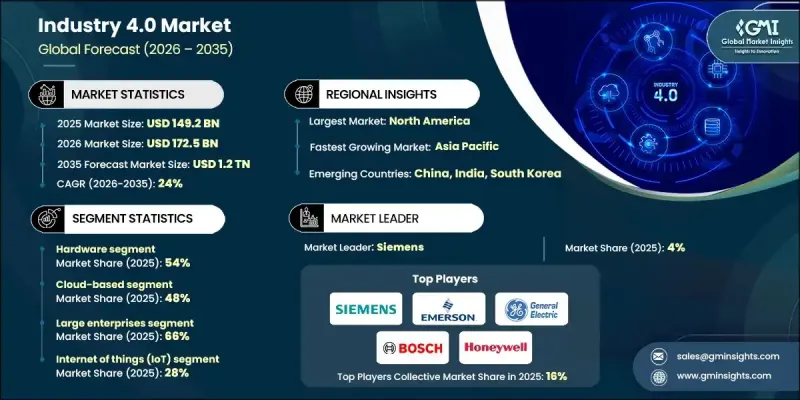
2025年全球工業4.0市場價值為1,492億美元,預計到2035年將以24%的複合年成長率成長至1.2兆美元。
工業環境的快速成長得益於數位系統、人工智慧和營運技術的加速融合。製造商正日益從實驗性的數位化措施轉向智慧工廠框架的全面部署,以提高生產力、永續性和營運視覺性。人工智慧在製造流程中的應用持續擴展,支援預測性營運、智慧調度、品質監控和即時決策等功能。生成式人工智慧進一步簡化了實施週期,加快了進階應用的部署。由於成本效益、營運安全性和易於整合等優勢,協作系統越來越受歡迎,機器人技術的應用也迅速擴展,尤其對小型企業而言更是如此。數位孿生、邊緣運算和智慧自動化平台的日益普及,透過實現模擬驅動的最佳化、提高資產利用率和數據驅動的效能提升,正在重塑工業工作流程。總而言之,這些發展正在將工業4.0確立為現代工業轉型的重要支柱。
| 市場範圍 | |
|---|---|
| 起始年份 | 2025 |
| 預測年份 | 2026-2035 |
| 起始值 | 1492億美元 |
| 預測值 | 1.2兆美元 |
| 複合年成長率 | 24% |
2025年,硬體領域佔比達到54%,預計2026年至2035年將以22.1%的複合年成長率成長。該領域涵蓋工業感測器、互聯設備、機器人、邊緣基礎設施、工業運算系統和智慧製造設備。處理能力、能源效率和設備小型化方面的持續創新正在推動對先進工業硬體的持續投資。隨著工業網路不斷發展以處理更高的資料吞吐量,邊緣硬體在管理人工智慧驅動的工作負載和實現生產層面的即時分析方面發揮著至關重要的作用。
2025年,基於雲端的部署方案將佔據48%的市場佔有率,預計2026年至2035年間將以24.3%的複合年成長率成長。雲端平台透過提供集中式資料存取、進階分析、成本最佳化、法規遵循和全球系統整合,支援工業4.0技術的可擴展應用。這種模式使各種規模的製造商都能在無需大量資本投入的情況下實施數位化解決方案,同時保持營運的靈活性和安全性。
美國工業4.0市場預計在2026年至2035年間以30.4%的強勁複合年成長率成長。先進的數位基礎設施、廣泛的工業物聯網部署以及對自動化和智慧製造的高度重視,支撐了其市場領先地位。持續不斷的公共和私營部門舉措,旨在鼓勵負責任的數位轉型,並專注於網路安全、韌性和可擴展的工業成長。
目錄
第1章:方法論
第2章:執行概要
第3章:行業洞察
- 產業生態系分析
- 供應商格局
- 利潤率分析
- 成本結構
- 每個階段的價值增加
- 影響價值鏈的因素
- 中斷
- 產業影響因素
- 成長促進因素
- 工業物聯網(IIoT)和智慧工廠解決方案的採用率不斷提高。
- 製造業各領域對自動化和機器人技術的需求不斷成長。
- 對即時資料分析和預測性維護的需求日益成長。
- 雲端運算、人工智慧和邊緣運算在工業運作中的擴展。
- 政府的各項措施和投資旨在支持數位製造和智慧產業。
- 產業陷阱與挑戰
- 中小企業實施成本高昂
- 網路安全與資料隱私風險
- 市場機遇
- 智慧工廠和自動化生產線的擴展
- 將人工智慧和機器學習技術應用於預測性維護
- 工業物聯網 (IIoT) 採用率的成長
- 面向工業營運的雲端運算和邊緣運算解決方案
- 政府激勵措施和促進數位化製造的舉措
- 成長潛力分析
- 監管環境
- 波特的分析
- PESTEL 分析
- 技術與創新格局
- 當前技術趨勢
- 新興技術
- 專利分析
- 價格趨勢
- 按地區
- 依產品
- 成本細分分析
- 使用案例和成功故事
- 永續性和環境方面
- 永續實踐
- 減少廢棄物策略
- 生產中的能源效率
- 環保舉措
- 碳足跡考量
- 未來展望與機遇
第4章:競爭格局
- 介紹
- 公司市佔率分析
- 北美洲
- 歐洲
- 亞太地區
- 拉丁美洲
- MEA
- 主要市場參與者的競爭分析
- 競爭定位矩陣
- 戰略展望矩陣
- 關鍵進展
- 併購
- 合作夥伴關係與合作
- 新產品發布
- 擴張計劃和資金
第5章:市場估算與預測:依組件分類,2022-2035年
- 硬體
- 軟體
- 服務
第6章:市場估算與預測:依部署模式分類,2022-2035年
- 本地部署
- 基於雲端的
- 混合
第7章:市場估算與預測:依組織規模分類,2022-2035年
- 大型企業
- 中小企業
第8章:市場估算與預測:依技術分類,2022-2035年
- 物聯網 (IoT)
- 數位孿生
- 巨量資料和人工智慧分析
- 網路安全
- 雲端運算
- 機器人與自動化
- 擴增實境(AR)
- 其他
第9章:市場估算與預測:依最終用途分類,2022-2035年
- 製造業
- 汽車
- 衛生保健
- 航太與國防
- 能源和公用事業
- 食品和飲料
- 其他
第10章:市場估計與預測:依地區分類,2022-2035年
- 北美洲
- 美國
- 加拿大
- 歐洲
- 德國
- 英國
- 法國
- 義大利
- 西班牙
- 俄羅斯
- 北歐
- 比荷盧經濟聯盟
- 亞太地區
- 中國
- 印度
- 日本
- 澳洲
- 韓國
- 新加坡
- 泰國
- 印尼
- 越南
- 拉丁美洲
- 巴西
- 墨西哥
- 阿根廷
- 哥倫比亞
- MEA
- 南非
- 沙烏地阿拉伯
- 阿拉伯聯合大公國
第11章:公司簡介
- 全球參與者
- ABB
- Emerson Electric
- Fanuc
- General Electric
- Honeywell International
- Mitsubishi Electric
- Robert Bosch
- Rockwell Automation
- Schneider Electric
- Siemens
- 區域玩家
- Beckhoff Automation
- Cisco Systems
- Dassault Systemes
- Eaton
- Hitachi
- KUKA
- Microsoft
- Oracle
- Yokogawa Electric
- Emerging Technology Innovators
- AspenTech
- AVEVA
- Bright Machines
- Instrumental
- PTC
The Global Industry 4.0 Market was valued at USD 149.2 billion in 2025 and is estimated to grow at a CAGR of 24% to reach USD 1.2 trillion by 2035.
The rapid growth is driven by the accelerating convergence of digital systems, artificial intelligence, and operational technologies across industrial environments. Manufacturers are increasingly transitioning from experimental digital initiatives to full-scale deployment of smart factory frameworks to improve productivity, sustainability, and operational visibility. Artificial intelligence adoption across manufacturing processes continues to scale, supporting functions such as predictive operations, intelligent scheduling, quality monitoring, and real-time decision-making. Generative AI is further streamlining implementation timelines, allowing faster deployment of advanced applications. Robotics adoption is expanding rapidly as collaborative systems gain traction due to cost efficiency, operational safety, and ease of integration, particularly for smaller enterprises. The growing use of digital twins, edge computing, and intelligent automation platforms is reshaping industrial workflows by enabling simulation-driven optimization, enhanced asset utilization, and data-driven performance improvements. Collectively, these developments are establishing Industry 4.0 as a foundational pillar of modern industrial transformation.
| Market Scope | |
|---|---|
| Start Year | 2025 |
| Forecast Year | 2026-2035 |
| Start Value | $149.2 Billion |
| Forecast Value | $1.2 Trillion |
| CAGR | 24% |
The hardware segment accounted for a 54% share in 2025 and is expected to grow at a CAGR of 22.1% from 2026 to 2035. This segment encompasses industrial sensors, connected devices, robotics, edge infrastructure, industrial computing systems, and smart manufacturing equipment. Continued innovation in processing capability, energy efficiency, and device miniaturization is driving sustained investment in advanced industrial hardware. As industrial networks evolve to handle higher data throughput, edge hardware plays a critical role in managing AI-driven workloads and enabling real-time analytics at the production level.
The cloud-based deployment held a share of 48% in 2025 and is expected to grow at a 24.3% CAGR between 2026 and 2035. Cloud platforms support scalable adoption of Industry 4.0 technologies by offering centralized data access, advanced analytics, cost optimization, regulatory compliance, and global system integration. This model allows manufacturers of all sizes to implement digital solutions without large capital investments while maintaining operational flexibility and security.
U.S. Industry 4.0 Market is forecast to grow at a strong CAGR of 30.4% from 2026 to 2035. Market leadership is supported by advanced digital infrastructure, widespread industrial IoT deployment, and strong emphasis on automation and smart manufacturing. Ongoing public and private initiatives continue to encourage responsible digital adoption with a focus on cybersecurity, resilience, and scalable industrial growth.
Key players operating in the Global Industry 4.0 Market include Siemens, Microsoft, Schneider Electric, General Electric, Cisco Systems, Mitsubishi Electric, Oracle, Robert Bosch, Honeywell International, and Emerson Electric. Companies active in the Global Industry 4.0 Market pursue focused strategies to reinforce their competitive positioning and expand global reach. Technology providers invest heavily in research and development to advance AI-driven automation, industrial analytics, and connected systems. Strategic partnerships with manufacturers and cloud platforms enable integrated solution delivery and faster deployment cycles. Firms emphasize modular and scalable platforms to address diverse industrial needs while reducing implementation complexity. Expansion into emerging markets supports long-term growth, while cybersecurity-focused innovation builds customer trust.
Table of Contents
Chapter 1 Methodology
- 1.1 Market scope and definition
- 1.2 Research design
- 1.2.1 Research approach
- 1.2.2 Data collection methods
- 1.3 Data mining sources
- 1.3.1 Global
- 1.3.2 Regional/Country
- 1.4 Base estimates and calculations
- 1.4.1 Base year calculation
- 1.4.2 Key trends for market estimation
- 1.5 Primary research and validation
- 1.5.1 Primary sources
- 1.6 Forecast model
- 1.7 Research assumptions and limitations
Chapter 2 Executive Summary
- 2.1 Industry 3600 synopsis, 2022 - 2035
- 2.2 Key market trends
- 2.2.1 Regional
- 2.2.2 Component
- 2.2.3 Deployment Mode
- 2.2.4 Organization Size
- 2.2.5 Technology
- 2.2.6 End Use
- 2.3 TAM Analysis, 2026-2035
- 2.4 CXO perspectives: Strategic imperatives
- 2.4.1 Executive decision points
- 2.4.2 Critical success factors
- 2.5 Future outlook and strategic recommendations
Chapter 3 Industry Insights
- 3.1 Industry ecosystem analysis
- 3.1.1 Supplier landscape
- 3.1.2 Profit margin analysis
- 3.1.3 Cost structure
- 3.1.4 Value addition at each stage
- 3.1.5 Factor affecting the value chain
- 3.1.6 Disruptions
- 3.2 Industry impact forces
- 3.2.1.1 Growth drivers
- 3.2.1.2 Increasing adoption of Industrial IoT (IIoT) and smart factory solutions.
- 3.2.1.3 Rising demand for automation and robotics across manufacturing sectors.
- 3.2.1.4 Growing need for real-time data analytics and predictive maintenance.
- 3.2.1.5 Expansion of cloud computing, AI, and edge computing in industrial operations.
- 3.2.1.6 Government initiatives and investments support digital manufacturing and smart industries.
- 3.2.2 Industry pitfalls and challenges
- 3.2.2.1 High implementation costs for SMEs
- 3.2.2.2 Cybersecurity and data privacy risks
- 3.2.3 Market opportunities
- 3.2.3.1 Expansion of smart factories and automated production lines
- 3.2.3.2 Integration of AI and machine learning for predictive maintenance
- 3.2.3.3 Growth in Industrial IoT (IIoT) adoption
- 3.2.3.4 Cloud and edge computing solutions for industrial operations
- 3.2.3.5 Government incentives and initiatives promoting digital manufacturing
- 3.3 Growth potential analysis
- 3.4 Regulatory landscape
- 3.5 Porter's analysis
- 3.6 PESTEL analysis
- 3.7 Technology and innovation landscape
- 3.7.1 Current technological trends
- 3.7.2 Emerging technologies
- 3.8 Patent analysis
- 3.9 Price trends
- 3.9.1 By region
- 3.9.2 By product
- 3.10 Cost breakdown analysis
- 3.11 Use cases & success stories
- 3.12 Sustainability and environmental aspects
- 3.12.1 Sustainable practices
- 3.12.2 Waste reduction strategies
- 3.12.3 Energy efficiency in production
- 3.12.4 Eco-friendly Initiatives
- 3.12.5 Carbon footprint considerations
- 3.13 Future outlook and opportunities
Chapter 4 Competitive Landscape, 2025
- 4.1 Introduction
- 4.2 Company market share analysis
- 4.2.1 North America
- 4.2.2 Europe
- 4.2.3 Asia Pacific
- 4.2.4 LATAM
- 4.2.5 MEA
- 4.3 Competitive analysis of major market players
- 4.4 Competitive positioning matrix
- 4.5 Strategic outlook matrix
- 4.6 Key developments
- 4.6.1 Mergers & acquisitions
- 4.6.2 Partnerships & collaborations
- 4.6.3 New product launches
- 4.6.4 Expansion plans and funding
Chapter 5 Market Estimates & Forecast, By Component, 2022 - 2035 ($Bn)
- 5.1 Key trends
- 5.2 Hardware
- 5.3 Software
- 5.4 Services
Chapter 6 Market Estimates & Forecast, By Deployment Mode, 2022 - 2035 ($Bn)
- 6.1 Key trends
- 6.2 On-Premise
- 6.3 Cloud-Based
- 6.4 Hybrid
Chapter 7 Market Estimates & Forecast, By Organization Size, 2022 - 2035 ($Bn)
- 7.1 Key trends
- 7.2 Large enterprises
- 7.3 Small and medium-sized enterprises (SMEs)
Chapter 8 Market Estimates & Forecast, By Technology, 2022 - 2035 ($Bn)
- 8.1 Key trends
- 8.2 Internet of things (IoT)
- 8.3 Digital twin
- 8.4 Big data and AI analytics
- 8.5 Cybersecurity
- 8.6 Cloud computing
- 8.7 Robotics and automation
- 8.8 Augmented reality (AR)
- 8.9 Others
Chapter 9 Market Estimates & Forecast, By End Use, 2022 - 2035 ($Bn)
- 9.1 Key trends
- 9.2 Manufacturing
- 9.3 Automotive
- 9.4 Healthcare
- 9.5 Aerospace and defense
- 9.6 Energy and utilities
- 9.7 Food and beverages
- 9.8 Others
Chapter 10 Market Estimates & Forecast, By Region, 2022 - 2035 ($Bn)
- 10.1 Key trends
- 10.2 North America
- 10.2.1 US
- 10.2.2 Canada
- 10.3 Europe
- 10.3.1 Germany
- 10.3.2 UK
- 10.3.3 France
- 10.3.4 Italy
- 10.3.5 Spain
- 10.3.6 Russia
- 10.3.7 Nordics
- 10.3.8 Benelux
- 10.4 Asia Pacific
- 10.4.1 China
- 10.4.2 India
- 10.4.3 Japan
- 10.4.4 Australia
- 10.4.5 South Korea
- 10.4.6 Singapore
- 10.4.7 Thailand
- 10.4.8 Indonesia
- 10.4.9 Vietnam
- 10.5 Latin America
- 10.5.1 Brazil
- 10.5.2 Mexico
- 10.5.3 Argentina
- 10.5.4 Colombia
- 10.6 MEA
- 10.6.1 South Africa
- 10.6.2 Saudi Arabia
- 10.6.3 UAE
Chapter 11 Company Profiles
- 11.1 Global Players
- 11.1.1 ABB
- 11.1.2 Emerson Electric
- 11.1.3 Fanuc
- 11.1.4 General Electric
- 11.1.5 Honeywell International
- 11.1.6 Mitsubishi Electric
- 11.1.7 Robert Bosch
- 11.1.8 Rockwell Automation
- 11.1.9 Schneider Electric
- 11.1.10 Siemens
- 11.2 Regional Players
- 11.2.1 Beckhoff Automation
- 11.2.2 Cisco Systems
- 11.2.3 Dassault Systemes
- 11.2.4 Eaton
- 11.2.5 Hitachi
- 11.2.6 KUKA
- 11.2.7 Microsoft
- 11.2.8 Oracle
- 11.2.9 Yokogawa Electric
- 11.3 Emerging Technology Innovators
- 11.3.1 AspenTech
- 11.3.2 AVEVA
- 11.3.3 Bright Machines
- 11.3.4 Instrumental
- 11.3.5 PTC

 2026年全球化學4.0市場報告2026年工業4.0人工智慧(AI)全球市場報告
 工業4.0與智慧製造:2026-2030年2026年全球機場4.0市場報告2026年工業4.0全球市場報告
 工業4.0市場分析及預測(至2035年):依類型、產品類型、服務、技術、組件、應用、流程、最終用戶、功能、解決方案分類
 工業4.0全球市場規模、佔有率、趨勢和成長分析報告(2026-2034年)
 工業4.0市場規模、佔有率、趨勢及預測(按組件、技術類型、最終用途行業和地區分類),2026-2034年2026年全球智慧製造軟體市場報告智慧製造軟體市場規模、佔有率、成長及全球產業分析:依類型、應用和地區劃分的洞察與預測(2026-2034 年)