


 |
市場調查報告書
商品編碼
1892806
旅行拖車市場機會、成長促進因素、產業趨勢分析及預測(2026-2035年)Travel Trailer Market Opportunity, Growth Drivers, Industry Trend Analysis, and Forecast 2026 - 2035 |
||||||

2025 年全球旅行拖車市場價值為 156 億美元,預計到 2035 年將以 4.7% 的複合年成長率成長至 241 億美元。
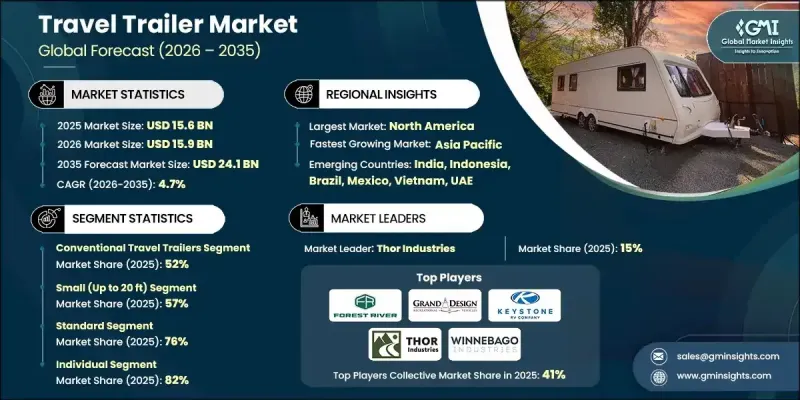
隨著消費者越來越追求便利、安全和靈活的度假方式,自駕遊、露營和國內旅行的需求日益成長,推動了市場需求。家庭、情侶和探險旅行者將旅行拖車視為酒店和度假村之外的經濟之選,兼具靈活性和舒適性。家庭收入的成長提升了購買力,使更多消費者能夠投資購買入門級和高階旅行拖車。這促使製造商拓展產品線,以滿足不同預算的需求。此外,退休人員和老年人旅行時間增多,也催生了對適合季節性居住和長期使用的拖車的需求。這一人口趨勢正激勵製造商開發適老化、無障礙的設計,以提升所有年齡層的舒適性和實用性。
| 市場範圍 | |
|---|---|
| 起始年份 | 2025 |
| 預測年份 | 2026-2035 |
| 起始值 | 156億美元 |
| 預測值 | 241億美元 |
| 複合年成長率 | 4.7% |
傳統旅行拖車市佔率佔比達52%,預計到2035年將以3.9%的複合年成長率成長。這些拖車因其尺寸、設計和設施的多樣性而廣受家庭和休閒旅行的青睞。它們經濟實惠、易於牽引,所需額外設備極少,對於追求性價比和便利性的消費者而言,無疑是理想之選。
小型旅行拖車(長度不超過20英尺)在2025年佔據了57%的市場佔有率,預計到2035年將以5.2%的複合年成長率成長。這些緊湊輕便的拖車非常適合單人旅客、情侶和首次購車者。它們提供基本的生活設施、出色的操控性和燃油效率,無需大型牽引車輛即可滿足週末旅行、短途度假或城市露營的需求。
預計到2025年,美國旅行拖車市場規模將達到57.7億美元。美國憑藉其完善的露營基礎設施、豐富的露營地資源以及較高的可支配收入,仍然是規模最大、發展最成熟的市場。消費者越來越傾向於選擇輕便、配備科技功能的拖車,以支持靈活的公路旅行體驗。遠距辦公的興起也推動了更長距離的房車旅行,尤其是在首次購置房車的年輕消費者群體中。
目錄
第1章:方法論
第2章:執行概要
第3章:行業洞察
- 產業生態系分析
- 供應商格局
- 利潤率
- 成本結構
- 每個階段的價值增加
- 影響價值鏈的因素
- 中斷
- 產業影響因素
- 成長促進因素
- 國內觀光發展
- 可支配所得增加
- 老化人口尋求休閒
- 戶外生活方式越來越受歡迎
- 產業陷阱與挑戰
- 高昂的前期成本
- 監管和許可障礙
- 市場機遇
- 新興市場的擴張
- 租賃和訂閱模式
- 與再生能源的融合
- 與旅遊公司合作
- 成長促進因素
- 成長潛力分析
- 監管環境
- 全球的
- 聯邦監管環境
- 州和地方監管框架
- 行業自律與標準
- 環境與排放法規
- 消費者保護與保固法
- 安全召回和報告要求
- 國際監管協調
- 北美洲
- 歐洲
- 亞太地區
- 拉丁美洲
- 中東和非洲
- 全球的
- 波特的分析
- PESTEL 分析
- 技術與創新格局
- 當前技術趨勢
- 輕質建築材料
- 智慧房車技術整合
- 電力和能源管理系統
- 四季工程解決方案
- 安全和駕駛輔助技術
- 新興技術
- 電氣化及電動車牽引最佳化
- 再生能源獨立性
- 先進材料與製造
- 自主牽引技術
- 人工智慧與預測性維護
- 未來技術路線圖(2030-2034)
- 當前技術趨勢
- 定價分析
- 價格層級細分及市場規模
- 中端市場
- 高階市場
- 超豪華細分市場
- 價格動態與趨勢
- 區域定價差異
- 融資對有效定價的影響
- 價格層級細分及市場規模
- 生產統計
- 生產中心
- 消費中心
- 進出口
- 成本細分分析
- 物料清單 (BOM) 分析
- 製造成本結構
- 不同產品類型的成本差異
- 成本通膨分析
- 規模經濟分析
- 利害關係人獲利能力分析
- 成本最佳化策略
- 專利分析
- 美國專利商標局旅行拖車專利概況
- 關鍵創新領域(輕量化、安全性、材料)
- 頂級專利持有者和技術領導者
- 永續性和環境方面
- 永續實踐
- 減少廢棄物策略
- 生產中的能源效率
- 環保舉措
- 碳足跡考量
- 消費者行為和使用情況洞察
- 客戶人口統計和心理統計特徵
- 購買決策過程
- 使用模式和頻率
- 生活方式區隔與動機
- 品牌忠誠度和擁護度
- 購買後體驗和滿意度
- 數位互動與社群媒體
- 最終使用者行為分析
- 個人/消費者最終用途模式
- 商用車隊最終用途分析
- 目的地露營和長期營地選址
- 維護和修改行為
- 點對點租賃業主行為
- 旅遊和休閒生態系統聯繫
- 國家和州立公園基礎設施
- 私人房車公園和度假村行業
- 野外露營和分散式露營
- 旅遊局和目的地行銷
- 加油站和加油站基礎設施
第4章:競爭格局
- 介紹
- 公司市佔率分析
- 北美洲
- 歐洲
- 亞太地區
- 拉丁美洲
- MEA
- 主要市場參與者的競爭分析
- 競爭定位矩陣
- 戰略展望矩陣
- 關鍵進展
- 併購
- 合作夥伴關係與合作
- 新產品發布
- 擴張計劃和資金
- 併購活動
- 私募股權對房車產業的興趣
- 創新領域的新創企業融資
- 公司擴張計劃
第5章:市場估價與預測:依拖車類型分類,2022-2035年
- 傳統旅行拖車
- 第五輪拖車
- 玩具運輸車
- 混合動力旅行拖車
- 水滴形拖車
- 彈出式/折疊式拖車
第6章:市場估算與預測:依長度分類,2022-2035年
- 小型(最大 20 英尺)
- 中(21-30 英尺)
- 大型(30 英尺以上)
第7章:市場估計與預測:依價格分類,2022-2035年
- 標準
- 奢華
第8章:市場估算與預測:依應用領域分類,2022-2035年
- 休閒度假旅遊
- 全職生活
- 探險與越野露營
- 季節性/週末露營
第9章:市場估算與預測:依最終用途分類,2022-2035年
- 個人
- 車隊車主
第10章:市場估計與預測:依地區分類,2022-2035年
- 北美洲
- 美國
- 加拿大
- 歐洲
- 德國
- 英國
- 法國
- 義大利
- 西班牙
- 北歐
- 俄羅斯
- 波蘭
- 羅馬尼亞
- 亞太地區
- 中國
- 印度
- 日本
- 韓國
- 澳新銀行
- 越南
- 印尼
- 拉丁美洲
- 巴西
- 墨西哥
- 阿根廷
- MEA
- 南非
- 沙烏地阿拉伯
- 阿拉伯聯合大公國
第11章:公司簡介
- 全球公司
- Airstream
- Dutchmen RV
- Grand Design RV
- Heartland RV
- Forest River
- Jayco
- Keystone RV
- KZ RV
- Prime Time Manufacturing
- Starcraft RV
- Thor Industries
- Winnebago Industries
- Venture RV
- 區域玩家
- Alliance RV
- Bean Trailer
- Coachmen RV
- CrossRoads RV
- Cruiser RV
- Escape Trailer Industries
- inTech RV
- Lance Camper Manufacturing
- Oliver Travel Trailers
- Palomino RV
- 新興玩家
- Brinkley RV
- Happier Camper
- Livin' Lite (CampLite)
- nuCamp RV
The Global Travel Trailer Market was valued at USD 15.6 billion in 2025 and is estimated to grow at a CAGR of 4.7% to reach USD 24.1 billion by 2035.
Growing interest in road trips, camping, and domestic travel is driving demand, as consumers increasingly seek convenient, safe, and flexible vacation options. Families, couples, and adventure travelers view travel trailers as an economical alternative to hotels and resorts, providing both mobility and comfort. Rising household incomes have expanded purchasing power, enabling more consumers to invest in both entry-level and premium travel trailers. This has prompted manufacturers to diversify their product lines to cater to varying budgets. Additionally, retirees and older adults are spending more time traveling, creating demand for trailers designed for seasonal living and long-term use. This demographic trend is motivating manufacturers to develop age-friendly, accessible designs that enhance comfort and usability for all age groups.
| Market Scope | |
|---|---|
| Start Year | 2025 |
| Forecast Year | 2026-2035 |
| Start Value | $15.6 Billion |
| Forecast Value | $24.1 Billion |
| CAGR | 4.7% |
The conventional travel trailers segment held a 52% share and is expected to grow at a CAGR of 3.9% through 2035. These trailers are widely favored for family and recreational travel due to their variety of sizes, designs, and amenities. They are cost-effective, easy to tow, and require minimal additional equipment, making them a practical choice for those seeking affordability and convenience.
The small travel trailer segment, measuring up to 20 feet, held a 57% share in 2025 and is projected to grow at a CAGR of 5.2% through 2035. These compact, lightweight trailers are perfect for solo travelers, couples, and first-time buyers. They offer basic amenities, excellent maneuverability, and fuel efficiency, making them ideal for weekend trips, short vacations, or urban camping without the need for large towing vehicles.
U.S. Travel Trailer Market reached USD 5.77 billion in 2025. The U.S. remains the largest and most mature market due to its extensive camping infrastructure, abundant campgrounds, and high disposable income. Consumers increasingly prefer lightweight, tech-enabled trailers that support flexible, road-based travel experiences. The rise of remote work is also encouraging longer RV trips, particularly among younger consumers who are entering the market as first-time owners.
Key players in the Global Travel Trailer Market include Forest River, Thor Industries, Winnebago Industries, Dutchmen RV, Grand Design RV, Coachmen RV, KZ RV, Lance Camper Manufacturing, Airstream, and Keystone RV. Companies in the Global Travel Trailer Market are adopting multiple strategies to strengthen their presence. They are focusing on product innovation by introducing lightweight, technologically advanced, and fuel-efficient trailers to appeal to evolving consumer preferences. Expanding product portfolios across entry-level, mid-range, and premium segments allows firms to target diverse buyer demographics. Manufacturers are investing in digital marketing, dealer networks, and customer experience enhancements to increase brand visibility and loyalty. Additionally, companies are offering customizable options, age-friendly designs, and sustainable features to meet changing lifestyle demands and regulatory expectations.
Table of Contents
Chapter 1 Methodology
- 1.1 Market scope and definition
- 1.2 Research design
- 1.2.1 Research approach
- 1.2.2 Data collection methods
- 1.3 Data mining sources
- 1.3.1 Global
- 1.3.2 Regional/Country
- 1.4 Base estimates and calculations
- 1.4.1 Base year calculation
- 1.4.2 Key trends for market estimation
- 1.5 Primary research and validation
- 1.5.1 Primary sources
- 1.6 Forecast model
- 1.7 Research assumptions and limitations
Chapter 2 Executive Summary
- 2.1 Industry 3600 synopsis
- 2.2 Key market trends
- 2.2.1 Regional
- 2.2.2 Trailer
- 2.2.3 Length
- 2.2.4 Price
- 2.2.5 Application
- 2.2.6 End use
- 2.3 TAM analysis, 2026-2035
- 2.4 CXO perspectives: Strategic imperatives
- 2.4.1 Executive decision points
- 2.4.2 Critical success factors
- 2.5 Future outlook
- 2.6 Strategic recommendations
Chapter 3 Industry Insights
- 3.1 Industry ecosystem analysis
- 3.1.1 Supplier landscape
- 3.1.2 Profit margin
- 3.1.3 Cost structure
- 3.1.4 Value addition at each stage
- 3.1.5 Factor affecting the value chain
- 3.1.6 Disruptions
- 3.2 Industry impact forces
- 3.2.1 Growth drivers
- 3.2.1.1 Growing domestic tourism
- 3.2.1.2 Rising disposable income
- 3.2.1.3 Aging population seeking leisure
- 3.2.1.4 Increased outdoor lifestyle popularity
- 3.2.2 Industry pitfalls and challenges
- 3.2.2.1 High upfront costs
- 3.2.2.2 Regulatory and licensing hurdles
- 3.2.3 Market opportunities
- 3.2.3.1 Expansion in emerging markets
- 3.2.3.2 Rental and subscription models
- 3.2.3.3 Integration with renewable energy
- 3.2.3.4 Collaboration with travel and tourism companies
- 3.2.1 Growth drivers
- 3.3 Growth potential analysis
- 3.4 Regulatory landscape
- 3.4.1 Global
- 3.4.1.1 Federal regulatory environment
- 3.4.1.2 State & local regulatory framework
- 3.4.1.3 Industry self-regulation & standards
- 3.4.1.4 Environmental & emissions regulations
- 3.4.1.5 Consumer protection & warranty laws
- 3.4.1.6 Safety recall & reporting requirements
- 3.4.1.7 International regulatory harmonization
- 3.4.2 North America
- 3.4.3 Europe
- 3.4.4 Asia Pacific
- 3.4.5 Latin America
- 3.4.6 Middle East & Africa
- 3.4.1 Global
- 3.5 Porter's analysis
- 3.6 PESTEL analysis
- 3.7 Technology and innovation landscape
- 3.7.1 Current technological trends
- 3.7.1.1 Lightweight construction materials
- 3.7.1.2 Smart RV technology integration
- 3.7.1.3 Power & energy management systems
- 3.7.1.4 Four-season engineering solutions
- 3.7.1.5 Safety & driver assistance technologies
- 3.7.2 Emerging technologies
- 3.7.2.1 Electrification & EV towing optimization
- 3.7.2.2 Renewable energy independence
- 3.7.2.3 Advanced materials & manufacturing
- 3.7.2.4 Autonomous towing technologies
- 3.7.2.5 AI & predictive maintenance
- 3.7.3 Future technology roadmap (2030-2034)
- 3.7.1 Current technological trends
- 3.8 Pricing analysis
- 3.8.1 Price tier segmentation & market size
- 3.8.1.1 Mid-tier segment
- 3.8.1.2 Premium segment
- 3.8.1.3 Ultra-luxury segment
- 3.8.2 Pricing dynamics & trends
- 3.8.3 Regional pricing variations
- 3.8.4 Financing impact on effective pricing
- 3.8.1 Price tier segmentation & market size
- 3.9 Production statistics
- 3.9.1 Production hubs
- 3.9.2 Consumption hubs
- 3.9.3 Export and import
- 3.10 Cost breakdown analysis
- 3.10.1 Bill of materials (BOM) analysis
- 3.10.2 Manufacturing cost structure
- 3.10.3 Cost variations by product type
- 3.10.4 Cost inflation analysis
- 3.10.5 Economies of scale analysis
- 3.10.6 Profitability analysis by stakeholder
- 3.10.7 Cost optimization strategies
- 3.11 Patent analysis
- 3.11.1 USPTO travel trailer patent landscape
- 3.11.2 Key innovation areas (lightweight, safety, materials)
- 3.11.3 Top patent holders and technology leaders
- 3.12 Sustainability and environmental aspects
- 3.12.1 Sustainable practices
- 3.12.2 Waste reduction strategies
- 3.12.3 Energy efficiency in production
- 3.12.4 Eco-friendly initiatives
- 3.12.5 Carbon footprint considerations
- 3.13 Consumer behavior and usage insights
- 3.13.1 Customer demographics and psychographics
- 3.13.2 Purchase decision journey
- 3.13.3 Usage patterns and frequency
- 3.13.4 Lifestyle segments and motivations
- 3.13.5 Brand loyalty and advocacy
- 3.13.6 Post-purchase experience and satisfaction
- 3.13.7 Digital engagement and social media
- 3.14 End use behavior analysis
- 3.14.1 Personal/consumer End use patterns
- 3.14.2 Commercial fleet End use analysis
- 3.14.3 Destination camping and long-term site placement
- 3.14.4 Maintenance and modification behavior
- 3.14.5 Peer-to-peer rental owner behavior
- 3.15 Tourism and recreational ecosystem linkages
- 3.15.1 National and state park infrastructure
- 3.15.2 Private RV park and resort industry
- 3.15.3 Boondocking and dispersed camping
- 3.15.4 Tourism board and destination marketing
- 3.15.5 Fuel and service station infrastructure
Chapter 4 Competitive Landscape, 2025
- 4.1 Introduction
- 4.2 Company market share analysis
- 4.2.1 North America
- 4.2.2 Europe
- 4.2.3 Asia Pacific
- 4.2.4 LATAM
- 4.2.5 MEA
- 4.3 Competitive analysis of major market players
- 4.4 Competitive positioning matrix
- 4.5 Strategic outlook matrix
- 4.6 Key developments
- 4.6.1 Mergers & acquisitions
- 4.6.2 Partnerships & collaborations
- 4.6.3 New product launches
- 4.6.4 Expansion plans and funding
- 4.6.4.1 M&A activity
- 4.6.4.2 Private equity interest in RV sector
- 4.6.4.3 Startup funding in innovative segments
- 4.6.4.4 Companies’ expansion plans
Chapter 5 Market Estimates & Forecast, By Trailer, 2022 - 2035 ($Mn, Units)
- 5.1 Key trends
- 5.2 Conventional travel trailers
- 5.3 Fifth-wheel trailers
- 5.4 Toy haulers
- 5.5 Hybrid travel trailers
- 5.6 Teardrop trailers
- 5.7 Pop-up / folding trailers
Chapter 6 Market Estimates & Forecast, By Length, 2022 - 2035 ($Mn, Units)
- 6.1 Key trends
- 6.2 Small (Up to 20 ft)
- 6.3 Medium (21-30 ft)
- 6.4 Large (Above 30 ft)
Chapter 7 Market Estimates & Forecast, By Price, 2022 - 2035 ($Mn, Units)
- 7.1 Key trends
- 7.2 Standard
- 7.3 Luxury
Chapter 8 Market Estimates & Forecast, By Application, 2022 - 2035 ($Mn, Units)
- 8.1 Key trends
- 8.2 Leisure & vacation travel
- 8.3 Full-time living
- 8.4 Adventure & off-road camping
- 8.5 Seasonal/weekend camping
Chapter 9 Market Estimates & Forecast, By End Use, 2022 - 2035 ($Mn, Units)
- 9.1 Key trends
- 9.2 Individual
- 9.3 Fleet owner
Chapter 10 Market Estimates & Forecast, By Region, 2022 - 2035 ($Mn, Units)
- 10.1 Key trends
- 10.2 North America
- 10.2.1 US
- 10.2.2 Canada
- 10.3 Europe
- 10.3.1 Germany
- 10.3.2 UK
- 10.3.3 France
- 10.3.4 Italy
- 10.3.5 Spain
- 10.3.6 Nordics
- 10.3.7 Russia
- 10.3.8 Poland
- 10.3.9 Romania
- 10.4 Asia Pacific
- 10.4.1 China
- 10.4.2 India
- 10.4.3 Japan
- 10.4.4 South Korea
- 10.4.5 ANZ
- 10.4.6 Vietnam
- 10.4.7 Indonesia
- 10.5 Latin America
- 10.5.1 Brazil
- 10.5.2 Mexico
- 10.5.3 Argentina
- 10.6 MEA
- 10.6.1 South Africa
- 10.6.2 Saudi Arabia
- 10.6.3 UAE
Chapter 11 Company Profiles
- 11.1 Global companies
- 11.1.1 Airstream
- 11.1.2 Dutchmen RV
- 11.1.3 Grand Design RV
- 11.1.4 Heartland RV
- 11.1.5 Forest River
- 11.1.6 Jayco
- 11.1.7 Keystone RV
- 11.1.8 KZ RV
- 11.1.9 Prime Time Manufacturing
- 11.1.10 Starcraft RV
- 11.1.11 Thor Industries
- 11.1.12 Winnebago Industries
- 11.1.13 Venture RV
- 11.2 Regional players
- 11.2.1 Alliance RV
- 11.2.2 Bean Trailer
- 11.2.3 Coachmen RV
- 11.2.4 CrossRoads RV
- 11.2.5 Cruiser RV
- 11.2.6 Escape Trailer Industries
- 11.2.7 inTech RV
- 11.2.8 Lance Camper Manufacturing
- 11.2.9 Oliver Travel Trailers
- 11.2.10 Palomino RV
- 11.3 Emerging players
- 11.3.1 Brinkley RV
- 11.3.2 Happier Camper
- 11.3.3 Livin' Lite (CampLite)
- 11.3.4 nuCamp RV

 2026年全球旅行拖車和露營車市場報告
 全球旅行拖車市場規模、佔有率、趨勢和成長分析報告:2026-2034年
 戶外露營拖車市場按產品類型、拖車長度、分銷管道和應用分類-全球預測,2026-2032年
 全球旅行拖車市場