

 |
市場調查報告書
商品編碼
1892802
奢侈鞋履市場機會、成長促進因素、產業趨勢分析及預測(2025-2034年)Luxury Footwear Market Opportunity, Growth Drivers, Industry Trend Analysis, and Forecast 2025 - 2034 |
||||||

2024 年全球奢侈鞋履市場價值為 206 億美元,預計到 2034 年將以 5.1% 的複合年成長率成長至 339 億美元。
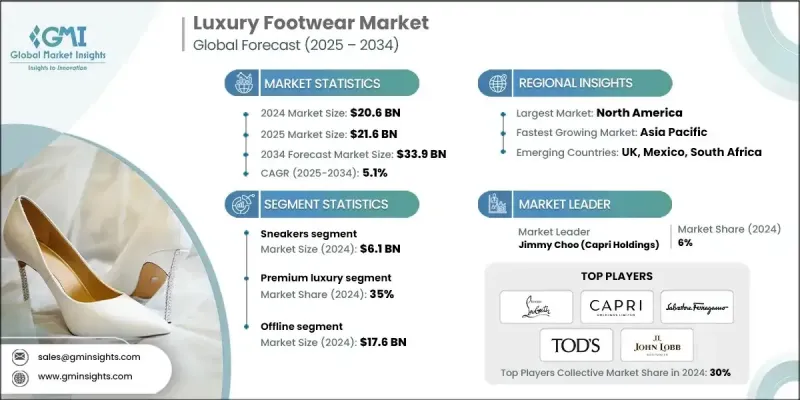
奢侈鞋履已從簡單的功能性物品演變為個人身分、獨特性和社會地位的象徵。消費者越來越青睞那些體現精湛工藝、品牌傳承和高階定位的鞋履。隨著高階時尚需求的不斷成長,高階化趨勢持續提升市場,透過強調限量、匠心獨具的設計以及聯名合作,強化了產品的稀缺性和品牌吸引力。這些因素加強了奢侈品牌與其受眾之間的情感聯繫,消費者珍惜個性以及與悠久品牌傳統相關的聲望。生活方式的改變也影響消費者的購買行為,奢侈鞋履已成為日常時尚選擇的一部分,兼具舒適性和精緻風格,適用於休閒和正式場合。奢華運動休閒服飾的興起凸顯了時尚前衛、性能卓越的設計如何創造新的機遇,並強調了功能性、高級時裝和日常穿著之間界限的融合。
| 市場範圍 | |
|---|---|
| 起始年份 | 2024 |
| 預測年份 | 2025-2034 |
| 起始值 | 206億美元 |
| 預測值 | 339億美元 |
| 複合年成長率 | 5.1% |
2024年,運動鞋市場規模預計將達61億美元。這些鞋款已演變為彰顯個人品味和地位的時尚宣言。舒適性和視覺吸引力的完美結合,使品牌能夠創造出獨特的設計,吸引收藏家和追求潮流的消費者。限量發售、獨特造型以及與業界領袖的合作,都有助於奢華運動鞋系列保持高需求。
2024年,高階奢侈品市佔率比達35%。由於消費者對品牌真實性和傳承的重視,這一細分市場持續成長。奢侈品牌透過強調每件產品背後的工藝、設計理念和傳統,來培養消費者的情感共鳴。透過精心策劃的行銷活動、旗艦店體驗和選擇性的合作關係,這些品牌在鞏固自身歷史傳承的同時,也推出了符合當代時尚潮流的現代詮釋。
2024年,美國奢侈鞋履市場佔73.7%的佔有率。該國的需求受到強大的時尚影響力、較高的購買力以及消費者對兼具創新性、舒適性和獨特性的產品的偏好所支撐。運動鞋繼續主導時尚潮流,而注重永續性的設計和客製化正成為美國奢侈鞋履行業的關鍵差異化因素。
目錄
第1章:方法論與範圍
第2章:執行概要
第3章:行業洞察
- 產業生態系分析
- 供應商格局
- 利潤率
- 每個階段的價值增加
- 影響價值鏈的因素
- 產業影響因素
- 成長促進因素
- 高階化和生活方式趨勢
- 日益增強的時尚意識
- 鞋類客製化和個人化需求的興起
- 名人代言和品牌合作
- 產業陷阱與挑戰
- 新興市場對價格高度敏感
- 快速時尚週期
- 機會
- 永續奢華鞋履
- 奢侈運動休閒領域
- 成長促進因素
- 成長潛力分析
- 未來市場趨勢
- 技術與創新格局
- 當前技術趨勢
- 新興技術
- 價格趨勢
- 按地區
- 依產品類型
- 監管環境
- 標準和合規要求
- 區域監理框架
- 認證標準
- 波特的分析
- PESTEL 分析
- 消費者行為分析
- 購買模式
- 偏好分析
- 消費者行為的區域差異
- 電子商務對購買決策的影響
第4章:競爭格局
- 介紹
- 公司市佔率分析
- 按地區
- 公司矩陣分析
- 主要市場參與者的競爭分析
- 競爭定位矩陣
- 關鍵進展
- 併購
- 合作夥伴關係與合作
- 新產品發布
- 擴張計劃
第5章:市場估算與預測:依產品類型分類,2021-2034年
- 靴子
- 公寓
- 高跟涼鞋
- 樂福鞋
- 睡眠者
- 運動鞋
- 其他
第6章:市場估計與預測:依價格分類,2021-2034年
- 入門豪華(0-0)
- 中檔豪華(0-500)
- 頂級奢侈品(500-5000美元)
- 超豪華(3000美元以上)
第7章:市場估計與預測:依消費族群分類,2021-2034年
- 男人
- 女性
- 孩子們
第8章:市場估算與預測:依配銷通路分類,2021-2034年
- 線上
- 電子商務
- 品牌網站
- 離線
- 奢侈品精品店
- 百貨公司
- 多品牌零售店
- 其他
第9章:市場估計與預測:依地區分類,2021-2034年
- 北美洲
- 美國
- 加拿大
- 歐洲
- 德國
- 英國
- 法國
- 義大利
- 西班牙
- 亞太地區
- 中國
- 日本
- 印度
- 澳洲
- 韓國
- 拉丁美洲
- 巴西
- 墨西哥
- 阿根廷
- 中東和非洲
- 南非
- 沙烏地阿拉伯
- 阿拉伯聯合大公國
第10章:公司簡介
- Berluti (LVMH)
- Bottega Veneta (Kering)
- Brunello Cucinelli
- Christian Louboutin
- Crockett & Jones
- Edward Green
- JM Weston
- Jimmy Choo (Capri Holdings)
- John Lobb (Hermes)
- Manolo Blahnik
- Paraboot
- Prada
- Salvatore Ferragamo
- Santoni
- Tod's Group
The Global Luxury Footwear Market was valued at USD 20.6 billion in 2024 and is estimated to grow at a CAGR of 5.1% to reach USD 33.9 billion by 2034.
Luxury shoes have evolved from simple functional items to symbols of personal identity, exclusivity, and social standing. Consumers increasingly gravitate toward footwear that reflects craftsmanship, brand heritage, and a premium positioning. As demand for high-end fashion deepens, premiumization continues to elevate the market by emphasizing limited releases, artisan-made designs, and collaborations that reinforce rarity and brand desirability. These factors strengthen the emotional connection between luxury labels and their audience, who value individuality and the prestige tied to longstanding brand traditions. Lifestyle changes are also shaping buying behavior as luxury footwear becomes part of daily fashion choices, blending comfort with sophisticated style for both casual and formal settings. The expansion of luxury athleisure highlights how fashion-forward, performance-inspired designs are driving new opportunities, underscoring the merging boundaries between functionality, high fashion, and everyday wear.
| Market Scope | |
|---|---|
| Start Year | 2024 |
| Forecast Year | 2025-2034 |
| Start Value | $20.6 Billion |
| Forecast Value | $33.9 Billion |
| CAGR | 5.1% |
The sneakers segment generated USD 6.1 billion in 2024. These styles have evolved into defining fashion statements that showcase personal taste and status. Their mix of comfort and visual appeal allows brands to deliver distinct designs that attract collectors and trend-focused consumers. Limited drops, unique styling, and partnerships with influential names help luxury sneaker lines maintain high demand.
The premium luxury tier represented 35% share in 2024. This segment continues to grow due to the importance consumers place on authenticity and brand heritage. Luxury houses cultivate emotional engagement by highlighting the craftsmanship, design narrative, and traditions behind each product. Through curated campaigns, flagship store experiences, and selective partnerships, these brands reinforce their legacy while offering modern interpretations that appeal to contemporary fashion preferences.
U.S. Luxury Footwear Market held 73.7% share in 2024. Demand in the country is supported by strong fashion influence, high purchasing power, and consumer preference for products that merge innovation, comfort, and exclusivity. Sneakers continue to dominate the style landscape, while sustainability-oriented designs and customization are emerging as key differentiators within the U.S. luxury footwear sector.
Key companies active in the Global Luxury Footwear Market include Berluti (LVMH), Bottega Veneta (Kering), Brunello Cucinelli, Christian Louboutin, Crockett & Jones, Edward Green, J.M. Weston, Jimmy Choo (Capri Holdings), John Lobb (Hermes), Manolo Blahnik, Paraboot, Prada, Salvatore Ferragamo, Santoni, and Tod's Group. Companies in the Global Luxury Footwear Market are strengthening their competitive edge by expanding their artisanal craftsmanship, enhancing personalization options, and incorporating sustainable materials that appeal to modern luxury buyers. Brands are investing in exclusive product lines, heritage-driven storytelling, and collaborations that elevate desirability and reinforce status value. Many are prioritizing omnichannel strategies that blend immersive retail experiences with digitally enhanced touchpoints to increase customer engagement. Limited-edition releases and capsule collections help maintain scarcity while driving higher margins.
Table of Contents
Chapter 1 Methodology and Scope
- 1.1 Market scope and definition
- 1.2 Research design
- 1.2.1 Research approach
- 1.2.2 Data collection methods
- 1.3 Data mining sources
- 1.3.1 Global
- 1.3.2 Regional/Country
- 1.4 Base estimates and calculations
- 1.4.1 Base year calculation
- 1.4.2 Key trends for market estimation
- 1.5 Primary research and validation
- 1.5.1 Primary sources
- 1.6 Forecast model
- 1.7 Research assumptions and limitations
Chapter 2 Executive Summary
- 2.1 Industry 360° synopsis
- 2.2 Key market trends
- 2.2.1 Regional
- 2.2.2 Product type
- 2.2.3 Price
- 2.2.4 Consumer group
- 2.2.5 Distribution channel
- 2.3 CXO perspectives: Strategic imperatives
- 2.3.1 Key decision points for industry executives
- 2.3.2 Critical success factors for market players
- 2.4 Future outlook and strategic recommendations
Chapter 3 Industry Insights
- 3.1 Industry ecosystem analysis
- 3.1.1 Supplier landscape
- 3.1.2 Profit margin
- 3.1.3 Value addition at each stage
- 3.1.4 Factor affecting the value chain
- 3.2 Industry impact forces
- 3.2.1 Growth drivers
- 3.2.1.1 Premiumization and Lifestyle Trends
- 3.2.1.2 Increasing fashion consciousness
- 3.2.1.3 Rise in footwear customizations and personalization
- 3.2.1.4 Celebrity endorsements and brand collaborations
- 3.2.2 Industry pitfalls & challenges
- 3.2.2.1 High price sensitivity in emerging markets
- 3.2.2.2 Rapid fashion cycles
- 3.2.3 Opportunities
- 3.2.3.1 Sustainable luxury footwear
- 3.2.3.2 Luxury athleisure segment
- 3.2.1 Growth drivers
- 3.3 Growth potential analysis
- 3.4 Future market trends
- 3.5 Technology and innovation landscape
- 3.5.1 Current technological trends
- 3.5.2 Emerging technologies
- 3.6 Price trends
- 3.6.1 By region
- 3.6.2 By product type
- 3.7 Regulatory landscape
- 3.7.1 Standards and compliance requirements
- 3.7.2 Regional regulatory frameworks
- 3.7.3 Certification standards
- 3.8 Porter's analysis
- 3.9 PESTEL analysis
- 3.10 Consumer behavior analysis
- 3.10.1 Purchasing patterns
- 3.10.2 Preference analysis
- 3.10.3 Regional variations in consumer behavior
- 3.10.4 Impact of e-commerce on buying decisions
Chapter 4 Competitive Landscape, 2024
- 4.1 Introduction
- 4.2 Company market share analysis
- 4.2.1 By region
- 4.2.1.1 North America
- 4.2.1.2 Europe
- 4.2.1.3 Asia Pacific
- 4.2.1.4 Latin America
- 4.2.1.5 Middle East and Africa
- 4.2.1 By region
- 4.3 Company matrix analysis
- 4.4 Competitive analysis of major market players
- 4.5 Competitive positioning matrix
- 4.6 Key developments
- 4.6.1 Mergers & acquisitions
- 4.6.2 Partnerships & collaborations
- 4.6.3 New product launches
- 4.6.4 Expansion plans
Chapter 5 Market Estimates and Forecast, By Product Type, 2021 - 2034 (USD Billion) (Thousand Units)
- 5.1 Key trends
- 5.2 Boots
- 5.3 Flats
- 5.4 High heel sandals
- 5.5 Loafers
- 5.6 Sleepers
- 5.7 Sneakers
- 5.8 Others
Chapter 6 Market Estimates and Forecast, By Price, 2021 - 2034 (USD Billion) (Thousand Units)
- 6.1 Key trends
- 6.2 Entry-level luxury (0-0)
- 6.3 Mid-tier luxury (0-,500)
- 6.4 Premium luxury (,500-,000)
- 6.5 Ultra-luxury (Above $3,000)
Chapter 7 Market Estimates and Forecast, By Consumer Group, 2021 - 2034 (USD Billion) (Thousand Units)
- 7.1 Key trends
- 7.2 Men
- 7.3 Women
- 7.4 Children
Chapter 8 Market Estimates and Forecast, By Distribution Channel, 2021 - 2034 (USD Billion) (Thousand Units)
- 8.1 Key trends
- 8.2 Online
- 8.2.1 E-commerce
- 8.2.2 Brand websites
- 8.3 Offline
- 8.3.1 Luxury boutiques
- 8.3.2 Department stores
- 8.3.3 Multi-brand retail stores
- 8.3.4 Others
Chapter 9 Market Estimates and Forecast, By Region, 2021 - 2034 (USD Billion) (Thousand Units)
- 9.1 Key trends
- 9.2 North America
- 9.2.1 U.S.
- 9.2.2 Canada
- 9.3 Europe
- 9.3.1 Germany
- 9.3.2 UK
- 9.3.3 France
- 9.3.4 Italy
- 9.3.5 Spain
- 9.4 Asia Pacific
- 9.4.1 China
- 9.4.2 Japan
- 9.4.3 India
- 9.4.4 Australia
- 9.4.5 South Korea
- 9.5 Latin America
- 9.5.1 Brazil
- 9.5.2 Mexico
- 9.5.3 Argentina
- 9.6 Middle East and Africa
- 9.6.1 South Africa
- 9.6.2 Saudi Arabia
- 9.6.3 UAE
Chapter 10 Company Profiles
- 10.1 Berluti (LVMH)
- 10.2 Bottega Veneta (Kering)
- 10.3 Brunello Cucinelli
- 10.4 Christian Louboutin
- 10.5 Crockett & Jones
- 10.6 Edward Green
- 10.7 J.M. Weston
- 10.8 Jimmy Choo (Capri Holdings)
- 10.9 John Lobb (Hermes)
- 10.10 Manolo Blahnik
- 10.11 Paraboot
- 10.12 Prada
- 10.13 Salvatore Ferragamo
- 10.14 Santoni
- 10.15 Tod's Group

 奢侈鞋履市場分析及預測(至2035年):類型、產品、材料類型、技術、最終用戶、應用、形式、組件、功能與服務
 全球女性用奢侈鞋履市場-產業規模、佔有率、趨勢、機會及預測(依產品類型、通路、地區及競爭格局分類,2021-2031年)全球奢侈鞋履市場-產業規模、佔有率、趨勢、機會及預測,依類型、最終用戶、配銷通路、地區及競爭格局分類,2021-2031年預測
 日本奢侈鞋履市場規模、佔有率、趨勢及預測(按產品、分銷管道、最終用戶和地區分類,2026-2034年)
 奢侈鞋履市場規模、佔有率及成長分析(按產品、最終用戶、通路及地區分類)-2026-2033年產業預測
 女士奢侈鞋類市場:全球產業分析、市場規模、佔有率、成長、趨勢和預測(2025-2032 年)
 全球豪華鞋類市場:成長、未來前景、競爭分析,2024-2032 年