


 |
市場調查報告書
商品編碼
1892796
卡車貨箱襯墊市場機會、成長促進因素、產業趨勢分析及預測(2026-2035年)Truck Bedliners Market Opportunity, Growth Drivers, Industry Trend Analysis, and Forecast 2026 - 2035 |
||||||

2025 年全球卡車貨箱襯墊市場價值為 6.996 億美元,預計到 2035 年將以 6.3% 的複合年成長率成長至 12.7 億美元。
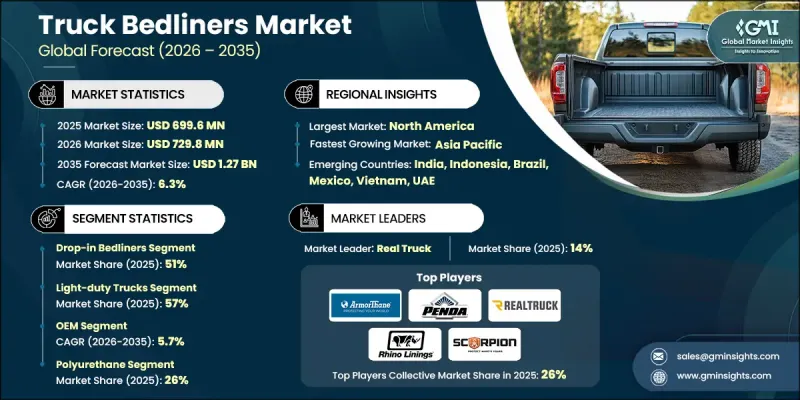
皮卡車在全球範圍內,無論是個人用途、商業用途或休閒用途,其日益普及都推動了市場成長。車輛保有量的持續成長不斷強化了皮卡車文化,並直接刺激了對貨箱保護解決方案的需求。貨箱襯墊被廣泛視為必不可少的配件,有助於保持車輛良好狀態,並有助於長期保值。OEM)和售後市場參與者均受益於更長的更換週期以及用戶群體對個人化客製化的不斷成長的需求。消費者越來越將皮卡車視為多功能資產,因此在提升車輛耐用性、外觀和實用性的配件上投入更多資金。貨箱襯墊仍然是最實用且經濟實惠的升級選項之一,因此廣受歡迎。配件零售網路的成長、DIY 普及以及產品供應的擴展進一步刺激了需求,尤其是在已開發市場和快速發展的城市地區。商業車隊營運商也做出了重要貢獻,因為耐用的貨箱保護有助於延長車輛使用壽命並降低日常維護成本,從而鞏固了貨箱襯墊作為一項具成本效益投資的地位。
| 市場範圍 | |
|---|---|
| 起始年份 | 2025 |
| 預測年份 | 2026-2035 |
| 起始值 | 6.996億美元 |
| 預測值 | 12.7億美元 |
| 複合年成長率 | 6.3% |
皮卡車主不斷對車輛進行個人化改裝,以提升車輛的功能性和視覺吸引力。貨箱襯墊因其卓越的防護性能和性價比而日益受到青睞。更便利的安裝方式以及消費者對自助安裝解決方案日益成長的信心,推動了售後市場滲透率的提升。商業營運商優先考慮耐用性,以減少與磨損相關的費用,從而確保了車隊應用領域對貨箱襯墊的穩定需求。
輕型卡車市場在2025年佔據57%的市場佔有率,預計2026年至2035年間將以7%的複合年成長率成長。該細分市場之所以領先,主要得益於較高的個人擁有率、配件支出增加、強勁的客製化趨勢以及電動皮卡車型的日益普及。此外,大規模生產能力和遍布全球的持續高貨箱襯墊安裝率也進一步鞏固了這些因素。
預計2026年至2035年間, OEM (原廠配套)細分市場將以5.7%的複合年成長率成長。 OEM安裝的貨箱襯墊可提供一體成型安裝、保固銜接以及為買家帶來的更多便利。輕型卡車產量不斷成長、高階原廠配件供應充足以及與供應商合作夥伴為滿足品質和監管標準而不斷擴大的合作,都將推動該細分市場的成長。
預計到2025年,美國卡車貨箱襯墊市場規模將達到2.619億美元。美國市場對耐用塗層解決方案的需求持續成長,尤其針對那些能夠承受高強度使用的場合。皮卡車的普及、車隊客製化程度的提高以及消費者對車輛個人化的日益重視,都推動了市場成長。製造商正積極回應市場需求,研發出與原廠車輛設計在視覺上相協調,同時又能維持性能耐久性的塗層產品。
目錄
第1章:方法論
第2章:執行概要
第3章:行業洞察
- 產業生態系分析
- 供應商格局
- 利潤率
- 成本結構
- 每個階段的價值增加
- 影響價值鏈的因素
- 中斷
- 產業影響因素
- 成長促進因素
- 皮卡車銷量上升
- 售後客製化市場成長
- 車輛防護的需求不斷成長
- 噴塗塗料技術的進步
- 產業陷阱與挑戰
- 原料成本波動
- 來自低成本替代品的競爭
- 市場機遇
- 新興皮卡市場的擴張
- OEM合作夥伴關係整合
- 開發環保塗料
- 商業車隊改裝業務成長
- 成長促進因素
- 成長潛力分析
- 監管環境
- 全球的
- 環境法規
- 排放控制要求
- 廢棄物處理條例
- 職業健康與安全標準
- 國際勞工組織標準
- 汽車OEM標準
- 北美洲
- 歐洲
- 亞太地區
- 拉丁美洲
- 中東和非洲
- 全球的
- 波特的分析
- PESTEL 分析
- 技術與創新格局
- 當前技術趨勢
- 聚氨酯化學與配方
- 聚脲化學與配方
- 混合系統技術
- 應用設備技術
- 新興技術
- 自修復塗層技術
- 奈米科技增強塗層
- 抗菌和抗微生物溶液
- 變色和熱致變色塗層
- 當前技術趨勢
- 定價分析
- 專業安裝價格
- 高級服務定價
- DIY產品定價
- 滾珠式套裝定價分析
- 床墊和地毯價格
- 嵌入式襯墊定價
- 電子商務與零售定價
- OEM安裝價格
- 生產統計
- 生產中心
- 消費中心
- 進出口
- 成本細分分析
- 製造成本結構
- 應用及安裝費用
- 分銷及通路成本
- 行銷和銷售成本
- 按細分市場進行獲利能力分析
- 成本最佳化策略
- 專利分析
- 永續性和環境方面
- 永續實踐
- 減少廢棄物策略
- 生產中的能源效率
- 環保舉措
- 碳足跡考量
- 消費者行為和客製化趨勢
- 客製化市場概覽
- 顏色和表面處理的偏好
- 紋理和表面客製化
- 功能客製化
- 按人口統計特徵分類的個人化趨勢
- 新興的客製化技術
- 區域購買偏好和使用模式
- 商業與個人區隔市場組合
- 按地區分類的使用模式分析
- 應用頻率和維護
第4章:競爭格局
- 介紹
- 公司市佔率分析
- 北美洲
- 歐洲
- 亞太地區
- 拉丁美洲
- MEA
- 主要市場參與者的競爭分析
- 競爭定位矩陣
- 戰略展望矩陣
- 關鍵進展
- 併購
- 合作夥伴關係與合作
- 新產品發布
- 擴張計劃和資金
第5章:市場估算與預測:依類型分類,2022-2035年
- 嵌入式貨箱襯墊
- 噴塗式貨箱襯裡
- 床墊和地毯
- 滾塗/刷塗式貨箱襯裡
- 混合型/客製化床襯
第6章:市場估算與預測:依材料分類,2022-2035年
- 聚氨酯
- 聚脲
- 橡皮
- 複合/聚乙烯
- 環氧樹脂配方
第7章:市場估價與預測:依車輛類型分類,2022-2035年
- 輕型卡車
- 中型卡車
- 重型卡車
第8章:市場估算與預測:依銷售管道分類,2022-2035年
- OEM
- 售後市場
- 線上零售
- 經銷商
第9章:市場估算與預測:依最終用途分類,2022-2035年
- 汽車
- 軍事與國防
- 能源(石油、天然氣和採礦)
- 建造
- 農業
- 零售與電子商務
- 其他
- 售後市場
第10章:市場估計與預測:依地區分類,2022-2035年
- 北美洲
- 美國
- 加拿大
- 歐洲
- 德國
- 英國
- 法國
- 義大利
- 西班牙
- 北歐
- 俄羅斯
- 波蘭
- 羅馬尼亞
- 亞太地區
- 中國
- 印度
- 日本
- 韓國
- 澳新銀行
- 越南
- 印尼
- 拉丁美洲
- 巴西
- 墨西哥
- 阿根廷
- MEA
- 南非
- 沙烏地阿拉伯
- 阿拉伯聯合大公國
第11章:公司簡介
- 全球公司
- ArmorThane
- BASF
- Dee Zee
- DualLiner
- Husky Liners
- LINE-X
- PPG Industries
- Rhino Linings
- Rugged Liner
- Ultimate Linings
- U-POL (RAPTOR)
- WeatherTech
- 區域玩家
- Aeroklas
- Armadillo Liners
- BedRug
- Bullet Liner
- Lund International
- OKULEN
- Penda Corporation
- Scorpion Protective Coatings
- SPEEDLINER
- Tuff Liner
- Vortex Liners
- 新興玩家
- AL's Liner
- Durabak
- Herculiner
- Iron Armor
- POR-15
The Global Truck Bedliners Market was valued at USD 699.6 million in 2025 and is estimated to grow at a CAGR of 6.3% to reach USD 1.27 billion by 2035.
Market momentum is driven by the rising global adoption of pickup trucks across personal, commercial, and recreational use. Increasing vehicle ownership continues to strengthen pickup truck culture, which directly fuels demand for protective cargo bed solutions. Bedliners are widely viewed as essential accessories that help preserve vehicle condition while supporting long-term value retention. Both OEM and aftermarket participants benefit from longer replacement timelines and a steady shift toward customization across user segments. Consumers increasingly view pickup trucks as multifunctional assets, prompting higher spending on accessories that enhance durability, appearance, and usability. Bedliners remain among the most practical and affordable upgrades, supporting their widespread acceptance. Growth in accessory retail networks, expanding do-it-yourself adoption, and broader product availability further stimulate demand, particularly in developed markets and fast-growing urban regions. Commercial fleet operators also contribute significantly, as durable bed protection helps extend vehicle service life and reduce ongoing maintenance expenses, reinforcing bedliners as a cost-efficient investment.
| Market Scope | |
|---|---|
| Start Year | 2025 |
| Forecast Year | 2026-2035 |
| Start Value | $699.6 Million |
| Forecast Value | $1.27 Billion |
| CAGR | 6.3% |
Pickup owners continue to personalize their vehicles to improve both functionality and visual appeal. Bedliners are increasingly selected for their protective performance and value proposition. Easier installation options and growing consumer confidence in self-installation solutions support rising aftermarket penetration. Commercial operators prioritize durability to limit wear-related expenses, reinforcing steady demand across fleet applications.
The light-duty truck segment accounted for a 57% share in 2025 and is projected to grow at a CAGR of 7% between 2026 and 2035. This segment leads due to higher personal ownership rates, increased spending on accessories, strong customization trends, and the growing presence of electric pickup models. These factors are reinforced by large-scale production capabilities and consistently high bedliner attachment rates across a broad geographic footprint.
The OEM segment is expected to grow at a CAGR of 5.7% from 2026 to 2035. OEM-installed bedliners offer integrated fitment, warranty alignment, and added convenience for buyers. Segment growth is supported by rising light truck production volumes, premium factory-installed accessory offerings, and expanding collaboration with supplier partners to meet quality and regulatory standards.
US Truck Bedliners Market reached USD 261.9 million in 2025. Demand in the US continues to be shaped by preferences for durable coating solutions suited for intensive use. Growth is supported by high adoption of pickup trucks, increased fleet customization, and strong consumer focus on vehicle personalization. Manufacturers are responding with finishes designed to align visually with factory vehicle designs while maintaining performance durability.
Key companies active in the Global Truck Bedliners Market include LINE-X, WeatherTech, Rhino Linings, DualLiner, Truck Hero (BedRug), Rugged Liner, Penda Corporation (Pendaliner), Ultimate Linings, SPEEDLINER (Industrial Polymers), and Scorpion Protective Coatings. Companies in the Global Truck Bedliners Market strengthen their competitive position through product innovation, expanded distribution networks, and strategic partnerships. Manufacturers invest in advanced materials to improve durability, appearance, and environmental performance. Many players focus on expanding OEM relationships to secure factory-fitment opportunities while also enhancing aftermarket reach through specialized retailers and installer networks. Brand differentiation is reinforced through customization options, improved installation efficiency, and consistent product quality. Geographic expansion into high-growth regions supports volume gains, while marketing strategies emphasize durability, long-term cost savings, and vehicle value preservation. Continuous investment in manufacturing efficiency and customer support further helps companies defend market share and build long-term brand loyalty.
Table of Contents
Chapter 1 Methodology
- 1.1 Market scope and definition
- 1.2 Research design
- 1.2.1 Research approach
- 1.2.2 Data collection methods
- 1.3 Data mining sources
- 1.3.1 Global
- 1.3.2 Regional/Country
- 1.4 Base estimates and calculations
- 1.4.1 Base year calculation
- 1.4.2 Key trends for market estimation
- 1.5 Primary research and validation
- 1.5.1 Primary sources
- 1.6 Forecast model
- 1.7 Research assumptions and limitations
Chapter 2 Executive Summary
- 2.1 Industry 3600 synopsis
- 2.2 Key market trends
- 2.2.1 Regional
- 2.2.2 Type
- 2.2.3 Material
- 2.2.4 Vehicle
- 2.2.5 Sales channel
- 2.2.6 End use
- 2.3 TAM analysis, 2026-2035
- 2.4 CXO perspectives: Strategic imperatives
- 2.4.1 Executive decision points
- 2.4.2 Critical success factors
- 2.5 Future outlook
- 2.6 Strategic recommendations
Chapter 3 Industry Insights
- 3.1 Industry ecosystem analysis
- 3.1.1 Supplier landscape
- 3.1.2 Profit margin
- 3.1.3 Cost structure
- 3.1.4 Value addition at each stage
- 3.1.5 Factor affecting the value chain
- 3.1.6 Disruptions
- 3.2 Industry impact forces
- 3.2.1 Growth drivers
- 3.2.1.1 Rising pickup truck sales
- 3.2.1.2 Growth in aftermarket customization
- 3.2.1.3 Increasing demand for vehicle protection
- 3.2.1.4 Advancements in spray-on coating materials
- 3.2.2 Industry pitfalls and challenges
- 3.2.2.1 Volatile raw material costs
- 3.2.2.2 Competition from low-cost alternatives
- 3.2.3 Market opportunities
- 3.2.3.1 Expansion in emerging pickup markets
- 3.2.3.2 OEM partnership integration
- 3.2.3.3 Development of eco-friendly coatings
- 3.2.3.4 Growth in commercial fleet upfitting
- 3.2.1 Growth drivers
- 3.3 Growth potential analysis
- 3.4 Regulatory landscape
- 3.4.1 Global
- 3.4.1.1 Environmental regulations
- 3.4.1.2 Emissions control requirements
- 3.4.1.3 Waste disposal regulations
- 3.4.1.4 Occupational health & safety standards
- 3.4.1.5 International labor organization standards
- 3.4.1.6 Automotive OEM standards
- 3.4.2 North America
- 3.4.3 Europe
- 3.4.4 Asia Pacific
- 3.4.5 Latin America
- 3.4.6 Middle East & Africa
- 3.4.1 Global
- 3.5 Porter's analysis
- 3.6 PESTEL analysis
- 3.7 Technology and innovation landscape
- 3.7.1 Current technological trends
- 3.7.1.1 Polyurethane chemistry & formulations
- 3.7.1.2 Polyurea chemistry & formulations
- 3.7.1.3 Hybrid system technologies
- 3.7.1.4 Application equipment technology
- 3.7.2 Emerging technologies
- 3.7.2.1 Self-healing coating technologies
- 3.7.2.2 Nano-technology enhanced coatings
- 3.7.2.3 Antimicrobial & antibacterial solutions
- 3.7.2.4 Color-changing & thermochromic finishes
- 3.7.1 Current technological trends
- 3.8 Pricing analysis
- 3.8.1.1 Professional installation pricing
- 3.8.1.2 Premium service pricing
- 3.8.1.3 DIY product pricing
- 3.8.1.4 Roll-on kit pricing analysis
- 3.8.1.5 Bed mat & rug pricing
- 3.8.1.6 Drop-in liner pricing
- 3.8.1.7 E-commerce vs retail pricing
- 3.8.1.8 OEM factory-install pricing
- 3.9 Production statistics
- 3.9.1 Production hubs
- 3.9.2 Consumption hubs
- 3.9.3 Export and import
- 3.10 Cost breakdown analysis
- 3.10.1 Manufacturing cost structure
- 3.10.2 Application & installation costs
- 3.10.3 Distribution & channel costs
- 3.10.4 Marketing & sales costs
- 3.10.5 Profitability analysis by segment
- 3.10.6 Cost optimization strategies
- 3.11 Patent analysis
- 3.12 Sustainability and environmental aspects
- 3.12.1 Sustainable practices
- 3.12.2 Waste reduction strategies
- 3.12.3 Energy efficiency in production
- 3.12.4 Eco-friendly initiatives
- 3.12.5 Carbon footprint considerations
- 3.13 Consumer behavior and customization trends
- 3.13.1 Customization market overview
- 3.13.2 Color & finish preferences
- 3.13.3 Texture & surface customization
- 3.13.4 Functional customization
- 3.13.5 Personalization trends by demographics
- 3.13.6 Emerging customization technologies
- 3.14 Regional purchasing preferences & usage patterns
- 3.14.1 Commercial vs personal segment mix
- 3.14.2 Usage pattern analysis by region
- 3.14.3 Application frequency & maintenance
Chapter 4 Competitive Landscape, 2025
- 4.1 Introduction
- 4.2 Company market share analysis
- 4.2.1 North America
- 4.2.2 Europe
- 4.2.3 Asia Pacific
- 4.2.4 LATAM
- 4.2.5 MEA
- 4.3 Competitive analysis of major market players
- 4.4 Competitive positioning matrix
- 4.5 Strategic outlook matrix
- 4.6 Key developments
- 4.6.1 Mergers & acquisitions
- 4.6.2 Partnerships & collaborations
- 4.6.3 New product launches
- 4.6.4 Expansion plans and funding
Chapter 5 Market Estimates & Forecast, By Type, 2022 - 2035 ($Mn, Units)
- 5.1 Key trends
- 5.2 Drop-in bedliners
- 5.3 Spray-on bedliners
- 5.4 Bed mats & rugs
- 5.5 Roll-on/brush-on bedliners
- 5.6 Hybrid/custom-fitted bedliners
Chapter 6 Market Estimates & Forecast, By Material, 2022 - 2035 ($Mn, Units)
- 6.1 Key trends
- 6.2 Polyurethane
- 6.3 Polyurea
- 6.4 Rubber
- 6.5 Composite/polyethylene
- 6.6 Epoxy-based formulations
Chapter 7 Market Estimates & Forecast, By Vehicle, 2022 - 2035 ($Mn, Units)
- 7.1 Key trends
- 7.2 Light-duty trucks
- 7.3 Medium-duty trucks
- 7.4 Heavy-duty trucks
Chapter 8 Market Estimates & Forecast, By Sales channel, 2022 - 2035 ($Mn, Units)
- 8.1 Key trends
- 8.2 OEM
- 8.3 Aftermarket
- 8.4 Online Retail
- 8.5 Dealerships
Chapter 9 Market Estimates & Forecast, By End use, 2022 - 2035 ($Mn, Units)
- 9.1 Key trends
- 9.2 Automotive
- 9.3 Military & defense
- 9.4 Energy (Oil, Gas, & Mining)
- 9.5 Construction
- 9.6 Agriculture
- 9.7 Retail & e-commerce
- 9.8 Others
- 9.9 Aftermarket
Chapter 10 Market Estimates & Forecast, By Region, 2022 - 2035 ($Mn, Units)
- 10.1 Key trends
- 10.2 North America
- 10.2.1 US
- 10.2.2 Canada
- 10.3 Europe
- 10.3.1 Germany
- 10.3.2 UK
- 10.3.3 France
- 10.3.4 Italy
- 10.3.5 Spain
- 10.3.6 Nordics
- 10.3.7 Russia
- 10.3.8 Poland
- 10.3.9 Romania
- 10.4 Asia Pacific
- 10.4.1 China
- 10.4.2 India
- 10.4.3 Japan
- 10.4.4 South Korea
- 10.4.5 ANZ
- 10.4.6 Vietnam
- 10.4.7 Indonesia
- 10.5 Latin America
- 10.5.1 Brazil
- 10.5.2 Mexico
- 10.5.3 Argentina
- 10.6 MEA
- 10.6.1 South Africa
- 10.6.2 Saudi Arabia
- 10.6.3 UAE
Chapter 11 Company Profiles
- 11.1 Global companies
- 11.1.1 ArmorThane
- 11.1.2 BASF
- 11.1.3 Dee Zee
- 11.1.4 DualLiner
- 11.1.5 Husky Liners
- 11.1.6 LINE-X
- 11.1.7 PPG Industries
- 11.1.8 Rhino Linings
- 11.1.9 Rugged Liner
- 11.1.10 Ultimate Linings
- 11.1.11 U-POL (RAPTOR)
- 11.1.12 WeatherTech
- 11.2 Regional players
- 11.2.1 Aeroklas
- 11.2.2 Armadillo Liners
- 11.2.3 BedRug
- 11.2.4 Bullet Liner
- 11.2.5 Lund International
- 11.2.6 OKULEN
- 11.2.7 Penda Corporation
- 11.2.8 Scorpion Protective Coatings
- 11.2.9 SPEEDLINER
- 11.2.10 Tuff Liner
- 11.2.11 Vortex Liners
- 11.3 Emerging players
- 11.3.1 AL’s Liner
- 11.3.2 Durabak
- 11.3.3 Herculiner
- 11.3.4 Iron Armor
- 11.3.5 POR-15

 2026-2030年全球卡車貨後廂墊市場
 卡車貨後廂墊市場分析與預測(至2035年):類型、產品類型、技術、應用、材料、最終用戶、功能、安裝方法
 車用配件市場:依產品類型、車輛類型、銷售管道和地區分類。
 汽車杯架市場:杯架類型、材質、安裝位置、容量、銷售管道和車型——2026-2032年全球市場預測卡車貨後廂墊市場:按類型、車輛類型、材料、最終用戶和分銷管道分類-2026-2032年全球市場預測汽車配件市場:依產品類型、材質、車輛類型和銷售管道-2026-2032年全球預測
 2026年全球皮卡車廂蓋市場研究報告
 2026年全球汽車杯架市場報告
 車載配件市場-全球產業規模、佔有率、趨勢、機會與預測:按產品類型、車輛類型、銷售管道、地區和競爭格局分類,2021-2031年汽車冷熱杯架市場按技術、應用、分銷管道和最終用戶分類,全球預測(2026-2032)