


 |
市場調查報告書
商品編碼
1892794
碾米機市場機會、成長促進因素、產業趨勢分析及預測(2025-2034年)Rice Milling Machine Market Opportunity, Growth Drivers, Industry Trend Analysis, and Forecast 2025 - 2034 |
||||||

2024 年全球碾米機市場價值為 12 億美元,預計到 2034 年將以 4.1% 的複合年成長率成長至 18 億美元。
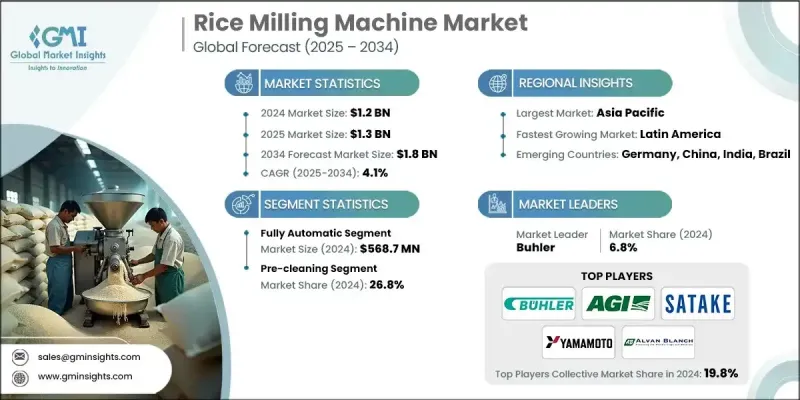
新興經濟體稻米產量的增加以及對高品質碾米設備需求的成長推動了市場的發展。自動化、節能設計和物聯網系統的進步正在改變市場格局,使碾米廠能夠在提高生產效率的同時最大限度地降低營運成本。全自動碾米系統因其能夠實現即時監控、最佳化效能並確保產量穩定而日益普及。政府推動農業現代化的舉措鼓勵採用先進的碾米解決方案,而製造商則正在開發專為小型農戶量身定做的模組化和緊湊型機器。這些機器的產能可調,能夠處理不同的稻米品種和季節性需求。隨著自動化和智慧技術的普及,碾米設備正從傳統設計朝向更靈活、互聯和高效的系統發展,以滿足大規模和在地化的加工需求。
| 市場範圍 | |
|---|---|
| 起始年份 | 2024 |
| 預測年份 | 2025-2034 |
| 起始值 | 12億美元 |
| 預測值 | 18億美元 |
| 複合年成長率 | 4.1% |
2024 年,全自動領域創造了 5.687 億美元的收入。這些系統通常與物聯網功能整合,可實現即時監控、營運最佳化和品質穩定,尤其是在高需求市場。
2024 年,預清理環節佔市場佔有率的 26.8%。預清理對於去除石塊、秸稈和灰塵等雜質、保護碾磨設備以及提高整體加工效率至關重要。
2024年,美國碾米機市佔率達到79%,這主要得益於自動化碾米技術的日益普及和消費者對優質米需求的成長。該地區的製造商已推出先進的碾米機,以滿足效率和品質方面的要求,從而支持不斷成長的米消費量。
目錄
第1章:方法論與範圍
第2章:執行概要
第3章:行業洞察
- 產業生態系分析
- 供應商格局
- 利潤率
- 每個階段的價值增加
- 影響價值鏈的因素
- 產業影響因素
- 成長促進因素
- 全球米消費和生產需求不斷成長
- 碾米自動化技術進步
- 政府支持農業現代化的舉措
- 產業陷阱與挑戰
- 缺乏機器操作熟練工人
- 先進銑削技術的前期投資較高
- 機會
- 對自動化和智慧銑削解決方案的需求不斷成長
- 新興市場擴張與小農戶一體化
- 成長促進因素
- 成長潛力分析
- 未來市場趨勢
- 技術與創新格局
- 當前技術趨勢
- 新興技術
- 價格趨勢
- 按地區
- 機器
- 監管環境
- 標準和合規要求
- 區域監理框架
- 認證標準
- 貿易統計(HS編碼- 84378020)
- 主要進口國
- 主要出口國
- 風險評估與緩解
- 差距分析
- 波特的分析
- PESTEL 分析
第4章:競爭格局
- 介紹
- 公司市佔率分析
- 按地區
- 公司矩陣分析
- 主要市場參與者的競爭分析
- 競爭定位矩陣
- 關鍵進展
- 併購
- 合作夥伴關係與合作
- 新產品發布
- 擴張計劃
第5章:市場估算與預測:依機器類型分類,2021-2034年
- 全自動
- 半自動
- 手動的
第6章:市場估計與預測:依技術分類,2021-2034年
- 傳統銑削
- 智慧/物聯網賦能的銑削
- 節能型研磨系統
第7章:市場估計與預測:依營運方式分類,2021-2034年
- 預先清潔
- 分離
- 等級
- 米漂白
- 其他
第8章:市場估算與預測:依產能分類,2021-2034年
- 小規模(低於10噸/天)
- 中等規模(10-50噸/天)
- 大規模(日產量超過50噸)
第9章:市場估算與預測:依最終用途分類,2021-2034年
- 商業磨坊
- 農夫/小型磨坊主
第10章:市場估價與預測:依配銷通路分類,2021-2034年
- 直接的
- 間接
第11章:市場估計與預測:按地區分類,2021-2034年
- 北美洲
- 美國
- 加拿大
- 歐洲
- 德國
- 英國
- 法國
- 西班牙
- 義大利
- 亞太地區
- 中國
- 日本
- 印度
- 澳洲
- 韓國
- 拉丁美洲
- 巴西
- 墨西哥
- 阿根廷
- MEA
- 南非
- 沙烏地阿拉伯
- 阿拉伯聯合大公國
第12章:公司簡介
- AG Growth International
- Alvan Blanch
- Buhler
- Fowler Westrup
- GG Dandekar
- Hubei Bishan
- Hubei Fotma
- Koolmill Systems
- Lushan Win Tone
- Mill Master
- PETKUS Technologie
- Ricetec
- Satake
- Yamamoto
- Zhejiang QiLi (QiLi Group)
The Global Rice Milling Machine Market was valued at USD 1.2 billion in 2024 and is estimated to grow at a CAGR of 4.1% to reach USD 1.8 billion by 2034.
The growth is driven by increasing rice production in emerging economies and rising demand for high-quality rice processing equipment. Advancements in automation, energy-efficient designs, and IoT-enabled systems are transforming the market, allowing mills to enhance productivity while minimizing operational costs. Fully automatic milling systems are becoming popular as they enable real-time monitoring, optimize performance, and ensure consistent output. Government initiatives promoting agricultural modernization are encouraging the adoption of advanced milling solutions, while manufacturers are developing modular and compact machines tailored to small-scale farmers. These machines offer adjustable capacities to handle different rice varieties and seasonal demands. As automation and smart technologies gain traction, rice milling equipment is evolving from traditional designs toward more flexible, connected, and efficient systems, addressing both large-scale and localized processing needs.
| Market Scope | |
|---|---|
| Start Year | 2024 |
| Forecast Year | 2025-2034 |
| Start Value | $1.2 Billion |
| Forecast Value | $1.8 Billion |
| CAGR | 4.1% |
The fully automatic segment generated USD 568.7 million in 2024. These systems, often integrated with IoT capabilities, allow real-time monitoring, operational optimization, and consistent quality, particularly in high-demand markets.
The pre-cleaning segment accounted for a 26.8% share in 2024. Pre-cleaning is essential for removing impurities such as stones, straw, and dust, protecting milling equipment, and enhancing overall processing efficiency.
U.S. Rice Milling Machine Market held a 79% market share in 2024, fueled by growing adoption of automated milling technologies and rising demand for high-quality rice. Manufacturers in the region have introduced advanced milling machines to meet efficiency and quality expectations, supporting increasing rice consumption.
Major players operating in the Global Rice Milling Machine Market include AG Growth International, Alvan Blanch, Buhler, Fowler Westrup, G.G. Dandekar, Hubei Bishan, Hubei Fotma, Koolmill Systems, Lushan Win Tone, Mill Master, PETKUS Technologie, Ricetec, Satake, Yamamoto, and Zhejiang QiLi (QiLi Group). Companies in the Rice Milling Machine Market are prioritizing technological innovation, developing fully automatic and IoT-enabled solutions that enhance efficiency, product quality, and operational monitoring. Manufacturers are also focusing on modular and portable designs to cater to small-scale and regional farmers. Strategic partnerships and collaborations with local distributors help expand market reach and tailor solutions to specific agricultural needs. Firms are investing in R&D to improve energy efficiency, reduce operational costs, and accommodate different rice varieties and seasonal production requirements.
Table of Contents
Chapter 1 Methodology & Scope
- 1.1 Market scope and definition
- 1.2 Research design
- 1.2.1 Research approach
- 1.2.2 Data collection methods
- 1.3 Data mining sources
- 1.3.1 Global
- 1.3.2 Regional/Country
- 1.4 Base estimates and calculations
- 1.4.1 Base year calculation
- 1.4.2 Key trends for market estimation
- 1.5 Primary research and validation
- 1.5.1 Primary sources
- 1.6 Forecast model
- 1.7 Research assumptions and limitations
Chapter 2 Executive Summary
- 2.1 Industry 360° synopsis
- 2.2 Key market trends
- 2.2.1 Regional
- 2.2.2 Machine
- 2.2.3 Technology
- 2.2.4 Operation
- 2.2.5 Capacity
- 2.2.6 End Use
- 2.2.7 Distribution Channel
- 2.3 CXO perspectives: Strategic imperatives
- 2.3.1 Key decision points for industry executives
- 2.3.2 Critical success factors for market players
- 2.4 Future outlook and strategic recommendations
Chapter 3 Industry Insights
- 3.1 Industry ecosystem analysis
- 3.1.1 Supplier landscape
- 3.1.2 Profit margin
- 3.1.3 Value addition at each stage
- 3.1.4 Factor affecting the value chain
- 3.2 Industry impact forces
- 3.2.1 Growth drivers
- 3.2.1.1 Rising global rice consumption and production demands
- 3.2.1.2 Technological advancements in rice milling automation
- 3.2.1.3 Government initiatives supporting agricultural modernization
- 3.2.2 Industry pitfalls & challenges
- 3.2.2.1 Lack of skilled labor for machine operation
- 3.2.2.2 High initial investment for advanced milling technology
- 3.2.3 Opportunities
- 3.2.3.1 Rising demand for automated and smart milling solutions
- 3.2.3.2 Expansion in emerging markets and smallholder integration
- 3.2.1 Growth drivers
- 3.3 Growth potential analysis
- 3.4 Future market trends
- 3.5 Technology and innovation landscape
- 3.5.1 Current technological trends
- 3.5.2 Emerging technologies
- 3.6 Price trends
- 3.6.1 By Region
- 3.6.2 By Machine
- 3.7 Regulatory landscape
- 3.7.1 Standards and compliance requirements
- 3.7.2 Regional regulatory frameworks
- 3.7.3 Certification standards
- 3.8 Trade statistics (HS Code- 84378020)
- 3.8.1 Major importing countries
- 3.8.2 Major exporting countries
- 3.9 Risk assessment and mitigation
- 3.10 Gap Analysis
- 3.11 Porter's analysis
- 3.12 PESTEL analysis
Chapter 4 Competitive Landscape, 2024
- 4.1 Introduction
- 4.2 Company market share analysis
- 4.2.1 By region
- 4.2.1.1 North America
- 4.2.1.2 Europe
- 4.2.1.3 Asia Pacific
- 4.2.1.4 Latin America
- 4.2.1.5 Middle East and Africa
- 4.2.1 By region
- 4.3 Company matrix analysis
- 4.4 Competitive analysis of major market players
- 4.5 Competitive positioning matrix
- 4.6 Key developments
- 4.6.1 Mergers & acquisitions
- 4.6.2 Partnerships & collaborations
- 4.6.3 New product launches
- 4.6.4 Expansion plans
Chapter 5 Market Estimates & Forecast, By Machine, 2021-2034 (USD Million) (Thousand Units)
- 5.1 Key trends
- 5.2 Fully automatic
- 5.3 Semi-automatic
- 5.4 Manual
Chapter 6 Market Estimates & Forecast, By Technology, 2021-2034 (USD Million) (Thousand Units)
- 6.1 Key trends
- 6.2 Conventional milling
- 6.3 Smart/IoT-enabled milling
- 6.4 Energy-efficient milling systems
Chapter 7 Market Estimates & Forecast, By Operation, 2021-2034 (USD Million) (Thousand Units)
- 7.1 Key trends
- 7.2 Pre-cleaning
- 7.3 Separating
- 7.4 Grading
- 7.5 Rice whitening
- 7.6 Other
Chapter 8 Market Estimates & Forecast, By Capacity, 2021-2034 (USD Million) (Thousand Units)
- 8.1 Key trends
- 8.2 Small-scale (below 10 tons/day)
- 8.3 Medium-scale (10-50 tons/day)
- 8.4 Large-scale (above 50 tons/day)
Chapter 9 Market Estimates & Forecast, By End Use, 2021-2034 (USD Million) (Thousand Units)
- 9.1 Key trends
- 9.2 Commercial mills
- 9.3 Farmers/small millers
Chapter 10 Market Estimates & Forecast, By Distribution Channel, 2021-2034 (USD Million) (Thousand Units)
- 10.1 Key trends
- 10.2 Direct
- 10.3 Indirect
Chapter 11 Market Estimates & Forecast, By Region, 2021-2034 (USD Million) (Thousand Units)
- 11.1 Key trends
- 11.2 North America
- 11.2.1 U.S.
- 11.2.2 Canada
- 11.3 Europe
- 11.3.1 Germany
- 11.3.2 UK
- 11.3.3 France
- 11.3.4 Spain
- 11.3.5 Italy
- 11.4 Asia Pacific
- 11.4.1 China
- 11.4.2 Japan
- 11.4.3 India
- 11.4.4 Australia
- 11.4.5 South Korea
- 11.5 Latin America
- 11.5.1 Brazil
- 11.5.2 Mexico
- 11.5.3 Argentina
- 11.6 MEA
- 11.6.1 South Africa
- 11.6.2 Saudi Arabia
- 11.6.3 UAE
Chapter 12 Company Profiles
- 12.1 AG Growth International
- 12.2 Alvan Blanch
- 12.3 Buhler
- 12.4 Fowler Westrup
- 12.5 G.G. Dandekar
- 12.6 Hubei Bishan
- 12.7 Hubei Fotma
- 12.8 Koolmill Systems
- 12.9 Lushan Win Tone
- 12.10 Mill Master
- 12.11 PETKUS Technologie
- 12.12 Ricetec
- 12.13 Satake
- 12.14 Yamamoto
- 12.15 Zhejiang QiLi (QiLi Group)

 食品加工機械市場:按設備類型、自動化程度、運作模式、產能範圍、動力來源和最終用途產業分類的全球預測,2026-2032年食品加工機械設備市場:依機器類型、操作方式、技術、應用、最終用戶和分銷管道分類,全球預測,2026-2032年全球麵條生產設備市場(按產品類型、技術、產能和最終用戶分類)預測(2026-2032年)嵌入式保溫食品保溫櫃市場:依最終用戶、通路、產品類型、材料類型和操作模式分類,全球預測(2026-2032年)食品保鮮設備市場按類型、技術、容量、最終用途、應用和分銷管道分類,全球預測(2026-2032年)
 起司切割機市場規模、佔有率及成長分析(按類型、材質、切割速度、切割方式、應用和地區分類)-2026-2033年產業預測
 2026-2034年低溫慢煮市場規模、佔有率、趨勢和成長分析報告全球食品加工設備市場規模、佔有率、趨勢和成長分析報告(2026-2034年)
 2026年全球糧食加工設備市場報告2026年全球衛生易清潔食品加工設備市場報告