


 |
市場調查報告書
商品編碼
1892749
聚甲醛市場機會、成長促進因素、產業趨勢分析及預測(2026-2035年)Polyoxymethylene Market Opportunity, Growth Drivers, Industry Trend Analysis, and Forecast 2026 - 2035 |
||||||

2025年全球聚甲醛市場價值為36億美元,預計到2035年將以7.4%的複合年成長率成長至72億美元。
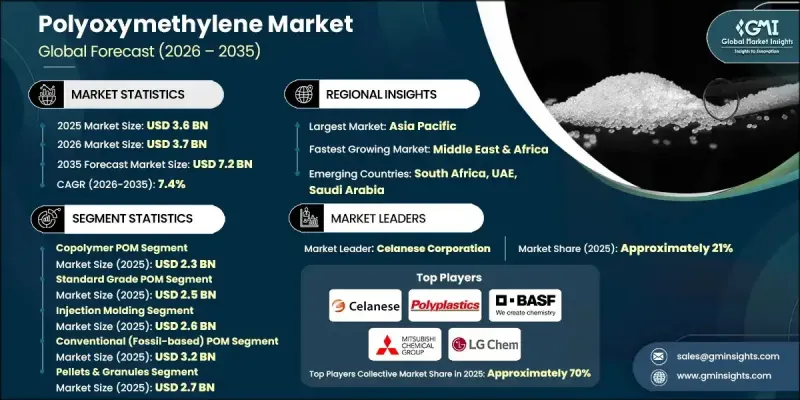
POM(聚甲醛)市場近年來成長顯著,主要得益於汽車產業的強勁需求。汽車產業對輕質、高強度和耐用材料的需求不斷成長。 POM的特性使其成為生產精密汽車零件(如齒輪、卡扣和連接器)的理想材料,有助於汽車製造商實現提高燃油效率和減輕車身重量的目標。全球汽車產量的持續成長進一步鞏固了POM市場。此外,消費性電子和家電領域也為市場擴張做出了貢獻。 POM的尺寸穩定性、優異的電絕緣性和耐磨性使其成為內部組件、連接器和外殼的理想選擇。隨著市場對緊湊型、高性能電子產品的需求不斷成長,製造商越來越依賴POM來滿足嚴格的品質和安全標準,從而促進生產和收入成長。
| 市場範圍 | |
|---|---|
| 起始年份 | 2025 |
| 預測年份 | 2026-2035 |
| 起始值 | 36億美元 |
| 預測值 | 72億美元 |
| 複合年成長率 | 7.4% |
2025年,共聚物POM市場規模達23億美元,預計2026年至2035年間將以7.5%的複合年成長率成長。共聚物POM以其優異的耐化學性和熱穩定性而著稱,廣泛應用於醫療器材和消費性電器等需要在嚴苛環境下使用的產品。該市場使製造商能夠滿足不同行業對性能的特殊要求。
2025 年標準級 POM 市場價值為 25 億美元,預計從 2026 年到 2035 年將以 7.1% 的複合年成長率成長。標準級和增強級主要用於一般工程應用,而衝擊改質級則具有更高的韌性和抗應力性,可滿足特定的工業需求。
預計2025年,北美聚甲醛(POM)市場規模將達6.4億美元。該地區POM的應用主要受汽車、電子和工業機械行業需求的驅動。先進的POM製造流程能夠生產輕量化、耐用且精密的零件,而對自動化和材料效率的投資則進一步推動了市場擴張。
目錄
第1章:方法論
第2章:執行概要
第3章:行業洞察
- 產業生態系分析
- 供應商格局
- 利潤率
- 每個階段的價值增加
- 影響價值鏈的因素
- 中斷
- 產業影響因素
- 成長促進因素
- 產業陷阱與挑戰
- 市場機遇
- 成長潛力分析
- 監管環境
- 北美洲
- 歐洲
- 亞太地區
- 拉丁美洲
- 中東和非洲
- 波特的分析
- PESTEL 分析
- 價格趨勢
- 按地區
- 按類型
- 未來市場趨勢
- 技術與創新格局
- 當前技術趨勢
- 新興技術
- 專利格局
- 貿易統計(註:僅提供重點國家的貿易統計)
- 主要進口國
- 主要出口國
- 永續性和環境方面
- 永續實踐
- 減少廢棄物策略
- 生產中的能源效率
- 環保舉措
- 碳足跡考量
第4章:競爭格局
- 介紹
- 公司市佔率分析
- 按地區
- 北美洲
- 歐洲
- 亞太地區
- 拉丁美洲
- MEA
- 按地區
- 公司矩陣分析
- 主要市場參與者的競爭分析
- 競爭定位矩陣
- 關鍵進展
- 併購
- 合作夥伴關係與合作
- 新產品發布
- 擴張計劃
第5章:市場估算與預測:依類型分類,2022-2035年
- 均聚物POM
- 共聚物POM
第6章:市場估算與預測:依等級分類,2022-2035年
- 標準級聚甲醛
- 增強聚甲醛
- 玻璃纖維增強聚甲醛
- 玻璃珠填充的POM
- 礦物耦合顆粒有機物
- 碳纖維增強聚甲醛
- 衝擊改質級聚甲醛
- 醫用級聚甲醛
- 紫外線穩定級聚甲醛
- 其他年級
第7章:市場估算與預測:依加工方式分類,2022-2035年
- 射出成型
- 擠壓
- 吹塑成型
- 壓縮成型
- 旋轉成型
- 金屬射出成型(MIM)
第8章:市場估算與預測:依原料類型分類,2022-2035年
- 傳統(化石基)多金屬氧酸鹽
- 生物基POM(ECO-B)
- 低碳POM(ECO-C)
- 再生材料聚甲醛
- 其他
第9章:市場估算與預測:依形式分類,2022-2035年
- 顆粒和粒料
- 桿
- 床單
- 電影
- 簡介
- 模製零件
第10章:市場估計與預測:依最終用途產業分類,2022-2035年
- 汽車產業
- 內部系統
- 外部系統
- 動力系統及引擎室
- 燃油系統
- 安全系統
- 懸吊系統
- 電池系統(電動車應用)
- 醫療保健產業
- 藥物輸送裝置
- 診斷設備
- 手術器械
- 流體處理系統
- 電氣和電子行業
- 連接器
- 開關
- 外殼和箱體
- 精密部件
- 消費品產業
- 家用電器
- 電動工具
- 手動工具
- 玩具
- 家具
- 個人護理
- 運動器材
- 工業機械業
- 齒輪和傳動部件
- 軸承和襯套
- 輸送系統
- 幫浦組件
- 水暖和建築業
- 水暖裝置
- 水系統
- 建築五金
- 其他終端用戶產業
第11章:市場估計與預測:按地區分類,2022-2035年
- 北美洲
- 美國
- 加拿大
- 歐洲
- 德國
- 英國
- 法國
- 義大利
- 西班牙
- 歐洲其他地區
- 亞太地區
- 中國
- 印度
- 日本
- 澳洲
- 韓國
- 亞太其他地區
- 拉丁美洲
- 巴西
- 墨西哥
- 阿根廷
- 拉丁美洲其他地區
- 中東和非洲
- 沙烏地阿拉伯
- 南非
- 阿拉伯聯合大公國
- 中東和非洲其他地區
第12章:公司簡介
- Celanese Corporation
- Polyplastics Co., Ltd.
- BASF SE
- 三菱化學集團公司
- LG Chem
- Formosa Plastics Corporation
- Asahi Kasei Corporation
- SABIC
- LyondellBasell Industries
- Daicel Corporation
- Kolon Plastics, Inc.
- Ensinger GmbH
- RTP Company
- Yunnan Yuntianhua
- Henan Energy Group Co., Ltd.
- Shanghai Bluestar POM
- Ticona (Celanese brand)
- PTM Engineering Plastics
The Global Polyoxymethylene Market was valued at USD 3.6 billion in 2025 and is estimated to grow at a CAGR of 7.4% to reach USD 7.2 billion by 2035.
POM has witnessed significant growth, primarily driven by the automotive sector, where demand for lightweight, high-strength, and durable materials is rising. Its properties make it ideal for producing precision car components such as gears, clips, and connectors, supporting automakers' goals of enhancing fuel efficiency and reducing vehicle weight. The market is further strengthened by consistent growth in automotive production globally. Additionally, the consumer electronics and appliances segment contributes to market expansion. POM's dimensional stability, excellent electrical insulation, and resistance to wear make it a preferred choice for internal components, connectors, and housings. As the demand for compact, high-performance electronic products increases, manufacturers increasingly rely on POM to meet stringent quality and safety standards, boosting production and revenue growth.
| Market Scope | |
|---|---|
| Start Year | 2025 |
| Forecast Year | 2026-2035 |
| Start Value | $3.6 Billion |
| Forecast Value | $7.2 Billion |
| CAGR | 7.4% |
The copolymer POM segment reached USD 2.3 billion in 2025 and is expected to grow at a CAGR of 7.5% between 2026 and 2035. Copolymer POM, known for its superior chemical resistance and thermal stability, is widely used in products exposed to harsh conditions, including medical and consumer appliances. This segment allows manufacturers to cater to specialized performance requirements across diverse industries.
The standard grade POM segment was valued at USD 2.5 billion in 2025 and is anticipated to grow at a CAGR of 7.1% from 2026 to 2035. Standard and reinforced grades are primarily used in general engineering applications, while impact-modified grades offer enhanced toughness and stress resistance, addressing specific industrial needs.
North America Polyoxymethylene Market generated USD 640 million in 2025. The region's POM adoption is driven by demand in the automotive, electronics, and industrial machinery sectors. Advanced POM-based manufacturing enables the production of lightweight, durable, and precision components, and investments in automation and material efficiency further support market expansion.
Key players in the Global Polyoxymethylene Market include Celanese Corporation, Polyplastics Co., Ltd., BASF SE, Mitsubishi Chemical Group, LG Chem, and others. Companies in the Global Polyoxymethylene Market are implementing multiple strategies to strengthen their position and expand their market footprint. They are investing heavily in research and development to create customized grades with enhanced chemical, thermal, and mechanical properties. Strategic collaborations with automotive, electronics, and industrial machinery manufacturers ensure long-term supply contracts and promote the adoption of high-performance POM products. Expanding production capacity in key regions reduces lead times and supports local demand. Firms are also integrating sustainability initiatives, such as energy-efficient manufacturing and recycling programs, to meet environmental standards.
Table of Contents
Chapter 1 Methodology
- 1.1 Market scope and definition
- 1.2 Research design
- 1.2.1 Research approach
- 1.2.2 Data collection methods
- 1.3 Data mining sources
- 1.3.1 Global
- 1.3.2 Regional/Country
- 1.4 Base estimates and calculations
- 1.4.1 Base year calculation
- 1.4.2 Key trends for market estimation
- 1.5 Primary research and validation
- 1.5.1 Primary sources
- 1.6 Forecast model
- 1.7 Research assumptions and limitations
Chapter 2 Executive Summary
- 2.1 Industry 3600 synopsis
- 2.2 Key market trends
- 2.2.1 Regional
- 2.2.2 Type
- 2.2.3 Grade
- 2.2.4 Processing Method
- 2.2.5 Feedstock Type
- 2.2.6 Form
- 2.2.7 End Use Industry
- 2.3 TAM Analysis, 2026-2035
- 2.4 CXO perspectives: Strategic imperatives
- 2.4.1 Executive decision points
- 2.4.2 Critical success factors
- 2.5 Future Outlook and Strategic Recommendations
Chapter 3 Industry Insights
- 3.1 Industry ecosystem analysis
- 3.1.1 Supplier Landscape
- 3.1.2 Profit Margin
- 3.1.3 Value addition at each stage
- 3.1.4 Factor affecting the value chain
- 3.1.5 Disruptions
- 3.2 Industry impact forces
- 3.2.1 Growth drivers
- 3.2.2 Industry pitfalls and challenges
- 3.2.3 Market opportunities
- 3.3 Growth potential analysis
- 3.4 Regulatory landscape
- 3.4.1 North America
- 3.4.2 Europe
- 3.4.3 Asia Pacific
- 3.4.4 Latin America
- 3.4.5 Middle East & Africa
- 3.5 Porter's analysis
- 3.6 PESTEL analysis
- 3.7 Price trends
- 3.7.1 By region
- 3.7.2 By type
- 3.8 Future market trends
- 3.9 Technology and Innovation landscape
- 3.9.1 Current technological trends
- 3.9.2 Emerging technologies
- 3.10 Patent Landscape
- 3.11 Trade statistics (Note: the trade statistics will be provided for key countries only)
- 3.11.1 Major importing countries
- 3.11.2 Major exporting countries
- 3.12 Sustainability and Environmental Aspects
- 3.12.1 Sustainable Practices
- 3.12.2 Waste Reduction Strategies
- 3.12.3 Energy Efficiency in Production
- 3.12.4 Eco-friendly Initiatives
- 3.13 Carbon Footprint Considerations
Chapter 4 Competitive Landscape, 2025
- 4.1 Introduction
- 4.2 Company market share analysis
- 4.2.1 By region
- 4.2.1.1 North America
- 4.2.1.2 Europe
- 4.2.1.3 Asia Pacific
- 4.2.1.4 LATAM
- 4.2.1.5 MEA
- 4.2.1 By region
- 4.3 Company matrix analysis
- 4.4 Competitive analysis of major market players
- 4.5 Competitive positioning matrix
- 4.6 Key developments
- 4.6.1 Mergers & acquisitions
- 4.6.2 Partnerships & collaborations
- 4.6.3 New Product Launches
- 4.6.4 Expansion Plans
Chapter 5 Market Estimates and Forecast, By Type, 2022 - 2035 (USD Billion, Kilo Tons)
- 5.1 Key trends
- 5.2 Homopolymer POM
- 5.3 Copolymer POM
Chapter 6 Market Estimates and Forecast, By Grade, 2022 - 2035 (USD Billion, Kilo Tons)
- 6.1 Key trends
- 6.2 Standard Grade POM
- 6.3 Reinforced Grade POM
- 6.3.1 Glass Fiber Reinforced POM
- 6.3.2 Glass Bead Filled POM
- 6.3.3 Mineral Coupled POM
- 6.3.4 Carbon Fiber Reinforced POM
- 6.4 Impact Modified Grade POM
- 6.5 Medical Grade POM
- 6.6 UV Stabilized Grade POM
- 6.7 Other Grades
Chapter 7 Market Estimates and Forecast, By Processing Method, 2022 - 2035 (USD Billion, Kilo Tons)
- 7.1 Key trends
- 7.2 Injection Molding
- 7.3 Extrusion
- 7.4 Blow Molding
- 7.5 Compression Molding
- 7.6 Rotational Molding
- 7.7 Metal Injection Molding (MIM)
Chapter 8 Market Estimates and Forecast, By Feedstock Type, 2022 - 2035 (USD Billion, Kilo Tons)
- 8.1 Key trends
- 8.2 Conventional (Fossil-based) POM
- 8.3 Bio-based POM (ECO-B)
- 8.4 Low-Carbon POM (ECO-C)
- 8.5 Recycled Content POM
- 8.6 Others
Chapter 9 Market Estimates and Forecast, By Form, 2022 - 2035 (USD Billion, Kilo Tons)
- 9.1 Key trends
- 9.2 Pellets & Granules
- 9.3 Rods
- 9.4 Sheets
- 9.5 Films
- 9.6 Profiles
- 9.7 Molded Parts
Chapter 10 Market Estimates and Forecast, By End Use Industry, 2022 - 2035 (USD Billion, Kilo Tons)
- 10.1 Key trends
- 10.2 Automotive industry
- 10.2.1 Interior systems
- 10.2.2 Exterior systems
- 10.2.3 Powertrain & under-the-hood
- 10.2.4 Fuel systems
- 10.2.5 Safety systems
- 10.2.6 Suspension systems
- 10.2.7 Battery systems (EV applications)
- 10.3 Medical & healthcare industry
- 10.3.1 Drug delivery devices
- 10.3.2 Diagnostic devices
- 10.3.3 Surgical instruments
- 10.3.4 Fluid handling systems
- 10.4 Electrical & electronics industry
- 10.4.1 Connectors
- 10.4.2 Switches
- 10.4.3 Housings & enclosures
- 10.4.4 Precision components
- 10.5 Consumer goods industry
- 10.5.1 Appliances
- 10.5.2 Power tools
- 10.5.3 Hand tools
- 10.5.4 Toys
- 10.5.5 Furniture
- 10.5.6 Personal care
- 10.5.7 Sports equipment
- 10.6 Industrial machinery industry
- 10.6.1 Gears & transmission components
- 10.6.2 Bearings & bushings
- 10.6.3 Conveyor systems
- 10.6.4 Pump components
- 10.7 Plumbing & building industry
- 10.7.1 Plumbing fixtures
- 10.7.2 Water systems
- 10.7.3 Building hardware
- 10.8 Other end use industries
Chapter 11 Market Estimates and Forecast, By Region, 2022 - 2035 (USD Billion, Kilo Tons)
- 11.1 Key trends
- 11.2 North America
- 11.2.1 U.S.
- 11.2.2 Canada
- 11.3 Europe
- 11.3.1 Germany
- 11.3.2 UK
- 11.3.3 France
- 11.3.4 Italy
- 11.3.5 Spain
- 11.3.6 Rest of Europe
- 11.4 Asia Pacific
- 11.4.1 China
- 11.4.2 India
- 11.4.3 Japan
- 11.4.4 Australia
- 11.4.5 South Korea
- 11.4.6 Rest of Asia Pacific
- 11.5 Latin America
- 11.5.1 Brazil
- 11.5.2 Mexico
- 11.5.3 Argentina
- 11.5.4 Rest of Latin America
- 11.6 Middle East & Africa
- 11.6.1 Saudi Arabia
- 11.6.2 South Africa
- 11.6.3 UAE
- 11.6.4 Rest of Middle East & Africa
Chapter 12 Company Profiles
- 12.1 Celanese Corporation
- 12.2 Polyplastics Co., Ltd.
- 12.3 BASF SE
- 12.4 Mitsubishi Chemical Group of companies
- 12.5 LG Chem
- 12.6 Formosa Plastics Corporation
- 12.7 Asahi Kasei Corporation
- 12.8 SABIC
- 12.9 LyondellBasell Industries
- 12.10 Daicel Corporation
- 12.11 Kolon Plastics, Inc.
- 12.12 Ensinger GmbH
- 12.13 RTP Company
- 12.14 Yunnan Yuntianhua
- 12.15 Henan Energy Group Co., Ltd.
- 12.16 Shanghai Bluestar POM
- 12.17 Ticona (Celanese brand)
- 12.18 PTM Engineering Plastics

 聚甲醛市場報告:按類型、製造流程、等級、最終用戶和地區分類(2026-2034 年)
 聚甲醛(POM)全球市場規模、佔有率、趨勢和成長分析報告(2026-2034)
 聚甲醛市場:依樹脂類型、形態、銷售管道和應用分類-2026-2032年全球市場預測
 全球聚甲醛市場:按類型、等級、加工技術、終端應用產業及地區分類-預測至2030年
 2026年全球聚甲醛(POM)市場報告聚甲醛樹脂市場依產品類型、加工技術、等級、通路和應用分類-2026-2032年全球預測
 聚甲醛(POM):市場佔有率分析、產業趨勢與統計、成長預測(2026-2031)全球聚甲醛市場:市場規模、佔有率、成長率、產業分析、按類型、應用和地區劃分的考量、未來預測(2026-2034)
 聚甲醛市場規模、佔有率和成長分析(按類型、應用、加工方法、等級和地區分類)-2026-2033年產業預測
 聚甲醛的全球市場