


 |
市場調查報告書
商品編碼
1892746
妥爾油脂肪酸市場機會、成長促進因素、產業趨勢分析及預測(2026-2035年)Tall Oil Fatty Acid Market Opportunity, Growth Drivers, Industry Trend Analysis, and Forecast 2026 - 2035 |
||||||

2025 年全球妥爾油脂肪酸市場價值為 12 億美元,預計到 2035 年將以 3.5% 的複合年成長率成長至 17 億美元。
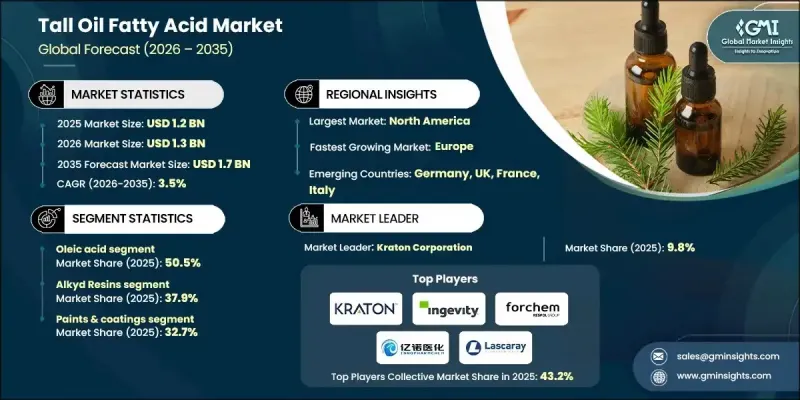
由於各行各業對永續和生物基化學品的需求不斷成長,該行業正經歷強勁成長。妥爾油脂肪酸源自松木硫酸鹽製漿,作為一種可再生且環保的傳統化學品替代品,正日益受到青睞。其生物分解性、低毒性和化學穩定性使其適用於多種應用。製造商利用其多功能性生產各種產品,包括肥皂、表面活性劑、潤滑劑、塑膠和塗料。其高抗氧化性和與其他化合物的相容性增強了其在工業配方中的功能性。隨著各行業尋求永續的替代方案,對環保塗料、塗層和潤滑劑的需求不斷成長,以及其在造紙和紙漿行業的化學程序應用,進一步推動了市場成長。日益嚴格的監管壓力和消費者對綠色產品的偏好也促進了其在全球的應用。
| 市場範圍 | |
|---|---|
| 起始年份 | 2025 |
| 預測年份 | 2026-2035 |
| 起始值 | 12億美元 |
| 預測值 | 17億美元 |
| 複合年成長率 | 3.5% |
2025年,油酸的市佔率達到50.5%,預計到2035年將以3.8%的複合年成長率成長。由於其天然、保濕和環保的特性,油酸在化妝品、潤滑劑和生物基產品中的需求不斷成長。萃取方法的不斷進步穩定了供應,並確保環保產品仍然是製造商關注的重點。
2025年,醇酸樹脂市佔率達到37.9%,預計2026年至2035年間將以3.6%的複合年成長率成長。源自妥爾油脂肪酸的二聚體酸需求不斷成長,主要歸功於其在高性能聚醯胺、環氧樹脂和黏合劑的應用。二聚體酸優異的耐化學性、耐久性和與工業應用的兼容性,以及塗料和密封劑生產技術的進步,都推動了其應用。此外,生產過程的永續性和環保性也進一步促進了二聚體酸市場的成長。
2024年,北美妥爾油脂肪酸市佔率達40.2%。該地區的成長主要得益於各行業(包括油漆、塗料、黏合劑和個人護理用品等)對永續和生物基化學品的強勁需求。日益嚴格的環境法規和消費者對環保產品意識的增強,促使製造商採用妥爾油衍生物。北美地區眾多大型化學和生物基企業的強大實力,也為妥爾油脂肪酸的創新和快速應用提供了支持。
目錄
第1章:方法論與範圍
第2章:執行概要
第3章:行業洞察
- 產業生態系分析
- 供應商格局
- 利潤率
- 每個階段的價值增加
- 影響價值鏈的因素
- 中斷
- 產業影響因素
- 成長促進因素
- 產業陷阱與挑戰
- 市場機遇
- 成長潛力分析
- 監管環境
- 北美洲
- 歐洲
- 亞太地區
- 拉丁美洲
- 中東和非洲
- 波特的分析
- PESTEL 分析
- 價格趨勢
- 按地區
- 依產品類型
- 未來市場趨勢
- 技術與創新格局
- 當前技術趨勢
- 新興技術
- 專利格局
- 貿易統計(HS編碼)(註:僅提供重點國家的貿易統計資料)
- 主要進口國
- 主要出口國
- 永續性和環境方面
- 永續實踐
- 減少廢棄物策略
- 生產中的能源效率
- 環保舉措
- 碳足跡考量
第4章:競爭格局
- 介紹
- 公司市佔率分析
- 按地區
- 北美洲
- 歐洲
- 亞太地區
- 拉丁美洲
- MEA
- 按地區
- 公司矩陣分析
- 主要市場參與者的競爭分析
- 競爭定位矩陣
- 關鍵進展
- 併購
- 合作夥伴關係與合作
- 新產品發布
- 擴張計劃
第5章:市場估算與預測:依產品類型分類,2022-2035年
- 油酸
- 亞麻油酸
- 棕櫚酸
- 硬脂酸
- 共軛亞麻油酸
第6章:市場估算與預測:依應用領域分類,2022-2035年
- 二聚酸
- 醇酸樹脂
- 脂肪酸酯
- 單體酸
- 三聚酸
- 乙氧基化物和丙氧基化物
- 胺和醯胺
第7章:市場估算與預測:依最終用途產業分類,2022-2035年
- 油漆和塗料
- 建築及裝飾塗料
- 汽車及交通運輸塗料
- 工業塗料
- 船舶和遊艇塗料
- 黏合劑和密封劑
- 石油和天然氣
- 肥皂和洗滌劑
- 工業清潔產品
- 家用清潔產品
- 汽車
- 汽車潤滑油
- 汽車塗料
- 汽車黏合劑和密封劑
- 橡膠和輪胎
- 紡織品
- 建造
- 建築材料
- 道路建設
- 礦業
- 生物燃料與能源
- 生質柴油生產
- 再生燃料添加劑
- 個人護理及化妝品
- 護髮
- 保養
- 製藥
- 農業
- 其他
第8章:市場估算與預測:依地區分類,2022-2035年
- 北美洲
- 美國
- 加拿大
- 歐洲
- 德國
- 英國
- 法國
- 西班牙
- 義大利
- 歐洲其他地區
- 亞太地區
- 中國
- 印度
- 日本
- 澳洲
- 韓國
- 亞太其他地區
- 拉丁美洲
- 巴西
- 墨西哥
- 阿根廷
- 拉丁美洲其他地區
- 中東和非洲
- 沙烏地阿拉伯
- 南非
- 阿拉伯聯合大公國
- 中東和非洲其他地區
第9章:公司簡介
- Forchem Oyj
- Harima Chemicals Group, Inc.
- Imperial Industrial Minerals Company
- Ingevity
- Kraton Corporation
- Lascaray SA
- NINGBO INNO PHARMCHEM CO.,LTD.
- Pasand Speciality Chemicals
- Pine Chemical Group
- Segezha Group
- SunPine AB
The Global Tall Oil Fatty Acid Market was valued at USD 1.2 billion in 2025 and is estimated to grow at a CAGR of 3.5% to reach USD 1.7 billion by 2035.
The industry is witnessing strong growth due to rising demand for sustainable and bio-based chemicals across multiple sectors. Tall oil fatty acid, derived from the kraft pulping of pine wood, is increasingly preferred as a renewable and environmentally friendly alternative to conventional chemicals. Its biodegradability, low toxicity, and chemical stability make it suitable for diverse applications. Manufacturers leverage their versatility to produce a wide range of products, including soaps, surfactants, lubricants, plastics, and coatings. Its high oxidation resistance and compatibility with other compounds enhance functionality in industrial formulations. The expanding demand for eco-friendly paints, coatings, and lubricants, along with their use as a chemical process in the paper and pulp industry, is further driving market growth as industries seek sustainable alternatives. Increasing regulatory pressure and consumer preference for greener products also support adoption worldwide.
| Market Scope | |
|---|---|
| Start Year | 2025 |
| Forecast Year | 2026-2035 |
| Start Value | $1.2 Billion |
| Forecast Value | $1.7 Billion |
| CAGR | 3.5% |
The oleic acid accounted for a 50.5% share in 2025 and is expected to grow at a CAGR of 3.8% through 2035. Its demand is rising in cosmetics, lubricants, and bio-based products due to its natural, moisturizing, and environmentally friendly properties. Continuous advancements in extraction methods are stabilizing supply and ensuring that eco-friendly products remain a central focus for manufacturers.
The alkyd resins segment held 37.9% share in 2025 and is projected to grow at a CAGR of 3.6% during 2026-2035. The increasing demand for dimer acids derived from tall oil fatty acids is attributed to their use in high-performance polyamides, epoxy resins, and adhesives. Their superior chemical resistance, durability, and compatibility with industrial applications, along with advancements in coatings and sealant production, drive their adoption. The sustainability and eco-friendliness of production processes further enhance the growth of dimer acids in the market.
North America Tall Oil Fatty Acid Market held a 40.2% share in 2024. Growth in this region is fueled by high demand for sustainable and bio-based chemicals across industries, including paints, coatings, adhesives, and personal care. Stringent environmental regulations and increasing consumer awareness regarding eco-friendly products push manufacturers to adopt tall oil derivatives. The strong presence of major chemical and bio-based companies in North America also supports innovation and the rapid adoption of tall oil fatty acids.
Key players in the Global Tall Oil Fatty Acid Market include Forchem Oyj, Harima Chemicals Group, Imperial Industrial Minerals Company, Ingevity, Kraton Corporation, Lascaray S.A., NINGBO INNO PHARMCHEM CO., LTD., Pasand Specialty Chemicals, Pine Chemical Group, Segezha Group, and SunPine AB. Companies in the Global Tall Oil Fatty Acid Market strengthen their foothold by focusing on research and development to enhance product quality and diversify applications across various industries. They are investing in sustainable and eco-friendly production methods to meet regulatory compliance and consumer demand. Strategic partnerships and collaborations with regional distributors and end-user industries expand market reach and improve supply chain efficiency. Additionally, firms are emphasizing marketing campaigns that highlight the renewable and environmentally responsible aspects of tall oil fatty acids, while continuously innovating formulations to address evolving industrial needs.
Table of Contents
Chapter 1 Methodology & Scope
- 1.1 Market scope and definition
- 1.2 Research design
- 1.2.1 Research approach
- 1.2.2 Data collection methods
- 1.3 Data mining sources
- 1.3.1 Global
- 1.3.2 Regional/Country
- 1.4 Base estimates and calculations
- 1.4.1 Base year calculation
- 1.4.2 Key trends for market estimation
- 1.5 Primary research and validation
- 1.5.1 Primary sources
- 1.6 Forecast model
- 1.7 Research assumptions and limitations
Chapter 2 Executive Summary
- 2.1 Industry 3600 synopsis
- 2.2 Key market trends
- 2.2.1 Regional
- 2.2.2 Product type
- 2.2.3 Application
- 2.2.4 End use industry
- 2.3 TAM Analysis, 2026-2035
- 2.4 CXO perspectives: Strategic imperatives
- 2.4.1 Executive decision points
- 2.4.2 Critical success factors
- 2.5 Future Outlook and Strategic Recommendations
Chapter 3 Industry Insights
- 3.1 Industry ecosystem analysis
- 3.1.1 Supplier landscape
- 3.1.2 Profit margin
- 3.1.3 Value addition at each stage
- 3.1.4 Factor affecting the value chain
- 3.1.5 Disruptions
- 3.2 Industry impact forces
- 3.2.1 Growth drivers
- 3.2.2 Industry pitfalls and challenges
- 3.2.3 Market opportunities
- 3.3 Growth potential analysis
- 3.4 Regulatory landscape
- 3.4.1 North America
- 3.4.2 Europe
- 3.4.3 Asia Pacific
- 3.4.4 Latin America
- 3.4.5 Middle East & Africa
- 3.5 Porter's analysis
- 3.6 PESTEL analysis
- 3.7 Price trends
- 3.7.1 By region
- 3.7.2 By Product type
- 3.8 Future market trends
- 3.9 Technology and Innovation landscape
- 3.9.1 Current technological trends
- 3.9.2 Emerging technologies
- 3.10 Patent Landscape
- 3.11 Trade statistics (HS code) ( Note: the trade statistics will be provided for key countries only)
- 3.11.1 Major importing countries
- 3.11.2 Major exporting countries
- 3.12 Sustainability and environmental aspects
- 3.12.1 Sustainable practices
- 3.12.2 Waste reduction strategies
- 3.12.3 Energy efficiency in production
- 3.12.4 Eco-friendly initiatives
- 3.13 Carbon footprint consideration
Chapter 4 Competitive Landscape, 2025
- 4.1 Introduction
- 4.2 Company market share analysis
- 4.2.1 By region
- 4.2.1.1 North America
- 4.2.1.2 Europe
- 4.2.1.3 Asia Pacific
- 4.2.1.4 LATAM
- 4.2.1.5 MEA
- 4.2.1 By region
- 4.3 Company matrix analysis
- 4.4 Competitive analysis of major market players
- 4.5 Competitive positioning matrix
- 4.6 Key developments
- 4.6.1 Mergers & acquisitions
- 4.6.2 Partnerships & collaborations
- 4.6.3 New Product Launches
- 4.6.4 Expansion Plans
Chapter 5 Market Estimates and Forecast, By Product Type, 2022-2035 (USD Billion) (Kilo Tons)
- 5.1 Key trends
- 5.2 Oleic acid
- 5.3 Linoleic acid
- 5.4 Palmitic acid
- 5.5 Stearic acid
- 5.6 Conjugated linoleic acid
Chapter 6 Market Estimates and Forecast, By Application, 2022-2035 (USD Billion) (Kilo Tons)
- 6.1 Key trends
- 6.2 Dimer acids
- 6.3 Alkyd resins
- 6.4 Fatty acid esters
- 6.5 Monomer acids
- 6.6 Trimer acids
- 6.7 Ethoxylates & propoxylates
- 6.8 Amines & amides
Chapter 7 Market Estimates and Forecast, By End Use Industry, 2022-2035 (USD Billion) (Kilo Tons)
- 7.1 Key trends
- 7.2 Paints & coatings
- 7.2.1 Architectural & decorative coatings
- 7.2.2 Automotive & transportation coatings
- 7.2.3 Industrial coatings
- 7.2.4 Marine & yacht coatings
- 7.3 Adhesives & sealants
- 7.4 Oil & gas
- 7.5 Soaps & detergents
- 7.5.1 Industrial cleaning products
- 7.5.2 Household cleaning products
- 7.6 Automotive
- 7.6.1 Automotive lubricants
- 7.6.2 Automotive coatings
- 7.6.3 Automotive adhesives & sealants
- 7.7 Rubber & tire
- 7.8 Textiles
- 7.9 Construction
- 7.9.1 Building materials
- 7.9.2 Road construction
- 7.10 Mining
- 7.11 Biofuels & energy
- 7.11.1 Biodiesel production
- 7.11.2 Renewable fuel additives
- 7.12 Personal care & cosmetics
- 7.12.1 Hair care
- 7.12.2 Skin care
- 7.13 Pharmaceuticals
- 7.14 Agriculture
- 7.15 Others
Chapter 8 Market Estimates and Forecast, By Region, 2022-2035 (USD Billion) (Kilo Tons)
- 8.1 Key trends
- 8.2 North America
- 8.2.1 U.S.
- 8.2.2 Canada
- 8.3 Europe
- 8.3.1 Germany
- 8.3.2 UK
- 8.3.3 France
- 8.3.4 Spain
- 8.3.5 Italy
- 8.3.6 Rest of Europe
- 8.4 Asia Pacific
- 8.4.1 China
- 8.4.2 India
- 8.4.3 Japan
- 8.4.4 Australia
- 8.4.5 South Korea
- 8.4.6 Rest of Asia Pacific
- 8.5 Latin America
- 8.5.1 Brazil
- 8.5.2 Mexico
- 8.5.3 Argentina
- 8.5.4 Rest of Latin America
- 8.6 Middle East and Africa
- 8.6.1 Saudi Arabia
- 8.6.2 South Africa
- 8.6.3 UAE
- 8.6.4 Rest of Middle East and Africa
Chapter 9 Company Profiles
- 9.1 Forchem Oyj
- 9.2 Harima Chemicals Group, Inc.
- 9.3 Imperial Industrial Minerals Company
- 9.4 Ingevity
- 9.5 Kraton Corporation
- 9.6 Lascaray S.A.
- 9.7 NINGBO INNO PHARMCHEM CO.,LTD.
- 9.8 Pasand Speciality Chemicals
- 9.9 Pine Chemical Group
- 9.10 Segezha Group
- 9.11 SunPine AB

 粗妥爾油衍生物市場:依衍生物類型、應用、終端用戶產業及銷售管道分類-2026-2032年全球市場預測妥爾油脂肪酸市場:2026-2032年全球市場預測(依產品類型、等級、應用、終端用戶產業及通路分類)妥爾油市場:依產品類型、原料、應用和終端用戶產業分類-2026-2032年全球預測
 全球粗妥爾油市場規模、佔有率、趨勢和成長分析報告(2026-2034年)
 2026年全球妥爾油脂肪酸市場報告
 妥爾油脂肪酸市場規模、佔有率及成長分析(按產品、應用、最終用戶和地區分類)-2026-2033年產業預測
 妥爾油粉(TOP):全球市場佔有率和排名、總收入和需求預測(2025-2031 年)
 2025 年至 2033 年粗妥爾油衍生物市場(按餾分、應用、最終用戶和地區分類)報告
 粗妥爾油的全球市場的評估:各產品,各地區,機會,預測(2018年~2032年)
 粗妥爾油市場-全球產業規模、佔有率、趨勢、機會和預測(按產品、應用、最終用戶、地區和競爭細分,2020-2030 年)