

 |
市場調查報告書
商品編碼
1892724
動態路線最佳化軟體市場機會、成長促進因素、產業趨勢分析及預測(2025-2034年)Dynamic Route Optimization Software Market Opportunity, Growth Drivers, Industry Trend Analysis, and Forecast 2025 - 2034 |
||||||

2024 年全球動態路線最佳化軟體市場價值為 19 億美元,預計到 2034 年將以 13.1% 的複合年成長率成長至 66 億美元。
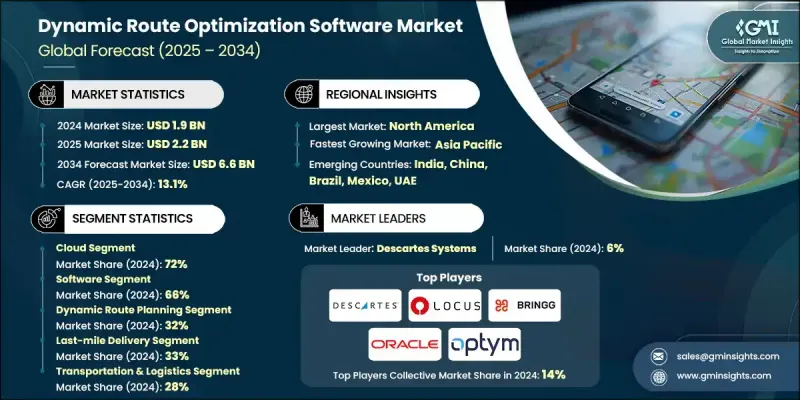
現代物流營運需要即時重新計算路線,以應對訂單量波動、交通中斷、服務水準承諾以及途中突發情況——這些挑戰是靜態路線規劃無法解決的。動態路線最佳化會持續重新計算最高效的路線,同時考慮車輛容量、駕駛員工作時間、配送時間窗口和即時路況。當發生交通事故或配送失敗時,路線會自動更新,以維持生產效率和準時交貨率。採用動態路線規劃的公司報告稱,準時交貨率超過 90%,遠高於傳統的手動規劃(通常為 70-80%)。對於尋求營運效率、客戶滿意度和競爭優勢的電商和物流供應商而言,這項功能已變得至關重要,因為車隊越來越依賴智慧的、人工智慧驅動的路線規劃來應對複雜多變的路況。
| 市場範圍 | |
|---|---|
| 起始年份 | 2024 |
| 預測年份 | 2025-2034 |
| 起始值 | 19億美元 |
| 預測值 | 66億美元 |
| 複合年成長率 | 13.1% |
雲端領域佔據了 72% 的市場佔有率,預計到 2034 年將以 13.4% 的複合年成長率成長。雲端基礎設施能夠即時攝取交通資料、遠端資訊處理數據、天氣更新和訂單管理訊息,確保分散式車隊的低延遲路線最佳化。
軟體業務在2024年佔66%,預計2025年至2034年間將以13.5%的複合年成長率成長。該業務板塊包括人工智慧驅動的路線規劃引擎、行動調度應用、最佳化演算法和管理介面的授權和訂閱服務。服務板塊涵蓋實施、整合、培訓、變更管理、持續支援、託管服務和諮詢。
美國動態路線最佳化軟體市場佔 81% 的市場佔有率,預計到 2024 年將創造 6.223 億美元的收入。美國的領先地位反映了國內主要參與者的營運規模和先進的物流需求,以及司機短缺帶來的壓力,而智慧裝載計畫正好可以解決這個問題。
目錄
第1章:方法論
第2章:執行概要
第3章:行業洞察
- 產業生態系分析
- 供應商格局
- 利潤率分析
- 成本結構
- 每個階段的價值增加
- 影響價值鏈的因素
- 中斷
- 產業影響因素
- 成長促進因素
- 電子商務交易量不斷成長,以及人們對更快配送速度的期望日益提高。
- AI/ML路由引擎的進步
- 越來越重視降低成本和提高車隊效率
- 遠端資訊處理、物聯網和即時交通資料可用性的成長
- 產業陷阱與挑戰
- 與TMS/WMS/ERP和傳統車載資訊系統整合的複雜性
- 交通/遠端資料處理資料的許可成本和隱私限制
- 供應商格局分散,投資報酬率衡量標準不明確。
- 市場機遇
- 亞太、拉丁美洲和中東非地區最後一公里物流的擴張
- 將DRO與TMS、視覺化和調度平台捆綁在一起
- 對永續性和低碳路線的需求
- 成長促進因素
- 成長潛力分析
- 監管環境
- 北美洲
- 歐洲
- 亞太地區
- 南美洲
- 中東和非洲
- 波特的分析
- PESTEL 分析
- 技術與創新格局
- 當前技術趨勢
- 新興技術
- 技術採納成熟度模型
- 產業成熟度評估
- 區域成熟度比較
- 成熟度發展路線圖
- 價格趨勢
- 按地區
- 依產品
- 成本細分分析
- 專利分析
- 永續性和環境方面
- 永續實踐
- 減少廢棄物策略
- 生產中的能源效率
- 環保舉措
- 碳足跡考量
- 市場成熟度與採納度分析
- 投資與融資分析
- 創投趨勢(2019-2024)
- 私募股權活動
- 首次公開募股活動及公開市場表現
- 企業創投參與
- 政府撥款和補貼
- 群眾募資和替代性融資
- 用例分析及產業應用
- 電子商務與零售應用案例
- 食品飲料應用案例
- 醫療保健和製藥應用案例
- 現場服務用例
- 最佳實踐框架與實施模型
- 實施方法
- 變革管理最佳實踐
- 數據品質與準備
- 整合最佳實踐
第4章:競爭格局
- 介紹
- 公司市佔率分析
- 主要市場參與者的競爭分析
- 競爭定位矩陣
- 戰略展望矩陣
- 關鍵進展
- 併購
- 合作夥伴關係與合作
- 新產品發布
- 擴張計劃和資金
第5章:市場估算與預測:依部署方式分類,2021-2034年
- 雲
- 本地部署
第6章:市場估算與預測:依組件分類,2021-2034年
- 軟體
- 核心最佳化引擎
- 使用者介面與體驗設計
- 行動應用程式和驅動程式工具
- API 和整合功能
- 服務
- 專業服務
- 託管服務
- 支援與維護服務
第7章:市場估算與預測:依路由技術與演算法分類,2021-2034年
- 動態路線規劃
- 混合路徑規劃(含動態元件)
- 持續最佳化
- 人工智慧和機器學習驅動的最佳化
- 動態網路路由與多層最佳化
第8章:市場估算與預測:依應用領域分類,2021-2034年
- 最後一公里配送最佳化
- 現場服務管理
- 貨運與物流管理
- 車隊管理與調度
- 大眾運輸和客運
- 廢棄物管理和市政服務
- 交叉轉運和整合
- 永續性和減排
第9章:市場估算與預測:依最終用途分類,2021-2034年
- 運輸與物流(第三方/第四方物流)
- 零售與電子商務
- 食品飲料分銷
- 醫療保健及醫療用品
- 製造業及工業分銷
- 政府和公共部門
- 公用事業和能源
- 批發與分銷
第10章:市場估計與預測:依組織規模分類,2021-2034年
- 大型企業
- 中小企業
第11章:市場估計與預測:按地區分類,2021-2034年
- 北美洲
- 美國
- 加拿大
- 歐洲
- 德國
- 英國
- 法國
- 義大利
- 西班牙
- 俄羅斯
- 北歐
- 波蘭
- 比荷盧經濟聯盟
- 亞太地區
- 中國
- 印度
- 日本
- 澳洲
- 韓國
- 東南亞
- 拉丁美洲
- 巴西
- 阿根廷
- 墨西哥
- MEA
- 南非
- 沙烏地阿拉伯
- 阿拉伯聯合大公國
第12章:公司簡介
- 全球參與者
- Alpega
- Blue Yonder
- Descartes Systems
- E2 open
- Manhattan Associates
- Omnitracs
- Oracle
- Paragon Software Systems (Aptean)
- SAP
- Shipwell
- Trimble
- Uber Freight
- Verizon Connect
- WorkWave
- Optym
- 區域玩家
- DispatchTrack
- HERE Technologies
- OptimoRoute
- Routific
- Transporeon
- 新興參與者
- Bringg
- FarEye
- Locus.sh
- Onfleet
- Route4 Me
- Wise Systems
The Global Dynamic Route Optimization Software Market was valued at USD 1.9 billion in 2024 and is estimated to grow at a CAGR of 13.1% to reach USD 6.6 billion by 2034.
Modern logistics operations demand real-time route recalculation to handle fluctuating order volumes, traffic disruptions, service-level commitments, and unexpected in-route insertions-challenges that static route planning cannot address. Dynamic route optimization continuously recalculates the most efficient routes, considering vehicle capacity, driver working hours, delivery time windows, and real-time traffic conditions. When traffic incidents occur or delivery attempts fail, routes are automatically updated to maintain productivity and on-time performance. Companies adopting dynamic routing report on-time delivery rates exceeding 90%, significantly higher than traditional manual planning, which typically achieves 70-80%. This capability has become essential for e-commerce and logistics providers seeking operational efficiency, customer satisfaction, and competitive advantage, as fleets increasingly rely on intelligent, AI-driven routing to navigate complex and rapidly changing conditions.
| Market Scope | |
|---|---|
| Start Year | 2024 |
| Forecast Year | 2025-2034 |
| Start Value | $1.9 Billion |
| Forecast Value | $6.6 Billion |
| CAGR | 13.1% |
The cloud segment held a 72% share and is expected to grow at a CAGR of 13.4% through 2034. Cloud infrastructure enables the real-time ingestion of traffic data, telematics feeds, weather updates, and order management information, ensuring low-latency route optimization across distributed fleets.
The software segment accounted for a 66% share in 2024 and is expected to grow at a CAGR of 13.5% between 2025 and 2034. This segment includes licenses and subscriptions for AI-driven route planning engines, mobile dispatch apps, optimization algorithms, and administrative interfaces. The services segment encompasses implementation, integration, training, change management, ongoing support, managed services, and consulting.
U.S. Dynamic Route Optimization Software Market held an 81% share, generating USD 622.3 million in 2024. Leadership in the U.S. reflects the operational scale and advanced logistics requirements of major domestic players, along with pressure from driver shortages, which intelligent load planning directly addresses.
Major players operating in the Global Dynamic Route Optimization Software Market include Bringg, Descartes Systems, Locus, Onfleet, OptimoRoute, Optym, Oracle, Route4Me, Routific, and Wise Systems. Companies in the dynamic route optimization software market are strengthening their presence by investing heavily in AI and machine learning to enhance real-time routing accuracy and predictive capabilities. Partnerships with fleet operators, logistics providers, and e-commerce firms help integrate solutions directly into operational workflows. Providers focus on cloud-native architectures for scalability, global deployment, and low-latency optimization across distributed fleets. Strategic acquisitions and alliances expand geographic reach and technology portfolios. Offering end-to-end solutions, including mobile applications, administrative dashboards, and managed services, helps companies retain clients and deliver measurable ROI. Continuous platform updates, customer support, and training services ensure adoption and satisfaction.
Table of Contents
Chapter 1 Methodology
- 1.1 Market scope and definition
- 1.2 Research design
- 1.2.1 Research approach
- 1.2.2 Data collection methods
- 1.3 Data mining sources
- 1.3.1 Global
- 1.3.2 Regional/Country
- 1.4 Base estimates and calculations
- 1.4.1 Base year calculation
- 1.4.2 Key trends for market estimation
- 1.5 Primary research and validation
- 1.5.1 Primary sources
- 1.6 Forecast model
- 1.7 Research assumptions and limitations
Chapter 2 Executive Summary
- 2.1 Industry 360° synopsis, 2021 - 2034
- 2.2 Key market trends
- 2.2.1 Regional
- 2.2.2 Deployment
- 2.2.3 Component
- 2.2.4 Routing Technology & Algorithm
- 2.2.5 Application
- 2.2.6 End Use
- 2.2.7 Organization Size
- 2.3 TAM Analysis, 2025-2034
- 2.4 CXO perspectives: Strategic imperatives
- 2.4.1 Executive decision points
- 2.4.2 Critical success factors
- 2.5 Future outlook and strategic recommendations
Chapter 3 Industry Insights
- 3.1 Industry ecosystem analysis
- 3.1.1 Supplier landscape
- 3.1.2 Profit margin analysis
- 3.1.3 Cost structure
- 3.1.4 Value addition at each stage
- 3.1.5 Factor affecting the value chain
- 3.1.6 Disruptions
- 3.2 Industry impact forces
- 3.2.1 Growth drivers
- 3.2.1.1 Rising e-commerce volumes and faster delivery expectations
- 3.2.1.2 Advancements in AI/ML-based routing engines
- 3.2.1.3 Increasing focus on cost reduction and fleet efficiency
- 3.2.1.4 Growth in telematics, IoT, and real-time traffic data availability
- 3.2.2 Industry pitfalls & challenges
- 3.2.2.1 Integration complexity with TMS/WMS/ERP and legacy telematics
- 3.2.2.2 Data licensing costs and privacy constraints for traffic/telematics data
- 3.2.2.3 Fragmented vendor landscape and unclear ROI measurement
- 3.2.3 Market opportunities
- 3.2.3.1 Expansion of last-mile logistics in APAC, LATAM, and MEA
- 3.2.3.2 Bundling DRO within TMS, visibility, and dispatch platforms
- 3.2.3.3 Demand for sustainability and carbon-efficient routing
- 3.2.1 Growth drivers
- 3.3 Growth potential analysis
- 3.4 Regulatory landscape
- 3.4.1 North America
- 3.4.2 Europe
- 3.4.3 Asia Pacific
- 3.4.4 South America
- 3.4.5 Middle East & Africa
- 3.5 Porter's analysis
- 3.6 PESTEL analysis
- 3.7 Technology and Innovation landscape
- 3.7.1 Current technological trends
- 3.7.2 Emerging technologies
- 3.7.3 Technology adoption maturity model
- 3.7.3.1 Industry maturity assessment
- 3.7.3.2 Regional maturity comparison
- 3.7.3.3 Maturity progression roadmap
- 3.8 Price trends
- 3.8.1 By region
- 3.8.2 By Products
- 3.9 Cost breakdown analysis
- 3.10 Patent analysis
- 3.11 Sustainability and environmental aspects
- 3.11.1 Sustainable practices
- 3.11.2 Waste reduction strategies
- 3.11.3 Energy efficiency in production
- 3.11.4 Eco-friendly initiatives
- 3.11.5 Carbon footprint considerations
- 3.11.6 Market Maturity & Adoption Analysis
- 3.12 Investment & funding analysis
- 3.12.1 Venture capital investment trends (2019-2024)
- 3.12.2 Private equity activity
- 3.12.3 IPO activity & public market performance
- 3.12.4 Corporate venture capital participation
- 3.12.5 Government grants & subsidies
- 3.12.6 Crowdfunding & alternative financing
- 3.13 Use case analysis & industry applications
- 3.13.1 E-commerce & retail use cases
- 3.13.2 Food & beverage use cases
- 3.13.3 Healthcare & pharmaceutical use cases
- 3.13.4 Field service use cases
- 3.14 Best practice frameworks & implementation models
- 3.14.1 Implementation methodology
- 3.14.2 Change management best practices
- 3.14.3 Data quality & preparation
- 3.14.4 Integration best practices
Chapter 4 Competitive Landscape, 2024
- 4.1 Introduction
- 4.2 Company market share analysis
- 4.2.1 North America
- 4.2.2 Europe
- 4.2.3 Asia Pacific
- 4.2.4 South America
- 4.2.5 MEA
- 4.3 Competitive analysis of major market players
- 4.4 Competitive positioning matrix
- 4.5 Strategic outlook matrix
- 4.6 Key developments
- 4.6.1 Mergers & acquisitions
- 4.6.2 Partnerships & collaborations
- 4.6.3 New Product Launches
- 4.6.4 Expansion Plans and funding
Chapter 5 Market Estimates & Forecast, By Deployment, 2021-2034 ($Bn)
- 5.1 Key trends
- 5.2 Cloud
- 5.3 On-premise
Chapter 6 Market Estimates & Forecast, By Component, 2021-2034 ($Bn)
- 6.1 Key trends
- 6.2 Software
- 6.2.1 Core optimization engines
- 6.2.2 User interface & experience design
- 6.2.3 Mobile applications & driver tools
- 6.2.4 API & integration capabilities
- 6.3 Services
- 6.3.1 Professional services
- 6.3.2 Managed services
- 6.3.3 Support & maintenance services
Chapter 7 Market Estimates & Forecast, By Routing Technology & Algorithm, 2021-2034 ($Bn)
- 7.1 Key trends
- 7.2 Dynamic route planning
- 7.3 Hybrid route planning (with dynamic components)
- 7.4 Continuous optimization
- 7.5 AI & machine learning-powered optimization
- 7.6 Dynamic network routing & multi-tier optimization
Chapter 8 Market Estimates & Forecast, By Application, 2021-2034 ($Bn)
- 8.1 Key trends
- 8.2 Last-mile delivery optimization
- 8.3 Field service management
- 8.4 Freight & logistics management
- 8.5 Fleet management & dispatch
- 8.6 Public transit & passenger transportation
- 8.7 Waste management & municipal services
- 8.8 Cross-docking & consolidation
- 8.9 Sustainability & emissions reduction
Chapter 9 Market Estimates & Forecast, By End Use, 2021-2034 ($Bn)
- 9.1 Key trends
- 9.2 Transportation & logistics (3pl/4pl)
- 9.3 Retail & e-commerce
- 9.4 Food & beverage distribution
- 9.5 Healthcare & medical supply
- 9.6 Manufacturing & industrial distribution
- 9.7 Government & public sector
- 9.8 Utilities & energy
- 9.9 Wholesale & distribution
Chapter 10 Market Estimates & Forecast, By Organization Size, 2021-2034 ($Bn)
- 10.1 Key trends
- 10.2 Large enterprise
- 10.3 Small & medium enterprises (SMEs)
Chapter 11 Market Estimates & Forecast, By Region, 2021 - 2034 ($Bn)
- 11.1 Key trends
- 11.2 North America
- 11.2.1 US
- 11.2.2 Canada
- 11.3 Europe
- 11.3.1 Germany
- 11.3.2 UK
- 11.3.3 France
- 11.3.4 Italy
- 11.3.5 Spain
- 11.3.6 Russia
- 11.3.7 Nordics
- 11.3.8 Poland
- 11.3.9 Benelux
- 11.4 Asia Pacific
- 11.4.1 China
- 11.4.2 India
- 11.4.3 Japan
- 11.4.4 Australia
- 11.4.5 South Korea
- 11.4.6 Southeast Asia
- 11.5 Latin America
- 11.5.1 Brazil
- 11.5.2 Argentina
- 11.5.3 Mexico
- 11.6 MEA
- 11.6.1 South Africa
- 11.6.2 Saudi Arabia
- 11.6.3 UAE
Chapter 12 Company Profiles
- 12.1 Global Players
- 12.1.1 Alpega
- 12.1.2 Blue Yonder
- 12.1.3 Descartes Systems
- 12.1.4. E2 open
- 12.1.5 Manhattan Associates
- 12.1.6 Omnitracs
- 12.1.7 Oracle
- 12.1.8 Paragon Software Systems (Aptean)
- 12.1.9 SAP
- 12.1.10 Shipwell
- 12.1.11 Trimble
- 12.1.12 Uber Freight
- 12.1.13 Verizon Connect
- 12.1.14 WorkWave
- 12.1.15 Optym
- 12.2 Regional Players
- 12.2.1 DispatchTrack
- 12.2.2 HERE Technologies
- 12.2.3 OptimoRoute
- 12.2.4 Routific
- 12.2.5 Transporeon
- 12.3 Emerging Players
- 12.3.1 Bringg
- 12.3.2 FarEye
- 12.3.3 Locus.sh
- 12.3.4 Onfleet
- 12.3.5. Route4 Me
- 12.3.6 Wise Systems

 路線最佳化軟體:市佔率分析、產業趨勢與統計、成長預測(2026-2031)
 基於人工智慧的路線最佳化市場預測至2034年-全球分析(按組件、部署模式、技術、路線類型、應用、最終用戶和地區分類)
 路線最佳化軟體市場規模、佔有率、趨勢和預測:按解決方案、部署類型、企業規模、行業和地區分類(2026-2034 年)
 2026年全球路線最佳化軟體市場報告2026年全球船舶航線最佳化人工智慧(AI)市場報告街道級路線最佳化市場預測至2034年-按組件、功能、企業規模、技術、應用、最終用戶和地區分類的全球分析
 引導帳戶匹配和路由軟體市場分析及至 2035 年的預測:按類型、產品類型、服務、技術、組件、應用、部署類型、最終用戶、功能和解決方案分類
 車輛路線最佳化軟體市場規模、佔有率、成長及全球產業分析:按類型、應用和地區分類的洞察,2026-2034 年預測
 路線最佳化軟體市場 - 全球產業規模、佔有率、趨勢、機會及預測(按解決方案、部署模式、公司規模、垂直產業、地區和競爭格局分類,2021-2031 年)
 2026-2030年全球路線最佳化軟體市場