

 |
市場調查報告書
商品編碼
1892679
量子超導材料市場機會、成長促進因素、產業趨勢分析及預測(2025-2034年)Superconducting Materials for Quantum Market Opportunity, Growth Drivers, Industry Trend Analysis, and Forecast 2025 - 2034 |
||||||

2024 年全球量子超導材料市場價值為 147 億美元,預計到 2034 年將以 11.7% 的複合年成長率成長至 471 億美元。
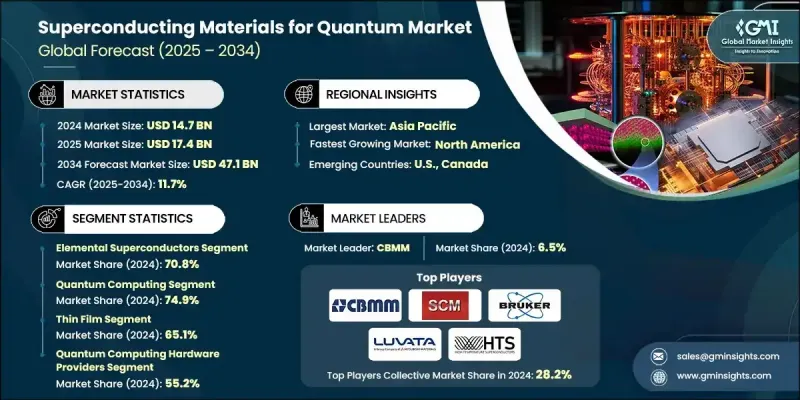
在量子運算、感測和通訊領域快速發展的推動下,超導材料正逐漸成為更廣泛的量子技術領域的核心支柱。超導材料能夠提供近乎零電阻,從而實現量子位元和量子電路的構建,這對於維持相干性和降低運行能耗至關重要。隨著政府機構和私人投資者加快對量子研究的投入,以及製藥、金融和網路安全等產業將量子解決方案融入長期策略,超導材料的發展勢頭日益強勁。可擴展量子處理器的需求持續成長,推動了超導元件的創新和商業化進程。除了計算領域,這些材料在成像系統、地質研究和環境監測等領域也越來越受歡迎。儘管高昂的成本和複雜的冷卻要求仍然是主要障礙,尤其是對能夠在低溫下穩定運行的可靠材料的需求,但目前針對高溫超導體的研究旨在降低運行成本並提高穩定性。預計這些技術的持續進步將在未來幾年拓展市場機會。
| 市場範圍 | |
|---|---|
| 起始年份 | 2024 |
| 預測年份 | 2025-2034 |
| 起始值 | 147億美元 |
| 預測值 | 471億美元 |
| 複合年成長率 | 11.7% |
2024年,元素超導體市佔率佔比達70.8%,預計到2034年將以11.7%的複合年成長率成長。這些材料,包括鈮、鉛和錫,仍然是加速器系統和診斷技術等科學和醫療應用的核心。它們的性能特徵已被廣泛認可,但由於需要極低的運行溫度,冷卻成本顯著增加,限制了其成長。
2024年,量子計算領域佔據74.9%的市場佔有率,預計2025年至2034年將以11.6%的複合年成長率成長。隨著越來越多的企業尋求能夠應對傳統系統無法處理的複雜運算挑戰的解決方案,量子運算的普及應用正在加速。這種不斷成長的需求促使企業加大對先進硬體和軟體的投資,量子技術在包括製藥、物流和金融建模在內的各個領域的影響也日益增強。技術生態系統中的主要參與者將繼續支持全球量子運算能力的擴展。
2024年,北美量子超導材料市場佔31.8%的比重。該地區的領先地位得益於大量的公共和私人投資、廣泛的研究項目以及強大的半導體和電子基礎,這些都促進了產品的快速商業化。大量資金投入量子硬體研發,為該地區超導材料的應用和發展創造了有利環境。
目錄
第1章:方法論與範圍
第2章:執行概要
第3章:行業洞察
- 產業生態系分析
- 供應商格局
- 利潤率
- 每個階段的價值增加
- 影響價值鏈的因素
- 中斷
- 產業影響因素
- 成長促進因素
- 產業陷阱與挑戰
- 市場機遇
- 成長潛力分析
- 監管環境
- 北美洲
- 歐洲
- 亞太地區
- 拉丁美洲
- 中東和非洲
- 波特的分析
- PESTEL 分析
- 價格趨勢
- 按地區
- 依產品類型
- 未來市場趨勢
- 技術與創新格局
- 當前技術趨勢
- 新興技術
- 專利格局
- 貿易統計(HS編碼)(註:僅提供重點國家的貿易統計資料)
- 主要進口國
- 主要出口國
- 永續性和環境方面
- 永續實踐
- 減少廢棄物策略
- 生產中的能源效率
- 環保舉措
- 碳足跡考量
第4章:競爭格局
- 介紹
- 公司市佔率分析
- 按地區
- 北美洲
- 歐洲
- 亞太地區
- 拉丁美洲
- MEA
- 按地區
- 公司矩陣分析
- 主要市場參與者的競爭分析
- 競爭定位矩陣
- 關鍵進展
- 併購
- 合作夥伴關係與合作
- 新產品發布
- 擴張計劃
第5章:市場估算與預測:依材料類型分類,2021-2034年
- 元素超導體
- 鈮(Nb)
- 鉭(Ta)
- 鋁(Al)
- 超導合金和化合物
- 鈮鈦合金(Nb-Ti)
- 鈮錫(Nb3Sn)
- 鈮鉭(Nb-Ta)
- 鈮鈦氮化物(NbTiN)
- 高溫超導體(HTS)
- YBCO(釔鋇銅氧化物)
- REBCO(稀土鋇銅氧化物)
- BSCCO(鉍鍶鈣銅氧化物)
第6章:市場估算與預測:依應用領域分類,2021-2034年
- 量子計算
- 量子感測
- 量子通訊與網路
第7章:市場估計與預測:依形式分類,2021-2034年
- 薄膜
- 桿和線
- 片材和箔材
- 粉末
- 其他
第8章:市場估算與預測:依最終用途分類,2021-2034年
- 量子運算硬體供應商
- 國防與航太
- 醫療保健與生命科學
- 基礎建設與地球物理
- 電信
- 科學研究機構
第9章:市場估計與預測:依地區分類,2021-2034年
- 北美洲
- 美國
- 加拿大
- 歐洲
- 德國
- 英國
- 法國
- 西班牙
- 義大利
- 歐洲其他地區
- 亞太地區
- 中國
- 印度
- 日本
- 澳洲
- 韓國
- 亞太其他地區
- 拉丁美洲
- 巴西
- 墨西哥
- 阿根廷
- 拉丁美洲其他地區
- 中東和非洲
- 沙烏地阿拉伯
- 南非
- 阿拉伯聯合大公國
- 中東和非洲其他地區
第10章:公司簡介
- Alloy Hit
- Bruker EAS (BEST)
- CBMM
- Hitachi
- Goodfellow
- High Temperature Superconductors Inc. (HTSI)
- Luvata
- Marketech International
- Stanford Advanced Materials
- Super Conductor Materials Inc. (SCM)
The Global Superconducting Materials for Quantum Market was valued at USD 14.7 billion in 2024 and is estimated to grow at a CAGR of 11.7% to reach USD 47.1 billion by 2034.
This sector is becoming a core pillar of the broader quantum technology landscape, supported by rapid advancements in quantum computing, sensing, and communication. Superconducting materials enable the creation of qubits and quantum circuits by offering near-zero electrical resistance, which is essential for maintaining coherence and reducing operational energy loss. Momentum is building as government bodies and private investors accelerate funding for quantum research and as industries such as pharmaceuticals, finance, and cybersecurity integrate quantum solutions into long-term strategies. Demand for scalable quantum processors continues to rise, driving innovation and commercialization efforts in superconducting components. Beyond computing, these materials are gaining traction in imaging systems, geological studies, and environmental monitoring. Although high costs and complex cooling requirements remain key barriers, particularly the need for reliable materials that perform at low temperatures, ongoing research focused on high-temperature superconductors aims to lower operational expenses and enhance stability. Continued progress in these technologies is expected to expand market opportunities in the coming years.
| Market Scope | |
|---|---|
| Start Year | 2024 |
| Forecast Year | 2025-2034 |
| Start Value | $14.7 Billion |
| Forecast Value | $47.1 Billion |
| CAGR | 11.7% |
The elemental superconductors segment accounted for a 70.8% share in 2024 and is projected to grow at an 11.7% CAGR through 2034. These materials, including niobium, lead, and tin, remain central to scientific and medical applications such as accelerator systems and diagnostic technologies. Their performance characteristics are widely established, yet their growth is tempered by the requirement for extremely low operating temperatures, which significantly increases cooling expenditure.
The quantum computing segment held a 74.9% share in 2024 and is set to grow at a CAGR of 11.6% from 2025 to 2034. Adoption is accelerating as more enterprises seek solutions capable of tackling complex computational challenges beyond the capabilities of traditional systems. This rising demand is inspiring larger investments in advanced hardware and software as quantum technology becomes more influential across sectors, including pharmaceuticals, logistics, and financial modeling. Major players in the technology ecosystem continue to support the scale-up of quantum computing capabilities worldwide.
North America Superconducting Materials for Quantum Market held a 31.8% share in 2024. The region's leadership is driven by substantial public and private investment, extensive research programs, and a strong semiconductor and electronics foundation that promotes rapid commercialization. Significant funding directed toward quantum hardware development is creating an environment conducive to the adoption and advancement of superconducting materials across the region.
Key companies active in the Global Superconducting Materials for Quantum Market include Alloy Hit, Bruker EAS (BEST), CBMM, Hitachi, Goodfellow, High Temperature Superconductors Inc., Luvata, Marketech International, Stanford Advanced Materials, and Super Conductor Materials Inc. (SCM). Companies competing in the Superconducting Materials for Quantum Market focus on several strategic initiatives to reinforce their standing. Many prioritize advancing material engineering to improve conductivity, stability, and performance at lower or more manageable temperatures, helping reduce cooling expenses. Firms are also strengthening partnerships with quantum hardware developers to integrate their materials more deeply into next-generation processors and sensing devices. Expanding production capabilities, enhancing quality control, and investing in precision fabrication technologies allow manufacturers to meet rising demand for highly reliable components.
Table of Contents
Chapter 1 Methodology & Scope
- 1.1 Market scope and definition
- 1.2 Research design
- 1.2.1 Research approach
- 1.2.2 Data collection methods
- 1.3 Data mining sources
- 1.3.1 Global
- 1.3.2 Regional/Country
- 1.4 Base estimates and calculations
- 1.4.1 Base year calculation
- 1.4.2 Key trends for market estimation
- 1.5 Primary research and validation
- 1.5.1 Primary sources
- 1.6 Forecast model
- 1.7 Research assumptions and limitations
Chapter 2 Executive Summary
- 2.1 Industry 360° synopsis
- 2.2 Key market trends
- 2.2.1 Regional
- 2.2.2 Material type
- 2.2.3 Application
- 2.2.4 Form
- 2.2.5 End Use
- 2.3 TAM Analysis, 2025-2034
- 2.4 CXO perspectives: Strategic imperatives
- 2.4.1 Executive decision points
- 2.4.2 Critical success factors
- 2.5 Future Outlook and Strategic Recommendations
Chapter 3 Industry Insights
- 3.1 Industry ecosystem analysis
- 3.1.1 Supplier landscape
- 3.1.2 Profit margin
- 3.1.3 Value addition at each stage
- 3.1.4 Factor affecting the value chain
- 3.1.5 Disruptions
- 3.2 Industry impact forces
- 3.2.1 Growth drivers
- 3.2.2 Industry pitfalls and challenges
- 3.2.3 Market opportunities
- 3.3 Growth potential analysis
- 3.4 Regulatory landscape
- 3.4.1 North America
- 3.4.2 Europe
- 3.4.3 Asia Pacific
- 3.4.4 Latin America
- 3.4.5 Middle East & Africa
- 3.5 Porter's analysis
- 3.6 PESTEL analysis
- 3.7 Price trends
- 3.7.1 By region
- 3.7.2 By Product type
- 3.8 Future market trends
- 3.9 Technology and Innovation landscape
- 3.9.1 Current technological trends
- 3.9.2 Emerging technologies
- 3.10 Patent Landscape
- 3.11 Trade statistics (HS code) ( Note: the trade statistics will be provided for key countries only)
- 3.11.1 Major importing countries
- 3.11.2 Major exporting countries
- 3.12 Sustainability and environmental aspects
- 3.12.1 Sustainable practices
- 3.12.2 Waste reduction strategies
- 3.12.3 Energy efficiency in production
- 3.12.4 Eco-friendly initiatives
- 3.13 Carbon footprint consideration
Chapter 4 Competitive Landscape, 2024
- 4.1 Introduction
- 4.2 Company market share analysis
- 4.2.1 By region
- 4.2.1.1 North America
- 4.2.1.2 Europe
- 4.2.1.3 Asia Pacific
- 4.2.1.4 LATAM
- 4.2.1.5 MEA
- 4.2.1 By region
- 4.3 Company matrix analysis
- 4.4 Competitive analysis of major market players
- 4.5 Competitive positioning matrix
- 4.6 Key developments
- 4.6.1 Mergers & acquisitions
- 4.6.2 Partnerships & collaborations
- 4.6.3 New Product Launches
- 4.6.4 Expansion Plans
Chapter 5 Market Estimates and Forecast, By Material Type, 2021-2034 (USD Billion) (Kilo Tons)
- 5.1 Key trends
- 5.2 Elemental Superconductors
- 5.2.1 Niobium (Nb)
- 5.2.2 Tantalum (Ta)
- 5.2.3 Aluminum (Al)
- 5.3 Superconducting Alloys & Compounds
- 5.3.1 Niobium-Titanium (Nb-Ti)
- 5.3.2 Niobium-Tin (Nb3Sn)
- 5.3.3 Niobium-Tantalum (Nb-Ta)
- 5.3.4 Niobium Titanium Nitride (NbTiN)
- 5.4 High-Temperature Superconductors (HTS)
- 5.4.1 YBCO (Yttrium Barium Copper Oxide)
- 5.4.2 REBCO (Rare-Earth Barium Copper Oxide)
- 5.4.3 BSCCO (Bismuth Strontium Calcium Copper Oxide)
Chapter 6 Market Estimates and Forecast, By Application, 2021-2034 (USD Billion) (Kilo Tons)
- 6.1 Key trends
- 6.2 Quantum computing
- 6.3 Quantum sensing
- 6.4 Quantum communication & networking
Chapter 7 Market Estimates and Forecast, By Form, 2021-2034 (USD Billion) (Kilo Tons)
- 7.1 Key trends
- 7.2 Thin films
- 7.3 Rods & wires
- 7.4 Sheets & foils
- 7.5 Powder
- 7.6 Others
Chapter 8 Market Estimates and Forecast, By End Use, 2021-2034 (USD Billion) (Kilo Tons)
- 8.1 Key trends
- 8.2 Quantum computing hardware providers
- 8.3 Defense & aerospace
- 8.4 Healthcare & life sciences
- 8.5 Infrastructure & geophysics
- 8.6 Telecommunications
- 8.7 Scientific research institutions
Chapter 9 Market Estimates and Forecast, By Region, 2021-2034 (USD Billion) (Kilo Tons)
- 9.1 Key trends
- 9.2 North America
- 9.2.1 U.S.
- 9.2.2 Canada
- 9.3 Europe
- 9.3.1 Germany
- 9.3.2 UK
- 9.3.3 France
- 9.3.4 Spain
- 9.3.5 Italy
- 9.3.6 Rest of Europe
- 9.4 Asia Pacific
- 9.4.1 China
- 9.4.2 India
- 9.4.3 Japan
- 9.4.4 Australia
- 9.4.5 South Korea
- 9.4.6 Rest of Asia Pacific
- 9.5 Latin America
- 9.5.1 Brazil
- 9.5.2 Mexico
- 9.5.3 Argentina
- 9.5.4 Rest of Latin America
- 9.6 Middle East and Africa
- 9.6.1 Saudi Arabia
- 9.6.2 South Africa
- 9.6.3 UAE
- 9.6.4 Rest of Middle East and Africa
Chapter 10 Company Profiles
- 10.1 Alloy Hit
- 10.2 Bruker EAS (BEST)
- 10.3 CBMM
- 10.4 Hitachi
- 10.5 Goodfellow
- 10.6 High Temperature Superconductors Inc. (HTSI)
- 10.7 Luvata
- 10.8 Marketech International
- 10.9 Stanford Advanced Materials
- 10.10 Super Conductor Materials Inc. (SCM)

 量子半導體裝置市場預測至2034年-全球分析(按元件類型、部署模式、材料類型、技術平台、製造技術、應用、最終用戶和地區分類)
 2026年全球超導性材料市場報告量子半導體材料市場預測:至 2034 年—按材料類型、晶圓尺寸、應用、最終用戶和地區分類的全球分析
 量子計算低溫解決方案(2026-2036):市場、技術與公司
 超導性材料市場分析及預測(至2035年):類型、產品類型、應用、技術、材料類型、最終用戶、組件、裝置、製程、安裝類型量子半導體材料市場分析及預測(至2035年):依類型、產品、服務、技術、組件、應用、材料類型、裝置、製程及最終用戶分類全球超導性材料市場規模、佔有率、趨勢和成長分析報告(2026-2034)
 鉭材料及鉭合金市場按應用產業、應用、材料形態、純度等級、合金類型和製造程序分類-2026年至2032年全球預測
 超導性材料市場規模、佔有率及成長分析(按產品、應用、類型及地區分類)-產業預測,2026-2033年
 超導材料市場機會、成長促進因素、產業趨勢分析及預測(2026-2035年)