


 |
市場調查報告書
商品編碼
1892672
家用廚房水槽市場機會、成長促進因素、產業趨勢分析及預測(2025-2034年)Household Kitchen Sink Market Opportunity, Growth Drivers, Industry Trend Analysis, and Forecast 2025 - 2034 |
||||||

2024 年全球家用廚房水槽市場價值為 71 億美元,預計到 2034 年將以 5.9% 的複合年成長率成長至 125 億美元。
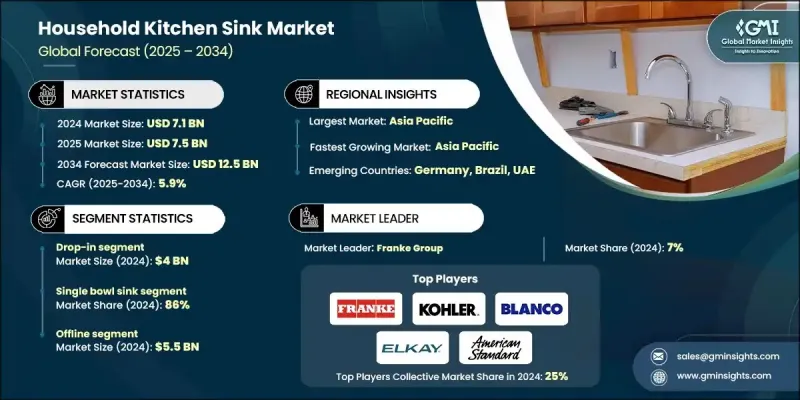
家居裝修項目的日益普及極大地推動了市場成長,而這又源於生活方式的提升、可支配收入的增加以及對更佳功能性和現代美感的追求。隨著消費者專注於現代設計和高階飾面,製造商也紛紛推出創新且可客製化的水槽產品。模組化廚房和豪華衛浴設備的日益流行,也為高品質水槽的需求注入了強勁動力。發展中地區的城市擴張也正在重塑住宅建設模式,尤其是在人口密集的城市,這些城市需要緊湊且美觀的廚房和浴室佈局。開發商正在採用更時尚、耐用且節省空間的水槽,以滿足不斷變化的消費者需求。拉丁美洲和亞太地區強勁的城市化趨勢,持續為那些能夠透過與建築商建立長期合作關係,提供價格具有競爭力且物有所值的產品的製造商創造了持續的機會。
| 市場範圍 | |
|---|---|
| 起始年份 | 2024 |
| 預測年份 | 2025-2034 |
| 起始值 | 71億美元 |
| 預測值 | 125億美元 |
| 複合年成長率 | 5.9% |
2024年,嵌入式水槽市場規模預計將達40億美元。這種安裝方式憑藉其成本效益、簡單的安裝流程以及與各種檯面設計的兼容性,在全球市場佔據領先地位。其廣泛的適用性使其成為翻新和新建住宅項目的首選。
2024年,單槽水槽佔了86%的市場。這一主導地位歸功於其節省空間的設計和實惠的價格,使其成為城市住宅和緊湊型廚房的理想之選。其簡潔的設計也使其易於安裝和維護,從而提升了其對承包商和屋主的吸引力。
2024年,中國家用廚房水槽市場佔據27%的市場佔有率,市場規模達7.8億美元。快速的城市化進程、不斷擴大的住宅開發以及居民收入的成長持續刺激著市場需求。強大的國內製造業生態系統確保了快速的生產週期和新型水槽設計的快速普及,鞏固了中國在該地區的領先地位。
目錄
第1章:方法論與範圍
第2章:執行概要
第3章:行業洞察
- 產業生態系分析
- 供應商格局
- 利潤率
- 每個階段的價值增加
- 影響價值鏈的因素
- 產業影響因素
- 成長促進因素
- 房屋翻新和改造活動日益增多
- 都市化及新建住宅
- 技術進步和智慧廚房整合
- 產業陷阱與挑戰
- 原料和製造成本高昂
- 農村地區的認知度和接受度有限
- 機會
- 都市化進程加速及現代生活水準提高
- 日益重視節水和永續發展
- 成長促進因素
- 成長潛力分析
- 未來市場趨勢
- 技術與創新格局
- 當前技術趨勢
- 新興技術
- 價格趨勢
- 按地區
- 依設備類型
- 監管環境
- 標準和合規要求
- 區域監理框架
- 認證標準
- 波特的分析
- PESTEL 分析
第4章:競爭格局
- 介紹
- 公司市佔率分析
- 按地區
- 公司矩陣分析
- 主要市場參與者的競爭分析
- 競爭定位矩陣
- 關鍵進展
- 併購
- 合作夥伴關係與合作
- 新產品發布
- 擴張計劃
第5章:市場估算與預測:依安裝類型分類,2021-2034年
- 無需預約
- 下裝式
- 工作站水槽
- 其他
第6章:市場估算與預測:依材料分類,2021-2034年
- 不銹鋼
- 花崗岩/石英
- 鑄鐵水槽
- 耐火黏土水槽
- 其他
第7章:市場估算與預測:依配置分類,2021-2034年
- 單槽水槽
- 雙槽水槽
第8章:市場估算與預測:依應用領域分類,2021-2034年
- 主要家庭廚房
- 輔助/備餐水槽
- 戶外住宅廚房
- 其他
第9章:市場估算與預測:依配銷通路分類,2021-2034年
- 線上
- 電子商務網站
- 公司網站
- 離線
- 大型超市和超市
- 專賣店
- 其他
第10章:市場估計與預測:依地區分類,2021-2034年
- 北美洲
- 美國
- 加拿大
- 歐洲
- 德國
- 英國
- 法國
- 義大利
- 西班牙
- 亞太地區
- 中國
- 日本
- 印度
- 澳洲
- 韓國
- 拉丁美洲
- 巴西
- 墨西哥
- 阿根廷
- 中東和非洲
- 南非
- 沙烏地阿拉伯
- 阿拉伯聯合大公國
第11章:公司簡介
- American Standard Brands
- Blanco GmbH + Co KG
- Elkay Manufacturing Company
- Franke Kitchen Systems
- Houzer Inc.
- Kingston Brass
- Kohler Co.
- Kraus USA
- Moen Incorporated
- Native Trails
- Rohl LLC
- Ruvati USA
- Thompson Traders
- VIGO Industries
- Zuhne
The Global Household Kitchen Sink Market was valued at USD 7.1 billion in 2024 and is estimated to grow at a CAGR of 5.9% to reach USD 12.5 billion by 2034.
Growth is heavily influenced by the rising adoption of home renovation projects, driven by lifestyle upgrades, growing disposable income, and a desire for improved functionality and modern aesthetics. As consumers focus on contemporary designs and premium finishes, manufacturers are responding with innovative, customizable sink options. Increasing interest in modular kitchens and luxury fixtures is adding substantial momentum to high-quality sink demand. Urban expansion across developing regions is also reshaping residential construction patterns, particularly in densely populated cities that require compact and visually appealing kitchen and bath layouts. Developers are integrating more stylish, durable, and space-efficient sinks to meet evolving consumer expectations. Strong urbanization trends in regions like Latin America and Asia-Pacific continue to create sustained opportunities for manufacturers capable of providing competitively priced, value-driven products through long-term builder partnerships.
| Market Scope | |
|---|---|
| Start Year | 2024 |
| Forecast Year | 2025-2034 |
| Start Value | $7.1 Billion |
| Forecast Value | $12.5 Billion |
| CAGR | 5.9% |
The drop-in sink segment generated USD 4 billion in 2024. This installation type leads the global segment because of its cost efficiency, straightforward installation process, and compatibility with a wide range of countertop designs. Its adaptability makes it a preferred choice in both renovations and new residential projects.
The single bowl sink segment accounted for an 86% share in 2024. This dominance is attributed to its space-saving design and affordability, making it ideal for urban homes and compact kitchens. Its simplicity also supports easy installation and maintenance, increasing its appeal for both contractors and homeowners.
China Household Kitchen Sink Market held a 27% share and generated USD 0.78 billion in 2024. Rapid urbanization, expanding residential development, and rising household incomes continue to stimulate demand. A strong domestic manufacturing ecosystem enables fast production cycles and rapid adoption of new sink designs, strengthening the country's leadership in the region.
Key companies in the Global Household Kitchen Sink Market include Kraus USA, Kingston Brass, American Standard Brands, Blanco GmbH + Co KG, Kohler Co., Rohl LLC, Native Trails, Elkay Manufacturing Company, Moen Incorporated, VIGO Industries, Houzer Inc., Ruvati USA, Thompson Traders, Zuhne, and Franke Kitchen Systems. Companies in the household kitchen sink market are strengthening their market position through a combination of design innovation, material advancements, and strategic partnerships. Many manufacturers are expanding their product portfolios with premium finishes, modern aesthetics, and customizable configurations to align with evolving consumer preferences for contemporary kitchens. Firms are investing in durable, lightweight, and eco-friendly materials to improve performance and sustainability. Collaboration with builders, architects, and interior designers is becoming a critical strategy to secure long-term supply agreements and increase brand visibility in new residential developments.
Table of Contents
Chapter 1 Methodology and Scope
- 1.1 Market scope and definition
- 1.2 Research design
- 1.2.1 Research approach
- 1.2.2 Data collection methods
- 1.3 Data mining sources
- 1.3.1 Global
- 1.3.2 Regional/Country
- 1.4 Base estimates and calculations
- 1.4.1 Base year calculation
- 1.4.2 Key trends for market estimation
- 1.5 Primary research and validation
- 1.5.1 Primary sources
- 1.6 Forecast model
- 1.7 Research assumptions and limitations
Chapter 2 Executive Summary
- 2.1 Industry 360° synopsis
- 2.2 Key market trends
- 2.2.1 Regional
- 2.2.2 Installation type
- 2.2.3 Material
- 2.2.4 Configuration
- 2.2.5 Application
- 2.2.6 Distribution channel
- 2.3 CXO perspectives: Strategic imperatives
- 2.3.1 Key decision points for industry executives
- 2.3.2 Critical success factors for market players
- 2.4 Future outlook and strategic recommendations
Chapter 3 Industry Insights
- 3.1 Industry ecosystem analysis
- 3.1.1 Supplier landscape
- 3.1.2 Profit margin
- 3.1.3 Value addition at each stage
- 3.1.4 Factor affecting the value chain
- 3.2 Industry impact forces
- 3.2.1 Growth drivers
- 3.2.1.1 Rising home renovation and remodeling activities
- 3.2.1.2 Urbanization and new residential construction
- 3.2.1.3 Technological advancements and smart kitchen integration
- 3.2.2 Industry pitfalls & challenges
- 3.2.2.1 High raw material and manufacturing costs
- 3.2.2.2 Limited awareness and adoption in rural areas
- 3.2.3 Opportunities
- 3.2.3.1 Rising urbanization and modern living standards
- 3.2.3.2 Increasing focus on water conservation and sustainability
- 3.2.1 Growth drivers
- 3.3 Growth potential analysis
- 3.4 Future market trends
- 3.5 Technology and innovation landscape
- 3.5.1 Current technological trends
- 3.5.2 Emerging technologies
- 3.6 Price trends
- 3.6.1 By region
- 3.6.2 By equipment type
- 3.7 Regulatory landscape
- 3.7.1 Standards and compliance requirements
- 3.7.2 Regional regulatory frameworks
- 3.7.3 Certification standards
- 3.8 Porter's analysis
- 3.9 PESTEL analysis
Chapter 4 Competitive Landscape, 2024
- 4.1 Introduction
- 4.2 Company market share analysis
- 4.2.1 By region
- 4.2.1.1 North America
- 4.2.1.2 Europe
- 4.2.1.3 Asia Pacific
- 4.2.1.4 Latin America
- 4.2.1.5 Middle East and Africa
- 4.2.1 By region
- 4.3 Company matrix analysis
- 4.4 Competitive analysis of major market players
- 4.5 Competitive positioning matrix
- 4.6 Key developments
- 4.6.1 Mergers & acquisitions
- 4.6.2 Partnerships & collaborations
- 4.6.3 New product launches
- 4.6.4 Expansion plans
Chapter 5 Market Estimates and Forecast, By Installation Type, 2021 - 2034 (USD Billion) (Thousand Units)
- 5.1 Key trends
- 5.2 Drop-in
- 5.3 Under mount
- 5.4 Workstation sinks
- 5.5 Others
Chapter 6 Market Estimates and Forecast, By Material, 2021 - 2034 (USD Billion) (Thousand Units)
- 6.1 Key trends
- 6.2 Stainless steel
- 6.3 Granite/Quartz
- 6.4 Cast iron sink
- 6.5 Fireclay sink
- 6.6 Others
Chapter 7 Market Estimates and Forecast, By Configuration, 2021 - 2034 (USD Billion) (Thousand Units)
- 7.1 Key trends
- 7.2 Single bowl sink
- 7.3 Double bowl sink
Chapter 8 Market Estimates and Forecast, By Application, 2021 - 2034 (USD Billion) (Thousand Units)
- 8.1 Key trends
- 8.2 Primary household kitchen
- 8.3 Secondary/prep sink
- 8.4 Outdoor residential kitchen
- 8.5 Others
Chapter 9 Market Estimates and Forecast, By Distribution Channel, 2021 - 2034 (USD Billion) (Thousand Units)
- 9.1 Key trends
- 9.2 Online
- 9.2.1 E-commerce website
- 9.2.2 Company website
- 9.3 Offline
- 9.3.1 Hypermarket & supermarket
- 9.3.2 Specialty stores
- 9.3.3 Others
Chapter 10 Market Estimates and Forecast, By Region, 2021 - 2034 (USD Billion) (Thousand Units)
- 10.1 Key trends
- 10.2 North America
- 10.2.1 U.S.
- 10.2.2 Canada
- 10.3 Europe
- 10.3.1 Germany
- 10.3.2 UK
- 10.3.3 France
- 10.3.4 Italy
- 10.3.5 Spain
- 10.4 Asia Pacific
- 10.4.1 China
- 10.4.2 Japan
- 10.4.3 India
- 10.4.4 Australia
- 10.4.5 South Korea
- 10.5 Latin America
- 10.5.1 Brazil
- 10.5.2 Mexico
- 10.5.3 Argentina
- 10.6 Middle East and Africa
- 10.6.1 South Africa
- 10.6.2 Saudi Arabia
- 10.6.3 UAE
Chapter 11 Company Profiles
- 11.1 American Standard Brands
- 11.2 Blanco GmbH + Co KG
- 11.3 Elkay Manufacturing Company
- 11.4 Franke Kitchen Systems
- 11.5 Houzer Inc.
- 11.6 Kingston Brass
- 11.7 Kohler Co.
- 11.8 Kraus USA
- 11.9 Moen Incorporated
- 11.10 Native Trails
- 11.11 Rohl LLC
- 11.12 Ruvati USA
- 11.13 Thompson Traders
- 11.14 VIGO Industries
- 11.15 Zuhne

 按槽數、安裝方式、材質、分銷管道和應用分類的全球分槽式水槽市場預測(2026-2032年)
 全球石英水槽市場規模、佔有率、趨勢和成長分析報告(2026-2034年)
 水處理設備市場 - 全球產業規模、佔有率、趨勢、機會及預測(按類型、應用、分銷管道、地區和競爭格局分類,2021-2031年)石英水槽市場 - 全球產業規模、佔有率、趨勢、機會及預測(按類型、應用、分銷管道、地區和競爭格局分類,2021-2031年)
 水洗水槽市場機會、成長要素、產業趨勢分析及2026年至2035年預測廚房水槽市場 - 全球產業規模、佔有率、趨勢、機會和預測,按材質(金屬、花崗岩、其他)、水槽數量(單槽、多槽)、最終用戶(住宅、商業)、地區和競爭格局分類,2021-2031年預測
 石英水槽市場規模、佔有率及成長分析(按類型、應用、通路和地區分類)-2026-2033年產業預測廚房水槽市場依材質、安裝方式、水槽形狀、應用和通路分類-2025-2032年全球預測
 全球多功能廚房水槽市場全球廚房水槽市場