


 |
市場調查報告書
商品編碼
1885908
LASIK眼科手術設備市場機會、成長促進因素、產業趨勢分析及預測(2025-2034年)LASIK Eye Surgery Devices Market Opportunity, Growth Drivers, Industry Trend Analysis, and Forecast 2025 - 2034 |
||||||

2024 年全球 LASIK 眼科手術設備市場價值為 19 億美元,預計到 2034 年將以 5.8% 的複合年成長率成長至 33 億美元。
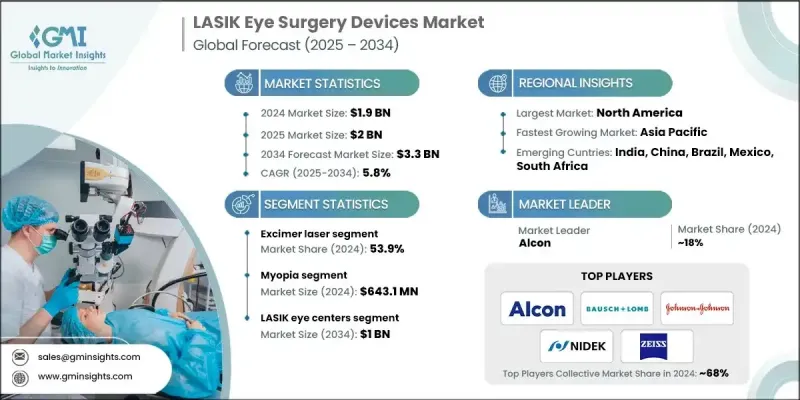
屈光手術技術的快速進步、人們對微創視力矯正日益成長的興趣以及常見屈光不正盛行率的上升,共同推動了市場擴張。 LASIK設備,主要是準分子雷射和飛秒雷射系統,能夠高精度地重塑角膜,矯正近視、遠視和散光。採用波前引導、地形圖引導和其他先進技術的新型系統,透過提高手術精度、減少副作用和提升個人化視力矯正的標準,正在改變臨床療效。診所正在採用能夠獲取詳細角膜測量數據的設備,從而實現更精確的消融模式和更快的恢復。影像、軟體整合和手術流程客製化方面的持續創新,支援了設備的頻繁升級,加速了高階平台的普及,並鞏固了全球向高度個人化屈光治療的轉變。
| 市場範圍 | |
|---|---|
| 起始年份 | 2024 |
| 預測年份 | 2025-2034 |
| 起始值 | 19億美元 |
| 預測值 | 33億美元 |
| 複合年成長率 | 5.8% |
飛秒雷射市場在2024年創造了8.62億美元的市場規模,預計到2034年將以6.1%的複合年成長率成長。其需求不斷成長的原因在於,外科醫生依賴其精準的瓣膜製作能力和先進的切口控制技術,這些優勢有助於提高術後癒合效果和手術可靠性。與新一代診斷技術的融合也進一步拓展了飛秒雷射在繁忙的屈光手術中心的應用。
預計到 2034 年,遠視矯正市場將以 5.4% 的複合年成長率成長。患者對遠視矯正的認知不斷提高,以及雷射消融術精度的提高,正在推動遠視矯正技術的普及,因為越來越多的人希望獲得更安全、更個性化的無眼鏡視力。
2024年美國雷射近視手術設備市場規模為6.221億美元,預計2034年將以4.6%的複合年成長率成長。與生活方式和長時間使用電子螢幕相關的視力問題日益增多,持續擴大著尋求治療的人群。該地區先進的屈光手術中心和專業眼科診所的廣泛分佈,進一步推動了手術量和設備需求的成長。
全球雷射近視手術設備市場的主要企業包括 LENSAR、蔡司 (ZEISS)、SCHWIND eye-tech-solutions、NIDEK、Spectra-Physics、博士倫 (BAUSCH & LOMB)、強生 (Johnson & Johnson)、愛爾康 (Alcon)、Ziemer Ophalmic、OptoTech Technologies Technologies、OptoTechiT、TaxER、CUUS、Vishalmic、OptoTech TechnologiesxTax寶、OptoTech、Vishalmic、Apera 和Alna-Medicalsystem。這些企業正積極尋求各種策略,以鞏固其競爭優勢並擴大市場覆蓋範圍。許多公司正在加大研發投入,以推動精密雷射平台的發展,並整合高解析度成像和人工智慧驅動的規劃工具,從而改善臨床效果。與眼科診所建立合作關係以及開展外科醫生培訓項目,有助於加速下一代系統的應用。此外,製造商也致力於開發可客製化的治療軟體和模組化設備升級方案,以提升使用者的長期忠誠度。
目錄
第1章:方法論與範圍
第2章:執行概要
第3章:行業洞察
- 產業生態系分析
- 產業影響因素
- 成長促進因素
- 眼科疾病患者人數增加
- 已開發國家的技術進步
- 眼科保健支出不斷增加
- 私人眼科診所和專科中心的擴張
- 產業陷阱與挑戰
- LASIK手術設備和耗材的前期成本很高
- 併發症和不良後果的風險
- 市場機遇
- 向新興市場進行地理擴張
- 為小型診所開發成本更低、體積更小的雷射近視手術平台
- 成長促進因素
- 成長潛力分析
- 監管環境
- 北美洲
- 歐洲
- 亞太地區
- 拉丁美洲
- 技術格局
- 當前技術趨勢
- 新興技術
- 報銷方案
- 消費者洞察
- 定價分析
- 波特的分析
- PESTEL 分析
- 未來市場趨勢
- 價值鏈分析
- 差距分析
第4章:競爭格局
- 介紹
- 公司矩陣分析
- 公司市佔率分析
- 全球的
- 北美洲
- 歐洲
- 亞太地區
- 拉丁美洲
- 競爭定位矩陣
- 主要市場參與者的競爭分析
- 關鍵進展
- 併購
- 合作夥伴關係與合作
- 新產品發布
- 擴張計劃
第5章:市場估算與預測:依產品分類,2021-2034年
- 主要趨勢
- 準分子雷射
- 飛秒雷射
第6章:市場估算與預測:依應用領域分類,2021-2034年
- 主要趨勢
- 近視
- 遠視
- 散光
- 其他應用
第7章:市場估算與預測:依最終用途分類,2021-2034年
- 主要趨勢
- 雷射眼科中心
- 醫院
- 門診手術中心
- 眼科診所
- 其他最終用途
第8章:市場估算與預測:依地區分類,2021-2034年
- 主要趨勢
- 北美洲
- 美國
- 加拿大
- 歐洲
- 德國
- 英國
- 法國
- 西班牙
- 義大利
- 荷蘭
- 亞太地區
- 中國
- 日本
- 印度
- 澳洲
- 韓國
- 拉丁美洲
- 巴西
- 墨西哥
- 阿根廷
- 中東和非洲
- 南非
- 沙烏地阿拉伯
- 阿拉伯聯合大公國
第9章:公司簡介
- Alcon
- Alna-Medicalsystem
- BAUSCH & LOMB
- COHERENT
- EXCELSIUS MEDICAL
- iVis Technologies
- Johnson & Johnson
- Kera Harvest
- LENSAR
- NIDEK
- OptoTech
- SCHWIND eye-tech-solutions
- Spectra-Physics
- ZEISS
- Ziemer Ophthalmic
The Global LASIK Eye Surgery Devices Market was valued at USD 1.9 billion in 2024 and is estimated to grow at a CAGR of 5.8% to reach USD 3.3 billion by 2034.
Market expansion is driven by rapid improvements in refractive surgery technologies, increasing interest in minimally invasive vision correction, and the growing prevalence of common refractive conditions. LASIK devices, primarily excimer and femtosecond laser systems, reshape the cornea to correct myopia, hyperopia, and astigmatism with high precision. Newer systems featuring wavefront-guided, topography-guided, and other advanced technologies are transforming clinical outcomes by enhancing accuracy, reducing side effects, and elevating the standard of customized vision correction. Clinics are adopting devices capable of capturing detailed corneal measurements, enabling more precise ablation patterns and faster recovery. Continuous innovation in imaging, software integration, and procedural customization supports frequent device upgrades, accelerates adoption of premium platforms, and reinforces the global shift toward highly personalized refractive treatments.
| Market Scope | |
|---|---|
| Start Year | 2024 |
| Forecast Year | 2025-2034 |
| Start Value | $1.9 Billion |
| Forecast Value | $3.3 Billion |
| CAGR | 5.8% |
The femtosecond laser category generated USD 862 million in 2024 and is forecast to grow at a 6.1% CAGR through 2034. Its demand is rising because surgeons rely on its precise flap creation capabilities and advanced incision control, which support better healing and procedure reliability. Integration with next-generation diagnostics continues to expand its use across busy refractive centers.
The hyperopia segment is expected to grow at a CAGR of 5.4% through 2034. Greater patient awareness of farsightedness correction and improvements in laser-based ablation accuracy are driving adoption, as more individuals seek glasses-free vision with improved safety and customization.
U.S. LASIK Eye Surgery Devices Market was valued at USD 622.1 million in 2024 and is set to grow at a 4.6% CAGR through 2034. Rising vision problems linked to lifestyle patterns and extended screen use continue to enlarge the treatment-seeking population. The region's widespread availability of advanced refractive surgery centers and specialized ophthalmology clinics further boosts procedural volume and device demand.
Key companies operating in the Global LASIK Eye Surgery Devices Market include LENSAR, ZEISS, SCHWIND eye-tech-solutions, NIDEK, Spectra-Physics, BAUSCH & LOMB, Johnson & Johnson, Alcon, Ziemer Ophthalmic, OptoTech, COHERENT, Kera Harvest, iVis Technologies, EXCELSIUS MEDICAL, and Alna-Medicalsystem. Companies in the LASIK Eye Surgery Devices Market are pursuing strategies that reinforce their competitive edge and broaden market reach. Many firms are increasing R&D investments to advance precision laser platforms, integrating high-resolution imaging and AI-driven planning tools to improve clinical outcomes. Partnerships with ophthalmic clinics and training programs for surgeons help accelerate the adoption of next-generation systems. Manufacturers also focus on developing customizable treatment software and modular device upgrades that support long-term user loyalty.
Table of Contents
Chapter 1 Methodology and Scope
- 1.1 Market scope and definitions
- 1.2 Research design
- 1.2.1 Research approach
- 1.2.2 Data collection methods
- 1.3 Data mining sources
- 1.3.1 Global
- 1.3.2 Regional/country
- 1.4 Base estimates and calculations
- 1.4.1 Base year calculation
- 1.4.2 Key trends for market estimation
- 1.5 Primary research and validation
- 1.5.1 Primary sources
- 1.6 Forecast model
- 1.7 Research assumptions and limitations
Chapter 2 Executive Summary
- 2.1 Industry 3600 synopsis
- 2.2 Key market trends
- 2.2.1 Regional trends
- 2.2.2 Product trends
- 2.2.3 Application trends
- 2.2.4 End use trends
- 2.3 CXO perspectives: Strategic imperatives
- 2.3.1 Key decision points for industry executives
- 2.3.2 Critical success factors for market players
- 2.4 Future outlook and strategic recommendations
Chapter 3 Industry Insights
- 3.1 Industry ecosystem analysis
- 3.2 Industry impact forces
- 3.2.1 Growth drivers
- 3.2.1.1 Rise in number of people suffering from ophthalmic disorders
- 3.2.1.2 Technological advancements in developed countries
- 3.2.1.3 Increasing eye care expenditure
- 3.2.1.4 Expansion of private ophthalmic clinics and specialty centers
- 3.2.2 Industry pitfalls and challenges
- 3.2.2.1 High upfront cost of LASIK devices and consumables
- 3.2.2.2 Risk of complications and adverse outcomes
- 3.2.3 Market opportunities
- 3.2.3.1 Geographic expansion into emerging markets
- 3.2.3.2 Development of lower-cost, compact LASIK platforms for smaller clinics
- 3.2.1 Growth drivers
- 3.3 Growth potential analysis
- 3.4 Regulatory landscape
- 3.4.1 North America
- 3.4.2 Europe
- 3.4.3 Asia Pacific
- 3.4.4 LAMEA
- 3.5 Technology landscape
- 3.5.1 Current technological trends
- 3.5.2 Emerging technologies
- 3.6 Reimbursement scenario
- 3.7 Consumer insights
- 3.8 Pricing analysis
- 3.9 Porter's analysis
- 3.10 PESTEL analysis
- 3.11 Future market trends
- 3.12 Value chain analysis
- 3.13 Gap analysis
Chapter 4 Competitive Landscape, 2024
- 4.1 Introduction
- 4.2 Company matrix analysis
- 4.3 Company market share analysis
- 4.3.1 Global
- 4.3.2 North America
- 4.3.3 Europe
- 4.3.4 Asia Pacific
- 4.3.5 LAMEA
- 4.4 Competitive positioning matrix
- 4.5 Competitive analysis of major market players
- 4.6 Key developments
- 4.6.1 Mergers & acquisitions
- 4.6.2 Partnerships & collaborations
- 4.6.3 New product launches
- 4.6.4 Expansion plans
Chapter 5 Market Estimates and Forecast, By Product, 2021 - 2034 ($ Mn)
- 5.1 Key trends
- 5.2 Excimer laser
- 5.3 Femtosecond laser
Chapter 6 Market Estimates and Forecast, By Application, 2021 - 2034 ($ Mn)
- 6.1 Key trends
- 6.2 Myopia
- 6.3 Hyperopia
- 6.4 Astigmatism
- 6.5 Other applications
Chapter 7 Market Estimates and Forecast, By End Use, 2021 - 2034 ($ Mn)
- 7.1 Key trends
- 7.2 LASIK eye centers
- 7.3 Hospitals
- 7.4 Ambulatory surgical centers
- 7.5 Ophthalmic clinics
- 7.6 Other end use
Chapter 8 Market Estimates and Forecast, By Region, 2021 - 2034 ($ Mn)
- 8.1 Key trends
- 8.2 North America
- 8.2.1 U.S.
- 8.2.2 Canada
- 8.3 Europe
- 8.3.1 Germany
- 8.3.2 UK
- 8.3.3 France
- 8.3.4 Spain
- 8.3.5 Italy
- 8.3.6 Netherlands
- 8.4 Asia Pacific
- 8.4.1 China
- 8.4.2 Japan
- 8.4.3 India
- 8.4.4 Australia
- 8.4.5 South Korea
- 8.5 Latin America
- 8.5.1 Brazil
- 8.5.2 Mexico
- 8.5.3 Argentina
- 8.6 Middle East and Africa
- 8.6.1 South Africa
- 8.6.2 Saudi Arabia
- 8.6.3 UAE
Chapter 9 Company Profiles
- 9.1 Alcon
- 9.2 Alna-Medicalsystem
- 9.3 BAUSCH & LOMB
- 9.4 COHERENT
- 9.5 EXCELSIUS MEDICAL
- 9.6 iVis Technologies
- 9.7 Johnson & Johnson
- 9.8 Kera Harvest
- 9.9 LENSAR
- 9.10 NIDEK
- 9.11 OptoTech
- 9.12 SCHWIND eye-tech-solutions
- 9.13 Spectra-Physics
- 9.14 ZEISS
- 9.15 Ziemer Ophthalmic

 個人化LASIK手術市場-2026-2032年全球市場預測
 2026-2030年全球LASIK手術市場
 客製化LASIK手術市場:依手術類型、治療應用和地區分類
 2026年全球LASIK近視手術設備市場報告
 2026-2034年全球個人化LASIK手術市場規模、佔有率、趨勢和成長分析報告2026-2034年全球雷射眼科手術器械市場規模、佔有率、趨勢和成長分析報告
 個人化LASIK手術市場規模、佔有率和成長分析(按手術類型、適應症、最終用戶和地區分類)—產業預測(2026-2033 年)
 LASIK眼科手術設備市場規模、佔有率和成長分析(按類型、視力缺陷、產品類型、最終用戶和地區分類)—2026-2033年產業預測
 全球個人化LASIK手術市場2025年全球個人化LASIK手術市場報告