


 |
市場調查報告書
商品編碼
1885892
電子垃圾回收市場機會、成長促進因素、產業趨勢分析及預測(2025-2034年)Electronic Waste Recycling Market Opportunity, Growth Drivers, Industry Trend Analysis, and Forecast 2025 - 2034 |
||||||

2024 年全球電子垃圾回收市場價值為 701 億美元,預計到 2034 年將以 13.5% 的複合年成長率成長至 2,519 億美元。
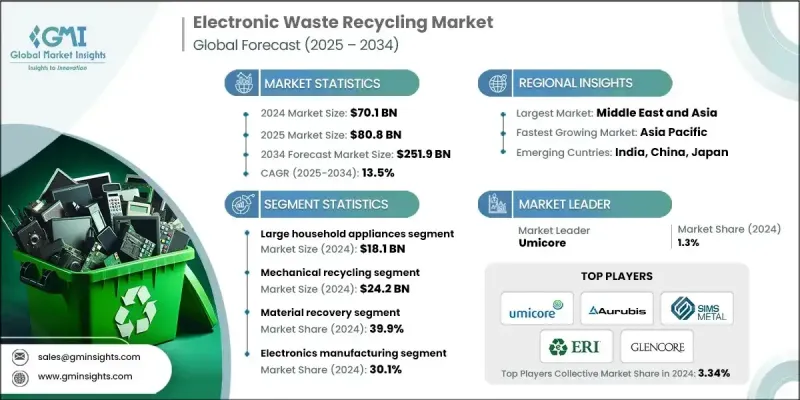
該市場涵蓋了從廢棄電子產品中提取、處理和回收有價值材料的組織。這些產品包括消費性電子產品、家用電器和電池等,回收過程有助於環境保護、減少浪費,並促進塑膠、銅、金和鋁等資源的再利用。該行業包含多個階段,包括設備拆解、材料分類、資源回收和負責任的廢棄物處理,所有環節均符合永續發展原則和監管標準。全球電子產品使用量持續成長,推動了對先進高效回收方法的需求。多個地區的政府正在加強監管框架,以限制不當處置行為並支持合法的回收工作。隨著企業和消費者對電子垃圾環境影響的認知不斷提高,參與正規回收計畫的人數也持續攀升。此外,回收資源的經濟價值也為廢棄物管理和回收公司提供了強大的經濟動力。
| 市場範圍 | |
|---|---|
| 起始年份 | 2024 |
| 預測年份 | 2025-2034 |
| 起始值 | 701億美元 |
| 預測值 | 2519億美元 |
| 複合年成長率 | 13.5% |
2024年,大型家用電器市場規模將達181億美元。其市場主導地位得益於頻繁的產品更換週期以及消費者對環保廢棄物處理方案日益成長的偏好。資訊科技和電信設備市場緊隨其後,這主要得益於設備的快速更新換代和持續的技術升級,從而產生大量可回收的材料。
預計到2024年,機械回收市場規模將達242億美元。該方法能夠有效率、大規模地從各種電子產品中回收金屬和塑膠。濕式冶金製程因其能夠透過環保的萃取方法生產高純度金屬而發展迅速,而火法冶金製程仍是處理複雜廢物流的重要選擇,它可以透過高溫處理來實現這一目標。
2024年,美國電子垃圾回收市場規模預計將達141億美元。北美市場的成長得益於政府嚴格的垃圾處理政策和企業對永續發展的承諾。科技的快速普及加速了筆記型電腦、伺服器、行動裝置及相關設備的報廢週期,增加了對回收能力的需求。人們日益認知到從廢棄電子產品中回收稀土元素、黃金和白銀等金屬所帶來的環境和經濟效益,這也進一步推動了市場擴張。
參與電子垃圾回收市場的主要公司包括美國電池技術公司(American Battery Technology Company)、Aurubis、Boliden、電子回收國際公司(Electronic Recyclers International)、嘉能可回收公司(Glencore Recycling)、Redwood Materials、Retriev Technologies、Sims Management、Stena Metall、TES(科技、Redwood Materials(技術、與世界)。該市場中的公司正透過擴大處理能力和投資先進的回收技術來提高材料回收率,從而鞏固其競爭地位。許多企業正在整合自動化和人工智慧驅動的分類系統,以提高營運效率並減少回收過程中的污染。各公司也正在與製造商、零售商和市政當局簽訂長期供應協議,以確保穩定的進料量。產品創新著重於開發更清潔、更節能的萃取方法,以便從複雜的電子廢棄物中回收高價值金屬。
目錄
第1章:方法論與範圍
第2章:執行概要
第3章:行業洞察
- 產業生態系分析
- 供應商格局
- 利潤率
- 每個階段的價值增加
- 影響價值鏈的因素
- 中斷
- 產業影響因素
- 成長促進因素
- 電子垃圾產生量不斷增加
- 日益增強的環保意識
- 有價值的材料回收
- 產業陷阱與挑戰
- 高初始投資
- 複雜產品組成
- 市場機遇
- 技術進步
- 開發電動車電池專用回收技術
- 與循環經濟計劃的融合
- 成長促進因素
- 成長潛力分析
- 監管環境
- 北美洲
- 歐洲
- 亞太地區
- 拉丁美洲
- 中東和非洲
- 波特的分析
- PESTEL 分析
- 技術與創新格局
- 當前技術趨勢
- 新興技術
- 價格趨勢
- 按地區
- 依產品類型
- 未來市場趨勢
- 技術與創新格局
- 當前技術趨勢
- 新興技術
- 專利格局
- 貿易統計(HS編碼)(註:僅提供重點國家的貿易統計資料)
- 主要進口國
- 主要出口國
- 永續性和環境方面
- 永續實踐
- 減少廢棄物策略
- 生產中的能源效率
- 環保舉措
- 碳足跡考量
第4章:競爭格局
- 介紹
- 公司市佔率分析
- 按地區
- 北美洲
- 歐洲
- 亞太地區
- 拉丁美洲
- MEA
- 按地區
- 公司矩陣分析
- 主要市場參與者的競爭分析
- 競爭定位矩陣
- 關鍵進展
- 併購
- 合作夥伴關係與合作
- 新產品發布
- 擴張計劃
第5章:市場估算與預測:依產品類型分類,2021-2034年
- 主要趨勢
- 大型家用電器
- 小型家用電器
- 資訊科技和電信設備
- 消費性電子產品
- 照明設備
- 電動汽車電池
第6章:市場估計與預測:依技術分類,2021-2034年
- 主要趨勢
- 機械回收
- 濕式冶金工藝
- 火法冶金加工
- 手動拆卸
- 先進的分選技術
第7章:市場估計與預測:依應用領域分類,2021-2034年
- 主要趨勢
- 材料回收
- 貴金屬回收
- 稀土元素提取
- 賤金屬回收
- 組件翻新
- 測試和維修流程
- 二手市場分析
- 安全處置
- 危險物質管理
- 垃圾掩埋場轉移策略
- 二次原料生產
- 高純度金屬生產
- 製造整合
- 能量回收
- 垃圾發電
- 不可回收組分管理
第8章:市場估算與預測:依最終用途產業分類,2021-2034年
- 主要趨勢
- 電子製造
- 金屬加工與冶煉
- 廢棄物管理服務
- 政府和市政當局
- 企業/商業
- 汽車產業
第9章:市場估計與預測:依地區分類,2021-2034年
- 主要趨勢
- 北美洲
- 美國
- 加拿大
- 墨西哥
- 歐洲
- 德國
- 英國
- 法國
- 西班牙
- 義大利
- 歐洲其他地區
- 亞太地區
- 中國
- 印度
- 日本
- 澳洲
- 韓國
- 亞太其他地區
- 拉丁美洲
- 巴西
- 墨西哥
- 阿根廷
- 拉丁美洲其他地區
- 中東和非洲
- 沙烏地阿拉伯
- 南非
- 阿拉伯聯合大公國
- 中東和非洲其他地區
第10章:公司簡介
- American Battery Technology Company
- Aurubis
- Boliden
- Electronic Recyclers International
- Glencore Recycling
- Redwood Materials
- Retriev Technologies
- Sims Metal Management
- Stena Metall
- TES (Technology, Environment & Services)
- Umicore
- Veolia
The Global Electronic Waste Recycling Market was valued at USD 70.1 billion in 2024 and is estimated to grow at a CAGR of 13.5% to reach USD 251.9 billion by 2034.
The market includes organizations involved in the collection, treatment, and recovery of valuable materials extracted from discarded electronic products. These items range from consumer electronics to appliances and batteries, and the recycling process supports environmental protection, waste reduction, and the recirculation of resources such as plastics, copper, gold, and aluminum. The industry encompasses several stages, including breakdown of devices, material sorting, resource recovery, and responsible waste handling, all aligned with sustainability principles and regulatory standards. Global electronics usage continues to rise, fueling the need for advanced and efficient recycling methods. Governments across multiple regions are strengthening their regulatory frameworks to limit improper disposal practices and support legitimate recycling efforts. As businesses and consumers become more aware of the environmental impact of e-waste, participation in formal recycling programs continues to climb. Additionally, the financial value of reclaimed resources presents a strong economic incentive for waste management and recovery companies.
| Market Scope | |
|---|---|
| Start Year | 2024 |
| Forecast Year | 2025-2034 |
| Start Value | $70.1 Billion |
| Forecast Value | $251.9 Billion |
| CAGR | 13.5% |
The large household appliances segment generated USD 18.1 billion in 2024. Their dominance is supported by frequent product replacement cycles and a growing preference for environmentally responsible disposal solutions. IT and telecommunications equipment follow closely, driven by rapid device turnover and constant technological upgrades that generate significant volumes of reusable materials.
The mechanical recycling segment reached USD 24.2 billion in 2024. This method supports efficient, large-scale recovery of metals and plastics from a broad range of electronic products. Hydrometallurgical processing is gaining momentum due to its ability to produce high-purity metal outputs through eco-friendly extraction methods, while pyrometallurgical processing remains an important choice for handling complex waste streams through high-temperature treatment.
U.S. Electronic Waste Recycling Market was valued at USD 14.1 billion in 2024. Growth in North America is supported by stringent government policies on waste disposal and corporate commitments to sustainability. High adoption rates of technology result in accelerated disposal cycles for laptops, servers, mobile devices, and related equipment, thereby increasing the demand for recycling capacity. Rising awareness of the environmental and financial benefits associated with recovering metals such as rare earth elements, gold, and silver from outdated electronics further contributes to market expansion.
Major companies participating in the Electronic Waste Recycling Market include American Battery Technology Company, Aurubis, Boliden, Electronic Recyclers International, Glencore Recycling, Redwood Materials, Retriev Technologies, Sims Metal Management, Stena Metall, TES (Technology, Environment & Services), Umicore, and Veolia. Companies in this market are strengthening their competitive positions by expanding processing capacity and investing in advanced recycling technologies that improve material recovery rates. Many organizations are integrating automation and AI-driven sorting systems to boost operational efficiency and reduce contamination during the recycling process. Firms are also securing long-term supply agreements with manufacturers, retailers, and municipalities to ensure steady input volumes. Product innovation focuses on developing cleaner, more energy-efficient extraction methods capable of reclaiming high-value metals from complex electronic waste.
Table of Contents
Chapter 1 Methodology & Scope
- 1.1 Market scope and definition
- 1.2 Research design
- 1.2.1 Research approach
- 1.2.2 Data collection methods
- 1.3 Data mining sources
- 1.3.1 Global
- 1.3.2 Regional/Country
- 1.4 Base estimates and calculations
- 1.4.1 Base year calculation
- 1.4.2 Key trends for market estimation
- 1.5 Primary research and validation
- 1.5.1 Primary sources
- 1.6 Forecast model
- 1.7 Research assumptions and limitations
Chapter 2 Executive Summary
- 2.1 Industry 360° synopsis
- 2.2 Key market trends
- 2.2.1 Product type
- 2.2.2 Technology
- 2.2.3 Application
- 2.2.4 End Use industry
- 2.2.5 Regional
- 2.3 TAM Analysis, 2025-2034
- 2.4 CXO perspectives: Strategic imperatives
- 2.4.1 Executive decision points
- 2.4.2 Critical success factors
- 2.5 Future outlook and strategic recommendations
Chapter 3 Industry Insights
- 3.1 Industry ecosystem analysis
- 3.1.1 Supplier landscape
- 3.1.2 Profit margin
- 3.1.3 Value addition at each stage
- 3.1.4 Factor affecting the value chain
- 3.1.5 Disruptions
- 3.2 Industry impact forces
- 3.2.1 Growth drivers
- 3.2.1.1 Rising e-waste generation
- 3.2.1.2 Growing environmental awareness
- 3.2.1.3 Valuable material recovery
- 3.2.2 Industry pitfalls and challenges
- 3.2.2.1 High initial investment
- 3.2.2.2 Complex product composition
- 3.2.3 Market opportunities
- 3.2.3.1 Technological advancements
- 3.2.3.2 Development of specialized recycling for EV batteries
- 3.2.3.3 Integration with circular economy initiatives
- 3.2.1 Growth drivers
- 3.3 Growth potential analysis
- 3.4 Regulatory landscape
- 3.4.1 North America
- 3.4.2 Europe
- 3.4.3 Asia Pacific
- 3.4.4 Latin America
- 3.4.5 Middle East & Africa
- 3.5 Porter's analysis
- 3.6 PESTEL analysis
- 3.7 Technology and innovation landscape
- 3.7.1 Current technological trends
- 3.7.2 Emerging technologies
- 3.8 Price trends
- 3.8.1 By region
- 3.8.2 By product type
- 3.9 Future market trends
- 3.10 Technology and innovation landscape
- 3.10.1 Current technological trends
- 3.10.2 Emerging technologies
- 3.11 Patent landscape
- 3.12 Trade statistics (HS code) ( Note: the trade statistics will be provided for key countries only)
- 3.12.1 Major importing countries
- 3.12.2 Major exporting countries
- 3.13 Sustainability and environmental aspects
- 3.13.1 Sustainable practices
- 3.13.2 Waste reduction strategies
- 3.13.3 Energy efficiency in production
- 3.13.4 Eco-friendly initiatives
- 3.14 Carbon footprint consideration
Chapter 4 Competitive Landscape, 2024
- 4.1 Introduction
- 4.2 Company market share analysis
- 4.2.1 By region
- 4.2.1.1 North America
- 4.2.1.2 Europe
- 4.2.1.3 Asia Pacific
- 4.2.1.4 LATAM
- 4.2.1.5 MEA
- 4.2.1 By region
- 4.3 Company matrix analysis
- 4.4 Competitive analysis of major market players
- 4.5 Competitive positioning matrix
- 4.6 Key developments
- 4.6.1 Mergers & acquisitions
- 4.6.2 Partnerships & collaborations
- 4.6.3 New product launches
- 4.6.4 Expansion plans
Chapter 5 Market Estimates and Forecast, By Product Type, 2021-2034 (USD Billion) (Kilo Tons)
- 5.1 Key trends
- 5.2 Large household appliances
- 5.3 Small household appliances
- 5.4 IT & telecommunications equipment
- 5.5 Consumer electronics
- 5.6 Lighting equipment
- 5.7 Electric vehicle batteries
Chapter 6 Market Estimates and Forecast, By Technology, 2021-2034 (USD Billion) (Kilo Tons)
- 6.1 Key trends
- 6.2 Mechanical recycling
- 6.3 Hydrometallurgical processing
- 6.4 Pyrometallurgical processing
- 6.5 Manual disassembly
- 6.6 Advanced sorting technologies
Chapter 7 Market Estimates and Forecast, By Application, 2021-2034 (USD Billion) (Kilo Tons)
- 7.1 Key trends
- 7.2 Material recovery
- 7.2.1 Precious metals recovery
- 7.2.2 Rare earth elements extraction
- 7.2.3 Base metals recovery
- 7.3 Component refurbishment
- 7.3.1 Testing & repair processes
- 7.3.2 Resale market analysis
- 7.4 Safe disposal
- 7.4.1 Hazardous substance management
- 7.4.2 Landfill diversion strategies
- 7.5 Secondary raw material production
- 7.5.1 High-purity metal production
- 7.5.2 Manufacturing integration
- 7.6 Energy recovery
- 7.6.1 Waste-to-energy
- 7.6.2 Non-recyclable fraction management
Chapter 8 Market Estimates and Forecast, By End Use Industry, 2021-2034 (USD Billion) (Kilo Tons)
- 8.1 Key trends
- 8.2 Electronics manufacturing
- 8.3 Metal processing & smelting
- 8.4 Waste management services
- 8.5 Government & municipalities
- 8.6 Corporate/commercial
- 8.7 Automotive industry
Chapter 9 Market Estimates and Forecast, By Region, 2021-2034 (USD Billion) (Kilo Tons)
- 9.1 Key trends
- 9.2 North America
- 9.2.1 U.S.
- 9.2.2 Canada
- 9.2.3 Mexico
- 9.3 Europe
- 9.3.1 Germany
- 9.3.2 UK
- 9.3.3 France
- 9.3.4 Spain
- 9.3.5 Italy
- 9.3.6 Rest of Europe
- 9.4 Asia Pacific
- 9.4.1 China
- 9.4.2 India
- 9.4.3 Japan
- 9.4.4 Australia
- 9.4.5 South Korea
- 9.4.6 Rest of Asia Pacific
- 9.5 Latin America
- 9.5.1 Brazil
- 9.5.2 Mexico
- 9.5.3 Argentina
- 9.5.4 Rest of Latin America
- 9.6 Middle East and Africa
- 9.6.1 Saudi Arabia
- 9.6.2 South Africa
- 9.6.3 UAE
- 9.6.4 Rest of Middle East and Africa
Chapter 10 Company Profiles
- 10.1 American Battery Technology Company
- 10.2 Aurubis
- 10.3 Boliden
- 10.4 Electronic Recyclers International
- 10.5 Glencore Recycling
- 10.6 Redwood Materials
- 10.7 Retriev Technologies
- 10.8 Sims Metal Management
- 10.9 Stena Metall
- 10.10 TES (Technology, Environment & Services)
- 10.11 Umicore
- 10.12 Veolia

 2026-2030年全球電子廢棄物回收市場
 2026年全球貴金屬電子廢棄物回收市場報告2026年全球電子廢棄物回收再利用服務市場報告
 電子垃圾回收再利用服務市場:依來源地和地區分類
 2026-2034年全球貴金屬電子廢棄物回收市場規模、佔有率、趨勢及成長分析報告
 日本電子廢棄物回收市場:規模、佔有率、趨勢和預測:按材料、來源和地區分類,2026-2034年
 貴金屬回收服務市場(按回收金屬類型、製程、客戶類型、純度等級、技術、產能、最終用途產業、分銷管道和應用分類),全球預測,2026-2032年
 電子廢棄物回收和資源回收市場預測至2032年:按廢棄物類型、材料類型、服務類型、技術、最終用戶和地區分類的全球分析電子垃圾回收市場預測至2032年:按服務類型、材質、電子垃圾來源、回收方法、最終用戶和地區分類的全球分析2032 年電子廢棄物來源市場預測:按組件、部署模式、公司規模、技術、應用、最終用戶和地區進行的全球分析