


 |
市場調查報告書
商品編碼
1885882
太陽能樹市場機會、成長促進因素、產業趨勢分析及預測(2025-2034年)Solar Tree Market Opportunity, Growth Drivers, Industry Trend Analysis, and Forecast 2025 - 2034 |
||||||

2024 年全球太陽能樹市場價值為 2.903 億美元,預計到 2034 年將以 7% 的複合年成長率成長至 5.715 億美元。
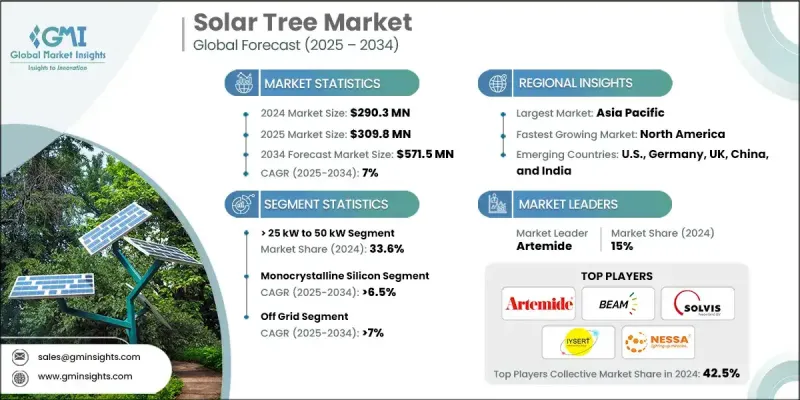
隨著模組化、使用者友善設計以及對城市環境適應性的提升,太陽能樹在公共空間的部署迎來新的機遇,市場正蓬勃發展。智慧照明系統與節能城市規劃的融合,進一步強化了太陽能樹在永續基礎設施中的作用。太陽能樹是一種在樹枝上安裝光伏板的結構,用於捕獲太陽能並將其轉化為電能。其設計旨在最佳化空間利用,同時為城市或公共區域提供美觀的再生能源解決方案。人們對美觀性和實用性能源發電的雙重需求,正使太陽能樹成為城市建築計畫的首選。輕質耐腐蝕材料和高性能光電技術的進步,提升了太陽能樹在各種氣候條件下的耐久性。物聯網監控系統與即時能源分析的結合,提高了運作效率和預測性維護能力。在太陽能樹安裝的同時,電動車充電設施的擴展,也為向清潔出行解決方案的轉型提供了支持。
| 市場範圍 | |
|---|---|
| 起始年份 | 2024 |
| 預測年份 | 2025-2034 |
| 起始值 | 2.903億美元 |
| 預測值 | 5.715億美元 |
| 複合年成長率 | 7% |
2024年,額定功率大於25千瓦至50千瓦的太陽能樹狀系統市佔率達33.6%,預計到2034年將以超過6.5%的複合年成長率成長。高效能太陽能組件和堅固的結構設計使該細分市場成為大規模商業應用的理想選擇。與先進的儲能系統和智慧能源管理平台整合,可提高關鍵基礎設施應用的可靠性。
預計到2034年,多晶矽太陽能樹市場規模將達8,000萬美元。成本效益高的多晶矽面板結合簡化的製造方法,提高了太陽能樹專案的經濟性。耐用材料與多晶矽技術的結合,增強了太陽能樹在惡劣戶外環境下的穩定性。
2024年,美國太陽能樹市場規模預計將達4,250萬美元。太陽能樹設計的創新以及與電動車充電站的整合,正在推動城市清潔旅行計畫的實施。智慧電網連接的發展與再生能源政策的實施一致,為太陽能樹的大規模部署創造了有利條件。
全球太陽能樹市場的主要參與者包括SmartFlower、Solar Forma、SolarLogix、Kondaas Solar Energy、LEADSUN、Spotlight Solar、RS Power Systems、EV Energy、Solvis、URJA SAUR ELECTRONICS、Imagine Powertree、SolarBotanic Tree、AGNI SOLAR SYSTEMS、Artemide、Inject Tree、SolarBotanic Tree、AGNI Energy ERACS SYSTEMS、Artemide、Inivity Solar、Yelson EnergyG、Eelom Energy、AxjDA、Artem Energy、ImERTer、Got Energy”這些公司正透過加強研發投入來提升面板效率、結構耐久性和模組化程度,鞏固其市場地位。與城市規劃者、再生能源公司和電動車充電基礎設施供應商的策略合作有助於拓展部署機會。此外,各公司也致力於智慧能源整合、物聯網監控系統和預測性維護解決方案,以提升營運效率。地理擴張、收購新興新創企業以及輕量化、低成本材料的創新,都有助於提升其市場競爭力。
目錄
第1章:方法論與範圍
第2章:執行概要
第3章:行業洞察
- 產業生態系分析
- 原物料供應及採購分析
- 製造能力評估
- 供應鏈韌性與風險因素
- 配電網路分析
- 監管環境
- 產業影響因素
- 成長促進因素
- 產業陷阱與挑戰
- 成長潛力分析
- 波特的分析
- PESTEL 分析
- 太陽能樹的成本結構分析
- 新興機會與趨勢
- 數位化和物聯網整合
- 投資分析及未來展望
第4章:競爭格局
- 介紹
- 按地區分類的公司市佔率分析
- 北美洲
- 歐洲
- 亞太地區
- 中東和非洲
- 拉丁美洲
- 戰略儀錶板
- Key partnerships & collaborations
- Major M&A activities
- Product innovations & launches
- Market expansion strategies
- 策略舉措
- 競爭性標竿分析
- 創新與技術格局
第5章:市場規模及預測:依產能分類,2021-2034年
- 主要趨勢
- ≤ 10 千瓦
- 10千瓦至25千瓦
- 25千瓦至50千瓦
- 大於 50 千瓦
第6章:市場規模及預測:依技術分類,2021-2034年
- 主要趨勢
- 單晶矽
- 多晶矽
- 薄膜
第7章:市場規模及預測:以連結方式分類,2021-2034年
- 主要趨勢
- 離網
- 電網
第8章:市場規模及預測:依組件分類,2021-2034年
- 主要趨勢
- 電池
- 太陽能光電模組
- 逆變器
- 電纜和連接器
第9章:市場規模及預測:依應用領域分類,2021-2034年
- 主要趨勢
- 住宅
- 商業和工業
- 公用事業
第10章:市場規模及預測:依地區分類,2021-2034年
- 主要趨勢
- 北美洲
- 美國
- 加拿大
- 墨西哥
- 歐洲
- 德國
- 英國
- 奧地利
- 挪威
- 義大利
- 西班牙
- 法國
- 荷蘭
- 亞太地區
- 中國
- 日本
- 印度
- 韓國
- 澳洲
- 新加坡
- 中東和非洲
- 沙烏地阿拉伯
- 阿拉伯聯合大公國
- 南非
- 拉丁美洲
- 巴西
- 阿根廷
第11章:公司簡介
- AGNI SOLAR SYSTEMS
- Artemide
- Beam Global
- EVT Energy
- Imagine Powertree
- Infinity Solar Energy
- IYSERT ENERGY
- Kondaas Solar Energy
- Kotson Solar
- LEADSUN
- NESSA
- RS Power Systems
- SmartFlower
- Solar Forma
- Solar Tree
- SolarBotanic Tree
- SolarLogix
- Solvis
- Spotlight Solar
- URJA SAUR ELECTRONICS
The Global Solar Tree Market was valued at USD 290.3 million in 2024 and is estimated to grow at a CAGR of 7% to reach USD 571.5 million by 2034.
The market is gaining momentum as modular, user-friendly designs and improved adaptability for urban environments create new opportunities for deployment in public spaces. Integration of smart lighting systems alongside energy-efficient city planning is reinforcing the role of solar trees in sustainable infrastructure. Solar trees are structures that feature photovoltaic panels mounted on branches to capture solar energy and convert it into electricity. They are designed to optimize space while offering a visually appealing renewable energy solution for urban or public areas. Growing demand for both aesthetic appeal and functional energy generation is positioning solar trees as a preferred choice for urban architectural projects. Advances in lightweight, corrosion-resistant materials and high-performance photovoltaic technology are improving durability in diverse climates. The adoption of IoT-enabled monitoring systems combined with real-time energy analytics enhances operational efficiency and predictive maintenance. Expanding electric vehicle charging capabilities alongside solar tree installations is supporting the transition to clean mobility solutions.
| Market Scope | |
|---|---|
| Start Year | 2024 |
| Forecast Year | 2025-2034 |
| Start Value | $290.3 Million |
| Forecast Value | $571.5 Million |
| CAGR | 7% |
The >25 kW to 50 kW rated solar tree segment accounted for 33.6% share in 2024 and is expected to grow at a CAGR of over 6.5% through 2034. High-efficiency solar modules and robust structural designs are making this segment ideal for large-scale commercial use. Integration with advanced energy storage systems and smart energy management platforms enhances reliability for critical infrastructure applications.
The polycrystalline silicon solar tree segment is projected to reach USD 80 million by 2034. Cost-effective polycrystalline panels combined with simplified manufacturing methods are improving affordability for solar tree projects. Durable materials paired with polycrystalline technology are increasing resilience for installations in harsh outdoor environments.
U.S. Solar Tree Market generated USD 42.5 million in 2024. Innovation in solar tree designs and integration with EV charging stations is driving clean mobility initiatives across urban landscapes. Development of smart grid connectivity in alignment with renewable energy mandates is fostering favorable conditions for large-scale solar tree deployment.
Key players operating in the Global Solar Tree Market include SmartFlower, Solar Forma, SolarLogix, Kondaas Solar Energy, LEADSUN, Spotlight Solar, RS Power Systems, EV Energy, Solvis, URJA SAUR ELECTRONICS, Imagine Powertree, SolarBotanic Tree, AGNI SOLAR SYSTEMS, Artemide, Infinity Solar Energy, EVT Energy, Kotson Solar, NESSA, and IYSERT ENERGY. Companies in the Global Solar Tree Market are strengthening their presence by investing in research and development to enhance panel efficiency, structural durability, and modularity. Strategic collaborations with urban planners, renewable energy firms, and EV charging infrastructure providers help expand deployment opportunities. Firms are also focusing on smart energy integration, IoT-enabled monitoring systems, and predictive maintenance solutions to improve operational performance. Geographic expansion, acquisition of emerging startups, and innovation in lightweight, cost-effective materials support competitive positioning.
Table of Contents
Chapter 1 Methodology & Scope
- 1.1 Research design
- 1.1.1 Research approach
- 1.1.2 Data collection methods
- 1.2 Base estimates and calculations
- 1.2.1 Base year calculation
- 1.2.2 Market estimates & forecast parameters
- 1.3 Forecast
- 1.3.1 Key trends for market estimates
- 1.3.2 Quantified market impact analysis
- 1.3.2.1 Mathematical impact of growth parameters on forecast
- 1.3.3 Scenario analysis framework
- 1.4 Primary research and validation
- 1.4.1 Some of the primary sources (but not limited to)
- 1.5 Data mining sources
- 1.5.1 Paid Sources
- 1.5.2 Sources, by region
- 1.6 Research trail & scoring components
- 1.6.1 Research trail components
- 1.6.2 Scoring components
- 1.7 Research transparency addendum
- 1.7.1 Source attribution framework
- 1.7.2 Quality assurance metrics
- 1.7.3 Our commitment to trust
- 1.8 Market definitions
Chapter 2 Executive Summary
- 2.1 Industry 360° synopsis, 2021 - 2034
- 2.2 Business trends
- 2.3 Capacity trends
- 2.4 Technology trends
- 2.5 Connectivity trends
- 2.6 Component trends
- 2.7 Application trends
- 2.8 Regional trends
Chapter 3 Industry Insights
- 3.1 Industry ecosystem analysis
- 3.1.1 Raw material availability & sourcing analysis
- 3.1.2 Manufacturing capacity assessment
- 3.1.3 Supply chain resilience & risk factors
- 3.1.4 Distribution network analysis
- 3.2 Regulatory landscape
- 3.3 Industry impact forces
- 3.3.1 Growth drivers
- 3.3.2 Industry pitfalls & challenges
- 3.4 Growth potential analysis
- 3.5 Porter's analysis
- 3.5.1 Bargaining power of suppliers
- 3.5.2 Bargaining power of buyers
- 3.5.3 Threat of new entrants
- 3.5.4 Threat of substitutes
- 3.6 PESTEL analysis
- 3.6.1 Political factors
- 3.6.2 Economic factors
- 3.6.3 Social factors
- 3.6.4 Technological factors
- 3.6.5 Legal factors
- 3.6.6 Environmental factors
- 3.7 Cost structure analysis of solar tree
- 3.8 Emerging opportunities & trends
- 3.9 Digitalization and IoT integration
- 3.10 Investment analysis & future outlook
Chapter 4 Competitive Landscape, 2025
- 4.1 Introduction
- 4.2 Company market share analysis, by region, 2024
- 4.2.1 North America
- 4.2.2 Europe
- 4.2.3 Asia Pacific
- 4.2.4 Middle East & Africa
- 4.2.5 Latin America
- 4.3 Strategic dashboard
- 4.3.1 Key partnerships & collaborations
- 4.3.2 Major M&A activities
- 4.3.3 Product innovations & launches
- 4.3.4 Market expansion strategies
- 4.4 Strategic initiatives
- 4.5 Competitive benchmarking
- 4.6 Innovation & technology landscape
Chapter 5 Market Size and Forecast, By Capacity, 2021 - 2034 (USD Million)
- 5.1 Key trends
- 5.2 ≤ 10 kW
- 5.3 > 10 kW to 25 kW
- 5.4 > 25 kW to 50 kW
- 5.5 > 50 kW
Chapter 6 Market Size and Forecast, By Technology, 2021 - 2034 (USD Million)
- 6.1 Key trends
- 6.2 Monocrystalline silicon
- 6.3 Polycrystalline silicon
- 6.4 Thin-film
Chapter 7 Market Size and Forecast, By Connectivity, 2021 - 2034 (USD Million)
- 7.1 Key trends
- 7.2 Off grid
- 7.3 On grid
Chapter 8 Market Size and Forecast, By Component, 2021 - 2034 (USD Million)
- 8.1 Key trends
- 8.2 Battery
- 8.3 Solar PV modules
- 8.4 Inverter
- 8.5 Cables and connectors
Chapter 9 Market Size and Forecast, By Application, 2021 - 2034 (USD Million)
- 9.1 Key trends
- 9.2 Residential
- 9.3 Commercial & industrial
- 9.4 Utility
Chapter 10 Market Size and Forecast, By Region, 2021 - 2034 (USD Million)
- 10.1 Key trends
- 10.2 North America
- 10.2.1 U.S.
- 10.2.2 Canada
- 10.2.3 Mexico
- 10.3 Europe
- 10.3.1 Germany
- 10.3.2 UK
- 10.3.3 Austria
- 10.3.4 Norway
- 10.3.5 Italy
- 10.3.6 Spain
- 10.3.7 France
- 10.3.8 Netherlands
- 10.4 Asia Pacific
- 10.4.1 China
- 10.4.2 Japan
- 10.4.3 India
- 10.4.4 South Korea
- 10.4.5 Australia
- 10.4.6 Singapore
- 10.5 Middle East & Africa
- 10.5.1 Saudi Arabia
- 10.5.2 UAE
- 10.5.3 South Africa
- 10.6 Latin America
- 10.6.1 Brazil
- 10.6.2 Argentina
Chapter 11 Company Profiles
- 11.1 AGNI SOLAR SYSTEMS
- 11.2 Artemide
- 11.3 Beam Global
- 11.4 EVT Energy
- 11.5 Imagine Powertree
- 11.6 Infinity Solar Energy
- 11.7 IYSERT ENERGY
- 11.8 Kondaas Solar Energy
- 11.9 Kotson Solar
- 11.10 LEADSUN
- 11.11 NESSA
- 11.12 RS Power Systems
- 11.13 SmartFlower
- 11.14 Solar Forma
- 11.15 Solar Tree
- 11.16 SolarBotanic Tree
- 11.17 SolarLogix
- 11.18 Solvis
- 11.19 Spotlight Solar
- 11.20 URJA SAUR ELECTRONICS

 光伏材料市場規模、佔有率和成長分析(按組件、產品、材料、電池類型、安裝類型、應用和地區分類)—產業預測(2026-2033 年)
 2025年全球現場太陽能電動車充電市場報告
 現場太陽能電子燃料市場機會、成長促進因素、產業趨勢分析及預測(2025-2034年)
 太陽能光電(PV)安裝市場:依技術、安裝方式、安裝服務、電網類型、應用領域、國家及地區分類-全球產業分析、市場規模、市場佔有率及2025-2032年預測光電材料市場:依材料類型、產品類型、技術、最終用戶、國家及地區分類-全球產業分析、市場規模、市場佔有率及2025-2032年預測
 住宅太陽能市場按安裝類型、並聯型、組件類型、技術類型、安裝類型、銷售管道和應用類型分類 - 2025-2032 年全球預測太陽能市場按電池板類型、技術類型、組件、發電容量、系統類型、安裝類型、應用和所有權模式分類 - 2025-2032 年全球預測
 美國的社區太陽能展望:2025年下半年
 太陽能收集市場-全球產業規模、佔有率、趨勢、機會和預測(按組件、按最終用戶、按地區和競爭進行細分,2020-2030 年)
 太陽光電(PV)市場分析及至2034年的預測:按類型、產品、服務、技術、應用、材料類型、組件、安裝類型、最終用戶和功能