


 |
市場調查報告書
商品編碼
1885864
用於傷口癒合的蛋白質水解物市場機會、成長促進因素、產業趨勢分析及預測(2025-2034年)Protein Hydrolysates for Wound Healing Market Opportunity, Growth Drivers, Industry Trend Analysis, and Forecast 2025 - 2034 |
||||||

2024 年全球傷口癒合用蛋白質水解物市場價值為 8.925 億美元,預計到 2034 年將以 12.1% 的複合年成長率成長至 28 億美元。
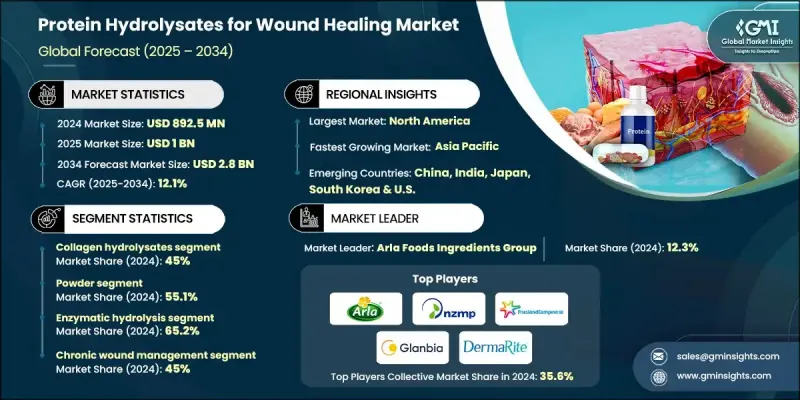
市場擴張的驅動力在於人們對先進傷口護理技術的認知不斷提高,以及全球慢性傷口盛行率的上升。源自膠原蛋白、角質蛋白和明膠的蛋白質水解物因其富含氨基酸和生物活性胜肽,在加速組織修復方面發揮關鍵作用。這些化合物有助於刺激組織再生、促進膠原蛋白形成並最大限度地減少炎症,最終促進傷口更快癒合並減少疤痕形成。它們良好的生物相容性使其非常適合用於傷口敷料、外用溶液和再生醫學等醫療應用。糖尿病潰瘍、壓瘡和術後傷口的發生率不斷上升,持續推高市場需求,而全球人口老化也進一步強化了對有效傷口管理產品的需求。隨著醫療保健機構尋求能夠增強細胞活性和改善癒合環境的解決方案,預計市場將迎來創新和產品擴張的巨大機會。
| 市場範圍 | |
|---|---|
| 起始年份 | 2024 |
| 預測年份 | 2025-2034 |
| 起始值 | 8.925億美元 |
| 預測值 | 28億美元 |
| 複合年成長率 | 12.1% |
膠原蛋白水解物在2024年佔據了45%的市場佔有率,這得益於其已證實的臨床療效、監管批准和廣泛的適用性。這些產品來自多種途徑,包括牛、豬、馬、禽和海洋生物,其中動物源性產品目前仍佔據最強的商業地位,儘管人們對海洋來源和重組配方的興趣日益濃厚。
2024年,粉末狀蛋白水解物市佔率達到55.1%。其保存期限長、濃度高、儲存方便且用途廣泛,使其在醫療領域備受青睞。粉末製劑採用酵素處理後,經冷凍乾燥、噴霧乾燥和真空乾燥等製程生產,既方便臨床醫生和患者使用,又經濟實惠。
2024年,北美傷口癒合用蛋白水解物市佔率達到40.1%,預計到2034年將以12.3%的複合年成長率成長。該地區的成長得益於強大的醫療基礎設施、慢性傷口病例的增加以及對創新傷口護理技術日益成長的需求。微創療法的廣泛接受和研發活動的持續發展,並不斷推動相關技術的進步。對個人化護理和新一代傷口管理解決方案的持續關注,使北美成為全球市場擴張的重要貢獻者。
全球傷口癒合用蛋白水解物市場的主要企業包括:菲仕蘭坎皮納(FrieslandCampina)、英格瑞亞(Ingredia SA)、美德瑞頓(Medtrition)、海美德(Hymed)、恆天然(Fonterra NZMP)、阿拉食品配料(Arla Foods Ingredients)、希爾瑪米(恆天然(Discom) International)、紐崔福(Nutriform)、德瑪瑞特(DermaRite)和格蘭比亞(Glanbia plc)。參與傷口癒合用蛋白水解物市場競爭的企業正採取一系列策略來鞏固其市場地位。許多企業正在擴大產能以滿足不斷成長的全球需求,同時推動水解技術的發展,以提高胜肽的純度和治療效果。與傷口護理產品製造商和醫療機構的策略合作有助於加速產品推廣,並支持實證驗證。此外,各企業也透過開發針對慢性傷口、手術恢復和再生療法的專用配方來實現產品組合多元化。永續發展舉措,例如探索海洋和重組來源,有助於企業保持長期競爭力並符合監管要求。
目錄
第1章:方法論與範圍
第2章:執行概要
第3章:行業洞察
- 產業生態系分析
- 供應商格局
- 利潤率
- 每個階段的價值增加
- 影響價值鏈的因素
- 中斷
- 產業影響因素
- 成長促進因素
- 產業陷阱與挑戰
- 市場機遇
- 成長潛力分析
- 監管環境
- 北美洲
- 歐洲
- 亞太地區
- 拉丁美洲
- 中東和非洲
- 波特的分析
- PESTEL 分析
- 價格趨勢
- 按地區
- 依產品類型
- 未來市場趨勢
- 技術與創新格局
- 當前技術趨勢
- 新興技術
- 專利格局
- 貿易統計(HS編碼)(註:僅提供重點國家的貿易統計資料)
- 主要進口國
- 主要出口國
- 永續性和環境方面
- 永續實踐
- 減少廢棄物策略
- 生產中的能源效率
- 環保舉措
- 碳足跡考量
第4章:競爭格局
- 介紹
- 公司市佔率分析
- 按地區
- 北美洲
- 歐洲
- 亞太地區
- 拉丁美洲
- MEA
- 按地區
- 公司矩陣分析
- 主要市場參與者的競爭分析
- 競爭定位矩陣
- 關鍵進展
- 併購
- 合作夥伴關係與合作
- 新產品發布
- 擴張計劃
第5章:市場估算與預測:依產品類型分類,2021-2034年
- 主要趨勢
- 膠原蛋白水解物
- 牛膠原蛋白水解物
- 豬膠原蛋白水解物
- 海洋膠原蛋白水解物
- 禽類膠原蛋白水解物
- 海洋蛋白水解物
- 魚源性生物活性胜肽
- 貝類水解物
- 藻類蛋白水解物
- 水母膠原蛋白胜肽
- 乳清蛋白水解物
- 特製胺基酸配方
- 富含精胺酸的水解物
- 添加麩醯胺酸的配方
- 支鏈胺基酸複合物
第6章:市場估算與預測:以實物形式分類,2021-2034年
- 主要趨勢
- 粉末
- 液體
第7章:市場估算與預測:依加工方式分類,2021-2034年
- 主要趨勢
- 酵素水解
- 酸水解
- 鹼性水解
- 組合處理方法
第8章:市場估算與預測:依應用領域分類,2021-2034年
- 關鍵趨勢
- 慢性傷口管理
- 糖尿病足潰瘍
- 壓瘡/潰瘍
- 靜脈性腿部潰瘍
- 動脈潰瘍
- 急性傷口護理
- 手術傷口
- 創傷性損傷
- 燒傷治療
- 緊急傷口護理
- 術後恢復
- 骨科手術恢復
- 心血管外科支持
- 一般外科應用
- 整形與重建外科
- 預防性傷口護理
- 高危險群患者營養支持
- 術前準備
- 免疫功能低下患者的護理
- 老年人傷口預防
第9章:市場估計與預測:依地區分類,2021-2034年
- 主要趨勢
- 北美洲
- 美國
- 加拿大
- 歐洲
- 德國
- 英國
- 法國
- 西班牙
- 義大利
- 歐洲其他地區
- 亞太地區
- 中國
- 印度
- 日本
- 澳洲
- 韓國
- 亞太其他地區
- 拉丁美洲
- 巴西
- 墨西哥
- 阿根廷
- 拉丁美洲其他地區
- 中東和非洲
- 沙烏地阿拉伯
- 南非
- 阿拉伯聯合大公國
- 中東和非洲其他地區
第10章:公司簡介
- Arla Foods Ingredients
- Davisco Foods International
- DermaRite
- Fonterra NZMP
- FrieslandCampina
- Glanbia plc
- Hilmar Ingredients
- Hymed
- Ingredia SA
- Medtrition
- Nutriform
The Global Protein Hydrolysates for Wound Healing Market was valued at USD 892.5 million in 2024 and is estimated to grow at a CAGR of 12.1% to reach USD 2.8 billion by 2034.
Market expansion is driven by increasing awareness of advanced wound care technologies and the rising prevalence of chronic wounds worldwide. Protein hydrolysates derived from collagen, keratin, and gelatin play a critical role in accelerating tissue repair due to their rich amino acid content and bioactive peptides. These compounds help stimulate tissue regeneration, support collagen formation, and minimize inflammation, ultimately promoting faster healing and reduced scarring. Their strong biocompatibility makes them well-suited for medical applications across wound dressings, topical solutions, and regenerative medicine. Growing incidences of diabetic ulcers, pressure injuries, and postoperative wounds continue to increase demand, while the aging global population further strengthens the need for effective wound management products. As healthcare providers pursue solutions that enhance cellular activity and improve healing environments, the market is expected to see significant opportunities for innovation and product expansion.
| Market Scope | |
|---|---|
| Start Year | 2024 |
| Forecast Year | 2025-2034 |
| Start Value | $892.5 Million |
| Forecast Value | $2.8 Billion |
| CAGR | 12.1% |
The collagen hydrolysates segment held a 45% share in 2024, supported by proven clinical benefits, regulatory approvals, and broad applicability. These products originate from multiple sources, including bovine, porcine, equine, avian, and marine materials, with animal-based variants currently holding the strongest commercial position even as interest grows in alternative marine and recombinant formulations.
The powder-based protein hydrolysates segment held 55.1% share in 2024. Their long shelf life, high concentration, storage convenience, and versatile application make them appealing for medical settings. Produced through methods like freeze-drying, spray-drying, and vacuum-drying following enzymatic processing, powder formulations provide ease of use for clinicians and patients while remaining cost-effective.
North America Protein Hydrolysates for Wound Healing Market held 40.1% share in 2024 and is projected to grow at a 12.3% CAGR through 2034. Growth in the region is supported by strong healthcare infrastructure, rising cases of chronic wounds, and increasing demand for innovative wound care technologies. Greater acceptance of minimally invasive approaches and expanded research and development activity continue to drive advancements. Ongoing interest in personalized care and next-generation wound management solutions positions North America as a major contributor to global market expansion.
Key companies in the Global Protein Hydrolysates for Wound Healing Market include FrieslandCampina, Ingredia SA, Medtrition, Hymed, Fonterra NZMP, Arla Foods Ingredients, Hilmar Ingredients, Davisco Foods International, Nutriform, DermaRite, and Glanbia plc. Companies competing in the Protein Hydrolysates for Wound Healing Market are employing a range of strategies to strengthen their market position. Many are expanding production capabilities to meet rising global demand while advancing hydrolysis technologies to improve peptide purity and therapeutic effectiveness. Strategic collaborations with wound care manufacturers and healthcare institutions help accelerate product adoption and support evidence-based validation. Firms are also diversifying their portfolios by developing specialized formulations targeted at chronic wounds, surgical recovery, and regenerative therapies. Sustainability initiatives, such as exploring marine and recombinant sources, support long-term competitiveness and regulatory alignment.
Table of Contents
Chapter 1 Methodology & Scope
- 1.1 Market scope and definition
- 1.2 Research design
- 1.2.1 Research approach
- 1.2.2 Data collection methods
- 1.3 Data mining sources
- 1.3.1 Global
- 1.3.2 Regional/Country
- 1.4 Base estimates and calculations
- 1.4.1 Base year calculation
- 1.4.2 Key trends for market estimation
- 1.5 Primary research and validation
- 1.5.1 Primary sources
- 1.6 Forecast model
- 1.7 Research assumptions and limitations
Chapter 2 Executive Summary
- 2.1 Industry 360° synopsis
- 2.2 Key market trends
- 2.2.1 Regional
- 2.2.2 Product type
- 2.2.3 Physical form
- 2.2.4 Processing method
- 2.2.5 Application
- 2.3 TAM Analysis, 2025-2034
- 2.4 CXO perspectives: Strategic imperatives
- 2.4.1 Executive decision points
- 2.4.2 Critical success factors
- 2.5 Future Outlook and Strategic Recommendations
Chapter 3 Industry Insights
- 3.1 Industry ecosystem analysis
- 3.1.1 Supplier landscape
- 3.1.2 Profit margin
- 3.1.3 Value addition at each stage
- 3.1.4 Factor affecting the value chain
- 3.1.5 Disruptions
- 3.2 Industry impact forces
- 3.2.1 Growth drivers
- 3.2.2 Industry pitfalls and challenges
- 3.2.3 Market opportunities
- 3.3 Growth potential analysis
- 3.4 Regulatory landscape
- 3.4.1 North America
- 3.4.2 Europe
- 3.4.3 Asia Pacific
- 3.4.4 Latin America
- 3.4.5 Middle East & Africa
- 3.5 Porter's analysis
- 3.6 PESTEL analysis
- 3.7 Price trends
- 3.7.1 By region
- 3.7.2 By product type
- 3.8 Future market trends
- 3.9 Technology and Innovation landscape
- 3.9.1 Current technological trends
- 3.9.2 Emerging technologies
- 3.10 Patent Landscape
- 3.11 Trade statistics (HS code) (Note: the trade statistics will be provided for key countries only)
- 3.11.1 Major importing countries
- 3.11.2 Major exporting countries
- 3.12 Sustainability and environmental aspects
- 3.12.1 Sustainable practices
- 3.12.2 Waste reduction strategies
- 3.12.3 Energy efficiency in production
- 3.12.4 Eco-friendly initiatives
- 3.13 Carbon footprint consideration
Chapter 4 Competitive Landscape, 2024
- 4.1 Introduction
- 4.2 Company market share analysis
- 4.2.1 By region
- 4.2.1.1 North America
- 4.2.1.2 Europe
- 4.2.1.3 Asia Pacific
- 4.2.1.4 LATAM
- 4.2.1.5 MEA
- 4.2.1 By region
- 4.3 Company matrix analysis
- 4.4 Competitive analysis of major market players
- 4.5 Competitive positioning matrix
- 4.6 Key developments
- 4.6.1 Mergers & acquisitions
- 4.6.2 Partnerships & collaborations
- 4.6.3 New Product Launches
- 4.6.4 Expansion Plans
Chapter 5 Market Estimates and Forecast, By Product Type, 2021-2034 (USD Million & Kilo Tons)
- 5.1 Key trends
- 5.2 Collagen hydrolysates
- 5.2.1 Bovine collagen hydrolysates
- 5.2.2 Porcine collagen hydrolysates
- 5.2.3 Marine collagen hydrolysates
- 5.2.4 Avian collagen hydrolysates
- 5.3 Marine protein hydrolysates
- 5.3.1 Fish-derived bioactive peptides
- 5.3.2 Shellfish-derived hydrolysates
- 5.3.3 Algae-based protein hydrolysates
- 5.3.4 Jellyfish collagen peptides
- 5.4 Whey protein hydrolysates
- 5.5 Specialized amino acid formulations
- 5.5.1 Arginine-enriched hydrolysates
- 5.5.2 Glutamine-enhanced formulations
- 5.5.3 Branched-chain amino acid complexes
Chapter 6 Market Estimates and Forecast, By Physical Form, 2021-2034 (USD Million & Kilo Tons)
- 6.1 Key trends
- 6.2 Powder
- 6.3 Liquid
Chapter 7 Market Estimates and Forecast, By Processing Method, 2021-2034 (USD Million & Kilo Tons)
- 7.1 Key trends
- 7.2 Enzymatic hydrolysis
- 7.3 Acid hydrolysis
- 7.4 Alkaline hydrolysis
- 7.5 Combined processing methods
Chapter 8 Market Estimates and Forecast, By Application, 2021-2034 (USD Million & Kilo Tons)
- 8.1 Key trend
- 8.2 Chronic wound management
- 8.2.1 Diabetic foot ulcers
- 8.2.2 Pressure injuries/ulcers
- 8.2.3 Venous leg ulcers
- 8.2.4 Arterial ulcers
- 8.3 Acute wound care
- 8.3.1 Surgical wounds
- 8.3.2 Traumatic injuries
- 8.3.3 Burn treatment
- 8.3.4 Emergency wound care
- 8.4 Post-surgical recovery
- 8.4.1 Orthopedic surgery recovery
- 8.4.2 Cardiovascular surgery support
- 8.4.3 General surgery applications
- 8.4.4 Plastic & reconstructive surgery
- 8.5 Preventive wound care
- 8.5.1 High-risk patient nutritional support
- 8.5.2 Pre-surgical conditioning
- 8.5.3 Immunocompromised patient care
- 8.5.4 Geriatric wound prevention
Chapter 9 Market Estimates and Forecast, By Region, 2021-2034 (USD Million & Kilo Tons)
- 9.1 Key trends
- 9.2 North America
- 9.2.1 U.S.
- 9.2.2 Canada
- 9.3 Europe
- 9.3.1 Germany
- 9.3.2 UK
- 9.3.3 France
- 9.3.4 Spain
- 9.3.5 Italy
- 9.3.6 Rest of Europe
- 9.4 Asia Pacific
- 9.4.1 China
- 9.4.2 India
- 9.4.3 Japan
- 9.4.4 Australia
- 9.4.5 South Korea
- 9.4.6 Rest of Asia Pacific
- 9.5 Latin America
- 9.5.1 Brazil
- 9.5.2 Mexico
- 9.5.3 Argentina
- 9.5.4 Rest of Latin America
- 9.6 Middle East and Africa
- 9.6.1 Saudi Arabia
- 9.6.2 South Africa
- 9.6.3 UAE
- 9.6.4 Rest of Middle East and Africa
Chapter 10 Company Profiles
- 10.1 Arla Foods Ingredients
- 10.2 Davisco Foods International
- 10.3 DermaRite
- 10.4 Fonterra NZMP
- 10.5 FrieslandCampina
- 10.6 Glanbia plc
- 10.7 Hilmar Ingredients
- 10.8 Hymed
- 10.9 Ingredia SA
- 10.10 Medtrition
- 10.11 Nutriform

 進階創傷護理市場報告:按產品、應用、最終用戶和地區分類(2026-2034 年)
 2026年全球進階創傷護理市場報告
 非處方高階創傷護理市場分析及預測至2035年:依類型、產品、技術、應用、材料類型、最終用戶、劑型、設備、製程及部署方式分類
 細菌纖維素市場機會、成長要素、產業趨勢分析及紡織品及生物醫學應用預測(2026-2035年)
 全球高階創傷護理市場規模、佔有率、趨勢和成長分析報告(2026-2034年)日本先進創傷護理市場報告:按產品、應用、最終用戶和地區分類(2026-2034年)
 rh-EGF外用溶液市場:依劑型、應用、最終用戶和通路分類-2026-2032年全球預測
 進階創傷護理市場規模、佔有率和趨勢分析報告:按產品、應用、最終用途、地區和細分市場預測(2026-2033 年)非處方高階創傷護理市場規模、佔有率和趨勢分析報告:按產品、應用、分銷管道、地區和細分市場預測(2026-2033 年)高階傷口護理市場機會、成長促進因素、產業趨勢分析及預測(2025-2034年)