


 |
市場調查報告書
商品編碼
1885862
石油和天然氣阻火器市場機會、成長促進因素、產業趨勢分析及預測(2025-2034年)Oil and Gas Flame Arrestors Market Opportunity, Growth Drivers, Industry Trend Analysis, and Forecast 2025 - 2034 |
||||||

2024 年全球油氣阻火器市場價值為 4.89 億美元,預計到 2034 年將以 5.9% 的複合年成長率成長至 8.7 億美元。
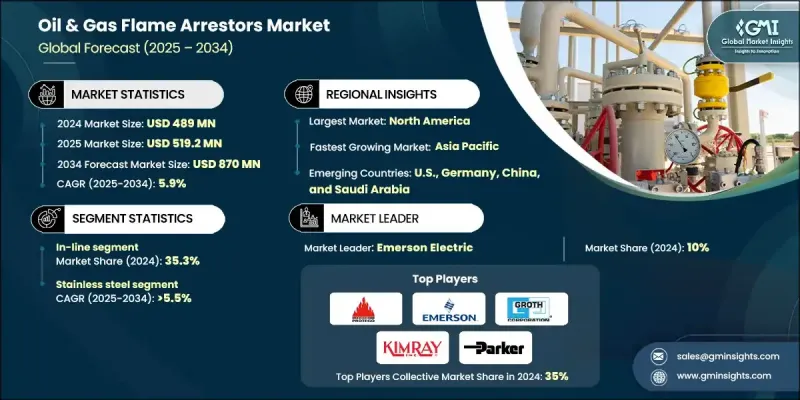
隨著上游和中游作業中防爆措施的日益重視,以及安全要求的不斷提高,阻火器系統的安裝量顯著成長。緊湊型模組化設計的持續發展,提高了能源效率並簡化了工業整合,也推動了市場成長。阻火器透過撲滅燃燒鋒面,阻止火焰在管道、通風口和加工單元中的蔓延,從而防止火焰到達下游含有可燃氣體或蒸氣的區域。在可燃混合物存在回火或爆炸風險的環境中,阻火器的作用至關重要。先進的監控功能和即時診斷技術正在被應用,以提高系統可靠性並簡化維護操作。對耐腐蝕和耐惡劣環境(尤其是在海上作業)的材料需求不斷成長,推動了新產品的改進。頁岩氣開發的擴張、對洩壓解決方案日益成長的需求以及對防爆保護的日益重視,進一步加速了阻火器的應用。此外,因其結構緊湊、安裝簡便而備受青睞的線上爆燃阻火器的日益普及,也促進了整個產業的擴張。
| 市場範圍 | |
|---|---|
| 起始年份 | 2024 |
| 預測年份 | 2025-2034 |
| 起始值 | 4.89億美元 |
| 預測值 | 8.7億美元 |
| 複合年成長率 | 5.9% |
預計2024年,油氣終端阻火器市場規模將達到1.452億美元。隨著營運商日益重視儲槽和通風系統免受大氣點燃,阻火器的部署正在增加。對蒸汽排放控制的日益重視,以及環境和消防安全標準的合規要求,都推動了阻火器在上游和下游作業中更廣泛的應用。
預計到2034年,碳鋼阻火器市場規模將達到2.5億美元。其受歡迎的原因在於適用於標準壓力應用以及在大型專案中具有成本效益。此外,碳鋼阻火器結構堅固耐用,在嚴苛的陸上環境下性能優異,這些優勢也持續推動碳鋼阻火器的應用。
2024年,美國油氣產業阻火器市場規模達1.347億美元。包括美國職業安全與健康管理局(OSHA)和美國消防協會(NFPA)指南在內的工作場所安全法規執行力度加大,正在加速國內油氣設施阻火器的安裝。頁岩氣和液化天然氣基礎設施建設資本投資的成長,以及為降低爆炸風險而採取的各項措施,都推動了探勘和輸送作業中阻火器的強勁應用。
參與油氣阻火器市場的主要公司包括 PROTEGO、Aager、Amarama Engineers、BS&B Innovations、Cashco、Cochin Steel、D-KTC Fluid Control、Elmac Technologies、Emerson Electric、Essex Industries、Fidicon Devices、Groth Corporation、Kimray、L&J Technologies、Mott、Paradox Technologies、Mrs.這些公司正透過技術升級、材料創新和策略合作等方式,不斷擴大在油氣阻火器市場的競爭力。許多製造商正在透過整合智慧監控系統、預測性診斷和先進的測試方法來提高阻火器的性能,以確保符合不斷發展的安全標準。此外,各公司也正在開發專為嚴苛的近海和高壓環境設計的專用產品線,以增強產品差異化優勢。
目錄
第1章:方法論與範圍
第2章:執行概要
第3章:行業洞察
- 產業生態系分析
- 原物料供應及採購分析
- 製造能力評估
- 供應鏈韌性與風險因素
- 配電網路分析
- 監管環境
- 產業影響因素
- 成長促進因素
- 產業陷阱與挑戰
- 成長潛力分析
- 波特的分析
- PESTEL 分析
- 油氣阻火器的成本結構分析
- 新興機會與趨勢
- 數位化和物聯網整合
- 投資分析及未來展望
第4章:競爭格局
- 介紹
- 按地區分類的公司市佔率分析
- 北美洲
- 歐洲
- 亞太地區
- 中東和非洲
- 拉丁美洲
- 戰略儀錶板
- Key partnerships & collaborations
- Major M&A activities
- Product innovations & launches
- Market expansion strategies
- 策略舉措
- 競爭性標竿分析
- 創新與技術格局
第5章:市場規模及預測:依產品分類,2021-2034年
- 主要趨勢
- 直列式阻火器
- 管線末端阻火器
- 爆燃抑制器
- 防爆器
- 其他
第6章:市場規模及預測:依材料分類,2021-2034年
- 主要趨勢
- 不銹鋼
- 碳鋼
- 鋁
- 其他
第7章:市場規模及預測:依地區分類,2021-2034年
- 主要趨勢
- 北美洲
- 美國
- 加拿大
- 墨西哥
- 歐洲
- 德國
- 英國
- 法國
- 俄羅斯
- 亞太地區
- 中國
- 印度
- 日本
- 韓國
- 印尼
- 中東和非洲
- 沙烏地阿拉伯
- 阿拉伯聯合大公國
- 南非
- 拉丁美洲
- 巴西
- 阿根廷
第8章:公司簡介
- PROTEGO
- Aager
- Amarama Engineers
- BS&B Innovations
- Cashco
- Cochin Steel
- D-KTC Fluid Control
- Elmac Technologies
- Emerson Electric
- Essex Industries
- Fidicon Devices
- Groth Corporation
- Kimray
- L&J Technologies
- Mott
- Paradox IP
- Parker Hannifin
- Sunflow Technologies
- The Protectoseal Company
- WITT-GASETECHNIK
The Global Oil & Gas Flame Arrestors Market was valued at USD 489 million in 2024 and is estimated to grow at a CAGR of 5.9% to reach USD 870 million by 2034.
Growing attention toward explosion prevention across upstream and midstream activities, paired with more rigorous safety requirements, is significantly increasing the installation of flame arrestor systems. Continuous development of compact, modular designs that improve energy efficiency and simplify industrial integration is also supporting market growth. Flame arrestors are engineered to block the spread of flames through pipelines, vents, and processing units by extinguishing the combustion front before it reaches downstream areas containing flammable gases or vapors. Their role is essential in environments where combustible mixtures pose a risk of flashback or explosion. Advanced monitoring features and real-time diagnostics are being incorporated to enhance system reliability and streamline maintenance operations. Demand is rising for materials that resist corrosion and withstand harsh conditions, particularly in offshore operations, driving new product enhancements. Expanding shale gas development, growing requirements for pressure relief solutions, and increased emphasis on detonation protection are further accelerating adoption. Additionally, the growing use of inline deflagration flame arrestors, valued for their compact structure and simplified installation, is amplifying overall industry expansion.
| Market Scope | |
|---|---|
| Start Year | 2024 |
| Forecast Year | 2025-2034 |
| Start Value | $489 Million |
| Forecast Value | $870 Million |
| CAGR | 5.9% |
The end-of-line oil & gas flame arrestors segment reached USD 145.2 million in 2024. Their deployment is increasing as operators focus on securing storage vessels and venting systems from atmospheric ignition. Growing emphasis on vapor emission control, along with compliance mandates for environmental and fire safety standards, is supporting wider use across upstream and downstream operations.
The carbon steel segment is expected to reach USD 250 million by 2034. Its popularity stems from suitability in standard pressure applications and cost-effectiveness in large-scale projects. Durable construction and strong performance under demanding onshore conditions continue to reinforce the adoption of carbon steel flame arrestors.
U.S. Oil & Gas Flame Arrestors Market generated USD 134.7 million in 2024. Heightened enforcement of workplace safety regulations, including OSHA and NFPA guidelines, is accelerating system installations across domestic oil & gas facilities. Growing capital investments in shale gas and LNG infrastructure, combined with measures to reduce explosion hazards, are supporting strong uptake across exploration and transmission operations.
Key companies participating in the Oil & Gas Flame Arrestors Market include PROTEGO, Aager, Amarama Engineers, BS&B Innovations, Cashco, Cochin Steel, D-KTC Fluid Control, Elmac Technologies, Emerson Electric, Essex Industries, Fidicon Devices, Groth Corporation, Kimray, L&J Technologies, Mott, Paradox IP, Parker Hannifin, Sunflow Technologies, The Protectoseal Company, and WITT-GASETECHNIK. Companies operating in the Oil & Gas Flame Arrestors Market are expanding their competitive footprint through a combination of technological upgrades, material innovation, and strategic partnerships. Many manufacturers are improving flame arrestor performance by integrating smart monitoring systems, predictive diagnostics, and advanced testing methods to ensure compliance with evolving safety standards. Firms are also developing specialized product lines designed for harsh offshore and high-pressure environments, strengthening differentiation.
Table of Contents
Chapter 1 Methodology & Scope
- 1.1 Research design
- 1.1.1 Research approach
- 1.1.2 Data collection methods
- 1.2 Base estimates and calculations
- 1.2.1 Base year calculation
- 1.2.2 Market estimates & forecast parameters
- 1.3 Forecast
- 1.3.1 Key trends for market estimates
- 1.3.2 Quantified market impact analysis
- 1.3.2.1 Mathematical impact of growth parameters on forecast
- 1.3.3 Scenario analysis framework
- 1.4 Primary research and validation
- 1.4.1 Some of the primary sources (but not limited to)
- 1.5 Data mining sources
- 1.5.1 Paid Sources
- 1.5.2 Sources, by region
- 1.6 Research trail & scoring components
- 1.6.1 Research trail components
- 1.6.2 Scoring components
- 1.7 Research transparency addendum
- 1.7.1 Source attribution framework
- 1.7.2 Quality assurance metrics
- 1.7.3 Our commitment to trust
- 1.8 Market definitions
Chapter 2 Executive Summary
- 2.1 Industry 360° synopsis, 2021 - 2034
- 2.2 Business trends
- 2.3 Product trends
- 2.4 Material trends
- 2.5 Regional trends
Chapter 3 Industry Insights
- 3.1 Industry ecosystem analysis
- 3.1.1 Raw material availability & sourcing analysis
- 3.1.2 Manufacturing capacity assessment
- 3.1.3 Supply chain resilience & risk factors
- 3.1.4 Distribution network analysis
- 3.2 Regulatory landscape
- 3.3 Industry impact forces
- 3.3.1 Growth drivers
- 3.3.2 Industry pitfalls & challenges
- 3.4 Growth potential analysis
- 3.5 Porter's analysis
- 3.5.1 Bargaining power of suppliers
- 3.5.2 Bargaining power of buyers
- 3.5.3 Threat of new entrants
- 3.5.4 Threat of substitutes
- 3.6 PESTEL analysis
- 3.6.1 Political factors
- 3.6.2 Economic factors
- 3.6.3 Social factors
- 3.6.4 Technological factors
- 3.6.5 Legal factors
- 3.6.6 Environmental factors
- 3.7 Cost structure analysis of oil & gas flame arrestors
- 3.8 Emerging opportunities & trends
- 3.9 Digitalization and IoT integration
- 3.10 Investment analysis & future outlook
Chapter 4 Competitive Landscape, 2025
- 4.1 Introduction
- 4.2 Company market share analysis, by region, 2024
- 4.2.1 North America
- 4.2.2 Europe
- 4.2.3 Asia Pacific
- 4.2.4 Middle East & Africa
- 4.2.5 Latin America
- 4.3 Strategic dashboard
- 4.3.1 Key partnerships & collaborations
- 4.3.2 Major M&A activities
- 4.3.3 Product innovations & launches
- 4.3.4 Market expansion strategies
- 4.4 Strategic initiatives
- 4.5 Competitive benchmarking
- 4.6 Innovation & technology landscape
Chapter 5 Market Size and Forecast, By Product, 2021 - 2034 (USD Million)
- 5.1 Key trends
- 5.2 In-line flame arrestors
- 5.3 End-of-line flame arrestors
- 5.4 Deflagration arrestors
- 5.5 Detonation arrestors
- 5.6 Others
Chapter 6 Market Size and Forecast, By Material, 2021 - 2034 (USD Million)
- 6.1 Key trends
- 6.2 Stainless steel
- 6.3 Carbon steel
- 6.4 Aluminum
- 6.5 Others
Chapter 7 Market Size and Forecast, By Region, 2021 - 2034 (USD Million)
- 7.1 Key trends
- 7.2 North America
- 7.2.1 U.S.
- 7.2.2 Canada
- 7.2.3 Mexico
- 7.3 Europe
- 7.3.1 Germany
- 7.3.2 UK
- 7.3.3 France
- 7.3.4 Russia
- 7.4 Asia Pacific
- 7.4.1 China
- 7.4.2 India
- 7.4.3 Japan
- 7.4.4 South Korea
- 7.4.5 Indonesia
- 7.5 Middle East & Africa
- 7.5.1 Saudi Arabia
- 7.5.2 UAE
- 7.5.3 South Africa
- 7.6 Latin America
- 7.6.1 Brazil
- 7.6.2 Argentina
Chapter 8 Company Profiles
- 8.1 PROTEGO
- 8.2 Aager
- 8.3 Amarama Engineers
- 8.4 BS&B Innovations
- 8.5 Cashco
- 8.6 Cochin Steel
- 8.7 D-KTC Fluid Control
- 8.8 Elmac Technologies
- 8.9 Emerson Electric
- 8.10 Essex Industries
- 8.11 Fidicon Devices
- 8.12 Groth Corporation
- 8.13 Kimray
- 8.14 L&J Technologies
- 8.15 Mott
- 8.16 Paradox IP
- 8.17 Parker Hannifin
- 8.18 Sunflow Technologies
- 8.19 The Protectoseal Company
- 8.20 WITT-GASETECHNIK
