


 |
市場調查報告書
商品編碼
1885833
鼻竇炎藥物市場機會、成長促進因素、產業趨勢分析及預測(2025-2034)Sinusitis Drugs Market Opportunity, Growth Drivers, Industry Trend Analysis, and Forecast 2025 - 2034 |
||||||

2024 年全球鼻竇炎藥物市場價值為 22 億美元,預計到 2034 年將以 5.9% 的複合年成長率成長至 38 億美元。
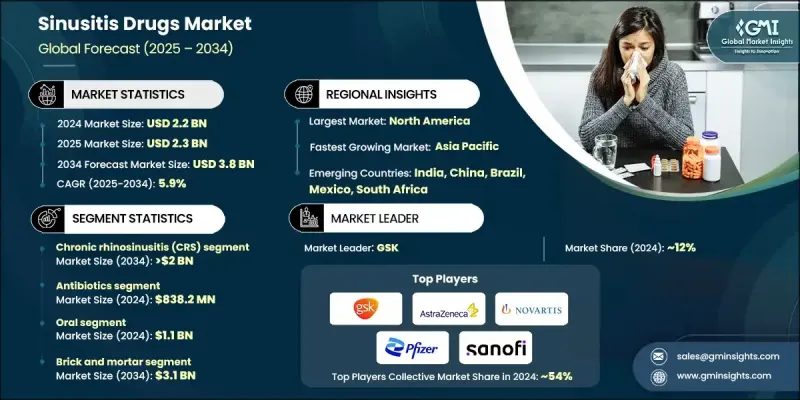
市場需求受到以下因素的推動:急性和慢性鼻竇炎盛行率的上升、非處方減充血劑和抗組織胺使用量的增加,以及靶向鼻腔給藥技術的進步。過敏引起的鼻竇疾病也進一步推高了市場需求。鼻竇炎藥物旨在減輕鼻竇腔的腫脹、感染和阻塞,同時緩解鼻塞、疼痛、壓力和鼻涕等症狀。這些藥物包括抗生素、皮質類固醇、抗組織胺、減充血劑和其他輔助療法,旨在恢復正常的鼻竇功能。鼻內皮質類固醇、黏膜黏附給藥系統和精準藥物-器械組合的創新正在提高療效,最大限度地減少全身副作用,並提高患者的依從性。患者越來越傾向於選擇起效更快、症狀長期控制效果更好、生物利用度更高的非侵入性治療方法。處方藥和非處方藥通路對這些先進療法的需求持續強勁成長。
| 市場範圍 | |
|---|---|
| 起始年份 | 2024 |
| 預測年份 | 2025-2034 |
| 起始值 | 22億美元 |
| 預測值 | 38億美元 |
| 複合年成長率 | 5.9% |
預計到2034年,皮質類固醇市場將以6.5%的複合年成長率成長。這一成長主要得益於其強大的抗發炎作用,與許多傳統療法相比,皮質類固醇能更有效地減輕黏膜腫脹並恢復鼻竇引流。鼻內製劑的進步提高了局部給藥和安全性,進一步促進了其在急性和慢性病例中的應用。
實體藥局佔了81.4%的市場佔有率,預計到2034年將達到31億美元。實體藥局仍然是鼻竇炎藥物,特別是抗生素和處方皮質類固醇藥物,最值得信賴的購買管道。患者重視便捷的購藥途徑、專業的指導以及藥劑師在非處方藥選擇、劑量和症狀管理方面的支持,這使得實體藥店客流量高、銷售額穩定。
2024年,北美鼻竇炎藥物市佔率達41%。該地區鼻竇炎發生率高,主要原因是過敏原、污染、病毒性呼吸道感染和室內空氣污染物。每年有數百萬成年人患有急性或慢性鼻竇炎,導致藥物需求持續成長。過敏性鼻炎的日益普遍進一步加劇了鼻竇炎症狀,從而也增加了藥物的消耗量。
全球性鼻竇炎藥物市場的主要參與者包括葛蘭素史克 (GSK)、AdvaCare Pharma、Amneal Pharmaceuticals、APOTEX、阿斯特捷利康 (AstraZeneca)、Aurobindo Pharma、Cipla、費森尤斯卡比 (Fresenius Kabi)、Glenmark Pharmaceuticals、HikkY (Pfizer)、賽諾菲 (Sanofi) 和 Viatris。這些公司致力於藥物遞送系統的創新,包括鼻噴劑、黏膜黏附製劑以及能夠實現精準給藥和提高生物利用度的器械-藥物組合。各公司正加大研發投入,以開發起效更快、更安全、非侵入性且病患依從性更高的療法。拓展高發地區的市場以及與醫療機構的合作,有助於增強市場佔有率和可近性。此外,各公司也重視強而有力的行銷活動、藥劑師和病患的教育計畫以及與經銷商的合作,以促進非處方藥和處方藥的普及。
目錄
第1章:方法論與範圍
第2章:執行概要
第3章:行業洞察
- 產業生態系分析
- 產業影響因素
- 成長促進因素
- 急性和慢性鼻竇炎發生率上升
- 對鼻內皮質類固醇的需求不斷成長
- 抗生素在細菌性鼻竇炎治療的應用日益廣泛
- 生物製劑在治療伴隨鼻息肉的慢性鼻竇炎的應用
- 產業陷阱與挑戰
- 抗生素濫用和抗藥性
- 某些藥物類別對慢性病例的療效有限
- 市場機遇
- 生物製劑和標靶療法的擴展
- 對非處方緩解症狀產品的需求不斷成長
- 成長促進因素
- 成長潛力分析
- 報銷方案
- 監管環境
- 北美洲
- 歐洲
- 亞太地區
- 技術格局
- 當前技術趨勢
- 新興技術
- 消費者洞察
- 管道分析
- 差距分析
- 波特的分析
- PESTEL 分析
- 價值鏈分析
- 未來市場趨勢
第4章:競爭格局
- 介紹
- 公司矩陣分析
- 公司市佔率分析
- 全球的
- 北美洲
- 歐洲
- 亞太地區
- 競爭定位矩陣
- 主要市場參與者的競爭分析
- 關鍵進展
- 併購
- 合作夥伴關係與合作
- 新產品發布
- 擴張計劃
第5章:市場估計與預測:依疾病類型分類,2021-2034年
- 主要趨勢
- 慢性鼻竇炎(CRS)
- 急性鼻竇炎(ARS)
第6章:市場估計與預測:依藥物類別分類,2021-2034年
- 主要趨勢
- 抗生素
- 皮質類固醇
- 抗組織胺藥
- 止痛藥
- 其他藥物類別
第7章:市場估計與預測:依給藥途徑分類,2021-2034年
- 主要趨勢
- 口服
- 鼻噴劑
- 主題
- 腸外
第8章:市場估算與預測:依配銷通路分類,2021-2034年
- 主要趨勢
- 磚瓦
- 電子商務
第9章:市場估計與預測:依地區分類,2021-2034年
- 主要趨勢
- 北美洲
- 美國
- 加拿大
- 歐洲
- 德國
- 英國
- 法國
- 西班牙
- 義大利
- 荷蘭
- 亞太地區
- 中國
- 日本
- 印度
- 澳洲
- 韓國
- 拉丁美洲
- 巴西
- 墨西哥
- 阿根廷
- 中東和非洲
- 南非
- 沙烏地阿拉伯
- 阿拉伯聯合大公國
第10章:公司簡介
- GSK
- AdvaCare Pharma
- Amneal Pharmaceuticals
- APOTEX
- AstraZeneca
- Aurobindo Pharma
- Cipla
- Fresenius Kabi
- Glenmark Pharmaceuticals
- Hikma Pharmaceuticals
- HSG (Bayer)
- NOVARTIS
- Pfizer
- Sanofi
- Viatris
The Global Sinusitis Drugs Market was valued at USD 2.2 billion in 2024 and is estimated to grow at a CAGR of 5.9% to reach USD 3.8 billion by 2034.
The market is fueled by a rising prevalence of acute and chronic sinusitis, increasing use of over-the-counter decongestants and antihistamines, and technological advancements in targeted nasal drug delivery. Allergy-induced sinus disorders are further contributing to demand. Sinusitis drugs are designed to reduce swelling, infection, and blockage of the sinus cavities while alleviating symptoms such as congestion, pain, pressure, and nasal discharge. These medications include antibiotics, corticosteroids, antihistamines, decongestants, and other supportive therapies that restore normal sinus function. Innovations in intranasal corticosteroids, mucoadhesive delivery systems, and precision drug-device combinations are enhancing efficacy, minimizing systemic side effects, and improving patient compliance. Patients increasingly prefer non-invasive treatments with faster relief, long-term symptom control, and improved bioavailability. Both prescription and OTC channels continue to witness strong adoption of these advanced therapies.
| Market Scope | |
|---|---|
| Start Year | 2024 |
| Forecast Year | 2025-2034 |
| Start Value | $2.2 Billion |
| Forecast Value | $3.8 Billion |
| CAGR | 5.9% |
The corticosteroids segment is expected to grow at a CAGR of 6.5% through 2034. This growth is driven by their potent anti-inflammatory effects, which reduce mucosal swelling and restore sinus drainage more effectively than many traditional therapies. Advances in intranasal formulations that improve localized delivery and safety are further increasing their adoption for both acute and chronic cases.
The brick-and-mortar segment held an 81.4% share and is expected to reach USD 3.1 billion through 2034. Physical drugstores remain the most trusted source for sinusitis medications, particularly antibiotics and prescription corticosteroids. Patients value immediate access, professional guidance, and pharmacist support for OTC selection, dosing, and symptom management, which sustains high footfall and consistent sales in these outlets.
North America Sinusitis Drugs Market held a 41% share in 2024. The region reports high incidences of sinusitis due to allergens, pollution, viral respiratory infections, and indoor air contaminants. Millions of adults experience acute or chronic sinusitis annually, creating a continuous demand for medications. The increasing prevalence of allergic rhinitis further aggravates sinus conditions, supporting sustained drug consumption.
Key players operating in the Global Sinusitis Drugs Market include GSK, AdvaCare Pharma, Amneal Pharmaceuticals, APOTEX, AstraZeneca, Aurobindo Pharma, Cipla, Fresenius Kabi, Glenmark Pharmaceuticals, Hikma Pharmaceuticals, HSG (Bayer), NOVARTIS, Pfizer, Sanofi, and Viatris. Companies in the Sinusitis Drugs Market are focusing on innovation in drug delivery systems, including nasal sprays, mucoadhesive formulations, and device-drug combinations that enable precision dosing and enhanced bioavailability. Firms are investing in research and development to create faster-acting, safer, and non-invasive therapies with improved patient compliance. Geographic expansion into high-prevalence regions and partnerships with healthcare providers strengthen market presence and accessibility. Additionally, companies emphasize robust marketing campaigns, educational programs for pharmacists and patients, and collaborations with distributors to enhance OTC and prescription adoption.
Table of Contents
Chapter 1 Methodology and Scope
- 1.1 Market scope and definitions
- 1.2 Research design
- 1.2.1 Research approach
- 1.2.2 Data collection methods
- 1.3 Data mining sources
- 1.3.1 Global
- 1.3.2 Regional/country
- 1.4 Base estimates and calculations
- 1.4.1 Base year calculation
- 1.4.2 Key trends for market estimation
- 1.5 Primary research and validation
- 1.5.1 Primary sources
- 1.6 Forecast model
- 1.7 Research assumptions and limitations
Chapter 2 Executive Summary
- 2.1 Industry 3600 synopsis
- 2.2 Key market trends
- 2.2.1 Regional trends
- 2.2.2 Disease type trends
- 2.2.3 Drug class trends
- 2.2.4 Route of administration trends
- 2.2.5 Distribution channel trends
- 2.3 CXO perspectives: Strategic imperatives
- 2.3.1 Key decision points for industry executives
- 2.3.2 Critical success factors for market players
- 2.4 Future outlook and strategic recommendations
Chapter 3 Industry Insights
- 3.1 Industry ecosystem analysis
- 3.2 Industry impact forces
- 3.2.1 Growth drivers
- 3.2.1.1 Rising prevalence of acute and chronic sinusitis
- 3.2.1.2 Increasing demand for intranasal corticosteroids
- 3.2.1.3 Growing use of antibiotics for bacterial sinusitis
- 3.2.1.4 Adoption of biologics for chronic rhinosinusitis with nasal polyps
- 3.2.2 Industry pitfalls and challenges
- 3.2.2.1 Overuse and resistance to antibiotics
- 3.2.2.2 Limited efficacy of certain drug classes in chronic cases
- 3.2.3 Market opportunities
- 3.2.3.1 Expansion of biologics and targeted therapies
- 3.2.3.2 Rising demand for OTC symptomatic relief products
- 3.2.1 Growth drivers
- 3.3 Growth potential analysis
- 3.4 Reimbursement scenario
- 3.5 Regulatory landscape
- 3.5.1 North America
- 3.5.2 Europe
- 3.5.3 Asia Pacific
- 3.6 Technology landscape
- 3.6.1 Current technological trends
- 3.6.2 Emerging technologies
- 3.7 Consumer insights
- 3.8 Pipeline analysis
- 3.9 Gap analysis
- 3.10 Porter's analysis
- 3.11 PESTEL analysis
- 3.12 Value chain analysis
- 3.13 Future market trends
Chapter 4 Competitive Landscape, 2024
- 4.1 Introduction
- 4.2 Company matrix analysis
- 4.3 Company market share analysis
- 4.3.1 Global
- 4.3.2 North America
- 4.3.3 Europe
- 4.3.4 Asia Pacific
- 4.4 Competitive positioning matrix
- 4.5 Competitive analysis of major market players
- 4.6 Key developments
- 4.6.1 Mergers & acquisitions
- 4.6.2 Partnerships & collaborations
- 4.6.3 New product launches
- 4.6.4 Expansion plans
Chapter 5 Market Estimates and Forecast, By Disease Type, 2021 - 2034 ($ Mn)
- 5.1 Key trends
- 5.2 Chronic rhinosinusitis (CRS)
- 5.3 Acute rhinosinusitis (ARS)
Chapter 6 Market Estimates and Forecast, By Drug Class, 2021 - 2034 ($ Mn)
- 6.1 Key trends
- 6.2 Antibiotics
- 6.3 Corticosteroids
- 6.4 Antihistamines
- 6.5 Analgesics
- 6.6 Other drug classes
Chapter 7 Market Estimates and Forecast, By Route of Administration, 2021 - 2034 ($ Mn)
- 7.1 Key trends
- 7.2 Oral
- 7.3 Nasal spray
- 7.4 Topical
- 7.5 Parenteral
Chapter 8 Market Estimates and Forecast, By Distribution Channel, 2021 - 2034 ($ Mn)
- 8.1 Key trends
- 8.2 Brick and mortar
- 8.3 E-commerce
Chapter 9 Market Estimates and Forecast, By Region, 2021 - 2034 ($ Mn)
- 9.1 Key trends
- 9.2 North America
- 9.2.1 U.S.
- 9.2.2 Canada
- 9.3 Europe
- 9.3.1 Germany
- 9.3.2 UK
- 9.3.3 France
- 9.3.4 Spain
- 9.3.5 Italy
- 9.3.6 Netherlands
- 9.4 Asia Pacific
- 9.4.1 China
- 9.4.2 Japan
- 9.4.3 India
- 9.4.4 Australia
- 9.4.5 South Korea
- 9.5 Latin America
- 9.5.1 Brazil
- 9.5.2 Mexico
- 9.5.3 Argentina
- 9.6 Middle East and Africa
- 9.6.1 South Africa
- 9.6.2 Saudi Arabia
- 9.6.3 UAE
Chapter 10 Company Profiles
- 10.1 GSK
- 10.2 AdvaCare Pharma
- 10.3 Amneal Pharmaceuticals
- 10.4 APOTEX
- 10.5 AstraZeneca
- 10.6 Aurobindo Pharma
- 10.7 Cipla
- 10.8 Fresenius Kabi
- 10.9 Glenmark Pharmaceuticals
- 10.10 Hikma Pharmaceuticals
- 10.11 HSG (Bayer)
- 10.12 NOVARTIS
- 10.13 Pfizer
- 10.14 Sanofi
- 10.15 Viatris

 慢性鼻竇炎市場-全球產業規模、佔有率、趨勢、機會、預測:按疾病表現型、治療類型、分銷管道、地區和競爭格局分類,2021-2031年鼻竇炎治療市場-全球產業規模、佔有率、趨勢、機會、預測:按疾病類型、給藥途徑、地區和競爭格局分類,2021-2031年
 鼻竇炎治療市場:按藥物類別、給藥途徑、劑型、處方狀態、患者年齡層、疾病類型、分銷管道、最終用戶和地區分類
 全球急性病毒性鼻竇炎治療市場:規模、佔有率、趨勢和成長分析報告(2026-2034)全球苯腎上腺素類藥物市場規模、佔有率、趨勢及成長分析報告(2026-2034年)全球鼻竇炎治療市場規模、佔有率、趨勢和成長分析報告(2026-2034年)
 鼻竇炎藥物市場預測至2032年:按藥物類別、給藥途徑、疾病類型、處方箋類型、分銷管道、最終用戶和地區分類的全球分析
 鼻竇炎藥物市場規模、佔有率和趨勢分析報告:按疾病、藥物類別、分銷管道、地區和細分市場預測(2025-2033 年)
 慢性鼻竇市場報告:2030 年趨勢、預測與競爭分析