


 |
市場調查報告書
商品編碼
1885828
鑽井液市場機會、成長促進因素、產業趨勢分析及預測(2025-2034年)Drilling Fluid Market Opportunity, Growth Drivers, Industry Trend Analysis, and Forecast 2025 - 2034 |
||||||

2024 年全球鑽井液市場價值為 124 億美元,預計到 2034 年將以 5% 的複合年成長率成長至 201 億美元。
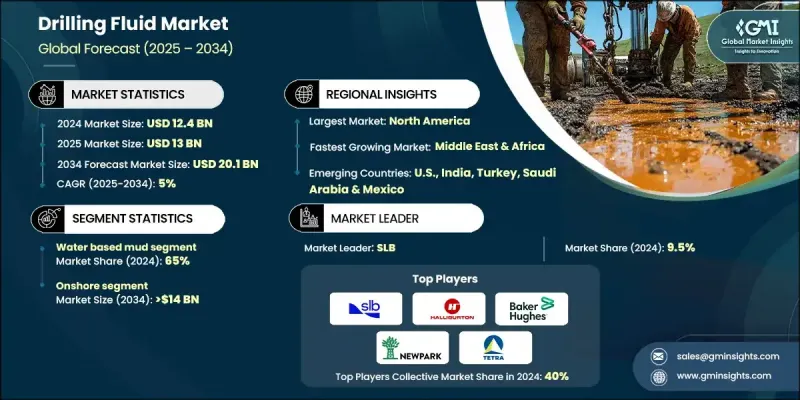
產業擴張的驅動力來自日益嚴格的環境合規要求以及對作業效率和油井完整性的日益重視。現代鑽井作業擴大採用環保高性能流體系統,以提高鑽井效率並最大限度地減少地層損害,從而兼顧永續發展目標和作業效率。鑽井液,無論是水基、油基或合成的,都是用於油氣探勘的工程化學配方,其作用包括冷卻和潤滑鑽頭、將岩屑輸送到地面以及維持井眼穩定性。鑽井液的作用已從基本的循環系統發展成為控制井孔壓力、最佳化性能和提高成本效益的策略工具。可重複使用和可回收的配方帶來了額外的經濟優勢,進一步鞏固了其在現代鑽井作業中的關鍵地位。
| 市場範圍 | |
|---|---|
| 起始年份 | 2024 |
| 預測年份 | 2025-2034 |
| 起始值 | 124億美元 |
| 預測值 | 201億美元 |
| 複合年成長率 | 5% |
2024年,水基泥漿市佔率達到65%,預計到2034年將以5%的複合年成長率成長。其適應性強且環境友好,使其成為淺井和中深井的首選。對永續鑽井實踐的重視以及監管機構對低毒性鑽井液的支持,將繼續推動水性泥漿的應用和市場成長。
2024年,陸上鑽井液市佔率達到75.3%,預計到2034年將達到140億美元。陸上作業需要經濟高效且環保的鑽井液,而陸上探勘計畫的大量發展也推動了對鑽井液的持續需求。隨著各國國內油氣產量的增加,油井開發規模擴大,為鑽井液供應商創造了穩定的機遇,並促進了市場擴張。
預計2024年,美國鑽井液市佔率將達72%,市場規模將達43億美元。監管合規以及政府對環保鑽井液的激勵措施,共同推動了市場發展。國內油氣資源豐富盆地的生產重點提升,帶動了對高性能鑽井液的強勁需求,也為供應商帶來了持續的成長機會。
全球鑽井液市場的主要參與者包括Stellar Drilling Fluids、Eco Drilling Fluids、Baker Hughes、Universal Performance Chemicals、Di-Corp、INEOS、Newpark Drilling Fluids、Halliburton、BCS Fluids、Cargill Energy、Gumpro Drilling Fluids、Halliburton、BCS Fluids、Cargill Energy、Gumpro Drilling Fluids、Tetra Technologies. Fluids、Ingevity、Supreme Drilling Fluid Chemicals和SumiSaujana。鑽井液市場的企業正優先考慮創新,以開發環保且高性能的鑽井液配方。對研發的投入確保了鑽井液能夠滿足不斷變化的監管標準,同時提高井眼穩定性和鑽井效率。與鑽井承包商、服務提供者和油田營運商建立策略合作夥伴關係,可以擴大市場准入並加強供應鏈。各公司正在利用可重複使用和可回收的鑽井液技術來降低營運成本,並吸引注重永續發展的客戶。向高成長地區進行地理擴張,可以確保獲得新興鑽井計畫的機會。
目錄
第1章:方法論與範圍
第2章:執行概要
第3章:行業洞察
- 產業生態系分析
- 原物料供應及採購分析
- 製造能力評估
- 供應鏈韌性與風險因素
- 配電網路分析
- 監管環境
- 產業影響因素
- 成長促進因素
- 產業陷阱與挑戰
- 成長潛力分析
- 波特的分析
- PESTEL 分析
- 鑽井液成本結構分析
- 新興機會與趨勢
- 數位化與物聯網整合
- 投資分析及未來展望
第4章:競爭格局
- 介紹
- 按地區分類的公司市佔率分析
- 北美洲
- 歐洲
- 亞太地區
- 中東和非洲
- 拉丁美洲
- 戰略儀錶板
- 策略舉措
- 重要夥伴關係與合作
- 主要併購活動
- 產品創新與發布
- 市場擴張策略
- 競爭性標竿分析
- 創新與永續發展格局
第5章:市場規模及預測:依產品類型分類,2021-2034年
- 主要趨勢
- 水基泥
- 油基泥漿
- 合成泥漿
- 其他
第6章:市場規模及預測:依應用領域分類,2021-2034年
- 主要趨勢
- 陸上
- 離岸
第7章:市場規模及預測:依油井類型分類,2021-2034年
- 主要趨勢
- 傳統的
- 高溫高壓
第8章:市場規模及預測:依地區分類,2021-2034年
- 主要趨勢
- 北美洲
- 美國
- 加拿大
- 歐洲
- 德國
- 土耳其
- 羅馬尼亞
- 英國
- 義大利
- 俄羅斯
- 荷蘭
- 挪威
- 亞太地區
- 中國
- 日本
- 印尼
- 印度
- 澳洲
- 泰國
- 中東和非洲
- 沙烏地阿拉伯
- 阿拉伯聯合大公國
- 卡達
- 埃及
- 阿爾及利亞
- 利比亞
- 奈及利亞
- 科威特
- 阿曼
- 拉丁美洲
- 巴西
- 墨西哥
- 哥倫比亞
- 阿根廷
第9章:公司簡介
- AES Drilling Fluids
- Baker Hughes
- BCS Fluids
- Cargill
- CES Energy Solutions Corp
- Chevron Phillips Chemical Company
- Di-Corp
- Eco Drilling Fluids
- Gumpro Drilling Fluids
- Halliburton
- INEOS
- Ingevity
- International Drilling Fluids
- National Energy Services Reunited Corp
- Newpark Drilling Fluids
- SLB
- Stellar Drilling Fluids
- SumiSaujana
- SUPREME DRILLING FLUID CHEMICALS
- Universal Performance Chemicals
The Global Drilling Fluid Market was valued at USD 12.4 billion in 2024 and is estimated to grow at a CAGR of 5% to reach USD 20.1 billion by 2034.
Industry expansion is driven by rising environmental compliance requirements and an increased focus on operational efficiency and well integrity. Modern drilling operations are increasingly utilizing eco-friendly, high-performance fluid systems to enhance drilling outcomes while minimizing formation damage, supporting both sustainability objectives and operational efficiency. Drilling fluids, whether water-based, oil-based, or synthetic, are engineered chemical formulations used in oil and gas exploration to cool and lubricate the drill bit, transport cuttings to the surface, and maintain wellbore stability. Their role has evolved beyond basic circulation to a strategic tool for wellbore pressure control, performance optimization, and cost efficiency. Reusable and recyclable formulations have created additional economic advantages, reinforcing their position as critical assets in modern drilling operations.
| Market Scope | |
|---|---|
| Start Year | 2024 |
| Forecast Year | 2025-2034 |
| Start Value | $12.4 Billion |
| Forecast Value | $20.1 Billion |
| CAGR | 5% |
The water-based mud segment accounted for a 65% share in 2024 and is projected to grow at 5% CAGR through 2034. Its adaptability and environmentally friendly nature make it the preferred choice for shallow and medium-depth wells. The emphasis on sustainable drilling practices and regulatory support for low-toxicity fluids will continue to drive adoption and market growth.
The onshore drilling fluid segment captured a 75.3% share in 2024 and is expected to reach USD 14 billion by 2034. Onshore operations favor cost-effective, environmentally safe fluids, fueling consistent demand due to the volume of land-based exploration projects. As countries increase domestic oil and gas production, well development expands, creating steady opportunities for drilling fluid suppliers and supporting market expansion.
U.S. Drilling Fluid Market held a 72% share in 2024, generating USD 4.3 billion. Regulatory compliance, combined with government incentives for greener fluids, has enhanced the market landscape. High demand for high-performance drilling fluids is being driven by a focus on domestic oil and gas production in prolific basins, ensuring continuous growth opportunities for suppliers.
Key players in the Global Drilling Fluid Market include Stellar Drilling Fluids, Eco Drilling Fluids, Baker Hughes, Universal Performance Chemicals, Di-Corp, INEOS, Newpark Drilling Fluids, Halliburton, BCS Fluids, Cargill, Gumpro Drilling Fluids, Tetra Technologies, Chevron Phillips Chemical Company, CES Energy Solutions Corp, AES Drilling Fluids, Ingevity, Supreme Drilling Fluid Chemicals, and SumiSaujana. Companies in the Drilling Fluid Market are prioritizing innovation to develop environmentally friendly and high-performance fluid formulations. Investment in research and development ensures that fluids meet evolving regulatory standards while enhancing wellbore stability and drilling efficiency. Strategic partnerships with drilling contractors, service providers, and oilfield operators expand market access and strengthen supply chains. Firms are leveraging reusable and recyclable fluid technologies to reduce operational costs and appeal to sustainability-focused clients. Geographic expansion into high-growth regions ensures access to emerging drilling projects.
Table of Contents
Chapter 1 Methodology & Scope
- 1.1 Research design
- 1.1.1 Research approach
- 1.1.2 Data collection methods
- 1.2 Base estimates and calculations
- 1.2.1 Base year calculation
- 1.2.2 Market estimates & forecast parameters
- 1.3 Forecast
- 1.3.1 Key trends for market estimates
- 1.3.2 Quantified market impact analysis
- 1.3.2.1 Mathematical impact of growth parameters on forecast
- 1.3.3 Scenario analysis framework
- 1.4 Primary research and validation
- 1.4.1 Some of the primary sources (but not limited to)
- 1.5 Data mining sources
- 1.5.1 Paid Sources
- 1.5.2 Sources, by region
- 1.6 Research trail & scoring components
- 1.6.1 Research trail components
- 1.6.2 Scoring components
- 1.7 Research transparency addendum
- 1.7.1 Source attribution framework
- 1.7.2 Quality assurance metrics
- 1.7.3 Our commitment to trust
- 1.8 Market definitions
Chapter 2 Executive Summary
- 2.1 Industry synopsis, 2021 - 2034
- 2.2 Business trends
- 2.3 Product type trends
- 2.4 Application trends
- 2.5 Well type trends
- 2.6 Regional trends
Chapter 3 Industry Insights
- 3.1 Industry ecosystem analysis
- 3.1.1 Raw material availability & sourcing analysis
- 3.1.2 Manufacturing capacity assessment
- 3.1.3 Supply chain resilience & risk factors
- 3.1.4 Distribution network analysis
- 3.2 Regulatory landscape
- 3.3 Industry impact forces
- 3.3.1 Growth drivers
- 3.3.2 Industry pitfalls & challenges
- 3.4 Growth potential analysis
- 3.5 Porter's analysis
- 3.5.1 Bargaining power of suppliers
- 3.5.2 Bargaining power of buyers
- 3.5.3 Threat of new entrants
- 3.5.4 Threat of substitutes
- 3.6 PESTEL analysis
- 3.6.1 Political factors
- 3.6.2 Economic factors
- 3.6.3 Social factors
- 3.6.4 Technological factors
- 3.6.5 Legal factors
- 3.6.6 Environmental factors
- 3.7 Cost structure analysis of drilling fluid
- 3.8 Emerging opportunities & trends
- 3.9 Digitalization & IoT integration
- 3.10 Investment analysis & future outlook
Chapter 4 Competitive Landscape, 2025
- 4.1 Introduction
- 4.2 Company market share analysis, by region, 2024
- 4.2.1 North America
- 4.2.2 Europe
- 4.2.3 Asia Pacific
- 4.2.4 Middle East & Africa
- 4.2.5 Latin America
- 4.3 Strategic dashboard
- 4.4 Strategic initiatives
- 4.4.1 Key partnerships & collaborations
- 4.4.2 Major M&A activities
- 4.4.3 Product innovations & launches
- 4.4.4 Market expansion strategies
- 4.5 Competitive benchmarking
- 4.6 Innovation & sustainability landscape
Chapter 5 Market Size and Forecast, By Product Type, 2021 - 2034 (USD Million)
- 5.1 Key trends
- 5.2 Water based mud
- 5.3 Oil based mud
- 5.4 Synthetic based mud
- 5.5 Others
Chapter 6 Market Size and Forecast, By Application, 2021 - 2034 (USD Million)
- 6.1 Key trends
- 6.2 Onshore
- 6.3 Offshore
Chapter 7 Market Size and Forecast, By Well Type, 2021 - 2034 (USD Million)
- 7.1 Key trends
- 7.2 Conventional
- 7.3 HPHT
Chapter 8 Market Size and Forecast, By Region, 2021 - 2034 (USD Million)
- 8.1 Key trends
- 8.2 North America
- 8.2.1 U.S.
- 8.2.2 Canada
- 8.3 Europe
- 8.3.1 Germany
- 8.3.2 Turkey
- 8.3.3 Romania
- 8.3.4 UK
- 8.3.5 Italy
- 8.3.6 Russia
- 8.3.7 Netherlands
- 8.3.8 Norway
- 8.4 Asia Pacific
- 8.4.1 China
- 8.4.2 Japan
- 8.4.3 Indonesia
- 8.4.4 India
- 8.4.5 Australia
- 8.4.6 Thailand
- 8.5 Middle East & Africa
- 8.5.1 Saudi Arabia
- 8.5.2 UAE
- 8.5.3 Qatar
- 8.5.4 Egypt
- 8.5.5 Algeria
- 8.5.6 Libya
- 8.5.7 Nigeria
- 8.5.8 Kuwait
- 8.5.9 Oman
- 8.6 Latin America
- 8.6.1 Brazil
- 8.6.2 Mexico
- 8.6.3 Colombia
- 8.6.4 Argentina
Chapter 9 Company Profiles
- 9.1 AES Drilling Fluids
- 9.2 Baker Hughes
- 9.3 BCS Fluids
- 9.4 Cargill
- 9.5 CES Energy Solutions Corp
- 9.6 Chevron Phillips Chemical Company
- 9.7 Di-Corp
- 9.8 Eco Drilling Fluids
- 9.9 Gumpro Drilling Fluids
- 9.10 Halliburton
- 9.11 INEOS
- 9.12 Ingevity
- 9.13 International Drilling Fluids
- 9.14 National Energy Services Reunited Corp
- 9.15 Newpark Drilling Fluids
- 9.16 SLB
- 9.17 Stellar Drilling Fluids
- 9.18 SumiSaujana
- 9.19 SUPREME DRILLING FLUID CHEMICALS
- 9.20 Universal Performance Chemicals

 鑽井以增稠劑市場:依流體類型、增稠劑類型、鑽井環境、井型和溫度範圍分類,全球預測(2026-2032年)
 井控液市場規模、佔有率和成長分析:按產品類型、應用、最終用戶和地區分類-2026-2033年產業預測
 全球鑽井液市場:市場規模、佔有率、成長、依類型和應用劃分的產業分析、區域洞察及未來預測(2026-2034)
 2026年全球鑽井液市場報告
 鑽井液市場-全球產業規模、佔有率、趨勢、機會與預測:按應用、流體系統、井型、地區和競爭格局分類,2021-2031年地熱鑽井液添加劑市場(依添加劑功能、流體類型、井筒溫度、井筒深度、應用階段、最終用途和通路分類)-全球預測,2026-2032年陸上鑽井液市場:依流體類型、作業方式、井型、井深及最終用戶分類,全球預測,2026-2032年
 鑽井液市場規模、佔有率和成長分析(按類型、應用、功能、最終用戶和地區分類)—2026-2033年產業預測鑽井液市場:未來預測(2025-2030)2026-2032 年鑽井液市場(依產品、應用及地區)