


 |
市場調查報告書
商品編碼
1885817
綠建築市場機會、成長促進因素、產業趨勢分析及預測(2025-2034年)Green Building Market Opportunity, Growth Drivers, Industry Trend Analysis, and Forecast 2025 - 2034 |
||||||

2024 年全球綠建築市場價值為 5,302 億美元,預計到 2034 年將以 10.2% 的複合年成長率成長至 1.39 兆美元。
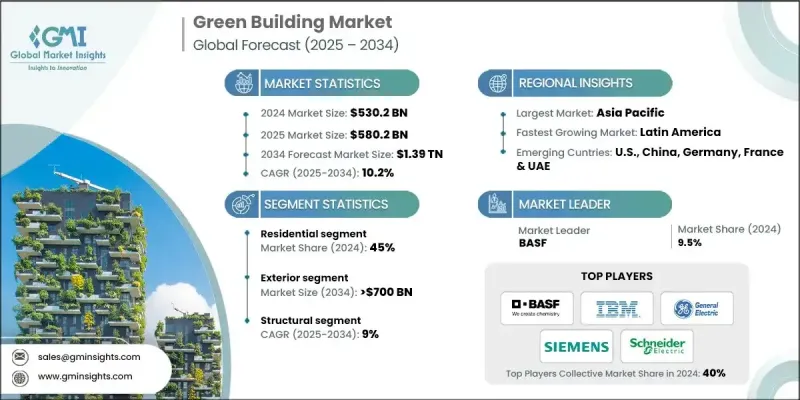
隨著永續性、能源效率和環境責任成為政府、消費者和房地產開發商的核心優先事項,綠色建築產業正在蓬勃發展。加速的城市化進程,加上日益嚴格的建築法規和人們對氣候影響的日益關注,持續推動市場成長。現代建築擴大採用節能材料、先進的暖通空調解決方案和現場再生能源系統,從根本上改變了建築的設計和運作方式。綠建築實踐能夠減少資源消耗,改善室內環境質量,並為住宅、商業和工業應用帶來長期的成本節約。全球認證框架、企業永續發展目標以及公眾對環保發展的日益成長的期望,進一步強化了市場需求。各行各業的組織都在升級改造設施,以滿足雄心勃勃的減排目標、最佳化營運績效並符合全球環境標準。
| 市場範圍 | |
|---|---|
| 起始年份 | 2024 |
| 預測年份 | 2025-2034 |
| 起始值 | 5302億美元 |
| 預測值 | 1.39兆美元 |
| 複合年成長率 | 10.2% |
2024年,住宅領域佔據了45%的市場佔有率,預計到2034年將以9.5%的複合年成長率成長。業主越來越重視更低的營運成本、更佳的室內空氣品質和環保設計。永續材料、智慧家居技術以及最大限度減少碳排放的施工方法推動了綠色建築的普及。政府激勵措施和更新的建築法規促進了綠色建築的廣泛應用,使其成為未來城市發展的重要組成部分。
2024年,室內綠色建築市場規模預計將達到1,888億美元,這反映出人們對採用環保材料和系統的更健康室內空間的日益關注。市場對可回收和低排放產品、增強自然採光、先進通風系統以及能夠最佳化舒適度和能源效率的智慧控制系統的需求不斷成長。日益嚴格的ESG(環境、社會和治理)承諾以及以健康為導向的設計標準正在加速向永續室內環境的轉變。
預計到2034年,北美綠建築市場規模將達到4,000億美元。嚴格的環境法規和日益提高的永續發展期望正促使開發商採用生態高效設計、節約資源的材料和智慧建築技術。扶持性政策、不斷擴展的認證項目以及對健康室內空間的日益重視,將繼續推動綠色建築技術在該地區長期普及應用。
活躍於綠色建築市場的關鍵企業包括 CertainTeed、杜邦、Binderholz、江森自控、Alumasc Building Products、通用電氣公司、BSW 集團、金斯潘集團、昕諾飛控股、CEMEX、HOLCIM、福爾波、博世安全系統、歐文斯科寧、大金、Bauder、Interface、Bauder、Interface、Albard、Redguard參與綠建築市場競爭的企業正採取一系列策略來鞏固市場地位並擴大全球業務。許多公司正在投資研發先進的永續材料、節能建築系統和低碳製造程序,以滿足日益成長的監管和消費者期望。與建築公司、技術供應商和認證機構的合作有助於加速創新,並打造符合現代綠色標準的整合解決方案。此外,各公司也持續拓展產品組合,以滿足從住宅改造到大型商業項目等各種應用需求。
目錄
第1章:方法論與範圍
第2章:執行概要
第3章:行業洞察
- 產業生態系分析
- 原物料供應及採購分析
- 製造能力評估
- 供應鏈韌性與風險因素
- 配電網路分析
- 監管環境
- 產業影響因素
- 成長促進因素
- 產業陷阱與挑戰
- 成長潛力分析
- 波特的分析
- PESTEL 分析
- 綠建築成本結構分析
- 新興成長機遇
- 影響永續建築的關鍵趨勢
- 投資環境及長期前景
- 數位轉型與產業4.0融合
- 永續發展計劃和標準
第4章:競爭格局
- 介紹
- 按地區分類的公司市佔率分析
- 北美洲
- 歐洲
- 亞太地區
- 中東和非洲
- 拉丁美洲
- 戰略儀錶板
- 策略舉措
- 重要夥伴關係與合作
- 主要併購活動
- 產品創新與發布
- 市場擴張策略
- 競爭性標竿分析
- 創新與永續發展格局
第5章:市場規模及預測:依最終用途分類,2021-2034年
- 主要趨勢
- 住宅
- 商業的
- 工業的
第6章:市場規模及預測:依專案類型分類,2021-2034年
- 主要趨勢
- 新的
- 改造
第7章:市場規模及預測:依產品分類,2021-2034年
- 主要趨勢
- 內部的
- 外部的
- 其他
第8章:市場規模及預測:依材料類型分類,2021-2034年
- 主要趨勢
- 結構
- 絕緣
- 精加工
- 玻璃和玻璃帷幕牆
第9章:市場規模及預測:依銷售管道分類,2021-2034年
- 主要趨勢
- 線上
- 離線
第10章:市場規模及預測:依地區分類,2021-2034年
- 主要趨勢
- 北美洲
- 美國
- 加拿大
- 墨西哥
- 歐洲
- 德國
- 英國
- 法國
- 荷蘭
- 瑞典
- 義大利
- 西班牙
- 丹麥
- 挪威
- 亞太地區
- 中國
- 日本
- 印度
- 韓國
- 澳洲
- 新加坡
- 印尼
- 馬來西亞
- 中東和非洲
- 阿拉伯聯合大公國
- 沙烏地阿拉伯
- 南非
- 卡達
- 科威特
- 埃及
- 肯亞
- 摩洛哥
- 拉丁美洲
- 巴西
- 智利
- 阿根廷
第11章:公司簡介
- ABB
- Alleguard
- Alumasc Building Products
- BASF
- Bauder Ltd.
- Binderholz GmbH
- Bosch Sicherheitssysteme GmbH
- BSW GROUP
- CEMEX
- CertainTeed, LLC
- Daikin
- DuPont
- Forbo
- General Electric Company
- HOLCIM
- IBM
- Interface, Inc.
- Johnson Controls
- Kingspan Group
- Owens Corning
- RedBuilt
- Schneider Electric
- Siemens
- Signify Holding
The Global Green Building Market was valued at USD 530.2 billion in 2024 and is estimated to grow at a CAGR of 10.2% to reach USD 1.39 trillion by 2034.
The industry is expanding as sustainability, energy efficiency, and environmental responsibility become core priorities for governments, consumers, and real estate developers. Accelerating urbanization, combined with stricter building regulations and heightened awareness of climate impacts, continues to drive market growth. Modern construction increasingly incorporates energy-efficient materials, advanced HVAC solutions, and on-site renewable systems, fundamentally reshaping how buildings are designed and operated. Green building practices reduce resource consumption, improve indoor environmental quality, and support long-term cost savings across residential, commercial, and industrial applications. Demand is further reinforced by global certification frameworks, corporate sustainability goals, and rising public expectations for environmentally conscious development. Organizations across multiple sectors are upgrading facilities to meet ambitious emissions targets, optimize operational performance, and align with global environmental standards.
| Market Scope | |
|---|---|
| Start Year | 2024 |
| Forecast Year | 2025-2034 |
| Start Value | $530.2 Billion |
| Forecast Value | $1.39 Trillion |
| CAGR | 10.2% |
The residential segment held a 45% share in 2024 and is projected to grow at a CAGR of 9.5% through 2034. Homeowners increasingly value lower operating costs, improved indoor air quality, and eco-friendly design features. Adoption is fueled by sustainability-driven materials, smart home technologies, and construction methods that minimize carbon output. Government incentives and updated building regulations support widespread integration, establishing residential green buildings as a key component of future urban development.
The interior green building segment reached USD 188.8 billion in 2024, reflecting growing interest in healthier indoor spaces that incorporate environmentally responsible materials and systems. Demand is rising for recycled and low-emission products, enhanced natural light, advanced ventilation, and smart controls that optimize comfort and energy performance. Strengthening ESG commitments and wellness-oriented design standards are accelerating the shift toward sustainable interior environments.
North America Green Building Market is expected to reach USD 400 billion by 2034. Strong environmental regulations and heightened sustainability expectations are encouraging developers to deploy eco-efficient designs, resource-saving materials, and intelligent building technologies. Supportive policies, expanding certification programs, and increased emphasis on healthy indoor spaces continue to drive long-term adoption across the region.
Key companies active in the Green Building Market include CertainTeed, DuPont, Binderholz, Johnson Controls, Alumasc Building Products, General Electric Company, BSW GROUP, Kingspan Group, Signify Holding, CEMEX, HOLCIM, Forbo, Bosch Sicherheitssysteme, Owens Corning, Daikin, Bauder, Interface, ABB, Alleguard, Schneider Electric, RedBuilt, Siemens, BASF, and IBM. Companies competing in the Green Building Market are employing a range of strategies to strengthen their market position and expand global reach. Many firms are investing in advanced sustainable materials, energy-efficient building systems, and low-carbon manufacturing processes to meet growing regulatory and consumer expectations. Partnerships with construction firms, technology providers, and certification bodies help accelerate innovation and create integrated solutions tailored to modern green standards. Companies are also expanding product portfolios to address diverse applications, from residential retrofits to large-scale commercial projects.
Table of Contents
Chapter 1 Methodology & Scope
- 1.1 Research design
- 1.1.1 Research approach
- 1.1.2 Data collection methods
- 1.2 Base estimates and calculations
- 1.2.1 Base year calculation
- 1.2.2 Market estimates & forecast parameters
- 1.3 Forecast model
- 1.3.1 Key trends for market estimates
- 1.3.2 Quantified market impact analysis
- 1.3.2.1 Mathematical impact of growth parameters on forecast
- 1.3.3 Scenario analysis framework
- 1.4 Primary research and validation
- 1.4.1 Some of the primary sources (but not limited to)
- 1.5 Data mining sources
- 1.5.1 Paid Sources
- 1.5.2 Sources, by region
- 1.6 Research trail & scoring components
- 1.6.1 Research trail components
- 1.6.2 Scoring components
- 1.7 Research transparency addendum
- 1.7.1 Source attribution framework
- 1.7.2 Quality assurance metrics
- 1.7.3 Our commitment to trust
- 1.8 Market definitions
Chapter 2 Executive Summary
- 2.1 Industry synopsis, 2021 - 2034
- 2.1.1 Business trends
- 2.1.2 End use trends
- 2.1.3 Project type trends
- 2.1.4 Product trends
- 2.1.5 Material type trends
- 2.1.6 Sales channel trends
- 2.1.7 Regional trends
Chapter 3 Industry Insights
- 3.1 Industry ecosystem analysis
- 3.1.1 Raw material availability & sourcing analysis
- 3.1.2 Manufacturing capacity assessment
- 3.1.3 Supply chain resilience & risk factors
- 3.1.4 Distribution network analysis
- 3.2 Regulatory landscape
- 3.3 Industry impact forces
- 3.3.1 Growth drivers
- 3.3.2 Industry pitfalls & challenges
- 3.4 Growth potential analysis
- 3.5 Porter's analysis
- 3.5.1 Bargaining power of suppliers
- 3.5.2 Bargaining power of buyers
- 3.5.3 Threat of new entrants
- 3.5.4 Threat of substitutes
- 3.6 PESTEL analysis
- 3.6.1 Political factors
- 3.6.2 Economic factors
- 3.6.3 Social factors
- 3.6.4 Technological factors
- 3.6.5 Legal factors
- 3.6.6 Environmental factors
- 3.7 Cost structure analysis of green buildings
- 3.8 Emerging growth opportunities
- 3.9 Key trends shaping sustainable construction
- 3.10 Investment landscape & long-term prospects
- 3.11 Digital transformation & industry 4.0 integration
- 3.12 Sustainability initiatives & standards
Chapter 4 Competitive Landscape, 2025
- 4.1 Introduction
- 4.2 Company market share analysis, by region, 2024
- 4.2.1 North America
- 4.2.2 Europe
- 4.2.3 Asia Pacific
- 4.2.4 Middle East & Africa
- 4.2.5 Latin America
- 4.3 Strategic dashboard
- 4.4 Strategic initiatives
- 4.4.1 Key partnerships & collaborations
- 4.4.2 Major M&A activities
- 4.4.3 Product innovations & launches
- 4.4.4 Market expansion strategies
- 4.5 Competitive benchmarking
- 4.6 Innovation & sustainability landscape
Chapter 5 Market Size and Forecast, By End Use, 2021 - 2034 (USD Million)
- 5.1 Key trends
- 5.2 Residential
- 5.3 Commercial
- 5.4 Industrial
Chapter 6 Market Size and Forecast, By Project Type, 2021 - 2034 (USD Million)
- 6.1 Key trends
- 6.2 New
- 6.3 Retrofit
Chapter 7 Market Size and Forecast, By Product, 2021 - 2034 (USD Million)
- 7.1 Key trends
- 7.2 Interior
- 7.3 Exterior
- 7.4 Others
Chapter 8 Market Size and Forecast, By Material Type, 2021 - 2034 (USD Million)
- 8.1 Key trends
- 8.2 Structural
- 8.3 Insulation
- 8.4 Finishing
- 8.5 Glass & glazing
Chapter 9 Market Size and Forecast, By Sales Channel, 2021 - 2034 (USD Million)
- 9.1 Key trends
- 9.2 Online
- 9.3 Offline
Chapter 10 Market Size and Forecast, By Region, 2021 - 2034 (USD Million)
- 10.1 Key trends
- 10.2 North America
- 10.2.1 U.S.
- 10.2.2 Canada
- 10.2.3 Mexico
- 10.3 Europe
- 10.3.1 Germany
- 10.3.2 UK
- 10.3.3 France
- 10.3.4 Netherlands
- 10.3.5 Sweden
- 10.3.6 Italy
- 10.3.7 Spain
- 10.3.8 Denmark
- 10.3.9 Norway
- 10.4 Asia Pacific
- 10.4.1 China
- 10.4.2 Japan
- 10.4.3 India
- 10.4.4 South Korea
- 10.4.5 Australia
- 10.4.6 Singapore
- 10.4.7 Indonesia
- 10.4.8 Malaysia
- 10.5 Middle East & Africa
- 10.5.1 UAE
- 10.5.2 Saudi Arabia
- 10.5.3 South Africa
- 10.5.4 Qatar
- 10.5.5 Kuwait
- 10.5.6 Egypt
- 10.5.7 Kenya
- 10.5.8 Morocco
- 10.6 Latin America
- 10.6.1 Brazil
- 10.6.2 Chile
- 10.6.3 Argentina
Chapter 11 Company Profiles
- 11.1 ABB
- 11.2 Alleguard
- 11.3 Alumasc Building Products
- 11.4 BASF
- 11.5 Bauder Ltd.
- 11.6 Binderholz GmbH
- 11.7 Bosch Sicherheitssysteme GmbH
- 11.8 BSW GROUP
- 11.9 CEMEX
- 11.10 CertainTeed, LLC
- 11.11 Daikin
- 11.12 DuPont
- 11.13 Forbo
- 11.14 General Electric Company
- 11.15 HOLCIM
- 11.16 IBM
- 11.17 Interface, Inc.
- 11.18 Johnson Controls
- 11.19 Kingspan Group
- 11.20 Owens Corning
- 11.21 RedBuilt
- 11.22 Schneider Electric
- 11.23 Siemens
- 11.24 Signify Holding

 綠建築:市場佔有率分析、產業趨勢與統計、成長預測(2026-2031)
 綠色外牆市場:按類型、植被類型、應用和區域分類
 2026年全球單戶住宅綠建築市場報告2026年全球多戶住宅綠建築市場報告2026年全球綠建築市場報告2026年全球非住宅綠建築市場報告2026年全球綠建築LEED諮詢市場報告
 簡易包裝市場規模、佔有率、成長及全球產業分析:按類型、應用和地區分類的洞察,2026-2034 年預測亞太地區綠建築:市場佔有率分析、產業趨勢與統計、成長預測(2026-2031年)
 綠色建築市場-全球產業規模、佔有率、趨勢、機會和預測:按產品類型、應用、地區和競爭格局分類,2021-2031年