


 |
市場調查報告書
商品編碼
1885803
雙面太陽能光電模組市場機會、成長促進因素、產業趨勢分析及預測(2025-2034年)Bifacial Solar PV Module Market Opportunity, Growth Drivers, Industry Trend Analysis, and Forecast 2025 - 2034 |
||||||

2024年全球雙面太陽能光電模組市場規模達8,430萬美元,預計2034年將以4.3%的複合年成長率成長至1.271億美元。
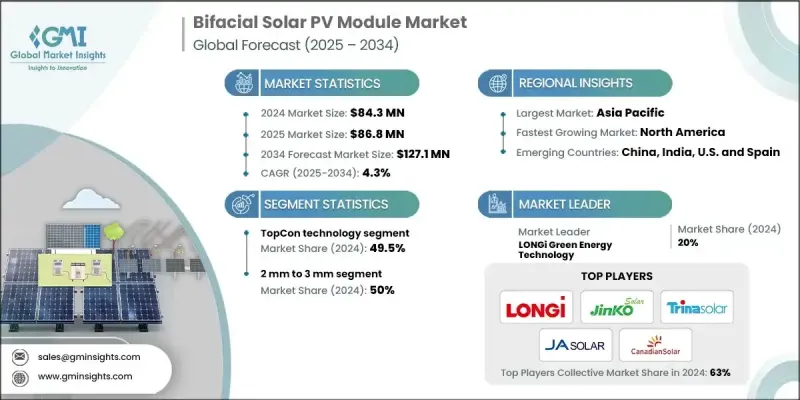
全球公用事業規模太陽能裝置的建造動能仍是推動雙面組件普及的主要因素。大型開發商從這些組件中獲益匪淺,因為它們能夠最佳化場地設計,並與先進的追蹤系統無縫整合,最終提高背面輻照度和整體能量輸出。雙面技術與單軸追蹤相結合已成為新建地面安裝系統的首選配置,超過一半的新建專案都整合了單軸追蹤系統。多項技術經濟評估一致表明,雙面組件與追蹤器結合使用可實現最低的平準化度電成本 (LCOE),這主要得益於追蹤系統帶來的 15-20% 的能量增益以及雙面組件性能帶來的額外提升。隨著產業加速從 PERC 架構向 n 型架構轉型,TOPCon 等技術因其更高的溫度係數、更高的雙面性以及在高溫和高輻照度條件下更優異的性能而持續獲得關注。在陽光強烈、地形反射率高的地區,雙面組件的產量優勢足以彌補其相對於上一代組件的顯著成本溢價,從而增強了各個市場的需求。
| 市場範圍 | |
|---|---|
| 起始年份 | 2024 |
| 預測年份 | 2025-2034 |
| 起始值 | 8430萬美元 |
| 預測值 | 1.271億美元 |
| 複合年成長率 | 4.3% |
預計到2034年,HJT(異質結電晶體)細分市場將以8.5%的複合年成長率成長,這主要得益於其顯著的高雙面性、優異的溫度特性和強大的弱光效率。儘管較高的生產成本和對封裝材料耐久性的擔憂限制了其應用,但持續的創新,尤其是針對降低成本和改進材料的創新,正在推動其未來的成長。
預計到2034年,2毫米厚光電模組市場將以5%的複合年成長率成長,這主要得益於其適用於輕量化和特殊應用,例如攜帶式能源解決方案和建築整合式光伏設計。更薄的結構在保持結構性能的同時降低了組件重量,從而減少了運輸和BOS(系統平衡)相關成本,並促進了其在屋頂和追蹤式光電系統中的更廣泛應用。
預計2024年,美國雙面太陽能光電模組市場規模將達1,500萬美元。該國公用事業規模的光電系統廣泛採用追蹤系統,從而持續推動了對雙面組件的需求。預測顯示,未來十年雙面率將穩定提升,這將有助於提高容量係數並降低系統成本。
參與全球雙面太陽能光電模組市場的主要公司包括晶澳太陽能科技、信實新能源、寶維太陽能集團、索拉利亞公司、晶科能源控股有限公司、REC集團、邁耶·伯格、Sunergy、天合光能、隆基綠色能源科技、First Solar、3Sun、Sipsen、韓華Q CELLS、Astroenergy、SunPowerCansen、Astroenergy、SunPowerZ、Cstroenergy、SunPower、Astroenergy、SunPower)、Risen
全球雙面太陽能光電模組市場的企業正專注於技術創新、提升製造效率和拓展全球市場的策略,強化其競爭優勢。許多企業正加大對n型電池架構、先進封裝材料和更高效率組件形式的投資,以提高輸出功率並降低衰減率。擴大產能、最佳化供應鏈和實現製造流程自動化有助於降低整體成本,同時擴大市場覆蓋範圍。與追蹤器製造商、EPC公司和公用事業開發商的合作,能夠實現系統級性能的全面提升。此外,企業也積極尋求策略合作夥伴關係、建造區域性製造工廠,並豐富產品組合,以滿足住宅、商業和公用事業規模等不同領域的需求。
目錄
第1章:方法論與範圍
第2章:執行概要
第3章:行業洞察
- 產業生態系統
- 監管環境
- 產業影響因素
- 成長促進因素
- 產業陷阱與挑戰
- 成長潛力分析
- 波特的分析
- PESTEL 分析
第4章:競爭格局
- 介紹
- 按地區分類的公司市佔率分析
- 北美洲
- 歐洲
- 亞太地區
- 中東和非洲
- 拉丁美洲
- 戰略儀錶板
- 策略舉措
- 公司標竿分析
- 創新與技術格局
第5章:市場規模及預測:依類型分類,2021-2034年
- 主要趨勢
- 雙層玻璃
- 玻璃背板
第6章:市場規模及預測:依技術分類,2021-2034年
- 主要趨勢
- 四氯乙烯
- 拓普康
- HJT
- 其他
第7章:市場規模及預測:依應用領域分類,2021-2034年
- 主要趨勢
- 住宅
- 商業及工業
- 公用事業
第8章:市場規模及預測:依框架類型分類,2021-2034年
- 主要趨勢
- 框
- 無框
第9章:市場規模及預測:依厚度分類,2021-2034年
- 主要趨勢
- 小於 2 毫米
- 2毫米至3毫米
- > 3 毫米
第10章:市場規模及預測:依地區分類,2021-2034年
- 主要趨勢
- 北美洲
- 美國
- 加拿大
- 墨西哥
- 歐洲
- 德國
- 英國
- 法國
- 荷蘭
- 西班牙
- 亞太地區
- 中國
- 印度
- 日本
- 韓國
- 澳洲
- 中東和非洲
- 阿拉伯聯合大公國
- 沙烏地阿拉伯
- 南非
- 卡達
- 埃及
- 拉丁美洲
- 巴西
- 智利
- 阿根廷
第11章:公司簡介
- 3Sun
- Astroenergy
- Boviet Solar Group
- Canadian Solar
- First Solar
- Hanwha Q CELLS Co., Ltd.
- JA Solar Technology
- JinkoSolar Holding Co., Ltd.
- LONGi Green Energy Technology
- Meyer Burger
- REC Group
- Reliance New Energy
- Risen Energy
- Sharp Corporation
- Seraphim Solar
- Solaria Corporation
- Sunergy
- SunPower Corporation
- Trina Solar
- Vikram Solar
The Global Bifacial Solar PV Module Market reached USD 84.3 million in 2024 and is estimated to grow at a CAGR of 4.3% to reach USD 127.1 million by 2034.
Global momentum toward utility-scale solar installations remains the primary catalyst for increasing adoption of bifacial systems. Large-scale developers benefit significantly from these modules because they allow optimized site design and seamless integration with advanced tracking systems, ultimately boosting rear-side irradiation capture and overall energy output. Bifacial technology combined with single-axis tracking has emerged as the preferred configuration for new ground-mounted setups, with over half of new installations integrating SAT systems. Multiple techno-economic evaluations have consistently shown that pairing bifacial modules with trackers delivers some of the lowest LCOE outcomes, driven by energy gains of 15-20% from tracking and an additional uplift attributed to bifacial performance. As the industry accelerates the shift from PERC to n-type architectures, technologies such as TOPCon continue to gain traction due to their improved temperature coefficients, higher bifaciality, and stronger performance under elevated temperatures and high-irradiance conditions. In regions characterized by intense sunlight and reflective terrain, bifacial modules deliver yield advantages that justify notable cost premiums over earlier-generation modules, strengthening demand across diverse markets.
| Market Scope | |
|---|---|
| Start Year | 2024 |
| Forecast Year | 2025-2034 |
| Start Value | $84.3 Million |
| Forecast Value | $127.1 Million |
| CAGR | 4.3% |
The HJT segment is projected to grow at a CAGR of 8.5% through 2034, supported by its notably high bifaciality levels, favorable temperature profiles, and strong low-light efficiency. Although adoption has been restrained by higher production expenses and concerns regarding encapsulant durability, ongoing innovation focused on cost reduction and material enhancements is shaping future growth.
The 2 mm segment is forecast to grow at a 5% CAGR by 2034, driven by its suitability for lightweight and specialized applications such as portable energy solutions and building-integrated photovoltaic designs. Its thinner structure decreases module weight while maintaining structural performance, enabling reduced transportation and BOS-related expenses and supporting broader uptake among rooftop and tracker-enabled installations.
U.S. Bifacial Solar PV Module Market reached USD 15 million in 2024. Utility-scale deployments in the country utilize tracking systems extensively, generating sustained demand for bifacial modules. Forecasts indicate a steady rise in bifaciality factors over the coming decade, which will contribute to improved capacity factors and lower system-level costs.
Key companies participating in the Global Bifacial Solar PV Module Market include JA Solar Technology, Reliance New Energy, Boviet Solar Group, Solaria Corporation, JinkoSolar Holding Co., Ltd., REC Group, Meyer Burger, Sunergy, Trina Solar, LONGi Green Energy Technology, First Solar, 3Sun, Sharp Corporation, Hanwha Q CELLS Co., Ltd., Astroenergy, SunPower Corporation, Risen Energy, Seraphim Solar, Canadian Solar, and Vikram Solar.
Companies in the Global Bifacial Solar PV Module Market strengthen their competitive position through targeted strategies that focus on technological innovation, manufacturing efficiency, and global expansion. Many firms are increasing investments in n-type cell architectures, advanced encapsulation materials, and higher efficiency module formats to improve output and reduce degradation rates. Scaling production capacity, optimizing supply chains, and automating manufacturing processes help reduce overall costs while supporting wider market reach. Collaboration with tracker manufacturers, EPC firms, and utility developers enables integrated system-level performance gains. Companies also pursue strategic partnerships, regional manufacturing facilities, and diversification of product portfolios to address demand across residential, commercial, and utility-scale segments.
Table of Contents
Chapter 1 Methodology & Scope
- 1.1 Research design
- 1.1.1 Research approach
- 1.1.2 Data collection methods
- 1.1.3 Base estimates and calculations
- 1.1.4 Base year calculation
- 1.1.5 Key trends for market estimates
- 1.2 Forecast model
- 1.3 Primary research & validation
- 1.3.1 Primary sources
- 1.4 Data mining sources
- 1.5 Market definitions
Chapter 2 Executive Summary
- 2.1 Industry 3600 synopsis, 2021 - 2034
- 2.2 Business trends
- 2.3 Type trends
- 2.4 Technology trends
- 2.5 Application trends
- 2.6 Frame type trends
- 2.7 Thickness trends
- 2.8 Regional trends
Chapter 3 Industry Insights
- 3.1 Industry ecosystem
- 3.2 Regulatory landscape
- 3.3 Industry impact forces
- 3.3.1 Growth drivers
- 3.3.2 Industry pitfalls & challenges
- 3.4 Growth potential analysis
- 3.5 Porter's analysis
- 3.5.1 Bargaining power of suppliers
- 3.5.2 Bargaining power of buyers
- 3.5.3 Threat of new entrants
- 3.5.4 Threat of substitutes
- 3.6 PESTEL analysis
Chapter 4 Competitive landscape, 2025
- 4.1 Introduction
- 4.2 Company market share analysis, by region, 2024
- 4.2.1 North America
- 4.2.2 Europe
- 4.2.3 Asia Pacific
- 4.2.4 Middle East & Africa
- 4.2.5 Latin America
- 4.3 Strategic dashboard
- 4.4 Strategic initiatives
- 4.5 Company benchmarking
- 4.6 Innovation & technology landscape
Chapter 5 Market Size and Forecast, By Type, 2021 - 2034 (USD Million & MW)
- 5.1 Key trends
- 5.2 Dual glass
- 5.3 Glass backsheet
Chapter 6 Market Size and Forecast, By Technology, 2021 - 2034 (USD Million & MW)
- 6.1 Key trends
- 6.2 PERC
- 6.3 TopCon
- 6.4 HJT
- 6.5 Others
Chapter 7 Market Size and Forecast, By Application, 2021 - 2034 (USD Million, Million m2 & MW)
- 7.1 Key trends
- 7.2 Residential
- 7.3 Commercial & Industrial
- 7.4 Utility
Chapter 8 Market Size and Forecast, By Frame type, 2021 - 2034 (USD Million & MW)
- 8.1 Key trends
- 8.2 Framed
- 8.3 Frameless
Chapter 9 Market Size and Forecast, By Thickness, 2021 - 2034 (USD Million & MW)
- 9.1 Key trends
- 9.2 < 2 mm
- 9.3 2 mm to 3 mm
- 9.4 > 3 mm
Chapter 10 Market Size and Forecast, By Region, 2021 - 2034 (USD Million & MW)
- 10.1 Key trends
- 10.2 North America
- 10.2.1 U.S.
- 10.2.2 Canada
- 10.2.3 Mexico
- 10.3 Europe
- 10.3.1 Germany
- 10.3.2 UK
- 10.3.3 France
- 10.3.4 Netherlands
- 10.3.5 Spain
- 10.4 Asia Pacific
- 10.4.1 China
- 10.4.2 India
- 10.4.3 Japan
- 10.4.4 South Korea
- 10.4.5 Australia
- 10.5 Middle East & Africa
- 10.5.1 UAE
- 10.5.2 Saudi Arabia
- 10.5.3 South Africa
- 10.5.4 Qatar
- 10.5.5 Egypt
- 10.6 Latin America
- 10.6.1 Brazil
- 10.6.2 Chile
- 10.6.3 Argentina
Chapter 11 Company Profiles
- 11.1 3Sun
- 11.2 Astroenergy
- 11.3 Boviet Solar Group
- 11.4 Canadian Solar
- 11.5 First Solar
- 11.6 Hanwha Q CELLS Co., Ltd.
- 11.7 JA Solar Technology
- 11.8 JinkoSolar Holding Co., Ltd.
- 11.9 LONGi Green Energy Technology
- 11.10 Meyer Burger
- 11.11 REC Group
- 11.12 Reliance New Energy
- 11.13 Risen Energy
- 11.14 Sharp Corporation
- 11.15 Seraphim Solar
- 11.16 Solaria Corporation
- 11.17 Sunergy
- 11.18 SunPower Corporation
- 11.19 Trina Solar
- 11.20 Vikram Solar

 折疊式太陽能電池市場:2026-2032 年全球市場預測,按應用、安裝系統、電池技術、功率等級、安裝類型和最終用戶分類。
 2026年雙面太陽能電池全球市場報告
 雙面太陽能半導體市場分析及預測(至2035年):依類型、產品類型、服務、技術、組件、應用、材料類型、安裝類型及最終用戶分類雙面單晶P型電池市場按封裝方式、電池厚度、應用和最終用戶分類-全球預測,2026-2032年
 雙面太陽能電池市場規模、佔有率和成長分析(按功率容量、面板類型、框架類型、電池技術、應用和地區分類)—產業預測(2026-2033 年)
 雙面太陽能模組市場機會、成長促進因素、產業趨勢分析及預測(2026-2035年)
 雙面太陽能市場,按材料、按功率容量、按框架類型、按電池類型、按應用、按國家/地區 - 2025 年至 2032 年全球行業分析、市場規模、市場佔有率及預測
 全球雙面太陽能市場
 雙面太陽能市場-全球產業規模、佔有率、趨勢、機會和預測(按類型、框架類型、應用、地區和競爭細分,2020-2030 年)
 2032 年雙面太陽能市場預測:按類型、安裝類型、安裝系統、框架、電池技術、應用、最終用戶和地區進行的全球分析