


 |
市場調查報告書
商品編碼
1885796
紡織品回收市場機會、成長促進因素、產業趨勢分析及預測(2025-2034年)Textile to Textile Recycling Market Opportunity, Growth Drivers, Industry Trend Analysis, and Forecast 2025 - 2034 |
||||||

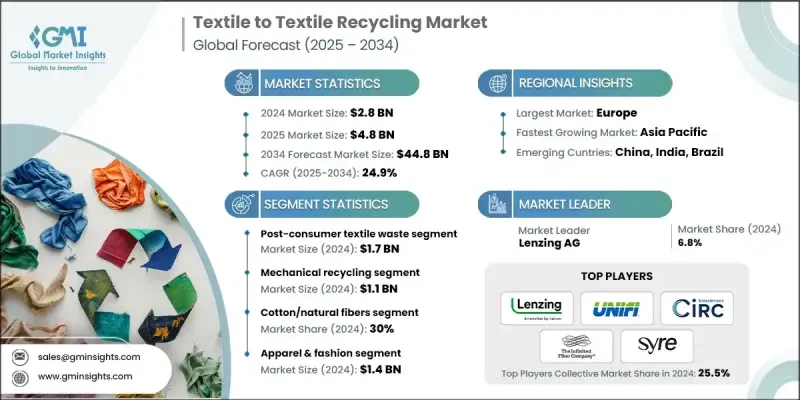
2024 年全球紡織品回收市場價值為 28 億美元,預計到 2034 年將以 24.9% 的複合年成長率成長至 448 億美元。
市場加速發展得益於區塊鏈賦能的數位產品護照和嵌入式纖維識別技術的快速整合,這些技術增強了可追溯性並實現了更精準的分類。這些數位系統使回收商能夠高精度地驗證纖維類型、追蹤材料來源並監控生命週期資料,在某些情況下還能支援即時決策。它們的應用提高了回收材料的質量,減少了污染,並確保符合歐洲不斷發展的循環紡織品法規。隨著永續發展期望的不斷提高,全球品牌正擴大採用這些技術來提升供應鏈責任感並滿足監管要求。同時,化學和酵素法回收製程的商業化程度也日益提高,能夠將複雜的紡織混合物分解成適用於高品質再生材料的纖維成分。隨著企業與大型服裝製造商建立合作關係並擴大產能,這些創新技術正從試點階段過渡到工業規模營運。
| 市場範圍 | |
|---|---|
| 起始年份 | 2024 |
| 預測年份 | 2025-2034 |
| 起始值 | 28億美元 |
| 預測值 | 448億美元 |
| 複合年成長率 | 24.9% |
2024年,消費後紡織品廢料市場規模將達17億美元,約佔紡織品回收原料總量的60%。這一主導地位主要得益於廢棄服裝數量的增加、回收管道的拓展以及支持循環時尚體系的政策舉措。
2024 年,服裝和時尚產業規模達到 14 億美元,這得益於全球服裝品牌對永續發展的堅定承諾,以及整個產業主流和特色服裝類別中再生纖維的日益普及。
2024年,北美紡織品回收市場規模預計將達7.41億美元,佔全球市場佔有率的26%。鼓勵生產者延伸責任制的政策發展,以及零售商與回收企業之間合作的加強,正在推動該地區更完善的收集、分類和回收基礎設施的建設。
參與紡織品回收市場的主要公司包括 Ambercycle Inc.、Boer Group Recycling Solutions BV、Circ Inc.、Ecotex Germany GmbH、Evrnu SPC、FABSCRAP Inc.、Grasim Industries Limited(Birla Cellulose)、Infinited Fiber Company Oy、Lenzing AGSAN Corporation(Birla Cellulose)、CortSole Corporation SA(IRARE) Corporation(WAPnz Corporation) Recycling International Ltd 和 Unifi Inc.。領先企業正透過大力投資先進的回收技術來鞏固其市場地位,這些技術能夠將混紡和難以回收的材料加工成高品質的再生纖維。許多公司正透過與全球服裝製造商建立合資企業和長期合作關係,從試點營運過渡到全面的工業化生產,從而擴大生產規模。企業也正在進一步整合數位化追蹤工具,例如嵌入式纖維標記和基於區塊鏈的資料系統,以增強可追溯性並滿足合規性要求。
目錄
第1章:方法論與範圍
第2章:執行概要
第3章:行業洞察
- 產業生態系分析
- 供應商格局
- 利潤率
- 每個階段的價值增加
- 影響價值鏈的因素
- 中斷
- 產業影響因素
- 成長促進因素
- 產業陷阱與挑戰
- 市場機遇
- 成長潛力分析
- 監管環境
- 北美洲
- 歐洲
- 亞太地區
- 拉丁美洲
- 中東和非洲 (MEA)
- 波特的分析
- PESTEL 分析
- 價格趨勢
- 按地區
- 按原料來源
- 未來市場趨勢
- 技術與創新格局
- 當前技術趨勢
- 新興技術
- 專利格局
- 貿易統計(HS編碼)
- 主要進口國
- 主要出口國
- 永續性和環境方面
- 永續實踐
- 減少廢棄物策略
- 生產中的能源效率
- 環保舉措
- 碳足跡考量
第4章:競爭格局
- 介紹
- 公司市佔率分析
- 按地區
- 北美洲
- 歐洲
- 亞太地區
- 拉丁美洲
- MEA
- 按地區
- 公司矩陣分析
- 主要市場參與者的競爭分析
- 競爭定位矩陣
- 關鍵進展
- 併購
- 合作夥伴關係與合作
- 新產品發布
- 擴張計劃
第5章:市場估算與預測:依原料來源分類,2021-2034年
- 主要趨勢
- 消費後紡織廢料
- 消費前工業廢料
- 混合紡織廢料流
第6章:市場估算與預測:依技術類型分類,2021-2034年
- 主要趨勢
- 機械回收
- 化學回收
- 生物/酵素回收
- 混合/組合技術
第7章:市場估算與預測:依纖維類型分類,2021-2034年
- 主要趨勢
- 聚酯/合成纖維
- 棉/天然纖維
- 混紡織物
- 特種纖維
第8章:市場估算與預測:依應用領域分類,2021-2034年
- 主要趨勢
- 服裝與時尚
- 工業紡織品
- 家用紡織品
- 汽車紡織品
- 非織物應用
第9章:市場估計與預測:依地區分類,2021-2034年
- 主要趨勢
- 北美洲
- 美國
- 加拿大
- 歐洲
- 德國
- 英國
- 法國
- 西班牙
- 義大利
- 歐洲其他地區
- 亞太地區
- 中國
- 印度
- 日本
- 澳洲
- 韓國
- 亞太其他地區
- 拉丁美洲
- 巴西
- 墨西哥
- 阿根廷
- 拉丁美洲其他地區
- 中東和非洲
- 沙烏地阿拉伯
- 南非
- 阿拉伯聯合大公國
- 中東和非洲其他地區
第10章:公司簡介
- Ambercycle Inc
- Boer Group Recycling Solutions BV
- Circ Inc
- Ecotex Germany GmbH
- Evrnu SPC
- FABSCRAP Inc
- Grasim Industries Limited (Birla Cellulose)
- Infinited Fiber Company Oy
- Lenzing AG
- Martex Fiber Southern Corporation
- Procotex Corporation SA
- RE&UP (SANKO Group)
- SYRE AB
- Textile Recycling International Ltd
- Unifi Inc
The Global Textile to Textile Recycling Market was valued at USD 2.8 billion in 2024 and is estimated to grow at a CAGR of 24.9% to reach USD 44.8 billion by 2034.
Market acceleration is driven by the rapid integration of blockchain-enabled digital product passports and embedded fiber identification technologies that enhance traceability and enable more accurate sorting. These digital systems allow recyclers to validate fiber type, track material origins, and monitor lifecycle data with high precision, supporting real-time decision-making in some instances. Their adoption improves the quality of recovered materials, reduces contamination, and ensures alignment with evolving circular textile regulations in Europe. As sustainability expectations grow, global brands are increasingly adopting these technologies to improve supply-chain accountability and meet regulatory expectations. At the same time, chemical and enzymatic recycling processes are achieving greater commercial maturity, offering the ability to break down complex textile blends into fiber components suitable for high-quality regenerated materials. These innovations are now transitioning from pilot stages into industrial-scale operations as companies secure partnerships with major apparel manufacturers and expand production capacity.
| Market Scope | |
|---|---|
| Start Year | 2024 |
| Forecast Year | 2025-2034 |
| Start Value | $2.8 Billion |
| Forecast Value | $44.8 Billion |
| CAGR | 24.9% |
The post-consumer textile waste segment accounted for USD 1.7 billion in 2024, representing roughly 60% of the total feedstock in textile-to-textile recycling. This dominant share is influenced by increased volumes of discarded garments, broader collection channels, and policy-driven initiatives supporting circular fashion systems.
The apparel and fashion segment reached USD 1.4 billion in 2024, benefiting from strong sustainability commitments among global clothing brands and rising incorporation of recycled fibers into mainstream and specialty apparel categories across the industry.
North America Textile to Textile Recycling Market generated USD 741 million in 2024, contributing 26% share. Policy developments encouraging extended producer responsibility programs, along with increased collaboration between retailers and recycling firms, are supporting stronger collection, sorting, and recovery infrastructure throughout the region.
Key companies participating in the Textile to Textile Recycling Market include Ambercycle Inc., Boer Group Recycling Solutions BV, Circ Inc., Ecotex Germany GmbH, Evrnu SPC, FABSCRAP Inc., Grasim Industries Limited (Birla Cellulose), Infinited Fiber Company Oy, Lenzing AG, Martex Fiber Southern Corporation, Procotex Corporation SA, RE&UP (SANKO Group), SYRE AB, Textile Recycling International Ltd, and Unifi Inc. Leading companies are strengthening their presence by investing heavily in advanced recycling technologies capable of processing blended and hard-to-recycle materials into high-quality regenerated fibers. Many firms are scaling production by transitioning from pilot operations to full industrial facilities through joint ventures and long-term collaborations with global apparel manufacturers. Businesses are further integrating digital tracking tools, such as embedded fiber markers and blockchain-enabled data systems, to enhance traceability and meet compliance demands.
Table of Contents
Chapter 1 Methodology & Scope
- 1.1 Market scope and definition
- 1.2 Research design
- 1.2.1 Research approach
- 1.2.2 Data collection methods
- 1.3 Data mining sources
- 1.3.1 Global
- 1.3.2 Regional/Country
- 1.4 Base estimates and calculations
- 1.4.1 Base year calculation
- 1.4.2 Key trends for market estimation
- 1.5 Primary research and validation
- 1.5.1 Primary sources
- 1.6 Forecast model
- 1.7 Research assumptions and limitations
Chapter 2 Executive Summary
- 2.1 Industry 360° synopsis
- 2.2 Key market trends
- 2.2.1 Regional
- 2.2.2 Feedstock source
- 2.2.3 Technology type
- 2.2.4 Fiber type
- 2.2.5 Application
- 2.3 TAM Analysis, 2025-2034
- 2.4 CXO perspectives: Strategic imperatives
- 2.4.1 Executive decision points
- 2.4.2 Critical success factors
- 2.5 Future Outlook and Strategic Recommendations
Chapter 3 Industry Insights
- 3.1 Industry ecosystem analysis
- 3.1.1 Supplier landscape
- 3.1.2 Profit margin
- 3.1.3 Value addition at each stage
- 3.1.4 Factor affecting the value chain
- 3.1.5 Disruptions
- 3.2 Industry impact forces
- 3.2.1 Growth drivers
- 3.2.2 Industry pitfalls and challenges
- 3.2.3 Market opportunities
- 3.3 Growth potential analysis
- 3.4 Regulatory landscape
- 3.4.1 North America
- 3.4.2 Europe
- 3.4.3 Asia Pacific
- 3.4.4 Latin America
- 3.4.5 Middle East & Africa (MEA)
- 3.5 Porter's analysis
- 3.6 PESTEL analysis
- 3.7 Price trends
- 3.7.1 By region
- 3.7.2 By feedstock source
- 3.8 Future market trends
- 3.9 Technology and innovation landscape
- 3.9.1 Current technological trends
- 3.9.2 Emerging technologies
- 3.10 Patent landscape
- 3.11 Trade statistics (HS code)
- 3.11.1 Major importing countries
- 3.11.2 Major exporting countries
- 3.12 Sustainability and environmental aspects
- 3.12.1 Sustainable practices
- 3.12.2 Waste reduction strategies
- 3.12.3 Energy efficiency in production
- 3.12.4 Eco-friendly initiatives
- 3.13 Carbon footprint consideration
Chapter 4 Competitive Landscape, 2024
- 4.1 Introduction
- 4.2 Company market share analysis
- 4.2.1 By region
- 4.2.1.1 North America
- 4.2.1.2 Europe
- 4.2.1.3 Asia Pacific
- 4.2.1.4 LATAM
- 4.2.1.5 MEA
- 4.2.1 By region
- 4.3 Company matrix analysis
- 4.4 Competitive analysis of major market players
- 4.5 Competitive positioning matrix
- 4.6 Key developments
- 4.6.1 Mergers & acquisitions
- 4.6.2 Partnerships & collaborations
- 4.6.3 New product launches
- 4.6.4 Expansion plans
Chapter 5 Market Estimates and Forecast, By Feedstock Source, 2021-2034 (USD Billion & Tons)
- 5.1 Key trends
- 5.2 Post-consumer textile waste
- 5.3 Pre-consumer industrial waste
- 5.4 Mixed textile waste streams
Chapter 6 Market Estimates and Forecast, By Technology Type, 2021-2034 (USD Billion & Tons)
- 6.1 Key trends
- 6.2 Mechanical recycling
- 6.3 Chemical recycling
- 6.4 Biological/enzymatic recycling
- 6.5 Hybrid/combined technologies
Chapter 7 Market Estimates and Forecast, By Fiber Type, 2021-2034 (USD Billion & Tons)
- 7.1 Key trends
- 7.2 Polyester/synthetic fibers
- 7.3 Cotton/natural fibers
- 7.4 Blended textiles
- 7.5 Specialty fibers
Chapter 8 Market Estimates and Forecast, By Application, 2021-2034 (USD Billion & Tons)
- 8.1 Key trends
- 8.2 Apparel & fashion
- 8.3 Industrial textiles
- 8.4 Home textiles
- 8.5 Automotive textiles
- 8.6 Non-woven applications
Chapter 9 Market Estimates and Forecast, By Region, 2021-2034 (USD Billion & Tons)
- 9.1 Key trends
- 9.2 North America
- 9.2.1 U.S.
- 9.2.2 Canada
- 9.3 Europe
- 9.3.1 Germany
- 9.3.2 UK
- 9.3.3 France
- 9.3.4 Spain
- 9.3.5 Italy
- 9.3.6 Rest of Europe
- 9.4 Asia Pacific
- 9.4.1 China
- 9.4.2 India
- 9.4.3 Japan
- 9.4.4 Australia
- 9.4.5 South Korea
- 9.4.6 Rest of Asia Pacific
- 9.5 Latin America
- 9.5.1 Brazil
- 9.5.2 Mexico
- 9.5.3 Argentina
- 9.5.4 Rest of Latin America
- 9.6 Middle East and Africa
- 9.6.1 Saudi Arabia
- 9.6.2 South Africa
- 9.6.3 UAE
- 9.6.4 Rest of Middle East and Africa
Chapter 10 Company Profiles
- 10.1 Ambercycle Inc
- 10.2 Boer Group Recycling Solutions BV
- 10.3 Circ Inc
- 10.4 Ecotex Germany GmbH
- 10.5 Evrnu SPC
- 10.6 FABSCRAP Inc
- 10.7 Grasim Industries Limited (Birla Cellulose)
- 10.8 Infinited Fiber Company Oy
- 10.9 Lenzing AG
- 10.10 Martex Fiber Southern Corporation
- 10.11 Procotex Corporation SA
- 10.12 RE&UP (SANKO Group)
- 10.13 SYRE AB
- 10.14 Textile Recycling International Ltd
- 10.15 Unifi Inc

 紡織品回收市場:依材料、製程、原料、形式及應用分類-2026-2032年全球市場預測
 紡織品回收市場預測至2034年:按材料、技術、工藝、應用、最終用戶和地區分類的全球分析
 紡織品回收市場規模、佔有率、成長及全球產業分析:按類型和應用、區域洞察及2026-2034年預測
 紡織品回收市場報告:按產品類型、紡織廢棄物、分銷管道、最終用途和地區分類(2026-2034 年)
 全球紡織品回收市場:市場規模、佔有率和趨勢分析(按材料、來源、製程和地區分類),細分市場預測(2026-2033 年)全球紡織品回收市場規模、佔有率、趨勢和成長分析報告(2026-2034)按產品類型、組織規模、產業、部署類型和分銷管道分類的文本型AIGC市場-全球預測,2026-2032年紡織品回收設備市場(按設備類型、技術、材料類型、應用、最終用戶和分銷管道分類)-2026-2032年全球預測日本紡織品回收市場報告(按產品類型、紡織廢料、配銷通路、最終用戶和地區分類,2026-2034年)
 紡織品回收市場機會、成長要素、產業趨勢分析及2026年至2035年預測