


 |
市場調查報告書
商品編碼
1876625
汽車影像訊號處理器市場機會、成長促進因素、產業趨勢分析及預測(2025-2034年)Automotive Image Signal Processor Market Opportunity, Growth Drivers, Industry Trend Analysis, and Forecast 2025 - 2034 |
||||||

2024 年全球汽車影像訊號處理器市場價值為 21.5 億美元,預計到 2034 年將以 16.1% 的複合年成長率成長至 93.7 億美元。
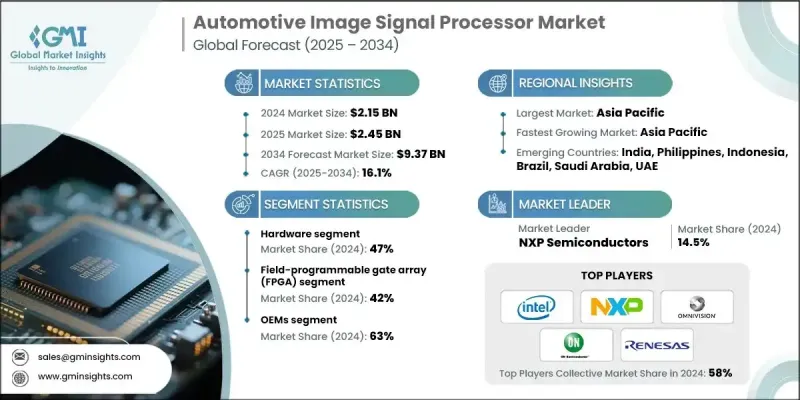
現代汽車中智慧成像技術的日益普及正在改變汽車影像處理器(ISP)的格局。先進的ISP能夠即時處理來自多個攝影機的影像,支援物體偵測、車道追蹤和360度全景影像系統等關鍵功能。這些處理器即使在光線和天氣條件惡劣的情況下也能提供超低延遲、高動態範圍和可靠的性能,從而促進更安全、更節能的車輛運行。向自動化和軟體定義車輛架構的持續演進正在加強高性能ISP的整合。半導體製造商、汽車製造商和人工智慧軟體公司之間的策略合作也在推動人工智慧驅動的影像處理技術的發展,以增強駕駛輔助和感知系統。與晶片製造商和攝影機模組供應商的合作正在最佳化集中式電子設計中的熱管理、圖像品質和系統整合,幫助汽車製造商提高安全性、舒適性和自動駕駛水平。隨著車輛向智慧出行生態系統轉型,ISP正成為下一代高階駕駛輔助系統(ADAS)和自動駕駛平台的關鍵組件。
| 市場範圍 | |
|---|---|
| 起始年份 | 2024 |
| 預測年份 | 2025-2034 |
| 起始值 | 21.5億美元 |
| 預測值 | 93.7億美元 |
| 複合年成長率 | 16.1% |
2024年,現場可程式閘陣列(FPGA)市佔率達到42%,預計到2034年將以14.9%的複合年成長率成長。基於FPGA的處理器憑藉其可重構架構、可擴展性和卓越的平行運算效能,在汽車ISP市場佔據主導地位。它們使汽車製造商無需進行大規模硬體重新設計,即可整合用於駕駛員監控、物體偵測和車道保持等應用的高級影像處理演算法。此外,它們對不斷變化的攝影機和感知需求的適應性也縮短了產品上市時間,使其成為下一代ADAS和自動駕駛汽車開發的關鍵。
2024年,OEM廠商佔據了63%的市場。原始設備製造商是汽車影像處理器(ISP)的主要採用者,因為他們在生產過程中將這些處理器直接整合到新車型中。這確保了影像系統能夠發揮最佳性能,滿足安全法規要求,並實現可靠運作。隨著汽車製造商部署高解析度攝影機、感測器融合技術和即時影像分析來增強高級駕駛輔助系統(ADAS)功能並提高駕駛安全性,原廠安裝ISP的趨勢日益明顯。多攝影機配置和先進感知功能的日益普及也進一步推動了全球OEM廠商對ISP的採用。
預計到2024年,中國汽車影像訊號處理器(ISP)市場將佔據39%的佔有率,市場規模達3.249億美元。憑藉強大的汽車電子和半導體製造生態系統,中國在該區域市場保持主導地位。國內主要汽車製造商快速部署高級駕駛輔助系統(ADAS)和半自動駕駛技術,大大推動了對ISP的需求。政府鼓勵智慧汽車和晶片設計創新的支持性政策,進一步加速了市場成長。中國致力於推動本土半導體生產和智慧出行解決方案,這將持續鞏固其在汽車ISP領域的領先地位。
全球汽車影像訊號處理器市場的主要參與者包括德州儀器 (TI)、安森美半導體 (ON Semiconductor)、瑞薩電子 (Renesas Electronics)、亞德諾半導體 (ADI)、意法半導體 (STMicroelectronics)、Arm Limited、恩智浦半導體 (NXP)、Hparty-pimimel) OmniVision Technologies。汽車影像訊號處理器市場的領導企業正採取多管齊下的策略來鞏固其競爭地位。許多企業致力於將人工智慧驅動的成像功能、邊緣處理和即時電腦視覺增強技術整合到其影像訊號處理器 (ISP) 架構中。各公司正與汽車製造商和軟體公司建立合作關係,共同開發針對高級駕駛輔助系統 (ADAS)、自動駕駛和車內監控等應用最佳化的客製化 ISP 平台。研發投入正集中於低功耗設計、先進的散熱解決方案以及增強的攝影機同步功能,以支援多感測器融合。
目錄
第1章:方法論
- 市場範圍和定義
- 研究設計
- 研究方法
- 資料收集方法
- 資料探勘來源
- 全球的
- 地區/國家
- 基準估算和計算
- 基準年計算
- 市場估算的關鍵趨勢
- 初步研究和驗證
- 原始資料
- 預測模型
- 研究假設和局限性
第2章:執行概要
第3章:行業洞察
- 產業生態系分析
- 供應商格局
- 利潤率分析
- 成本結構
- 每個階段的價值增加
- 影響價值鏈的因素
- 中斷
- 產業影響因素
- 成長促進因素
- ADAS和自動駕駛汽車研發的激增
- 高解析度汽車攝影機的擴展
- 車輛安全法規日益增多
- 電動車普及率不斷提高,智慧駕駛艙功能日益增強
- 產業陷阱與挑戰
- 高昂的開發和整合成本
- 軟體和感測器校準的複雜性
- 市場機遇
- 軟體定義車輛的出現
- 車隊和商用車分析的成長
- 在二輪車和入門級車輛的應用
- 原始設備製造商和半導體公司之間的合作
- 成長促進因素
- 成長潛力分析
- 監管環境
- 北美洲
- 歐洲
- 亞太地區
- 拉丁美洲
- 波特的分析
- PESTEL 分析
- 技術與創新格局
- 當前技術趨勢
- 新興技術
- 專利分析
- 價格趨勢
- 按地區
- 按組件
- 成本細分分析
- 商業案例及投資報酬率分析
- 總擁有成本框架
- 投資報酬率計算方法
- 實施時間表和里程碑
- 風險評估與緩解策略
- 永續性和環境影響分析
- 永續實踐
- 減少廢棄物策略
- 生產中的能源效率
- 環保舉措
- 碳足跡考量
- 未來展望與機遇
- 技術演進與下一代網際網路服務供應商架構
- 人工智慧和機器學習整合趨勢
- 邊緣運算與分散式處理模型
3.14.4. 5G 連接與車聯網 (V2X) 整合
- 永續性和環境影響考量
- 監理演變與全球協調趨勢
- 市場整合與產業結構變化
- 新興應用及用例開發
第4章:競爭格局
- 介紹
- 公司市佔率分析
- 北美洲
- 歐洲
- 亞太地區
- 拉丁美洲
- 主要市場參與者的競爭分析
- 競爭定位矩陣
- 戰略展望矩陣
- 關鍵進展
- 併購
- 合作夥伴關係與合作
- 新產品發布
- 擴張計劃和資金
第5章:市場估算與預測:依組件分類,2021-2034年
- 主要趨勢
- 硬體
- 模擬前端
- 影像感測器
- 訊號處理核心
- 記憶
- 輸出介面
- 軟體
- 服務
第6章:市場估算與預測:依應用領域分類,2021-2034年
- 主要趨勢
- ADAS系統
- 自動駕駛汽車
- 停車輔助/後視/環視
- 夜視系統
- 駕駛員監控系統
- 其他
第7章:市場估計與預測:依技術分類,2021-2034年
- 主要趨勢
- 數位訊號處理(DSP)
- 現場可程式閘陣列(FPGA)
- 專用積體電路(ASIC)
第8章:市場估算與預測:依類型分類,2021-2034年
- 主要趨勢
- 獨立影像訊號處理器
- 整合影像訊號處理器
第9章:市場估算與預測:依最終用途分類,2021-2034年
- 主要趨勢
- OEM
- 售後市場
第10章:市場估計與預測:依地區分類,2021-2034年
- 主要趨勢
- 北美洲
- 美國
- 加拿大
- 歐洲
- 德國
- 英國
- 法國
- 義大利
- 西班牙
- 俄羅斯
- 亞太地區
- 中國
- 印度
- 日本
- 澳洲
- 韓國
- 菲律賓
- 印尼
- 拉丁美洲
- 巴西
- 墨西哥
- 阿根廷
- MEA
- 南非
- 沙烏地阿拉伯
- 阿拉伯聯合大公國
第11章:公司簡介
- 全球參與者
- ARM
- Broadcom
- Cirrus Logic
- Fujitsu
- Infineon Technologies
- Intel (Mobileye)
- Microchip Technology
- Nikon
- NVIDIA
- NXP Semiconductors
- Olympus
- OmniVision Technologies
- Qualcomm Technologies
- Renesas Electronics
- Sony Semiconductor Solutions
- STMicroelectronics
- Texas Instruments
- ON Semiconductor
- Analog Devices
- 區域玩家
- Allwinner Technology
- Amlogic
- HiSilicon Technologies
- MediaTek
- Rockchip Electronics
- 新興參與者
11.3.1. 10x工程師
- Cadence 設計系統
- 電子經濟系統
- 影像品質實驗室
- 獨立半導體
- 創新磁碟
- 晶格半導體
- 豹子影像
The Global Automotive Image Signal Processor Market was valued at USD 2.15 billion in 2024 and is estimated to grow at a CAGR of 16.1% to reach USD 9.37 billion by 2034.
The rising use of intelligent imaging technologies in modern vehicles is transforming the landscape of automotive ISPs. Advanced ISPs now enable real-time image processing from multiple cameras, supporting key functions such as object detection, lane tracking, and 360-degree view systems. These processors deliver ultra-low latency, high dynamic range, and dependable performance even in challenging lighting and weather conditions, fostering safer and more energy-efficient vehicle operations. The ongoing evolution toward automated and software-defined vehicle architectures is strengthening the integration of high-performance ISPs. Strategic collaborations between semiconductor manufacturers, automakers, and AI software companies are also advancing AI-driven image processing for enhanced driver-assistance and perception systems. Partnerships with chipmakers and camera module suppliers are optimizing thermal management, image quality, and system integration in centralized electronic designs, helping automakers improve safety, comfort, and autonomy levels. As vehicles transition toward intelligent mobility ecosystems, ISPs are becoming critical components in next-generation ADAS and autonomous driving platforms.
| Market Scope | |
|---|---|
| Start Year | 2024 |
| Forecast Year | 2025-2034 |
| Start Value | $2.15 Billion |
| Forecast Value | $9.37 Billion |
| CAGR | 16.1% |
The field-programmable gate array (FPGA) segment held a 42% share in 2024 and is anticipated to grow at a CAGR of 14.9% through 2034. FPGA-based processors dominate the automotive ISP market due to their reconfigurable architecture, scalability, and superior parallel computing performance. They enable vehicle manufacturers to integrate advanced image-processing algorithms for applications such as driver monitoring, object detection, and lane-keeping without extensive hardware redesign. Their adaptability to changing camera and perception requirements also reduces time-to-market, making them essential for next-generation ADAS and autonomous vehicle development.
In 2024, the OEMs segment held a 63% share. Original equipment manufacturers are the leading adopters of automotive ISPs because they directly integrate these processors into new vehicle models during production. This ensures that imaging systems perform optimally, meet safety regulations, and deliver reliable operation. The preference for factory-installed ISPs is increasing as automakers deploy high-resolution cameras, sensor-fusion technologies, and real-time image analysis to enhance ADAS capabilities and improve driver safety. The growing use of multi-camera configurations and advanced perception features further supports ISP adoption among global OEMs.
China Automotive Image Signal Processor Market held a 39% share in 2024, generating USD 324.9 million. The country maintains a dominant position in the region due to its strong automotive electronics and semiconductor manufacturing ecosystem. Rapid implementation of ADAS and semi-autonomous technologies by major domestic automakers has fueled significant demand for ISPs. Supportive government programs encouraging innovation in smart vehicles and chip design are further accelerating market growth. China's commitment to advancing local semiconductor production and intelligent mobility solutions continues to reinforce its leadership in the automotive ISP space.
Key industry participants in the Global Automotive Image Signal Processor Market include Texas Instruments, ON Semiconductor, Renesas Electronics, Analog Devices, STMicroelectronics, Arm Limited, NXP Semiconductors, Microchip Technology, Intel (Mobileye), and OmniVision Technologies. Leading players in the Automotive Image Signal Processor Market are adopting multi-faceted strategies to strengthen their competitive positioning. Many are focusing on integrating AI-driven imaging capabilities, edge processing, and real-time computer vision enhancements into their ISP architectures. Companies are forming partnerships with automakers and software firms to co-develop customized ISP platforms optimized for ADAS, autonomous driving, and in-cabin monitoring. R&D investments are being directed toward low-power designs, advanced thermal solutions, and enhanced camera synchronization to support multi-sensor fusion.
Table of Contents
Chapter 1 Methodology
- 1.1 Market scope and definition
- 1.2 Research design
- 1.2.1 Research approach
- 1.2.2 Data collection methods
- 1.3 Data mining sources
- 1.3.1 Global
- 1.3.2 Regional/Country
- 1.4 Base estimates and calculations
- 1.4.1 Base year calculation
- 1.4.2 Key trends for market estimation
- 1.5 Primary research and validation
- 1.5.1 Primary sources
- 1.6 Forecast model
- 1.7 Research assumptions and limitations
Chapter 2 Executive Summary
- 2.1 Industry 3600 synopsis, 2021 - 2034
- 2.2 Key market trends
- 2.2.1 Regional
- 2.2.2 Component
- 2.2.3 Type
- 2.2.4 Technology
- 2.2.5 End Use
- 2.2.6 Application
- 2.3 TAM Analysis, 2025-2034
- 2.4 CXO perspectives: Strategic imperatives
- 2.4.1 Executive decision points
- 2.4.2 Critical success factors
- 2.5 Future outlook and strategic recommendations
Chapter 3 Industry Insights
- 3.1 Industry ecosystem analysis
- 3.1.1 Supplier landscape
- 3.1.2 Profit margin analysis
- 3.1.3 Cost structure
- 3.1.4 Value addition at each stage
- 3.1.5 Factor affecting the value chain
- 3.1.6 Disruptions
- 3.2 Industry impact forces
- 3.2.1 Growth drivers
- 3.2.1.1 Surge in ADAS and autonomous vehicle development
- 3.2.1.2 Expansion of high-resolution automotive cameras
- 3.2.1.3 Rise in vehicle safety regulations
- 3.2.1.4 Growing EV adoption and smart cockpit features
- 3.2.2 Industry pitfalls and challenges
- 3.2.2.1 High development and integration costs
- 3.2.2.2 Complexity in software and sensor calibration
- 3.2.3 Market opportunities
- 3.2.3.1 Emergence of software-defined vehicles
- 3.2.3.2 Growth in fleet and commercial vehicle analytics
- 3.2.3.3 Adoption in two-wheelers and entry-level vehicles
- 3.2.3.4 Collaborations between OEMs and semiconductor firms
- 3.2.1 Growth drivers
- 3.3 Growth potential analysis
- 3.4 Regulatory landscape
- 3.4.1 North America
- 3.4.2 Europe
- 3.4.3 Asia Pacific
- 3.4.4 LAMEA
- 3.5 Porter's analysis
- 3.6 PESTEL analysis
- 3.7 Technology and Innovation landscape
- 3.7.1 Current technological trends
- 3.7.2 Emerging technologies
- 3.8 Patent analysis
- 3.9 Price trends
- 3.9.1 By region
- 3.9.2 By component
- 3.10 Cost breakdown analysis
- 3.11 Business Case & ROI Analysis
- 3.11.1 Total cost of ownership framework
- 3.11.2 ROI calculation methodologies
- 3.11.3 Implementation timeline & milestones
- 3.11.4 Risk assessment & mitigation strategies
- 3.12 Sustainability and environmental impact analysis
- 3.12.1 Sustainable practices
- 3.12.2 Waste reduction strategies
- 3.12.3 Energy efficiency in production
- 3.12.4 Eco-friendly initiatives
- 3.13 Carbon footprint considerations
- 3.14 Future outlook & opportunities
- 3.14.1 Technology evolution & next-generation ISP architectures
- 3.14.2 AI & machine learning integration trends
- 3.14.3 Edge computing & distributed processing models
3.14.4. 5G connectivity & vehicle-to-everything (V2X) integration
- 3.14.5 Sustainability & environmental impact considerations
- 3.14.6 Regulatory evolution & global harmonization trends
- 3.14.7 Market consolidation & industry structure changes
- 3.14.8 Emerging applications & use case development
Chapter 4 Competitive Landscape, 2024
- 4.1 Introduction
- 4.2 Company market share analysis
- 4.2.1 North America
- 4.2.2 Europe
- 4.2.3 Asia Pacific
- 4.2.4 LAMEA
- 4.3 Competitive analysis of major market players
- 4.4 Competitive positioning matrix
- 4.5 Strategic outlook matrix
- 4.6 Key developments
- 4.6.1 Mergers & acquisitions
- 4.6.2 Partnerships & collaborations
- 4.6.3 New Product Launches
- 4.6.4 Expansion Plans and funding
Chapter 5 Market Estimates & Forecast, By Component, 2021 - 2034 ($Bn, Units)
- 5.1 Key trends
- 5.2 Hardware
- 5.2.1 Analog Front-End
- 5.2.2 Image Sensor
- 5.2.3 Signal Processing Core
- 5.2.4 Memory
- 5.2.5 Output Interface
- 5.3 Software
- 5.4 Services
Chapter 6 Market Estimates & Forecast, By Application, 2021 - 2034 ($Bn, Units)
- 6.1 Key trends
- 6.2 ADAS Systems
- 6.3 Autonomous Vehicles
- 6.4 Parking Assistance / Rear-View / Surround View
- 6.5 Night Vision Systems
- 6.6 Driver Monitoring Systems
- 6.7 Others
Chapter 7 Market Estimates & Forecast, By Technology, 2021 - 2034 ($Bn, Units)
- 7.1 Key trends
- 7.2 Digital signal processing (DSP)
- 7.3 Field-programmable gate array (FPGA)
- 7.4 Application-specific integrated circuits (ASIC)
Chapter 8 Market Estimates & Forecast, By Type, 2021 - 2034 ($Bn, Units)
- 8.1 Key trends
- 8.2 Standalone image signal processors
- 8.3 Integrated image signal processors
Chapter 9 Market Estimates & Forecast, By End Use, 2021 - 2034 ($Bn, Units)
- 9.1 Key trends
- 9.2 OEM
- 9.3 Aftermarket
Chapter 10 Market Estimates & Forecast, By Region, 2021 - 2034 ($Bn, Units)
- 10.1 Key trends
- 10.2 North America
- 10.2.1 US
- 10.2.2 Canada
- 10.3 Europe
- 10.3.1 Germany
- 10.3.2 UK
- 10.3.3 France
- 10.3.4 Italy
- 10.3.5 Spain
- 10.3.6 Russia
- 10.4 Asia Pacific
- 10.4.1 China
- 10.4.2 India
- 10.4.3 Japan
- 10.4.4 Australia
- 10.4.5 South Korea
- 10.4.6 Philippines
- 10.4.7 Indonesia
- 10.5 Latin America
- 10.5.1 Brazil
- 10.5.2 Mexico
- 10.5.3 Argentina
- 10.6 MEA
- 10.6.1 South Africa
- 10.6.2 Saudi Arabia
- 10.6.3 UAE
Chapter 11 Company Profiles
- 11.1 Global Players
- 11.1.1 ARM
- 11.1.2 Broadcom
- 11.1.3 Cirrus Logic
- 11.1.4 Fujitsu
- 11.1.5 Infineon Technologies
- 11.1.6 Intel (Mobileye)
- 11.1.7 Microchip Technology
- 11.1.8 Nikon
- 11.1.9 NVIDIA
- 11.1.10 NXP Semiconductors
- 11.1.11 Olympus
- 11.1.12 OmniVision Technologies
- 11.1.13 Qualcomm Technologies
- 11.1.14 Renesas Electronics
- 11.1.15 Sony Semiconductor Solutions
- 11.1.16 STMicroelectronics
- 11.1.17 Texas Instruments
- 11.1.18 ON Semiconductor
- 11.1.19 Analog Devices
- 11.2 Regional Players
- 11.2.1 Allwinner Technology
- 11.2.2 Amlogic
- 11.2.3 HiSilicon Technologies
- 11.2.4 MediaTek
- 11.2.5 Rockchip Electronics
- 11.3 Emerging Players
11.3.1. 10xEngineers
- 11.3.2 Cadence Design Systems
- 11.3.3 e-con Systems
- 11.3.4 Image Quality Labs
- 11.3.5 Indie Semiconductor
- 11.3.6 Innodisk
- 11.3.7 Lattice Semiconductor
- 11.3.8 Leopard Imaging

 汽車電子編程系統市場:按車輛類型、技術、工具類型、最終用途、部署模式和應用分類,全球預測,2026-2032年
 全球汽車電子元件市場:按應用、銷售管道、動力方式、車輛類型、類型、國家和地區分類-產業分析、市場規模、佔有率及2025年至2032年未來預測汽車偏光濾鏡市場:按材料、偏光濾鏡類型、車輛類型、應用和銷售管道,全球預測,2026-2032年汽車級胎壓監測晶片市場:按應用、類型、車輛類型和技術分類的全球預測(2026-2032年)車用級藍牙晶片市場:按應用、晶片類型、整合類型、車輛類型、分銷管道和範圍分類 - 全球預測,2026-2032年
 全球汽車電子市場規模、佔有率、趨勢和成長分析報告(2026-2034)
 汽車電子導電塑膠市場:市場機會、成長要素、產業趨勢分析及2026-2035年預測
 日本汽車電子市場規模、佔有率、趨勢和預測:按零件、車輛類型、分銷管道、應用和地區分類,2026-2034年汽車電子市場規模、佔有率、趨勢及預測(按組件、車輛類型、通路、應用和地區分類),2026-2034年
 2026年全球汽車引擎蓋下電子設備市場報告