


 |
市場調查報告書
商品編碼
1876582
液態空氣儲能市場機會、成長促進因素、產業趨勢分析及預測(2025-2034年)Liquid Air Energy Storage Market Opportunity, Growth Drivers, Industry Trend Analysis, and Forecast 2025 - 2034 |
||||||

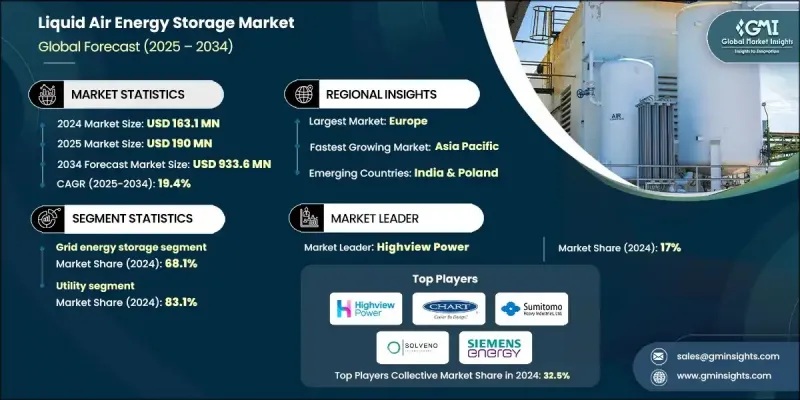
2024 年全球液態空氣儲能市場價值為 1.631 億美元,預計到 2034 年將以 19.4% 的複合年成長率成長至 9.336 億美元。
雷射輔助儲能(LAES)技術利用空氣和鋼等易得且無毒的材料,使其成為鋰離子電池的環保且可回收的替代方案。其20-30年的使用壽命以及極低的性能衰減,降低了傳統儲能系統的生命週期成本和環境影響。全球向清潔能源(尤其是風能和太陽能)的轉型,正在推動對LAES等長時儲能技術的需求。與適用於短期應用的鋰離子電池不同,LAES系統可以儲存數小時甚至數天的電力,從而提供至關重要的電網穩定性和靈活性。該技術能夠將功率和能量容量分離,為電力公司提供可客製化的設計方案,確保在再生能源間歇性或高能耗時期也能實現穩定的電力供應。此外,低溫工程、能量回收和整合技術的不斷進步正在提高系統效率,往返效率已接近70%,進一步加速了該技術在各地區的普及應用。
| 市場範圍 | |
|---|---|
| 起始年份 | 2024 |
| 預測年份 | 2025-2034 |
| 起始值 | 1.631億美元 |
| 預測值 | 9.336億美元 |
| 複合年成長率 | 19.4% |
2024年,電網儲能市佔率達到68.1%,預計到2034年將以19%的複合年成長率成長。風能和太陽能發電在電網中的日益普及,使得可靠、長時儲能系統的需求不斷成長。空氣吸收儲能(LAES)提供了一種永續的零排放解決方案,能夠儲存多餘的可再生能源,並在用電高峰期釋放,從而提高電網可靠性。由於利用環境空氣且無需稀缺材料,LAES成為大規模儲能部署的經濟高效且環境友善的選擇。
公用事業領域佔據83.1%的市場佔有率,預計在2025年至2034年間將以19.2%的複合年成長率成長。隨著再生能源併網帶來的能源生產和消費波動日益加劇,公用事業公司正擴大採用液態鋁儲能(LAES)技術來應對這一挑戰。該技術具有可擴展性、長時儲能能力和零排放運行等特點,使其成為實現永續發展目標和保障能源安全的理想選擇。政府支持清潔能源轉型的各項措施進一步推動了該技術的應用,為預測期內市場的顯著擴張鋪平了道路。
2024年,美國液態空氣儲能市場佔96.7%的市場佔有率,預計到2034年將達到8,800萬美元。再生能源基礎設施投資的不斷成長以及日益嚴格的環境法規正推動公用事業公司和各行業採用液態空氣儲能系統(LAES)。 LAES系統能夠儲存過剩的太陽能和風能,並在用電高峰期釋放,從而穩定電網,使其成為國家永續能源組合的重要組成部分。此外,LAES技術還具有卓越的安全性、零排放性能以及與現有電網系統的兼容性,使其在長期能源規劃中更具吸引力。
全球液態空氣儲能市場的主要參與者包括Chart Industries、Everllence、Huge Energy、Siemens Energy、Phelas、Solveno Technologies、Sumitomo Heavy Industries, Ltd、Highview Power、Innovatium和ENERGY DOME。為了鞏固市場地位,這些公司正著力推動多項策略措施。許多公司大力投資研發,以提高液態空氣儲能系統的能源效率和成本效益。與公用事業公司和再生能源開發商的合作正在拓展其全球部署機會。策略夥伴關係和合資企業正被用於加速商業化進程並擴大產能。各公司也透過試點計畫和示範工廠來加強區域擴張,以吸引投資並建立對液態空氣儲能技術的信任。此外,各公司還優先考慮永續工程實踐和數位化整合,以最佳化系統、降低營運成本並滿足全球不斷變化的儲能需求。
目錄
第1章:方法論與範圍
第2章:執行概要
第3章:行業洞察
- 產業生態系統
- 監管環境
- 產業影響因素
- 成長促進因素
- 產業陷阱與挑戰
- 成長潛力分析
- 成本結構分析
- 波特的分析
- PESTEL 分析
- 新興機會與趨勢
- 數位化與物聯網整合
- 新興市場滲透
- 投資分析及未來展望
第4章:競爭格局
- 介紹
- 按地區分類的公司市佔率分析
- 北美洲
- 歐洲
- 亞太地區
- 世界其他地區
- 戰略儀錶板
- 策略舉措
- 公司標竿分析
- 創新與技術格局
第5章:市場規模及預測:依應用領域分類,2021-2034年
- 主要趨勢
- 電網儲能
- 再生能源併網
- 備用電源
- 其他
第6章:市場規模及預測:依最終用途分類,2021-2034年
- 主要趨勢
- 公用事業
- 商業和工業
- 住宅
第7章:市場規模及預測:依地區分類,2021-2034年
- 主要趨勢
- 北美洲
- 美國
- 加拿大
- 歐洲
- 英國
- 德國
- 波蘭
- 西班牙
- 亞太地區
- 中國
- 日本
- 印度
- 世界其他地區
第8章:公司簡介
- Chart Industries
- ENERGY DOME
- Everllence
- Highview Power
- Huge Energy
- Innovatium
- Phelas
- Siemens Energy
- Solveno Technologies
- Sumitomo Heavy Industries Ltd
The Global Liquid Air Energy Storage Market was valued at USD 163.1 million in 2024 and is estimated to grow at a CAGR of 19.4% to reach USD 933.6 million by 2034.
LAES technology utilizes readily available and non-toxic materials such as air and steel, making it an eco-friendly and recyclable alternative to lithium-ion batteries. Its operational life span of 20-30 years with minimal performance degradation reduces lifecycle costs and environmental impacts associated with conventional energy storage systems. The global transition toward clean energy, particularly wind and solar, is fueling the demand for long-duration storage technologies like LAES. Unlike lithium-ion batteries suited for short-term applications, LAES systems can store power for several hours or even days, providing essential grid stability and flexibility. The technology's ability to separate power and energy capacity offers utilities a customizable design, ensuring a consistent power supply during periods of renewable intermittency or high energy demand. Moreover, continuous advancements in cryogenic engineering, energy recovery, and integration are improving system efficiency, with round-trip efficiency levels approaching 70%, further accelerating adoption across regions.
| Market Scope | |
|---|---|
| Start Year | 2024 |
| Forecast Year | 2025-2034 |
| Start Value | $163.1 Million |
| Forecast Value | $933.6 Million |
| CAGR | 19.4% |
In 2024, the grid energy storage segment held a 68.1% share and is forecasted to grow at a CAGR of 19% through 2034. The rising integration of wind and solar power across energy grids is increasing the necessity for dependable, long-duration storage systems. LAES provides a sustainable, emission-free solution capable of storing surplus renewable energy and discharging it during demand peaks, thereby enhancing grid reliability. The use of ambient air and the absence of scarce materials make it a cost-effective and environmentally responsible choice for large-scale storage deployment.
The utility segment held 83.1% share, and is expected to grow at a CAGR of 19.2% between 2025 and 2034. Utilities are increasingly turning to LAES technology to handle the growing fluctuations in energy production and consumption resulting from renewable energy integration. Its scalability, long-duration storage capabilities, and zero-emission operation make it an attractive alternative for meeting sustainability goals and ensuring energy security. Government initiatives supporting clean energy transition further encourage the adoption of this technology, paving the way for significant market expansion throughout the forecast period.
United States Liquid Air Energy Storage Market held a 96.7% share in 2024 and is projected to reach USD 88 million by 2034. Increasing investments in renewable infrastructure and stricter environmental regulations are pushing utilities and industries to adopt LAES systems. Their ability to stabilize the grid by storing excess solar and wind energy and releasing it during demand surges positions them as an essential component of the nation's sustainable energy portfolio. Furthermore, LAES technology offers superior safety, zero-emission performance, and compatibility with existing grid systems, enhancing its appeal for long-term energy planning.
Key companies operating in the Global Liquid Air Energy Storage Market include Chart Industries, Everllence, Huge Energy, Siemens Energy, Phelas, Solveno Technologies, Sumitomo Heavy Industries, Ltd, Highview Power, Innovatium, and ENERGY DOME. To strengthen their foothold, these companies are focusing on several strategic initiatives. Many are investing heavily in research and development to enhance the energy efficiency and cost performance of LAES systems. Collaborations with utilities and renewable energy developers are expanding their deployment opportunities globally. Strategic partnerships and joint ventures are being used to accelerate commercialization and scale up production capacity. Companies are also emphasizing regional expansion through pilot projects and demonstration plants to attract investments and build trust in LAES technology. Additionally, firms are prioritizing sustainable engineering practices and digital integration to improve system optimization, reduce operational costs, and meet evolving energy storage demands worldwide.
Table of Contents
Chapter 1 Methodology & Scope
- 1.1 Research design
- 1.1.1 Research approach
- 1.1.2 Data collection methods
- 1.1.3 Base estimates and calculations
- 1.1.4 Base year calculation
- 1.1.5 Key trends for market estimates
- 1.2 Forecast model
- 1.3 Primary research & validation
- 1.3.1 Primary sources
- 1.4 Data mining sources
- 1.5 Market definitions
Chapter 2 Executive Summary
- 2.1 Industry synopsis, 2021 - 2034
- 2.2 Business trends
- 2.3 Application trends
- 2.4 End use trends
- 2.5 Regional trends
Chapter 3 Industry Insights
- 3.1 Industry ecosystem
- 3.2 Regulatory landscape
- 3.3 Industry impact forces
- 3.3.1 Growth drivers
- 3.3.2 Industry pitfalls & challenges
- 3.4 Growth potential analysis
- 3.5 Cost structure analysis
- 3.6 Porter's analysis
- 3.6.1 Bargaining power of suppliers
- 3.6.2 Bargaining power of buyers
- 3.6.3 Threat of new entrants
- 3.6.4 Threat of substitutes
- 3.7 PESTEL analysis
- 3.7.1 Political factors
- 3.7.2 Economic factors
- 3.7.3 Social factors
- 3.7.4 Technological factors
- 3.7.5 Legal factors
- 3.7.6 Environmental factors
- 3.8 Emerging opportunities & trends
- 3.8.1 Digitalization & IoT integration
- 3.8.2 Emerging market penetration
- 3.9 Investment analysis and future outlook
Chapter 4 Competitive landscape, 2025
- 4.1 Introduction
- 4.2 Company market share analysis, by region, 2024
- 4.2.1 North America
- 4.2.2 Europe
- 4.2.3 Asia Pacific
- 4.2.4 Rest of World
- 4.3 Strategic dashboard
- 4.4 Strategic initiatives
- 4.5 Company benchmarking
- 4.6 Innovation & technology landscape
Chapter 5 Market Size and Forecast, By Application, 2021 - 2034 (USD Million)
- 5.1 Key trends
- 5.2 Grid energy storage
- 5.3 Renewable energy integration
- 5.4 Backup power
- 5.5 Others
Chapter 6 Market Size and Forecast, By End Use, 2021 - 2034 (USD Million)
- 6.1 Key trends
- 6.2 Utility
- 6.3 Commercial & industrial
- 6.4 Residential
Chapter 7 Market Size and Forecast, By Region, 2021 - 2034 (USD Million)
- 7.1 Key trends
- 7.2 North America
- 7.2.1 U.S.
- 7.2.2 Canada
- 7.3 Europe
- 7.3.1 UK
- 7.3.2 Germany
- 7.3.3 Poland
- 7.3.4 Spain
- 7.4 Asia Pacific
- 7.4.1 China
- 7.4.2 Japan
- 7.4.3 India
- 7.5 Rest of World
Chapter 8 Company Profiles
- 8.1 Chart Industries
- 8.2 ENERGY DOME
- 8.3 Everllence
- 8.4 Highview Power
- 8.5 Huge Energy
- 8.6 Innovatium
- 8.7 Phelas
- 8.8 Siemens Energy
- 8.9 Solveno Technologies
- 8.10 Sumitomo Heavy Industries Ltd

 壓縮空氣儲能市場:依技術類型、部署模式、應用程式和最終用戶分類-2026-2032年全球市場預測
 2026年全球電網自動化系統市場報告2026年全球電網自動化系統市場報告
 壓縮空氣儲能(CAES)市場規模、佔有率及預測:依系統設計(絕熱、非絕熱、等溫)、儲能容量、往返效率及專案規模劃分-全球預測至2036年
 全球壓縮空氣儲能市場規模、佔有率、趨勢及成長分析報告(2026-2034年)
 日本電網自動化市場規模、佔有率、趨勢及預測(按組件、應用、最終用戶和地區分類),2026-2034年
 液態空氣儲能市場-全球產業規模、佔有率、趨勢、機會、預測:按容量、應用、地區和競爭格局分類,2021-2031年
 壓縮空氣儲能市場規模、佔有率及成長分析(按類型、容量、儲存類型、儲存容量、應用和地區分類)-2026-2033年產業預測
 壓縮空氣儲能市場規模、佔有率和趨勢分析報告:按技術、應用、地區和細分市場預測(2025-2033 年)液態空氣儲能市場規模、佔有率、趨勢分析(按類型、應用、地區和細分市場預測,2025-2033 年)