


 |
市場調查報告書
商品編碼
1876573
藥物再利用市場機會、成長促進因素、產業趨勢分析及預測(2025-2034年)Drug Repurposing Market Opportunity, Growth Drivers, Industry Trend Analysis, and Forecast 2025 - 2034 |
||||||

2024 年全球藥物再利用市場價值為 326 億美元,預計到 2034 年將以 4.7% 的複合年成長率成長至 511 億美元。
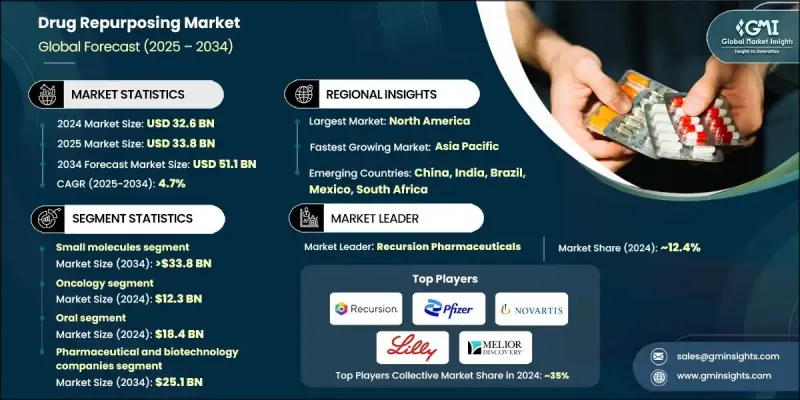
慢性複雜疾病(例如癌症、阿茲海默症和罕見遺傳疾病)的日益普遍推動了藥物重定位的擴張,這些疾病催生了對更快、更經濟有效的治療方案的需求。藥物重定位能夠更快地提供治療,尤其適用於那些因商業誘因不足而難以進行傳統研發的疾病。透過利用已知安全性和藥理學特徵的化合物,藥物重定位可以繞過早期臨床試驗,縮短研發週期,並加快法規核准。這種方法對尋求更快投資回報的製藥公司尤其具有吸引力。藥物重定位是指為現有藥物(包括已獲批准、已停產或已放棄的藥物)發現新的治療用途,從而在減少藥物研發總時間和成本的同時,拓展多種疾病領域的治療選擇。
| 市場範圍 | |
|---|---|
| 起始年份 | 2024 |
| 預測年份 | 2025-2034 |
| 起始值 | 326億美元 |
| 預測值 | 511億美元 |
| 複合年成長率 | 4.7% |
2024年,小分子藥物市佔率達到67.5%,預計到2034年將達到338億美元,複合年成長率(CAGR)為4.5%。小分子藥物因其成熟的藥物動力學、安全性資料和生產流程,是藥物再利用的理想候選藥物。現有的臨床資料可用於減少大規模臨床試驗的需求,而監管途徑,例如FDA的505(b)(2)條款,則允許透過參考既往證據加快核准速度。
2024年,口服藥物市場規模預計將達到184億美元。口服製劑應用廣泛,涵蓋腫瘤、代謝性疾病、感染性疾病和中樞神經系統疾病等多個治療領域。其多功能性和明確的藥物動力學特性使其成為藥物再利用的首選,具有廣泛的臨床應用價值和商業吸引力。
預計到2024年,北美藥物再利用市場將佔據48.2%的佔有率,其中美國佔據主導地位。美國受益於健全的藥物再利用監管框架。美國食品藥物管理局(FDA)的505(b)(2)途徑可讓企業參考現有藥物的安全性和有效性資料來開發新的適應症,從而顯著縮短研發時間和降低成本。這種監管靈活性鼓勵製藥和生物技術公司大力投資藥物再利用策略,促進創新並加速市場成長。
全球藥物再利用市場的主要參與者包括勃林格殷格翰、禮來、安進、艾伯維、諾華、Pharnext、葛蘭素史克、Schwarz Pharma、Recursion Pharmaceuticals、Revolution Medicines、Cyclica、輝瑞、Melior Discovery、賽諾菲和Valence Discovery。這些公司正採取多種策略來鞏固市場地位並擴大業務範圍。他們大力投資研發,以尋找現有藥物的新治療用途並最佳化臨床試驗效率。與生物技術公司、學術機構和研究機構的策略合作與夥伴關係有助於加速藥物再利用化合物的發現和驗證。
目錄
第1章:方法論與範圍
第2章:執行概要
第3章:行業洞察
- 產業生態系分析
- 供應商格局
- 每個階段的價值增加
- 影響價值鏈的因素
- 產業影響因素
- 成長促進因素
- 慢性病和罕見病患疾病率不斷上升
- 藥物再利用的成本與時間效率
- 人工智慧驅動平台的整合
- 未滿足的醫療需求和藥品短缺
- 產業陷阱與挑戰
- 缺乏對非專利藥物的激勵措施
- 責任與安全問題
- 市場機遇
- 對經濟有效的療法的需求日益成長
- 拓展至罕見疾病和被忽視疾病領域
- 成長促進因素
- 成長潛力分析
- 監管環境
- 北美洲
- 歐洲
- 亞太地區
- 技術格局
- 當前技術趨勢
- 新興技術
- 未來市場趨勢
- 定價分析
- 臨床試驗分析
- 波特的分析
- PESTEL 分析
第4章:競爭格局
- 介紹
- 公司市佔率分析
- 全球的
- 北美洲
- 歐洲
- 公司矩陣分析
- 主要市場參與者的競爭分析
- 競爭定位矩陣
- 關鍵進展
- 併購
- 夥伴關係與合作
- 新產品發布
- 擴張計劃
第5章:市場估算與預測:依藥物類型分類,2021-2034年
- 主要趨勢
- 小分子
- 生物製劑
第6章:市場估計與預測:依治療領域分類,2021-2034年
- 主要趨勢
- 腫瘤學
- 神經病學和中樞神經系統疾病
- 傳染病
- 心血管疾病
- 代謝紊亂
- 其他治療領域
第7章:市場估計與預測:依給藥途徑分類,2021-2034年
- 主要趨勢
- 口服
- 靜脈
- 其他給藥途徑
第8章:市場估算與預測:依最終用途分類,2021-2034年
- 主要趨勢
- 製藥和生物製藥公司
- 合約研究組織(CRO)
- 其他最終用途
第9章:市場估計與預測:依地區分類,2021-2034年
- 主要趨勢
- 北美洲
- 美國
- 加拿大
- 歐洲
- 德國
- 英國
- 法國
- 西班牙
- 義大利
- 荷蘭
- 亞太地區
- 中國
- 日本
- 印度
- 澳洲
- 韓國
- 拉丁美洲
- 巴西
- 墨西哥
- 阿根廷
- 中東和非洲
- 南非
- 沙烏地阿拉伯
- 阿拉伯聯合大公國
第10章:公司簡介
- AbbVie
- Amgen
- Boehringer Ingelheim
- Cyclica
- Eli Lilly and Company
- GlaxoSmithKline
- Melior Discovery
- Novartis
- Pfizer
- Pharnext
- Recursion Pharmaceuticals
- Revolution Medicines
- Sanofi
- Schwarz Pharma
- Valence Discovery
The Global Drug Repurposing Market was valued at USD 32.6 billion in 2024 and is estimated to grow at a CAGR of 4.7% to reach USD 51.1 billion by 2034.
The expansion is driven by the rising prevalence of chronic and complex diseases such as cancer, Alzheimer's, and rare genetic disorders, which are creating demand for faster and more cost-effective therapeutic solutions. Drug repurposing enables quicker access to treatments, particularly for conditions where traditional R&D is limited due to low commercial incentives. By leveraging compounds with known safety and pharmacological profiles, repurposing bypasses early-stage trials, shortens development timelines, and accelerates regulatory approvals. This approach is particularly appealing to pharmaceutical firms seeking quicker returns on investment. Drug repurposing involves discovering new therapeutic applications for existing medications, including approved, discontinued, or abandoned drugs, reducing the overall time and cost of drug development while expanding treatment options across multiple disease areas.
| Market Scope | |
|---|---|
| Start Year | 2024 |
| Forecast Year | 2025-2034 |
| Start Value | $32.6 Billion |
| Forecast Value | $51.1 Billion |
| CAGR | 4.7% |
The small molecules segment held 67.5% share in 2024 and is expected to reach USD 33.8 billion by 2034, growing at a CAGR of 4.5%. Small molecules are ideal candidates for repurposing due to their established pharmacokinetics, safety data, and manufacturing processes. Existing clinical data can be leveraged to reduce the need for extensive trials, while regulatory pathways, such as the FDA's 505(b)(2), allow for faster approval by referencing prior evidence.
The oral drug segment generated USD 18.4 billion in 2024. Oral formulations are widely applicable across therapeutic areas, including oncology, metabolic, infectious, and CNS disorders. Their versatility and well-understood pharmacokinetics make them a preferred choice for repurposing, offering broad clinical utility and commercial appeal.
North America Drug Repurposing Market accounted for 48.2% share in 2024, led by the U.S., which benefits from a robust regulatory framework supporting drug repurposing. The FDA's 505(b)(2) pathway enables companies to reference existing safety and efficacy data for new indications, significantly reducing development time and costs. This regulatory flexibility has encouraged both pharmaceutical and biotech firms to invest heavily in repurposing strategies, fostering innovation and accelerating market growth.
Key players operating in the Global Drug Repurposing Market include Boehringer Ingelheim, Eli Lilly and Company, Amgen, AbbVie, Novartis, Pharnext, GlaxoSmithKline, Schwarz Pharma, Recursion Pharmaceuticals, Revolution Medicines, Cyclica, Pfizer, Melior Discovery, Sanofi, and Valence Discovery. Companies in the drug repurposing market are adopting multiple strategies to strengthen their market presence and expand their footprint. They are heavily investing in research and development to identify new therapeutic applications for existing drugs and optimize clinical trial efficiency. Strategic collaborations and partnerships with biotech firms, academic institutions, and research organizations help accelerate the discovery and validation of repurposed compounds.
Table of Contents
Chapter 1 Methodology and Scope
- 1.1 Market scope and definition
- 1.2 Research design
- 1.2.1 Research approach
- 1.2.2 Data collection methods
- 1.3 Data mining sources
- 1.3.1 Global
- 1.3.2 Regional/Country
- 1.4 Base estimates and calculations
- 1.4.1 Base year calculation
- 1.4.2 Key trends for market estimation
- 1.5 Primary research and validation
- 1.5.1 Primary sources
- 1.6 Forecast model
- 1.7 Research assumptions and limitations
Chapter 2 Executive Summary
- 2.1 Industry 3600 synopsis
- 2.2 Key market trends
- 2.2.1 Regional trends
- 2.2.2 Drug type trends
- 2.2.3 Therapeutic area trends
- 2.2.4 Route of administration trends
- 2.2.5 End use trends
- 2.3 CXO perspectives: Strategic imperatives
- 2.3.1 Key decision points for industry executives
- 2.3.2 Critical success factors for market players
- 2.4 Future outlook and strategic recommendations
Chapter 3 Industry Insights
- 3.1 Industry ecosystem analysis
- 3.1.1 Supplier landscape
- 3.1.2 Value addition at each stage
- 3.1.3 Factors affecting the value chain
- 3.2 Industry impact forces
- 3.2.1 Growth drivers
- 3.2.1.1 Rising prevalence of chronic and rare diseases
- 3.2.1.2 Cost and time efficiency of drug repurposing
- 3.2.1.3 Integration of AI-driven platforms
- 3.2.1.4 Unmet medical needs and drug shortages
- 3.2.2 Industry pitfalls and challenges
- 3.2.2.1 Lack of incentives for off-patent drugs
- 3.2.2.2 Liability and safety concerns
- 3.2.3 Market opportunities
- 3.2.3.1 Growing demand for cost-effective therapies
- 3.2.3.2 Expansion into rare and neglected diseases
- 3.2.1 Growth drivers
- 3.3 Growth potential analysis
- 3.4 Regulatory landscape
- 3.4.1 North America
- 3.4.2 Europe
- 3.4.3 Asia Pacific
- 3.5 Technology landscape
- 3.5.1 Current technological trends
- 3.5.2 Emerging technologies
- 3.6 Future market trends
- 3.7 Pricing analysis
- 3.8 Clinical trial analysis
- 3.9 Porter's analysis
- 3.10 PESTEL analysis
Chapter 4 Competitive Landscape, 2024
- 4.1 Introduction
- 4.2 Company market share analysis
- 4.2.1 Global
- 4.2.2 North America
- 4.2.3 Europe
- 4.3 Company matrix analysis
- 4.4 Competitive analysis of major market players
- 4.5 Competitive positioning matrix
- 4.6 Key developments
- 4.6.1 Merger and acquisition
- 4.6.2 Partnership and collaboration
- 4.6.3 New product launches
- 4.6.4 Expansion plans
Chapter 5 Market Estimates and Forecast, By Drug Type, 2021 - 2034 ($ Mn)
- 5.1 Key trends
- 5.2 Small molecules
- 5.3 Biologics
Chapter 6 Market Estimates and Forecast, By Therapeutic Area, 2021 - 2034 ($ Mn)
- 6.1 Key trends
- 6.2 Oncology
- 6.3 Neurology and CNS disorders
- 6.4 Infectious diseases
- 6.5 Cardiovascular diseases
- 6.6 Metabolic disorders
- 6.7 Other therapeutic areas
Chapter 7 Market Estimates and Forecast, By Route of Administration, 2021 - 2034 ($ Mn)
- 7.1 Key trends
- 7.2 Oral
- 7.3 Intravenous
- 7.4 Other routes of administration
Chapter 8 Market Estimates and Forecast, By End Use, 2021 - 2034 ($ Mn)
- 8.1 Key trends
- 8.2 Pharmaceutical and biopharmaceutical companies
- 8.3 Contract Research Organization (CROs)
- 8.4 Other end use
Chapter 9 Market Estimates and Forecast, By Region, 2021 - 2034 ($ Mn)
- 9.1 Key trends
- 9.2 North America
- 9.2.1 U.S.
- 9.2.2 Canada
- 9.3 Europe
- 9.3.1 Germany
- 9.3.2 UK
- 9.3.3 France
- 9.3.4 Spain
- 9.3.5 Italy
- 9.3.6 Netherlands
- 9.4 Asia Pacific
- 9.4.1 China
- 9.4.2 Japan
- 9.4.3 India
- 9.4.4 Australia
- 9.4.5 South Korea
- 9.5 Latin America
- 9.5.1 Brazil
- 9.5.2 Mexico
- 9.5.3 Argentina
- 9.6 Middle East and Africa
- 9.6.1 South Africa
- 9.6.2 Saudi Arabia
- 9.6.3 UAE
Chapter 10 Company Profiles
- 10.1 AbbVie
- 10.2 Amgen
- 10.3 Boehringer Ingelheim
- 10.4 Cyclica
- 10.5 Eli Lilly and Company
- 10.6 GlaxoSmithKline
- 10.7 Melior Discovery
- 10.8 Novartis
- 10.9 Pfizer
- 10.10 Pharnext
- 10.11 Recursion Pharmaceuticals
- 10.12 Revolution Medicines
- 10.13 Sanofi
- 10.14 Schwarz Pharma
- 10.15 Valence Discovery

 全球藥物定序市場:按部署方法、治療領域、最終用途、藥物分子、方法類型、給藥途徑、國家和地區分類-產業分析、市場規模、佔有率和預測(2025-2032)
 藥物再利用市場按方法、藥物類型、治療領域、給藥途徑、最終用戶和地區分類
 藥物定序市場預測至2032年:按治療領域、藥物類型、應用、最終用戶和地區分類的全球分析
 藥物重定位市場規模、佔有率和趨勢分析報告:按治療領域、藥物類型、最終用途、地區和細分市場預測(2025-2033 年)
 全球藥物再利用市場研究報告 - 產業分析、規模、佔有率、成長、趨勢及預測(2025 年至 2033 年)
 藥物再利用市場 - 全球產業分析、規模、佔有率、成長、趨勢和預測,2024-2034 年