


 |
市場調查報告書
商品編碼
1876546
再生塑膠市場機會、成長促進因素、產業趨勢分析及預測(2025-2034年)Recycled Plastics Market Opportunity, Growth Drivers, Industry Trend Analysis, and Forecast 2025 - 2034 |
||||||

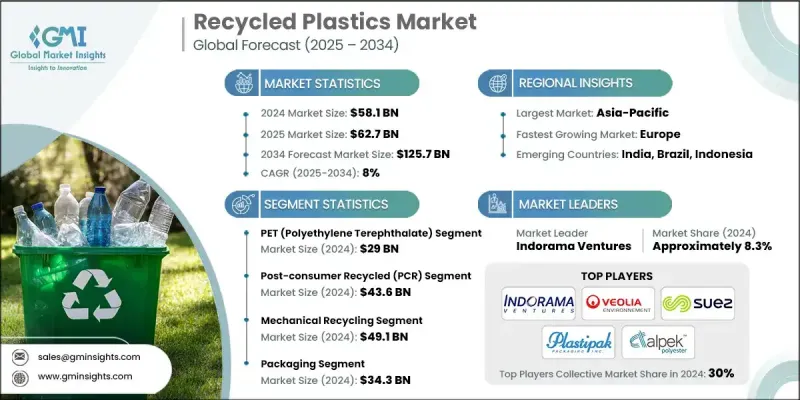
2024 年全球再生塑膠市場價值為 581 億美元,預計到 2034 年將以 8% 的複合年成長率成長至 1,257 億美元。
隨著各主要產業的公司擴大採用再生塑膠來減少碳排放和遏制環境污染,整個產業正經歷強勁的發展勢頭。原油價格上漲和企業永續發展目標的設定,正推動著從原生樹脂轉向再生替代品的轉變。由於機械再生往往無法達到薄膜和多層應用所需的純度,因此人們的關注點正轉向化學回收方法,例如解聚。大規模項目和投資表明,人們對回收作為減少浪費和實現材料循環的長期解決方案越來越有信心。垂直整合正在成為主要的競爭策略,許多快速消費品公司和時尚品牌正在投資或收購回收業務,以確保原料供應並提高材料回收能力。這一趨勢凸顯了整個市場正在向建構閉迴路系統轉變,該系統優先考慮永續性、效率和減少對原生聚合物的依賴。
| 市場範圍 | |
|---|---|
| 起始年份 | 2024 |
| 預測年份 | 2025-2034 |
| 起始值 | 581億美元 |
| 預測值 | 1257億美元 |
| 複合年成長率 | 8% |
2024年,PET市場規模達到290億美元,預計2025年至2034年間將以7.9%的複合年成長率成長。飲料和紡織業需求的成長是PET持續佔據主導地位的主要原因。對再生材料含量需求和升級再造紡織品生產的日益重視,加速了瓶到瓶回收系統的發展。時尚產業也進一步推動了對PET的需求,各大品牌擴大使用rPET纖維,這標誌著原料採購方式的重大轉變,並為全球生產商創造了強勁的成長機會。
2024年,包裝產業的市場規模達到343億美元,預計到2034年將以7.8%的複合年成長率成長,佔全球市場佔有率的59%。包裝應用消耗了全球一半以上的再生聚合物產量,並且正在採用更嚴格的品質和可追溯性標準。隨著新的監管要求強制執行再生材料認證和可追溯性,食品級rPET的使用量激增。非食品應用領域,例如個人護理容器和家用清潔劑包裝,現在也要求更高的再生材料含量,這進一步刺激了消費品製造業對具有除臭功能的再生HDPE和PP的需求。
2024年美國再生塑膠市場規模達88億美元,預計2034年將以8%的複合年成長率成長。該地區正從分散的回收網路向垂直整合的系統轉型,從而提高原料供應和供應鏈穩定性。公私合作正在擴大高品質再生材料(尤其是rPET和rHDPE)的取得管道,尤其是在加州和美國東南部等地區。人工智慧分類技術的進步和品質平衡認證標準的實施,顯著提高了再生材料的品質和一致性,尤其是在歐洲和北美的硬質包裝應用領域。
全球再生塑膠市場的主要參與者包括威立雅環境集團(Veolia Environnement)、Indorama Ventures、Alpek Polyester/DAK Americas、Plastipak Holdings(清潔技術)和蘇伊士集團(Suez SA)。再生塑膠市場的領導企業正在推行多項策略舉措,以提升其市場佔有率和競爭力。他們大力投資化學回收技術,以提高回收材料的純度並處理混合或受污染的廢棄物。此外,他們還透過策略性收購和合作,確保穩定的原料供應並擴大回收能力。各公司也正在開發閉迴路系統和垂直整合的生產模式,以確保材料的可追溯性和供應穩定性。
目錄
第1章:方法論
- 市場範圍和定義
- 研究設計
- 研究方法
- 資料收集方法
- 資料探勘來源
- 全球的
- 地區/國家
- 基準估算和計算
- 基準年計算
- 市場估算的關鍵趨勢
- 初步研究和驗證
- 原始資料
- 預測模型
- 研究假設和局限性
第2章:執行概要
第3章:行業洞察
- 產業生態系分析
- 供應商格局
- 利潤率
- 每個階段的價值增加
- 影響價值鏈的因素
- 中斷
- 產業影響因素
- 成長促進因素
- 產業陷阱與挑戰
- 市場機遇
- 成長潛力分析
- 監管環境
- 北美洲
- 歐洲
- 亞太地區
- 拉丁美洲
- 中東和非洲
- 波特的分析
- PESTEL 分析
- 價格趨勢
- 按地區
- 未來市場趨勢
- 技術與創新格局
- 當前技術趨勢
- 新興技術
- 專利格局
- 貿易統計(註:僅提供重點國家的貿易統計)
- 主要進口國
- 主要出口國
- 永續性和環境方面
- 永續實踐
- 減少廢棄物策略
- 生產中的能源效率
- 環保舉措
- 碳足跡考量
第4章:競爭格局
- 介紹
- 公司市佔率分析
- 按地區
- 北美洲
- 歐洲
- 亞太地區
- 拉丁美洲
- MEA
- 按地區
- 公司矩陣分析
- 主要市場參與者的競爭分析
- 競爭定位矩陣
- 關鍵進展
- 併購
- 合作夥伴關係與合作
- 新產品發布
- 擴張計劃
第5章:市場估算與預測:依聚合物類型分類,2025-2034年
- 主要趨勢
- PET(聚對苯二甲酸乙二醇酯)
- 瓶對瓶回收
- 紡織纖維應用
- HDPE(高密度聚乙烯)
- PP(聚丙烯)
- 低密度聚乙烯(LDPE)
- PS(聚苯乙烯)
- 其他材質(PVC、ABS、PC)
第6章:市場估算與預測:依來源類型分類,2025-2034年
- 主要趨勢
- 消費後回收物(PCR)
- 市政收集系統
- 存款返還計劃
- 零售回收計劃
- 工業後回收物(PIR)
第7章:市場估算與預測:依回收技術分類,2025-2034年
- 主要趨勢
- 機械回收
- 化學回收
- 熱解
- 解聚
- 氣化
- 先進的回收技術
第8章:市場估算與預測:依最終用途分類,2025-2034年
- 主要趨勢
- 包裝
- 食品級包裝
- 非食品包裝
- 汽車
- 室內應用
- 外部應用
- 建築施工
- 紡織品和服裝
- 電學
- 其他
第9章:市場估計與預測:依地區分類,2025-2034年
- 主要趨勢
- 北美洲
- 美國
- 加拿大
- 歐洲
- 德國
- 英國
- 法國
- 義大利
- 西班牙
- 歐洲其他地區
- 亞太地區
- 中國
- 印度
- 日本
- 澳洲
- 韓國
- 亞太其他地區
- 拉丁美洲
- 巴西
- 墨西哥
- 阿根廷
- 拉丁美洲其他地區
- 中東和非洲
- 沙烏地阿拉伯
- 南非
- 阿拉伯聯合大公國
- 中東和非洲其他地區
第10章:公司簡介
- Indorama Ventures (IVL)
- Veolia Environnement
- Suez SA
- Plastipak Holdings (Clean Tech)
- Alpek Polyester / DAK Americas
- Far Eastern New Century (FENC)
- MBA Polymers
- KW Plastics
- Envision Plastics
- Biffa plc
- Evergreen (formerly CarbonLite)
- Loop Industries
- Waste Management (WM Recycle America)
- PETCO (South Africa)
- RPC bpi recycled products
- Ultra-Poly Plastics
- REMONDIS
- ALPLA Recycling
- TOMRA Recycling
- PureCycle Technologies
The Global Recycled Plastics Market was valued at USD 58.1 billion in 2024 and is estimated to grow at a CAGR of 8% to reach USD 125.7 billion by 2034.
The industry is experiencing strong momentum as companies across major sectors are increasingly adopting recycled plastics to minimize carbon emissions and curb environmental waste. Rising crude oil prices and corporate sustainability targets are driving the transition from virgin resins to recycled alternatives. The focus is shifting toward chemical recycling methods such as depolymerization, as mechanical regrind often fails to achieve the required purity for films and multilayer applications. Large-scale projects and investments indicate growing confidence in recycling as a long-term solution to waste reduction and material circularity. Vertical integration is emerging as a leading competitive strategy, with many fast-moving consumer goods companies and fashion brands financing or acquiring recycling operations to secure feedstock and enhance material recovery capabilities. This trend underscores a market-wide shift toward building closed-loop systems that prioritize sustainability, efficiency, and reduced reliance on virgin polymers.
| Market Scope | |
|---|---|
| Start Year | 2024 |
| Forecast Year | 2025-2034 |
| Start Value | $58.1 Billion |
| Forecast Value | $125.7 Billion |
| CAGR | 8% |
The PET segment was valued at USD 29 billion in 2024 and is forecast to register a 7.9% CAGR between 2025 and 2034. PET continues to dominate due to increased demand from the beverage and textile sectors. The growing emphasis on recycled content mandates and upcycled textile production has accelerated bottle-to-bottle recycling systems. The fashion industry is further reinforcing demand as brands increasingly use rPET fibers, marking a significant transformation in raw material sourcing and creating strong growth opportunities for producers worldwide.
The packaging segment was valued at USD 34.3 billion in 2024 and is estimated to grow at a CAGR of 7.8% through 2034, accounting for a 59% share. Packaging applications consume more than half of global recycled polymer output and are adopting stricter quality and traceability standards. Food-grade rPET usage has surged following new regulatory requirements that enforce recyclate certification and traceability. Non-food applications such as personal care containers and household cleaner packaging are now specifying higher recycled content levels, further stimulating demand for odor-controlled recycled HDPE and PP grades across consumer goods manufacturing.
U.S. Recycled Plastics Market reached USD 8.8 billion in 2024 and is expected to record an 8% CAGR by 2034. The region is transitioning from fragmented recycling networks to vertically integrated systems that enhance feedstock availability and supply chain stability. Public-private collaborations are expanding access to high-quality recycled materials, particularly rPET and rHDPE, in regions such as California and the southeastern United States. Advancements in AI-enabled sorting technologies and the implementation of mass balance certification standards are significantly improving recyclate quality and consistency, especially in rigid packaging applications across Europe and North America.
Key players active in the Global Recycled Plastics Market include Veolia Environnement, Indorama Ventures, Alpek Polyester / DAK Americas, Plastipak Holdings (Clean Tech), and Suez SA. Leading companies in the Recycled Plastics Market are pursuing several strategic initiatives to enhance their market presence and competitiveness. They are investing heavily in chemical recycling technologies to achieve higher purity levels and to process mixed or contaminated waste streams. Strategic acquisitions and partnerships are being established to secure a consistent feedstock supply and expand recycling capacity. Firms are also developing closed-loop systems and vertically integrated production models to ensure material traceability and supply stability.
Table of Contents
Chapter 1 Methodology
- 1.1 Market scope and definition
- 1.2 Research design
- 1.2.1 Research approach
- 1.2.2 Data collection methods
- 1.3 Data mining sources
- 1.3.1 Global
- 1.3.2 Regional/Country
- 1.4 Base estimates and calculations
- 1.4.1 Base year calculation
- 1.4.2 Key trends for market estimation
- 1.5 Primary research and validation
- 1.5.1 Primary sources
- 1.6 Forecast model
- 1.7 Research assumptions and limitations
Chapter 2 Executive Summary
- 2.1 Industry 360° synopsis
- 2.2 Key market trends
- 2.2.1 Regional
- 2.2.2 Polymer Type
- 2.2.3 Source Type
- 2.2.4 Recycling Technology
- 2.2.5 End use
- 2.3 TAM Analysis, 2025-2034
- 2.4 CXO perspectives: Strategic imperatives
- 2.4.1 Executive decision points
- 2.4.2 Critical success factors
- 2.5 Future Outlook and Strategic Recommendations
Chapter 3 Industry Insights
- 3.1 Industry ecosystem analysis
- 3.1.1 Supplier Landscape
- 3.1.2 Profit Margin
- 3.1.3 Value addition at each stage
- 3.1.4 Factor affecting the value chain
- 3.1.5 Disruptions
- 3.2 Industry impact forces
- 3.2.1 Growth drivers
- 3.2.2 Industry pitfalls and challenges
- 3.2.3 Market opportunities
- 3.3 Growth potential analysis
- 3.4 Regulatory landscape
- 3.4.1 North America
- 3.4.2 Europe
- 3.4.3 Asia Pacific
- 3.4.4 Latin America
- 3.4.5 Middle East & Africa
- 3.5 Porter's analysis
- 3.6 PESTEL analysis
- 3.7 Price trends
- 3.7.1 By region
- 3.8 Future market trends
- 3.9 Technology and Innovation landscape
- 3.9.1 Current technological trends
- 3.9.2 Emerging technologies
- 3.10 Patent Landscape
- 3.11 Trade statistics (Note: the trade statistics will be provided for key countries only)
- 3.11.1 Major importing countries
- 3.11.2 Major exporting countries
- 3.12 Sustainability and Environmental Aspects
- 3.12.1 Sustainable Practices
- 3.12.2 Waste Reduction Strategies
- 3.12.3 Energy Efficiency in Production
- 3.12.4 Eco-friendly Initiatives
- 3.13 Carbon Footprint Considerations
Chapter 4 Competitive Landscape, 2024
- 4.1 Introduction
- 4.2 Company market share analysis
- 4.2.1 By region
- 4.2.1.1 North America
- 4.2.1.2 Europe
- 4.2.1.3 Asia Pacific
- 4.2.1.4 LATAM
- 4.2.1.5 MEA
- 4.2.1 By region
- 4.3 Company matrix analysis
- 4.4 Competitive analysis of major market players
- 4.5 Competitive positioning matrix
- 4.6 Key developments
- 4.6.1 Mergers & acquisitions
- 4.6.2 Partnerships & collaborations
- 4.6.3 New Product Launches
- 4.6.4 Expansion Plans
Chapter 5 Market Estimates and Forecast, By Polymer Type, 2025 - 2034 (USD Million, Kilo Tons)
- 5.1 Key trends
- 5.2 PET (Polyethylene terephthalate)
- 5.2.1 Bottle-to-bottle recycling
- 5.2.2 Textile fiber applications
- 5.3 HDPE (High-density polyethylene)
- 5.4 PP (Polypropylene)
- 5.5 LDPE (Low-density polyethylene)
- 5.6 PS (Polystyrene)
- 5.7 Others (PVC, ABS, PC)
Chapter 6 Market Estimates and Forecast, By Source Type, 2025 - 2034 (USD Million, Kilo Tons)
- 6.1 Key trends
- 6.2 Post-consumer recycled (PCR)
- 6.2.1 Municipal collection systems
- 6.2.2 Deposit-return schemes
- 6.2.3 Retail take-back programs
- 6.3 Post-industrial recycled (PIR)
Chapter 7 Market Estimates and Forecast, By Recycling Technology, 2025 - 2034 (USD Million, Kilo Tons)
- 7.1 Key trends
- 7.2 Mechanical recycling
- 7.3 Chemical recycling
- 7.3.1 Pyrolysis
- 7.3.2 Depolymerization
- 7.3.3 Gasification
- 7.4 Advanced recycling technologies
Chapter 8 Market Estimates and Forecast, By End use, 2025 - 2034 (USD Million, Kilo Tons)
- 8.1 Key trends
- 8.2 Packaging
- 8.2.1 Food-grade packaging
- 8.2.2 Non-food packaging
- 8.3 Automotive
- 8.3.1 Interior applications
- 8.3.2 Exterior applications
- 8.4 Construction and building
- 8.5 Textiles and apparel
- 8.6 Electronics and electrical
- 8.7 Others
Chapter 9 Market Estimates and Forecast, By Region, 2025 - 2034 (USD Million, Kilo Tons)
- 9.1 Key trends
- 9.2 North America
- 9.2.1 U.S.
- 9.2.2 Canada
- 9.3 Europe
- 9.3.1 Germany
- 9.3.2 UK
- 9.3.3 France
- 9.3.4 Italy
- 9.3.5 Spain
- 9.3.6 Rest of Europe
- 9.4 Asia Pacific
- 9.4.1 China
- 9.4.2 India
- 9.4.3 Japan
- 9.4.4 Australia
- 9.4.5 South Korea
- 9.4.6 Rest of Asia Pacific
- 9.5 Latin America
- 9.5.1 Brazil
- 9.5.2 Mexico
- 9.5.3 Argentina
- 9.5.4 Rest of Latin America
- 9.6 Middle East & Africa
- 9.6.1 Saudi Arabia
- 9.6.2 South Africa
- 9.6.3 UAE
- 9.6.4 Rest of Middle East & Africa
Chapter 10 Company Profiles
- 10.1 Indorama Ventures (IVL)
- 10.2 Veolia Environnement
- 10.3 Suez SA
- 10.4 Plastipak Holdings (Clean Tech)
- 10.5 Alpek Polyester / DAK Americas
- 10.6 Far Eastern New Century (FENC)
- 10.7 MBA Polymers
- 10.8 KW Plastics
- 10.9 Envision Plastics
- 10.10 Biffa plc
- 10.11 Evergreen (formerly CarbonLite)
- 10.12 Loop Industries
- 10.13 Waste Management (WM Recycle America)
- 10.14 PETCO (South Africa)
- 10.15 RPC bpi recycled products
- 10.16 Ultra-Poly Plastics
- 10.17 REMONDIS
- 10.18 ALPLA Recycling
- 10.19 TOMRA Recycling
- 10.20 PureCycle Technologies

 再生塑膠市場:2026-2032年全球市場預測(依產品、回收製程、形態、原料來源及應用分類)
 海洋塑膠升級再造市場預測至2034年-全球原料類型、升級再造製程、產量、價值鏈參與者、最終用戶與區域分析
 全球再生塑膠市場規模、佔有率、趨勢和成長分析報告(2026-2034)
 2026年全球再生塑膠市場報告
 BOPE 和 MOPE 市場:市場需求和預測分析(2034 年)再生木板市場按產品類型、應用、最終用戶、原料、厚度和表面處理分類,全球預測(2026-2032)全球再生高密度聚乙烯 (HDPE) 市場:市場規模、佔有率、成長率、產業分析、按類型、應用和地區劃分的考量、未來預測 (2026-2034)
 再生塑膠市場規模、佔有率和趨勢分析報告:按產品、原料、應用、地區和細分市場預測(2026-2033 年)再生複合材料市場規模、佔有率和趨勢分析報告:按最終用途、纖維類型、地區和細分市場預測(2025-2033 年)原位再生塑膠市場預測至2032年:按工藝類型、材料類型、技術、應用、最終用戶和地區分類的全球分析