


 |
市場調查報告書
商品編碼
1871306
智慧藥盒及藥瓶市場機會、成長促進因素、產業趨勢分析及預測(2025-2034年)Smart Pill Boxes and Bottles Market Opportunity, Growth Drivers, Industry Trend Analysis, and Forecast 2025 - 2034 |
||||||

2024 年全球智慧藥盒和藥瓶市場價值為 1.936 億美元,預計到 2034 年將以 8.8% 的複合年成長率成長至 4.544 億美元。
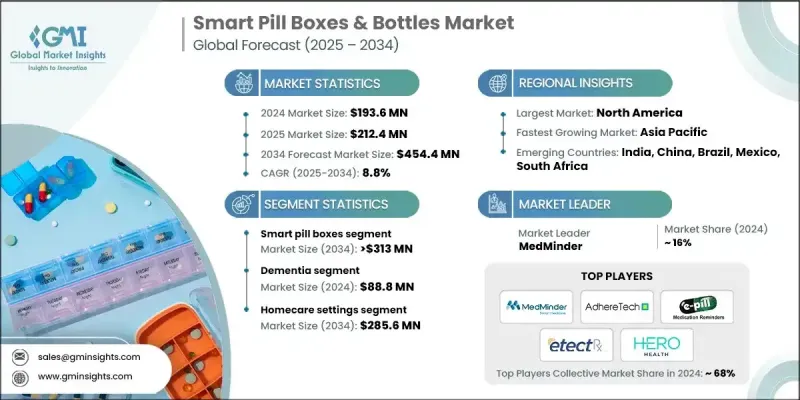
市場擴張的促進因素包括人口老化加劇、藥物依從性差的普遍現象、慢性病盛行率上升以及物聯網、藍牙和感測器技術的快速發展。遠距醫療和遠距患者監護的興起也催生了對互聯藥物管理解決方案的強勁需求。智慧藥盒和藥瓶配備感測器、警報和數位追蹤功能,幫助用戶按時服藥。這些設備通常與行動應用程式或雲端平台整合,提供服藥提醒、劑量通知和依從性報告。它們廣泛應用於老年護理、慢性病管理和遠距醫療計畫中,有效改善了患者的治療效果。疫情後居家醫療的興起進一步加速了智慧藥物管理解決方案的普及,而即時依從性追蹤則增強了遠距醫療和基於價值的醫療服務模式。
| 市場範圍 | |
|---|---|
| 起始年份 | 2024 |
| 預測年份 | 2025-2034 |
| 起始值 | 1.936億美元 |
| 預測值 | 4.544億美元 |
| 複合年成長率 | 8.8% |
智慧藥盒市場預計在2024年將佔據70.2%的市場佔有率,這主要得益於其能夠透過自動提醒、直覺的設計和即時監測來提高患者的用藥依從性。對於需要服用多種藥物或接受複雜治療方案的患者而言,智慧藥盒尤其有效,能夠減少用藥錯誤並提高依從性。
2024 年,失智症市場創造了 8,880 萬美元的收入,預計到 2034 年將以 8.5% 的複合年成長率成長。記憶障礙患者受益於模組化設計、警報和提醒,確保正確服藥,降低住院風險,並使臨床醫生能夠透過互聯平台追蹤患者的用藥依從性。
2024年美國智慧藥盒和藥瓶市值為7,500萬美元,預計2025年至2034年間將以7.1%的複合年成長率成長。慢性病和複雜用藥方案的普遍存在推動了對這些設備的需求,這些設備有助於減少用藥依從性差的情況,並改善患者的健康狀況。
全球智慧藥盒及藥瓶市場的主要參與者包括 DoseTap、Tenovi、PillDrill、Livi、Pillohealth、SMRxT、MedReady、e-pill Medication Reminders、Hero Health、AdhereTech、Pill Connect、Tricella、MedMinder、Loba 和 etectRx。這些公司正透過加大研發投入,開發更人性化、配備感測器且互聯互通的設備,進而鞏固其市場地位。他們專注於整合人工智慧和行動應用平台,為護理人員和醫療保健提供者提供即時用藥依從性資料。與遠距醫療平台進行策略合作、與藥局建立夥伴關係以及拓展家庭醫療保健管道,都有助於擴大市場覆蓋範圍。此外,這些公司也重視病患教育、針對慢性病的個人化解決方案以及合規性,從而增強用戶信任並促進產品普及。
目錄
第1章:方法論與範圍
第2章:執行概要
第3章:行業洞察
- 產業生態系分析
- 產業影響因素
- 成長促進因素
- 慢性疾病負擔日益加重
- 智慧藥盒和藥瓶的技術進步
- 老年人口基數上升
- 家庭護理機構對個人化治療的需求日益成長
- 產業陷阱與挑戰
- 缺乏了解和產品成本高昂
- 市場機遇
- 遠距醫療和數位健康平台的發展
- 成長促進因素
- 成長潛力分析
- 監管環境
- 北美洲
- 歐洲
- 亞太地區
- 技術格局
- 當前技術趨勢
- 新興技術
- 未來市場趨勢
- 2024年定價分析
- 消費者行為分析
- 投資環境
- 波特的分析
- PESTEL 分析
- 差距分析
第4章:競爭格局
- 介紹
- 公司矩陣分析
- 公司市佔率分析
- 競爭定位矩陣
- 主要市場參與者的競爭分析
- 關鍵進展
- 併購
- 合作夥伴關係與合作
- 新產品發布
- 擴張計劃
第5章:市場估算與預測:依產品類型分類,2021-2034年
- 主要趨勢
- 智慧藥盒
- 智慧藥瓶
第6章:市場估算與預測:依指示劑分類,2021-2034年
- 主要趨勢
- 失智
- 癌症管理
- 糖尿病護理
- 其他跡象
第7章:市場估算與預測:依最終用途分類,2021-2034年
- 主要趨勢
- 家庭護理機構
- 老年護理與輔助生活中心
- 其他最終用途
第8章:市場估算與預測:依地區分類,2021-2034年
- 主要趨勢
- 北美洲
- 美國
- 加拿大
- 歐洲
- 德國
- 英國
- 法國
- 西班牙
- 義大利
- 荷蘭
- 亞太地區
- 中國
- 日本
- 印度
- 澳洲
- 韓國
- 拉丁美洲
- 巴西
- 墨西哥
- 阿根廷
- 中東和非洲
- 南非
- 沙烏地阿拉伯
- 阿拉伯聯合大公國
第9章:公司簡介
- AdhereTech
- DoseTap
- e-pill Medication Reminders
- etectRx
- Hero Health
- Livi
- Loba
- MedMinder
- MedReady
- Pill Connect
- PillDrill
- Pillohealth
- SMRxT
- Tenovi
- Tricella
The Global Smart Pill Boxes & Bottles Market was valued at USD 193.6 million in 2024 and is estimated to grow at a CAGR of 8.8% to reach USD 454.4 million by 2034.
The market expansion is fueled by the increasing aging population, widespread medication non-adherence, rising prevalence of chronic conditions, and rapid advancements in IoT, Bluetooth, and sensor technologies. The growth of telehealth and remote patient monitoring is also creating strong demand for connected medication management solutions. Smart pill boxes and bottles are designed with sensors, alerts, and digital tracking to help users take medications on time. These devices often integrate with mobile applications or cloud platforms, offering reminders, dosage notifications, and adherence reports. They are widely used in elderly care, chronic disease management, and remote healthcare programs, improving patient outcomes. Post-pandemic shifts toward home healthcare have further accelerated adoption, while real-time adherence tracking enhances telemedicine and value-based care initiatives.
| Market Scope | |
|---|---|
| Start Year | 2024 |
| Forecast Year | 2025-2034 |
| Start Value | $193.6 Million |
| Forecast Value | $454.4 Million |
| CAGR | 8.8% |
The smart pill boxes segment held 70.2% share in 2024, driven by their capacity to boost medication adherence through automated reminders, intuitive designs, and real-time monitoring. They are particularly effective for patients managing multiple medications or complex treatment schedules, reducing errors and improving compliance.
The dementia segment generated USD 88.8 million in 2024 and is expected to grow at a CAGR of 8.5% through 2034. Patients with memory impairments benefit from compartmentalized designs, alarms, and reminders, ensuring proper medication intake, lowering hospitalization risk, and enabling clinicians to track adherence through connected platforms.
U.S. Smart Pill Boxes & Bottles Market was valued at USD 75 million in 2024 and is estimated to grow at a CAGR of 7.1% between 2025 and 2034. The prevalence of chronic illnesses and complex medication regimens drives the need for these devices, which help reduce non-adherence and improve patient health outcomes.
Key players in the Global Smart Pill Boxes & Bottles Market include DoseTap, Tenovi, PillDrill, Livi, Pillohealth, SMRxT, MedReady, e-pill Medication Reminders, Hero Health, AdhereTech, Pill Connect, Tricella, MedMinder, Loba, and etectRx. Companies in the Smart Pill Boxes & Bottles Market are strengthening their presence by investing in R&D to develop more user-friendly, sensor-equipped, and connected devices. They focus on integrating AI and mobile app platforms to provide real-time adherence data to caregivers and healthcare providers. Strategic collaborations with telehealth platforms, partnerships with pharmacies, and expansion into home healthcare channels help broaden market reach. Companies also emphasize patient education, personalized solutions for chronic conditions, and regulatory compliance, which enhance trust and adoption.
Table of Contents
Chapter 1 Methodology and Scope
- 1.1 Market scope and definitions
- 1.2 Research design
- 1.2.1 Research approach
- 1.2.2 Data collection methods
- 1.3 Data mining sources
- 1.3.1 Global
- 1.3.2 Regional/country
- 1.4 Base estimates and calculations
- 1.4.1 Base year calculation
- 1.4.2 Key trends for market estimation
- 1.5 Primary research and validation
- 1.5.1 Primary sources
- 1.6 Forecast model
- 1.7 Research assumptions and limitations
Chapter 2 Executive Summary
- 2.1 Industry 3600 synopsis
- 2.2 Key market trends
- 2.2.1 Regional trends
- 2.2.2 Product type trends
- 2.2.3 Indication trends
- 2.2.4 End use trends
- 2.3 CXO perspectives: Strategic imperatives
- 2.3.1 Key decision points for industry executives
- 2.3.2 Critical success factors for market players
- 2.4 Future outlook and strategic recommendations
Chapter 3 Industry Insights
- 3.1 Industry ecosystem analysis
- 3.2 Industry impact forces
- 3.2.1 Growth drivers
- 3.2.1.1 Increasing burden of chronic diseases
- 3.2.1.2 Technological advancements in smart pill boxes and bottles
- 3.2.1.3 Rise in geriatric population base
- 3.2.1.4 Growing demand for personalized treatment at home care settings
- 3.2.2 Industry pitfalls and challenges
- 3.2.2.1 Lack of understanding and high product cost
- 3.2.3 Market opportunities
- 3.2.3.1 Growth in remote care and digital health platforms
- 3.2.1 Growth drivers
- 3.3 Growth potential analysis
- 3.4 Regulatory landscape
- 3.4.1 North America
- 3.4.2 Europe
- 3.4.3 Asia Pacific
- 3.5 Technology landscape
- 3.5.1 Current technological trends
- 3.5.2 Emerging technologies
- 3.6 Future market trends
- 3.7 Pricing analysis, 2024
- 3.8 Consumer behaviour analysis
- 3.9 Investment landscape
- 3.10 Porter's analysis
- 3.11 PESTEL analysis
- 3.12 Gap analysis
Chapter 4 Competitive Landscape, 2024
- 4.1 Introduction
- 4.2 Company matrix analysis
- 4.3 Company market share analysis
- 4.4 Competitive positioning matrix
- 4.5 Competitive analysis of major market players
- 4.6 Key developments
- 4.6.1 Mergers & acquisitions
- 4.6.2 Partnerships & collaborations
- 4.6.3 New product launches
- 4.6.4 Expansion plans
Chapter 5 Market Estimates and Forecast, By Product Type, 2021 - 2034 ($ Mn)
- 5.1 Key trends
- 5.2 Smart pill boxes
- 5.3 Smart pill bottles
Chapter 6 Market Estimates and Forecast, By Indication, 2021 - 2034 ($ Mn)
- 6.1 Key trends
- 6.2 Dementia
- 6.3 Cancer management
- 6.4 Diabetes care
- 6.5 Other indications
Chapter 7 Market Estimates and Forecast, By End Use, 2021 - 2034 ($ Mn)
- 7.1 Key trends
- 7.2 Homecare settings
- 7.3 Senior care & assisted living centers
- 7.4 Other end use
Chapter 8 Market Estimates and Forecast, By Region, 2021 - 2034 ($ Mn)
- 8.1 Key trends
- 8.2 North America
- 8.2.1 U.S.
- 8.2.2 Canada
- 8.3 Europe
- 8.3.1 Germany
- 8.3.2 UK
- 8.3.3 France
- 8.3.4 Spain
- 8.3.5 Italy
- 8.3.6 Netherlands
- 8.4 Asia Pacific
- 8.4.1 China
- 8.4.2 Japan
- 8.4.3 India
- 8.4.4 Australia
- 8.4.5 South Korea
- 8.5 Latin America
- 8.5.1 Brazil
- 8.5.2 Mexico
- 8.5.3 Argentina
- 8.6 Middle East and Africa
- 8.6.1 South Africa
- 8.6.2 Saudi Arabia
- 8.6.3 UAE
Chapter 9 Company Profiles
- 9.1 AdhereTech
- 9.2 DoseTap
- 9.3 e-pill Medication Reminders
- 9.4 etectRx
- 9.5 Hero Health
- 9.6 Livi
- 9.7 Loba
- 9.8 MedMinder
- 9.9 MedReady
- 9.10 Pill Connect
- 9.11 PillDrill
- 9.12 Pillohealth
- 9.13 SMRxT
- 9.14 Tenovi
- 9.15 Tricella

 智慧藥盒及藥瓶市場:2026-2032年全球市場預測(依產品類型、連結方式、應用、最終用戶及通路分類)
 藥物依從性市場分析及預測(至2035年):按類型、產品類型、服務、技術、應用、最終用戶、功能、部署類型、解決方案和模式分類
 全球智慧藥盒市場規模、佔有率、趨勢和成長分析報告(2026-2034年)
 藥物依從性市場規模、佔有率和成長分析(按產品類型、藥物類型、給藥途徑、最終用戶和地區分類)-2026-2033年產業預測
 藥物依從性市場-全球產業規模、佔有率、趨勢、機會和預測,按類型、藥物、地區和競爭格局分類,2020-2030年預測
 智慧藥盒和藥瓶市場預測至2032年:按產品類型、功能、技術、分銷管道、最終用戶和地區分類的全球分析藥物依從性設備市場-全球產業規模、佔有率、趨勢、機會和預測(按類型、藥物、地區和競爭細分,2020-2030 年)全球藥物依從性增強市場規模(依產品類型、治療領域、地區、範圍和預測)