


 |
市場調查報告書
商品編碼
1871218
特種罐頭食品市場機會、成長促進因素、產業趨勢分析及預測(2025-2034年)Specialty Canned Foods Market Opportunity, Growth Drivers, Industry Trend Analysis, and Forecast 2025 - 2034 |
||||||

2024 年全球特色罐頭食品市場價值為 99 億美元,預計到 2034 年將以 4.5% 的複合年成長率成長至 151 億美元。
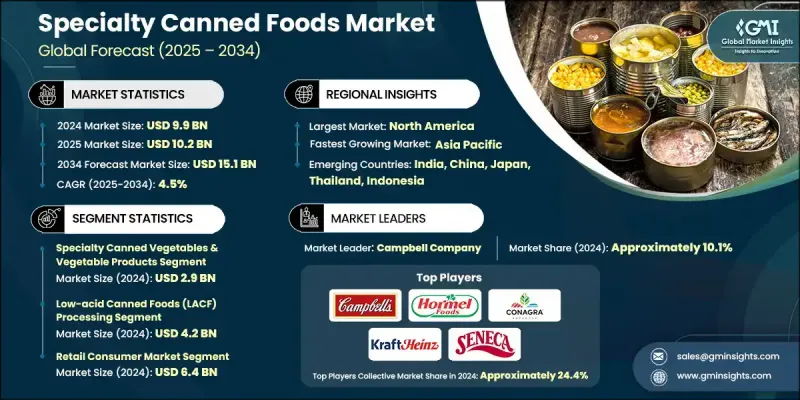
隨著消費者對優質、精緻、手工罐頭食品的需求日益成長,市場正經歷強勁成長。這些罐頭食品選用高品質原料,並具有獨特的風味。現代消費者正從大量生產的商品轉向小批量、手工風格的產品,這推動了已開發地區的需求。消費者對國際美食和多元文化食品的興趣日益濃厚,進一步擴大了市場,因為特色罐頭食品如今能夠提供來自世界各地的風味。此外,消費者對有機和清潔標籤產品的偏好也持續推動市場成長。城市居民和注重健康的消費者對便利、營養豐富且保存期限長的食品的需求,為國內和出口市場都創造了機遇,促使製造商不斷創新,豐富產品種類,以滿足不斷變化的消費者口味。
| 市場範圍 | |
|---|---|
| 起始年份 | 2024 |
| 預測年份 | 2025-2034 |
| 起始值 | 99億美元 |
| 預測值 | 151億美元 |
| 複合年成長率 | 4.5% |
2024年,特色罐裝蔬菜及蔬菜製品市場規模為29億美元,預計2025年至2034年將以5%的複合年成長率成長。隨著城市消費者尋求便利的膳食補充,以及新鮮農產品供應有限的地區受益於這些穩定的替代品,對營養豐富、保存期限長的罐裝水果和蔬菜的需求正在增加。
2024年,低酸罐頭食品(LACF)加工產業的市場規模達到42億美元,預計2034年將以4.6%的複合年成長率成長。這一成長主要得益於肉類、海鮮和蔬菜類低酸罐頭食品產量的不斷提高,這些產品需要精確的熱力滅菌以確保安全性和延長保存期限。密封和滅菌過程追蹤技術的進步提高了產品品質和消費者信心,從而促進了國內外市場的擴張。
2024年,北美特色罐頭食品市佔率達32.1%。市場成長主要得益於消費者對便利、健康、即食食品的需求。消費者對手工和異國風味食品的需求不斷成長,也拓展了罐裝水果、蔬菜、醬料和即食食品的種類。都會生活方式和單身家庭的增多,也增加了對保存期限長、品質優良的產品的需求。零售和電商通路的擴張提高了產品的可及性,而對有機和營養豐富產品的重視則支撐了區域市場的穩定成長。
全球特色罐頭食品市場的主要參與者包括荷美爾食品公司(Hormel Foods Corporation)、康尼格拉食品公司(Conagra Brands Inc.)、金寶湯公司(Campbell Company)、卡夫亨氏公司(Kraft Heinz Company)、塞內卡食品公司(Seneca Foods Corporation)等。各公司致力於產品創新,打造小批量、手工風格和高階產品,以滿足注重健康和追求美食的消費者的需求。包裝的改進,例如可重複密封、環保和份量控制設計,提高了便利性並減少了食物浪費。與零售商和電商平台建立策略合作夥伴關係,拓展了分銷管道,提高了市場知名度。各公司也加大研發投入,開發獨特的口味、強化產品和有機產品,以滿足不斷變化的飲食偏好。向高成長地區拓展市場並適應當地的飲食趨勢,有助於提高市場滲透率。品牌推廣和行銷活動強調品質、真實性和永續性,以增強消費者忠誠度。
目錄
第1章:方法論
- 市場範圍和定義
- 研究設計
- 研究方法
- 資料收集方法
- 資料探勘來源
- 全球的
- 地區/國家
- 基準估算和計算
- 基準年計算
- 市場估算的關鍵趨勢
- 初步研究和驗證
- 原始資料
- 預測模型
- 研究假設和局限性
第2章:執行概要
第3章:行業洞察
- 產業生態系分析
- 供應商格局
- 利潤率
- 每個階段的價值增加
- 影響價值鏈的因素
- 中斷
- 產業影響因素
- 成長促進因素
- 產業陷阱與挑戰
- 供應鏈的複雜性
- 市場機遇
- 成長潛力分析
- 監管環境
- 北美洲
- 歐洲
- 亞太地區
- 拉丁美洲
- 中東和非洲
- 波特的分析
- PESTEL 分析
- 價格趨勢
- 按地區
- 依產品
- 未來市場趨勢
- 技術與創新格局
- 當前技術趨勢
- 新興技術
- 專利格局
- 貿易統計(註:僅提供重點國家的貿易統計)
- 主要進口國
- 主要出口國
- 永續性和環境方面
- 永續實踐
- 減少廢棄物策略
- 生產中的能源效率
- 環保舉措
- 碳足跡考量
第4章:競爭格局
- 介紹
- 公司市佔率分析
- 按地區
- 北美洲
- 歐洲
- 亞太地區
- 拉丁美洲
- MEA
- 按地區
- 公司矩陣分析
- 主要市場參與者的競爭分析
- 競爭定位矩陣
- 關鍵進展
- 併購
- 合作夥伴關係與合作
- 新產品發布
- 擴張計劃
第5章:市場估算與預測:依產品類型分類,2021-2034年
- 主要趨勢
- 特色罐裝水果及水果製品
- 美味水果拼盤
- 手工水果沙拉和什錦水果
- 優質桃子和梨品種
- 異國熱帶水果系列
- 有機水果產品
- 水果醬
- 美味水果醬
- 甜點配菜和配料
- 烹飪和烘焙應用
- 美味水果拼盤
- 特色罐裝蔬菜及蔬菜製品
- 手工蔬菜製品
- 傳家寶和傳統品種
- 小批量處理
- 主廚創意料理
- 有機天然蔬菜
- 經認證的有機產品
- 非基因改造認證選項
- 不含殺蟲劑的替代品
- 民族風味蔬菜料理
- 墨西哥和拉丁美洲蔬菜
- 亞洲特色蔬菜
- 地中海風味
- 手工蔬菜製品
- 特色湯品、燉菜和即食餐
- 各種美味湯品
- 濃湯和奶油湯
- 以肉湯為基底的高級湯品
- 季節限定款和限量版
- 民族風味湯
- 亞洲湯(拉麵、越南河粉、味噌湯)
- 歐洲湯品傳統
- 拉丁美洲特色湯
- 優質燉菜和套餐
- 慢燉菜品種
- 即食餐解決方案
- 單份裝和份量控制
- 各種美味湯品
- 特色醬料、調味品及醃製品
- 手工義大利麵和烹飪醬料
- 美味馬裡納拉醬和番茄醬
- 香蒜醬和香草醬
- 國際醬料種類
- 優質莎莎醬和沾醬
- 手工莎莎醬種類
- 特色沾醬和塗抹醬
- 辣醬和辛辣食品
- 美味蜜餞和果醬
- 小批量水果蜜餞
- 無糖和低糖選項
- 美味蜜餞和酸辣醬
- 手工義大利麵和烹飪醬料
- 特色肉類和海鮮產品
- 優質罐裝肉
- 草飼和有機肉類產品
- 特色辣椒和燉肉
- 精緻的肉醬和塗抹醬
- 永續海鮮
- MSC認證海鮮
- 野生捕撈的優質魚類
- 特色海鮮料理
- 民族風味肉類和海鮮料理
- 亞洲風味海鮮產品
- 歐洲肉類特色菜
- 拉丁美洲的準備
- 優質罐裝肉
- 民族及國際特色食品
- 拉丁裔/西班牙裔特色菜
- 正宗墨西哥產品
- 中美洲品種
- 南美洲特色菜
- 亞洲菜餚的準備
- 中國傳統美食
- 日本特產
- 東南亞產品
- 歐洲美食產品
- 義大利特色食品
- 法國美食
- 地中海風味
- 拉丁裔/西班牙裔特色菜
第6章:市場估算與預測:依加工技術分類,2021-2034年
- 主要趨勢
- 低酸罐頭食品(LACF)加工
- 釜式加工技術
- 蒸汽蒸餾釜系統
- 水浸式殺菌釜
- 連續式釜式加工
- 壓力處理應用
- 蒸餾釜操作
- 攪拌式蒸餾釜系統
- 水壓蒸餾釜
- FDA註冊和流程備案要求
- 更好的流程控制學校合規性
- 釜式加工技術
- 酸化食品加工
- 控制酸化方法
- 醋酸化
- 檸檬酸加工
- 乳酸發酵
- pH控制和監測系統
- 達到平衡pH值的方案
- 流程授權驗證要求
- 控制酸化方法
- 高酸性食品加工
- 巴氏殺菌技術
- 水浴處理
- 蒸汽處理
- 隧道式巴氏殺菌法
- 熱灌裝加工方法
- 熱灌裝和保溫系統
- 反演處理
- 真空密封應用
- 巴氏殺菌技術
- 先進加工技術
- 高壓加工(HPP)
- 冷高壓加工應用
- 熱輔助高壓
- 蒸煮袋加工
- 軟性袋系統
- 自立袋應用
- 無菌加工包裝
- 超高溫瞬時滅菌
- 無菌填充系統
- 高壓加工(HPP)
第7章:市場估計與預測:依最終用途應用分類,2021-2034年
- 主要趨勢
- 零售消費市場
- 食品連鎖店配送
- 全國性食品零售商
- 區域性連鎖超市
- 折扣零售通路
- 特色食品店
- 美食零售商
- 健康食品店
- 民族食品市場
- 電子商務與直接面對消費者
- 線上市場銷售
- 品牌直營網站
- 訂閱盒服務
- 食品連鎖店配送
- 餐飲服務及機構市場
- 餐廳和餐飲應用
- 高級餐廳
- 休閒餐飲連鎖店
- 速食店
- 機構餐飲服務
- 醫療機構
- 教育機構
- 公司食堂
- 酒店和旅遊
- 飯店和度假村餐飲服務
- 航空公司餐飲
- 郵輪公司申請
- 餐廳和餐飲應用
- 食品製造及配料
- 食品加工機應用
- 即食食品生產商
- 醬料和調味品生產商
- 烘焙和零食公司
- 自有品牌生產
- 零售商自有品牌生產
- 經銷商自有品牌
- 聯合製造服務
- 原料供應應用
- 散裝原料銷售
- 餐飲服務原料供應
- 工業食品加工
- 食品加工機應用
第8章:市場估算與預測:依地區分類,2021-2034年
- 主要趨勢
- 北美洲
- 美國
- 加拿大
- 歐洲
- 德國
- 英國
- 法國
- 義大利
- 西班牙
- 歐洲其他地區
- 亞太地區
- 中國
- 印度
- 日本
- 澳洲
- 韓國
- 亞太其他地區
- 拉丁美洲
- 巴西
- 墨西哥
- 阿根廷
- 拉丁美洲其他地區
- 中東和非洲
- 沙烏地阿拉伯
- 南非
- 阿拉伯聯合大公國
- 中東和非洲其他地區
第9章:公司簡介
- The JM Smucker Company
- Seneca Foods Corporation
- Pacific Coast Producers
- Del Monte Foods Inc.
- Campbell Company
- Conagra Brands Inc.
- Nestle USA
- Teasdale Latin Foods
- LiDestri Foods Inc.
- Giovanni Foods
- Lakeside Foods Inc.
- Hirzel Canning Company/Dei Fratelli
- Stanislaus Food Products
- Wild Planet Foods
- Bianco DiNapoli
- Initiative Foods
- Patriot Pickle
- Victory's Kitchen
The Global Specialty Canned Foods Market was valued at USD 9.9 Billion in 2024 and is expected to grow at a CAGR of 4.5% to reach USD 15.1 Billion by 2034.
The market is witnessing strong growth as consumers increasingly seek premium, gourmet, and artisanal canned foods that deliver high-quality ingredients and unique flavors. Modern buyers are shifting from mass-produced offerings to small-batch, craft-style products, driving demand in developed regions. Rising interest in international cuisines and culturally diverse foods has further expanded the market, as specialty canned foods now provide flavors from around the world. Additionally, consumer preference for organic and clean-label products continues to support growth. The demand for convenient, nutrient-rich, and shelf-stable foods among urban populations and health-conscious consumers is creating opportunities for both domestic and export markets, pushing manufacturers to innovate and diversify their offerings to meet evolving tastes.
| Market Scope | |
|---|---|
| Start Year | 2024 |
| Forecast Year | 2025-2034 |
| Start Value | $9.9 Billion |
| Forecast Value | $15.1 Billion |
| CAGR | 4.5% |
The specialty canned vegetables and vegetable products segment was valued at USD 2.9 Billion in 2024 and is expected to grow at a CAGR of 5% from 2025 to 2034. The demand for nutrient-rich, long-lasting canned fruits and vegetables is increasing as urban consumers seek convenient dietary additions, and regions with limited access to fresh produce benefit from these stable alternatives.
The low-acid canned foods (LACF) processing segment was valued at USD 4.2 Billion in 2024 and is projected to grow at a CAGR of 4.6% through 2034. This growth is fueled by the rising production of meat, seafood, and vegetable-based LACF products, which require precise thermal sterilization for safety and shelf life. Advances in sealing and sterilization tracking have improved product quality and consumer confidence, boosting market expansion in both domestic and international markets.
North America Specialty Canned Foods Market held a 32.1% share in 2024. The market's growth is driven by consumers' preference for convenient, healthy, and ready-to-eat options. Rising demand for artisanal and ethnic flavors has expanded the range of canned fruits, vegetables, sauces, and ready meals. Urban lifestyles and single-person households have increased the need for shelf-stable, premium products. The expansion of retail and e-commerce channels has improved accessibility, while an emphasis on organic and nutrient-rich offerings supports steady regional growth.
Key players in the Global Specialty Canned Foods Market include Hormel Foods Corporation, Conagra Brands Inc., Campbell Company, Kraft Heinz Company, Seneca Foods Corporation, and others. Companies are focusing on product innovation, creating small-batch, craft-style, and premium offerings to cater to health-conscious and gourmet-focused consumers. Packaging enhancements, including resealable, eco-friendly, and portion-controlled designs, improve convenience and reduce food waste. Strategic partnerships with retailers and e-commerce platforms expand distribution channels and enhance market visibility. Firms are also investing in R&D to develop unique flavors, fortified options, and organic products to meet evolving dietary preferences. Market expansion into high-growth regions and adaptation to local culinary trends help increase market penetration. Branding and marketing campaigns highlight quality, authenticity, and sustainability to strengthen consumer loyalty.
Table of Contents
Chapter 1 Methodology
- 1.1 Market scope and definition
- 1.2 Research design
- 1.2.1 Research approach
- 1.2.2 Data collection methods
- 1.3 Data mining sources
- 1.3.1 Global
- 1.3.2 Regional/Country
- 1.4 Base estimates and calculations
- 1.4.1 Base year calculation
- 1.4.2 Key trends for market estimation
- 1.5 Primary research and validation
- 1.5.1 Primary sources
- 1.6 Forecast model
- 1.7 Research assumptions and limitations
Chapter 2 Executive Summary
- 2.1 Industry 360° synopsis
- 2.2 Key market trends
- 2.2.1 Regional
- 2.2.2 Product Type
- 2.2.3 Processing Technology
- 2.2.4 End use Application
- 2.3 TAM Analysis, 2025-2034
- 2.4 CXO perspectives: Strategic imperatives
- 2.4.1 Executive decision points
- 2.4.2 Critical success factors
- 2.5 Future Outlook and Strategic Recommendations
Chapter 3 Industry Insights
- 3.1 Industry ecosystem analysis
- 3.1.1 Supplier Landscape
- 3.1.2 Profit Margin
- 3.1.3 Value addition at each stage
- 3.1.4 Factor affecting the value chain
- 3.1.5 Disruptions
- 3.2 Industry impact forces
- 3.2.1 Growth drivers
- 3.2.2 Industry pitfalls and challenges
- 3.2.2.1 Supply chain complexity
- 3.2.3 Market opportunities
- 3.3 Growth potential analysis
- 3.4 Regulatory landscape
- 3.4.1 North America
- 3.4.2 Europe
- 3.4.3 Asia Pacific
- 3.4.4 Latin America
- 3.4.5 Middle East & Africa
- 3.5 Porter's analysis
- 3.6 PESTEL analysis
- 3.7 Price trends
- 3.7.1 By region
- 3.7.2 By product
- 3.8 Future market trends
- 3.9 Technology and Innovation landscape
- 3.9.1 Current technological trends
- 3.9.2 Emerging technologies
- 3.10 Patent Landscape
- 3.11 Trade statistics (Note: the trade statistics will be provided for key countries only)
- 3.11.1 Major importing countries
- 3.11.2 Major exporting countries
- 3.12 Sustainability and Environmental Aspects
- 3.12.1 Sustainable Practices
- 3.12.2 Waste Reduction Strategies
- 3.12.3 Energy Efficiency in Production
- 3.12.4 Eco-friendly Initiatives
- 3.13 Carbon Footprint Considerations
Chapter 4 Competitive Landscape, 2024
- 4.1 Introduction
- 4.2 Company market share analysis
- 4.2.1 By region
- 4.2.1.1 North America
- 4.2.1.2 Europe
- 4.2.1.3 Asia Pacific
- 4.2.1.4 LATAM
- 4.2.1.5 MEA
- 4.2.1 By region
- 4.3 Company matrix analysis
- 4.4 Competitive analysis of major market players
- 4.5 Competitive positioning matrix
- 4.6 Key developments
- 4.6.1 Mergers & acquisitions
- 4.6.2 Partnerships & collaborations
- 4.6.3 New Product Launches
- 4.6.4 Expansion Plans
Chapter 5 Market Estimates and Forecast, By Product Type, 2021-2034 (USD Billion, Kilo Tons)
- 5.1 Key trends
- 5.2 Specialty Canned Fruits & Fruit Products
- 5.2.1 Gourmet fruit preparations
- 5.2.1.1 Artisanal fruit salads and medleys
- 5.2.1.2 Premium peach and pear varieties
- 5.2.1.3 Exotic and tropical fruit collections
- 5.2.2 Organic fruit products
- 5.2.3 Fruit-based sauces and compotes
- 5.2.3.1 Gourmet fruit sauces
- 5.2.3.2 Dessert compotes and toppings
- 5.2.3.3 Cooking and baking applications
- 5.2.1 Gourmet fruit preparations
- 5.3 Specialty Canned Vegetables & Vegetable Products
- 5.3.1 Artisanal vegetable preparations
- 5.3.1.1 Heirloom and heritage varieties
- 5.3.1.2 Small-batch processing
- 5.3.1.3 Chef-inspired preparations
- 5.3.2 Organic and natural vegetables
- 5.3.2.1 Certified organic products
- 5.3.2.2 Non-GMO verified options
- 5.3.2.3 Pesticide-free alternatives
- 5.3.3 Ethnic vegetable preparations
- 5.3.3.1 Mexican and Latino vegetables
- 5.3.3.2 Asian vegetable specialties
- 5.3.3.3 Mediterranean preparations
- 5.3.1 Artisanal vegetable preparations
- 5.4 Specialty Soups, Stews & Ready Meals
- 5.4.1 Gourmet soup varieties
- 5.4.1.1 Bisques and cream-based soups
- 5.4.1.2 Broth-based premium soups
- 5.4.1.3 Seasonal and limited edition varieties
- 5.4.2 Ethnic cuisine soups
- 5.4.2.1 Asian soup varieties (ramen, pho, miso)
- 5.4.2.2 European soup traditions
- 5.4.2.3 Latin American soup specialties
- 5.4.3 Premium stews and complete meals
- 5.4.3.1 Slow-cooked stew varieties
- 5.4.3.2 Ready-to-eat meal solutions
- 5.4.3.3 Single-serve and portion control
- 5.4.1 Gourmet soup varieties
- 5.5 Specialty Sauces, Condiments & Preserves
- 5.5.1 Artisanal pasta and cooking sauces
- 5.5.1.1 Gourmet marinara and tomato sauces
- 5.5.1.2 Pesto and herb-based sauces
- 5.5.1.3 International sauce varieties
- 5.5.2 Premium salsas and dips
- 5.5.2.1 Artisanal salsa varieties
- 5.5.2.2 Specialty dips and spreads
- 5.5.2.3 Hot sauce and spicy preparations
- 5.5.3 Gourmet preserves and jams
- 5.5.3.1 Small-batch fruit preserves
- 5.5.3.2 Sugar-free and low-sugar options
- 5.5.3.3 Savory preserves and chutneys
- 5.5.1 Artisanal pasta and cooking sauces
- 5.6 Specialty Meat & Seafood Products
- 5.6.1 Premium canned meats
- 5.6.1.1 Grass-fed and organic meat products
- 5.6.1.2 Specialty chili and meat stews
- 5.6.1.3 Gourmet pates and spreads
- 5.6.2 Sustainable seafood products
- 5.6.2.1 MSC certified seafood
- 5.6.2.2 Wild-caught premium fish
- 5.6.2.3 Specialty seafood preparations
- 5.6.3 Ethnic meat and seafood preparations
- 5.6.3.1 Asian-style seafood products
- 5.6.3.2 European meat specialties
- 5.6.3.3 Latin American preparations
- 5.6.1 Premium canned meats
- 5.7 Ethnic & International Specialty Foods
- 5.7.1 Latino/Hispanic specialties
- 5.7.1.1 Mexican authentic products
- 5.7.1.2 Central American varieties
- 5.7.1.3 South American specialties
- 5.7.2 Asian cuisine preparations
- 5.7.2.1 Chinese traditional foods
- 5.7.2.2 Japanese specialty items
- 5.7.2.3 Southeast Asian products
- 5.7.3 European gourmet products
- 5.7.3.1 Italian specialty foods
- 5.7.3.2 French gourmet items
- 5.7.3.3 Mediterranean preparations
- 5.7.1 Latino/Hispanic specialties
Chapter 6 Market Estimates and Forecast, By Processing Technology, 2021-2034 (USD Billion, Kilo Tons)
- 6.1 Key trends
- 6.2 Low-Acid Canned Foods (LACF) Processing
- 6.2.1 Retort processing technology
- 6.2.1.1 Steam retort systems
- 6.2.1.2 Water immersion retorts
- 6.2.1.3 Continuous retort processing
- 6.2.2 Pressure processing applications
- 6.2.2.1 Still retort operations
- 6.2.2.2 Agitating retort systems
- 6.2.2.3 Hydrostatic retorts
- 6.2.3 FDA registration and process filing requirements
- 6.2.4 Better Process Control School compliance
- 6.2.1 Retort processing technology
- 6.3 Acidified Foods Processing
- 6.3.1 Controlled acidification methods
- 6.3.1.1 Vinegar-based acidification
- 6.3.1.2 Citric acid processing
- 6.3.1.3 Lactic acid fermentation
- 6.3.2 pH control and monitoring systems
- 6.3.3 Equilibrium pH achievement protocols
- 6.3.4 Process authority validation requirements
- 6.3.1 Controlled acidification methods
- 6.4 High-Acid Foods Processing
- 6.4.1 Pasteurization technologies
- 6.4.1.1 Water bath processing
- 6.4.1.2 Steam processing
- 6.4.1.3 Tunnel pasteurization
- 6.4.2 Hot-fill processing methods
- 6.4.2.1 Hot-fill and hold systems
- 6.4.2.2 Inversion processing
- 6.4.2.3 Vacuum sealing applications
- 6.4.1 Pasteurization technologies
- 6.5 Advanced Processing Technologies
- 6.5.1 High-pressure processing (HPP)
- 6.5.1.1 Cold HPP applications
- 6.5.1.2 Thermal-assisted HPP
- 6.5.2 Retort pouch processing
- 6.5.2.1 Flexible pouch systems
- 6.5.2.2 Stand-up pouch applications
- 6.5.3 Aseptic processing and packaging
- 6.5.3.1 UHT sterilization
- 6.5.3.2 Sterile filling systems
- 6.5.1 High-pressure processing (HPP)
Chapter 7 Market Estimates and Forecast, By End Use Application, 2021-2034 (USD Billion, Kilo Tons)
- 7.1 Key trends
- 7.2 Retail Consumer Market
- 7.2.1 Grocery chain distribution
- 7.2.1.1 National grocery retailers
- 7.2.1.2 Regional grocery chains
- 7.2.1.3 Discount retail channels
- 7.2.2 Specialty food stores
- 7.2.2.1 Gourmet food retailers
- 7.2.2.2 Health food stores
- 7.2.2.3 Ethnic food markets
- 7.2.3 E-commerce and direct-to-consumer
- 7.2.3.1 Online marketplace sales
- 7.2.3.2 Direct brand websites
- 7.2.3.3 Subscription box services
- 7.2.1 Grocery chain distribution
- 7.3 Foodservice & Institutional Market
- 7.3.1 Restaurant and catering applications
- 7.3.1.1 Fine dining establishments
- 7.3.1.2 Casual dining chains
- 7.3.1.3 Quick service restaurants
- 7.3.2 Institutional foodservice
- 7.3.2.1 Healthcare facilities
- 7.3.2.2 Educational institutions
- 7.3.2.3 Corporate cafeterias
- 7.3.3 Hospitality and travel
- 7.3.3.1 Hotel and resort food service
- 7.3.3.2 Airline catering
- 7.3.3.3 Cruise line applications
- 7.3.1 Restaurant and catering applications
- 7.4 Food Manufacturing & Ingredients
- 7.4.1 Food processor applications
- 7.4.1.1 Ready meal manufacturers
- 7.4.1.2 Sauce and condiment producers
- 7.4.1.3 Bakery and snack food companies
- 7.4.2 Private label manufacturing
- 7.4.2.1 Retailer brand production
- 7.4.2.2 Distributor private labels
- 7.4.2.3 Co-manufacturing services
- 7.4.3 Ingredient supply applications
- 7.4.3.1 Bulk ingredient sales
- 7.4.3.2 Food service ingredient supply
- 7.4.3.3 Industrial food processing
- 7.4.1 Food processor applications
Chapter 8 Market Estimates and Forecast, By Region, 2021-2034 (USD Billion, Kilo Tons)
- 8.1 Key trends
- 8.2 North America
- 8.2.1 U.S.
- 8.2.2 Canada
- 8.3 Europe
- 8.3.1 Germany
- 8.3.2 UK
- 8.3.3 France
- 8.3.4 Italy
- 8.3.5 Spain
- 8.3.6 Rest of Europe
- 8.4 Asia Pacific
- 8.4.1 China
- 8.4.2 India
- 8.4.3 Japan
- 8.4.4 Australia
- 8.4.5 South Korea
- 8.4.6 Rest of Asia Pacific
- 8.5 Latin America
- 8.5.1 Brazil
- 8.5.2 Mexico
- 8.5.3 Argentina
- 8.5.4 Rest of Latin America
- 8.6 Middle East & Africa
- 8.6.1 Saudi Arabia
- 8.6.2 South Africa
- 8.6.3 UAE
- 8.6.4 Rest of Middle East & Africa
Chapter 9 Company Profiles
- 9.1 The J.M. Smucker Company
- 9.2 Seneca Foods Corporation
- 9.3 Pacific Coast Producers
- 9.4 Del Monte Foods Inc.
- 9.5 Campbell Company
- 9.6 Conagra Brands Inc.
- 9.7 Nestle USA
- 9.8 Teasdale Latin Foods
- 9.9 LiDestri Foods Inc.
- 9.10 Giovanni Foods
- 9.11 Lakeside Foods Inc.
- 9.12 Hirzel Canning Company/Dei Fratelli
- 9.13 Stanislaus Food Products
- 9.14 Wild Planet Foods
- 9.15 Bianco DiNapoli
- 9.16 Initiative Foods
- 9.17 Patriot Pickle
- 9.18 Victory's Kitchen
