

 |
市場調查報告書
商品編碼
1871152
穿戴式裝置用可拉伸電子產品市場機會、成長促進因素、產業趨勢分析及預測(2025-2034年)Stretchable Electronics for Wearables Market Opportunity, Growth Drivers, Industry Trend Analysis, and Forecast 2025 - 2034 |
||||||

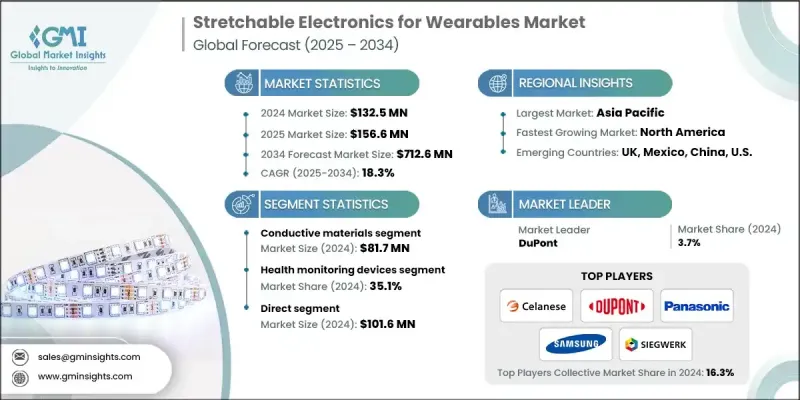
2024 年全球穿戴式裝置用可拉伸電子產品市場價值為 1.325 億美元,預計到 2034 年將以 18.3% 的複合年成長率成長至 7.126 億美元。
作為智慧紡織品和軟性電子產業中最具創新性的細分市場之一,穿戴式裝置市場正迅速發展。消費者和醫療保健專業人員對非侵入式即時健康追蹤的需求日益成長,是推動市場成長的主要因素。材料科學的進步提升了可拉伸電子產品的性能、柔韌性和使用壽命,使其能夠無縫整合到穿戴式裝置設計中。奈米材料、導電聚合物和軟性基材的最新進展提高了導電性和機械韌性,從而創造出更舒適、更有效率的穿戴式裝置。人工智慧在穿戴式科技領域日益重要的角色也正在改變使用者體驗,實現早期健康預警、個人化洞察和即時分析。同時,製造商正優先考慮永續發展,使用可回收和可生物分解的材料來減少對環境的影響。人工智慧、生物相容性和可拉伸材料的融合正在重新定義穿戴式裝置在各種應用領域中支援持續健康監測、運動表現和日常健康管理的方式。
| 市場範圍 | |
|---|---|
| 起始年份 | 2024 |
| 預測年份 | 2025-2034 |
| 起始值 | 1.325億美元 |
| 預測值 | 7.126億美元 |
| 複合年成長率 | 18.3% |
2024年,導電材料市場規模達8,170萬美元。這些材料是可拉伸電子系統的基礎,能夠實現訊號傳輸、能量轉移和資料感測等關鍵功能。碳奈米管、石墨烯、銀基化合物和導電聚合物等材料因其優異的柔韌性、導電性和親膚安全性而備受青睞。這使得它們特別適用於需要長時間佩戴在身上的穿戴式設備,例如智慧紡織品、健身監測器和醫療級設備。它們的生物相容性確保了即使在持續運動或環境壓力下也能保持穩定的性能和舒適度。
2024年,健康監測設備市佔率達35.1%。用於健康追蹤的穿戴式設備,例如智慧服裝、生物感測貼片和智慧布料,採用先進的可拉伸感測器,能夠緊密貼合人體自然輪廓。這些感測器可以精確測量水分含量、肌肉活動、心率和呼吸功能等參數。它們對運動的適應性使其成為臨床護理、健身和個人健康監測等場景下長時間監測的理想選擇,確保在使用過程中提供準確可靠的讀數。
2024年,美國可拉伸穿戴電子產品市場佔據81.6%的市場佔有率,市場規模達3,250萬美元。北美憑藉其強大的技術應用文化、較高的消費者意識以及對健康監測和健身應用的強勁需求,繼續保持領先地位。該地區先進的研發環境、新創企業創新生態系統以及可拉伸組件在消費級穿戴裝置的早期應用,進一步推動了市場擴張。醫療器材開發商和電子產品製造商之間日益密切的合作,也持續鞏固了北美在穿戴式科技領域的領先地位。
穿戴式可拉伸電子產品市場的主要參與者包括 NextFlex、塞拉尼斯、三星電子、StretchSense、Electroninks、Polyera Corporation、Pragmatic Semiconductor、Yamaichi Electronics、Dycotec、杜邦、Bone Health Technologies、Panasonic、Siegwerk、Xsensio 和 Medidata Solutions。為了鞏固自身地位,各公司正採取以創新、合作和永續發展為核心的策略。領先的製造商正大力投資研發,以提高材料的導電性、拉伸性和生物相容性,同時確保成本效益和可擴展性。與科技公司、醫療機構和研究中心的合作有助於加速產品開發並擴展應用領域。各公司也致力於整合人工智慧驅動的分析和物聯網連接,以提供更智慧、數據響應更迅速的穿戴式裝置。此外,許多公司正在向環保材料和節能製造流程轉型,以符合全球永續發展目標,建立品牌信任並增強長期市場競爭力。
目錄
第1章:方法論與範圍
第2章:執行概要
第3章:行業洞察
- 產業生態系分析
- 供應商格局
- 利潤率
- 每個階段的價值增加
- 影響價值鏈的因素
- 產業影響因素
- 成長促進因素
- 材料科學的進展
- 健康監測需求不斷成長
- 與物聯網生態系統整合
- 產業陷阱與挑戰
- 製造複雜性和成本
- 可靠性和長期穩定性
- 機會
- 拓展至醫療及復健領域
- 永續和可生物分解的電子產品
- 成長促進因素
- 成長潛力分析
- 未來市場趨勢
- 技術與創新格局
- 當前技術趨勢
- 新興技術
- 價格趨勢
- 按地區
- 按類型
- 監管環境
- 標準和合規要求
- 區域監理框架
- 認證標準
- 貿易統計
- 主要進口國
- 主要出口國
- 差距分析
- 風險評估與緩解
- 波特的分析
- PESTEL 分析
- 消費者行為分析
- 購買模式
- 偏好分析
- 消費者行為的區域差異
- 電子商務對購買決策的影響
第4章:競爭格局
- 介紹
- 公司市佔率分析
- 按地區
- 公司矩陣分析
- 主要市場參與者的競爭分析
- 競爭定位矩陣
- 關鍵進展
- 併購
- 合作夥伴關係與合作
- 新產品發布
- 擴張計劃
第5章:市場估算與預測:依類型分類,2021-2034年
- 主要趨勢
- 導電材料
- 導電聚合物
- 可拉伸導電油墨
- 液態金屬系統
- 奈米材料增強導體
- 基板技術
- 彈性體基材
- 紡織基材
- 混合基質
- 電子元件
第6章:市場估算與預測:依應用領域分類,2021-2034年
- 主要趨勢
- 智慧手錶
- 智慧戒指
- 智慧服裝
- 健康監測設備
- 其他(智慧耳機等)
第7章:市場估計與預測:依配銷通路分類,2021-2034年
- 主要趨勢
- 直接的
- 間接
第8章:市場估算與預測:依地區分類,2021-2034年
- 主要趨勢
- 北美洲
- 美國
- 加拿大
- 歐洲
- 德國
- 英國
- 法國
- 義大利
- 西班牙
- 亞太地區
- 中國
- 日本
- 印度
- 澳洲
- 韓國
- 拉丁美洲
- 巴西
- 墨西哥
- 阿根廷
- 中東和非洲
- 南非
- 沙烏地阿拉伯
- 阿拉伯聯合大公國
第9章:公司簡介
- Bone Health Technologies
- Celanese
- DuPont
- Dycotec
- Electroninks
- Medidata Solutions
- NextFlex
- Panasonic
- Polyera Corporation
- Pragmatic Semiconductor
- Samsung Electronics
- Siegwerk
- StretchSense
- Xsensio
- Yamaichi Electronics
The Global Stretchable Electronics for Wearables Market was valued at USD 132.5 million in 2024 and is estimated to grow at a CAGR of 18.3% to reach USD 712.6 million by 2034.
The market is rapidly evolving as one of the most innovative segments within the broader smart textiles and flexible electronics industries. The increasing demand for non-invasive, real-time health tracking from both consumers and healthcare professionals is a major factor fueling growth. Advancements in material science are enhancing the performance, flexibility, and longevity of stretchable electronics, allowing seamless integration into wearable designs. New developments in nanomaterials, conductive polymers, and flexible substrates are providing higher conductivity and mechanical resilience, enabling more comfortable and efficient wearable devices. The growing role of artificial intelligence in wearable technology is also transforming user experiences, enabling early health alerts, personalized insights, and real-time analysis. At the same time, manufacturers are prioritizing sustainability by using recyclable and biodegradable materials to reduce environmental impact. The convergence of AI, bio-compatibility, and stretchable materials is redefining how wearables support continuous health monitoring, athletic performance, and daily wellness management across a wide range of applications.
| Market Scope | |
|---|---|
| Start Year | 2024 |
| Forecast Year | 2025-2034 |
| Start Value | $132.5 Million |
| Forecast Value | $712.6 Million |
| CAGR | 18.3% |
In 2024, the conductive materials segment generated USD 81.7 million. These materials form the foundation of stretchable electronic systems by enabling vital functions such as signal transmission, energy transfer, and data sensing. Materials like carbon nanotubes, graphene, silver-based compounds, and conductive polymers are valued for their excellent flexibility, conductivity, and safety for skin contact. This makes them particularly suitable for wearables that remain attached to the body for prolonged periods, including smart textiles, fitness monitors, and medical-grade devices. Their biocompatible nature ensures consistent performance and comfort, even under continuous movement or environmental stress.
The health monitoring devices segment held a 35.1% share in 2024. Wearables designed for health tracking, such as smart garments, biosensing patches, and intelligent fabrics, use advanced stretchable sensors that can closely follow the body's natural contours. These sensors precisely measure parameters such as hydration, muscle activity, heart rate, and respiratory function. Their adaptability to motion makes them ideal for extended monitoring in clinical care, fitness, and personal wellness contexts, ensuring accurate and reliable readings throughout use.
United States Stretchable Electronics for Wearables Market held an 81.6% share and generated USD 32.5 million in 2024. North America continues to lead due to a strong culture of technology adoption, high consumer awareness, and robust demand for health monitoring and fitness applications. The region's advanced R&D environment, startup innovation ecosystem, and early integration of stretchable components into consumer wearables are further driving market expansion. The growing collaboration between medical device developers and electronics manufacturers continues to strengthen North America's leadership in wearable technologies.
Major players in the Stretchable Electronics for Wearables Market include NextFlex, Celanese, Samsung Electronics, StretchSense, Electroninks, Polyera Corporation, Pragmatic Semiconductor, Yamaichi Electronics, Dycotec, DuPont, Bone Health Technologies, Panasonic, Siegwerk, Xsensio, and Medidata Solutions. To strengthen their position, companies are adopting strategies centered on innovation, collaboration, and sustainability. Leading manufacturers are investing heavily in R&D to enhance the conductivity, stretchability, and biocompatibility of materials while ensuring cost efficiency and scalability. Partnerships with technology firms, healthcare institutions, and research centers are helping accelerate product development and expand application areas. Companies are also focusing on integrating AI-driven analytics and IoT connectivity to deliver smarter, data-responsive wearables. Furthermore, many are transitioning toward eco-friendly materials and energy-efficient manufacturing processes to align with global sustainability goals, build brand trust, and reinforce long-term market competitiveness.
Table of Contents
Chapter 1 Methodology and Scope
- 1.1 Market scope and definition
- 1.2 Research design
- 1.2.1 Research approach
- 1.2.2 Data collection methods
- 1.3 Data mining sources
- 1.3.1 Global
- 1.3.2 Regional/Country
- 1.4 Base estimates and calculations
- 1.4.1 Base year calculation
- 1.4.2 Key trends for market estimation
- 1.5 Primary research and validation
- 1.5.1 Primary sources
- 1.6 Forecast model
- 1.7 Research assumptions and limitations
Chapter 2 Executive Summary
- 2.1 Industry 360° synopsis
- 2.2 Key market trends
- 2.2.1 Regional
- 2.2.2 Type
- 2.2.3 Application
- 2.2.4 Distribution channel
- 2.3 CXO perspectives: strategic imperatives
- 2.3.1 Key decision points for industry executives
- 2.3.2 Critical success factors for market players
- 2.4 Future outlook and strategic recommendations
Chapter 3 Industry Insights
- 3.1 Industry ecosystem analysis
- 3.1.1 Supplier landscape
- 3.1.2 Profit margin
- 3.1.3 Value addition at each stage
- 3.1.4 Factor affecting the value chain
- 3.2 Industry impact forces
- 3.2.1 Growth drivers
- 3.2.1.1 Advancements in material science
- 3.2.1.2 Rising demand for health monitoring
- 3.2.1.3 Integration with IoT ecosystems
- 3.2.2 Industry pitfalls & challenges
- 3.2.2.1 Manufacturing complexity and cost
- 3.2.2.2 Reliability and long-term stability
- 3.2.3 Opportunities
- 3.2.3.1 Expansion into medical and rehabilitation sectors
- 3.2.3.2 Sustainable and biodegradable electronics
- 3.2.1 Growth drivers
- 3.3 Growth potential analysis
- 3.4 Future market trends
- 3.5 Technology and innovation landscape
- 3.5.1 Current technological trends
- 3.5.2 Emerging technologies
- 3.6 Price trends
- 3.6.1 By region
- 3.6.2 By type
- 3.7 Regulatory landscape
- 3.7.1 Standards and compliance requirements
- 3.7.2 Regional regulatory frameworks
- 3.7.3 Certification standards
- 3.8 Trade statistics
- 3.8.1 Major importing countries
- 3.8.2 Major exporting countries
- 3.9 Gap analysis
- 3.10 Risk assessment and mitigation
- 3.11 Porter's analysis
- 3.12 PESTEL analysis
- 3.13 Consumer behaviour analysis
- 3.13.1 Purchasing patterns
- 3.13.2 Preference analysis
- 3.13.3 Regional variations in consumer behaviour
- 3.13.4 Impact of e-commerce on buying decisions
Chapter 4 Competitive Landscape, 2024
- 4.1 Introduction
- 4.2 Company market share analysis
- 4.2.1 By region
- 4.2.1.1 North America
- 4.2.1.2 Europe
- 4.2.1.3 Asia Pacific
- 4.2.1.4 Latin America
- 4.2.1.5 Middle East and Africa
- 4.2.1 By region
- 4.3 Company matrix analysis
- 4.4 Competitive analysis of major market players
- 4.5 Competitive positioning matrix
- 4.6 Key developments
- 4.6.1 Mergers & acquisitions
- 4.6.2 Partnerships & collaborations
- 4.6.3 New product launches
- 4.6.4 Expansion plans
Chapter 5 Market Estimates and Forecast, By Type, 2021 - 2034 (USD Million) (Thousand Units)
- 5.1 Key trends
- 5.2 Conductive materials
- 5.2.1 Conductive polymers
- 5.2.2 Stretchable conductive inks
- 5.2.3 Liquid metal systems
- 5.2.4 Nanomaterial-enhanced conductors
- 5.3 Substrate technologies
- 5.3.1 Elastomeric substrates
- 5.3.2 Textile substrates
- 5.3.3 Hybrid substrates
- 5.3.4 Electronic components
Chapter 6 Market Estimates and Forecast, By Application, 2021 - 2034 (USD Million) (Thousand Units)
- 6.1 Key trends
- 6.2 Smartwatch
- 6.3 Smart ring
- 6.4 Smart apparel
- 6.5 Health monitoring devices
- 6.6 Others (smart hearables etc.)
Chapter 7 Market Estimates and Forecast, By Distribution Channel, 2021 - 2034 (USD Million) (Thousand Units)
- 7.1 Key trends
- 7.2 Direct
- 7.3 Indirect
Chapter 8 Market Estimates and Forecast, By Region, 2021 - 2034 (USD Million) (Thousand Units)
- 8.1 Key trends
- 8.2 North America
- 8.2.1 U.S.
- 8.2.2 Canada
- 8.3 Europe
- 8.3.1 Germany
- 8.3.2 UK
- 8.3.3 France
- 8.3.4 Italy
- 8.3.5 Spain
- 8.4 Asia Pacific
- 8.4.1 China
- 8.4.2 Japan
- 8.4.3 India
- 8.4.4 Australia
- 8.4.5 South Korea
- 8.5 Latin America
- 8.5.1 Brazil
- 8.5.2 Mexico
- 8.5.3 Argentina
- 8.6 Middle East and Africa
- 8.6.1 South Africa
- 8.6.2 Saudi Arabia
- 8.6.3 UAE
Chapter 9 Company Profiles
- 9.1 Bone Health Technologies
- 9.2 Celanese
- 9.3 DuPont
- 9.4 Dycotec
- 9.5 Electroninks
- 9.6 Medidata Solutions
- 9.7 NextFlex
- 9.8 Panasonic
- 9.9 Polyera Corporation
- 9.10 Pragmatic Semiconductor
- 9.11 Samsung Electronics
- 9.12 Siegwerk
- 9.13 StretchSense
- 9.14 Xsensio
- 9.15 Yamaichi Electronics
