


 |
市場調查報告書
商品編碼
1844370
左心耳封堵器市場機會、成長動力、產業趨勢分析及 2025 - 2034 年預測Left Atrial Appendage Closure Devices Market Opportunity, Growth Drivers, Industry Trend Analysis, and Forecast 2025 - 2034 |
||||||

2024 年全球左心耳封堵器市場價值為 18 億美元,預計到 2034 年將以 14.2% 的複合年成長率成長,達到 70 億美元。
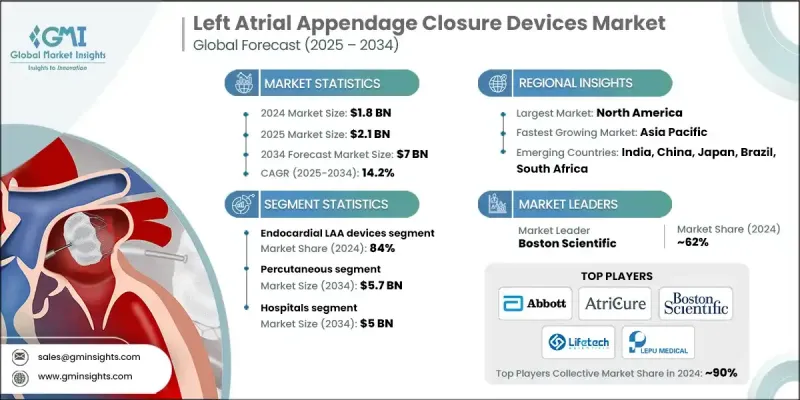
市場擴張的驅動力包括心房顫動發生率的上升、對微創心血管手術的日益青睞以及整個醫療保健系統報銷政策範圍的擴大。左心耳封堵器用於封閉左心耳(此類患者中血栓形成的常見部位),從而降低非瓣膜性心房顫動患者的中風風險。隨著心房顫動變得越來越普遍,尤其是在老年人口中,對這些中風預防解決方案的需求也不斷攀升。世界各國政府正在加大對心血管護理的投入,以減輕與心房顫動相關併發症相關的長期醫療保健成本。增加的資金也支持公眾意識宣傳活動和對更先進治療技術(包括下一代封堵器)的研究。對早期診斷和創新基於設備的治療方案的重視,正在為全球左心耳封堵器產業塑造一個光明的前景。
| 市場範圍 | |
|---|---|
| 起始年份 | 2024 |
| 預測年份 | 2025-2034 |
| 起始值 | 18億美元 |
| 預測值 | 70億美元 |
| 複合年成長率 | 14.2% |
2024年,心內膜左心耳封堵器市場佔有84%的佔有率。這類器材因其微創性、卓越的臨床試驗表現、廣泛的醫生信任度以及成功的實際應用而廣受青睞。其設計允許醫生透過導管操作封鎖左心耳,從而降低心房顫動患者的中風風險,而無需進行開胸心臟手術。隨著對恢復時間更短且長期療效可靠的手術的需求不斷成長,該領域將繼續受益。
預計到2034年,經皮介入性心臟病學市場規模將達到57億美元,這得益於其適應性強以及介入性心臟病學基礎設施日益普及。經皮介入性心臟病學可在多種場所進行,包括醫院和心臟護理中心,並由經驗豐富的臨床醫生和現代化的導管室技術提供支援。經皮介入性心臟病學的廣泛普及和操作安全性有助於鞏固其作為市場主導技術的地位。
2024年,北美左心耳封堵器市場佔有46.2%的市佔率。該地區在結構性心臟護理創新領域處於領先地位,這得益於先進的醫療基礎設施、強大的研發實力以及持續的臨床試驗活動。高度專業化的醫療中心以及廣泛的心臟手術培訓管道,為該領域的發展提供了支持。此外,人工智慧輔助術前規劃和數位監測工具等技術進步進一步鞏固了北美在左心耳封堵器領域的領先地位。
積極參與左心耳封堵器市場的知名公司包括微創醫療、美敦力、樂普醫療、雅培、AtriCure、波士頓科學和先健科技。左心耳封堵器市場的公司正在實施策略性舉措,以鞏固其市場地位。許多公司正在大力投資研發下一代設備,以提高植入的便利性、手術安全性和長期療效。各公司正在擴大臨床試驗管道,以加速獲得監管部門的批准並加強臨床驗證。他們正在與醫院和研究中心建立策略合作夥伴關係,透過實踐培訓和資料共享來擴大醫生的採用率。
目錄
第1章:方法論與範圍
第 2 章:執行摘要
第3章:行業洞察
- 產業生態系統分析
- 產業衝擊力
- 成長動力
- 心房顫動盛行率不斷上升
- 技術進步
- 微創手術的採用日益增多
- 擴大報銷範圍
- 產業陷阱與挑戰
- 手續費用高昂
- 併發症風險
- 市場機會
- 向新興市場擴張
- 成長動力
- 成長潛力分析
- 監管格局
- 技術格局
- 現有技術
- 新興技術
- 未來市場趨勢
- 報銷場景
- 管道分析
- 投資前景
- 2024年定價分析
- 波特的分析
- PESTEL分析
- 差距分析
第4章:競爭格局
- 介紹
- 公司矩陣分析
- 公司市佔率分析
- 北美洲
- 歐洲
- 亞太地區
- 拉丁美洲和中東
- 主要市場參與者的競爭分析
- 競爭定位矩陣
- 關鍵進展
- 併購
- 夥伴關係與合作
- 新產品發布
- 擴張計劃
第5章:市場估計與預測:按產品,2021 - 2034 年
- 主要趨勢
- 心內膜左心耳裝置
- 心外膜左心耳裝置
第6章:市場估計與預測:按程序,2021 - 2034 年
- 主要趨勢
- 經皮
- 外科
第7章:市場估計與預測:依最終用途,2021 - 2034
- 主要趨勢
- 醫院
- 門診手術中心
- 其他最終用途
第8章:市場估計與預測:按地區,2021 - 2034 年
- 主要趨勢
- 北美洲
- 美國
- 加拿大
- 歐洲
- 德國
- 英國
- 法國
- 西班牙
- 義大利
- 荷蘭
- 亞太地區
- 中國
- 日本
- 印度
- 澳洲
- 韓國
- 拉丁美洲
- 巴西
- 墨西哥
- 阿根廷
- 中東和非洲
- 南非
- 沙烏地阿拉伯
- 阿拉伯聯合大公國
第9章:公司簡介
- Abbott
- AtriCure
- Boston Scientific
- LEPU MEDICAL
- Lifetech
- Medtronic
- MicroPort
The Global Left Atrial Appendage Closure Devices Market was valued at USD 1.8 billion in 2024 and is estimated to grow at a CAGR of 14.2% to reach USD 7 billion by 2034.
Market expansion is driven by the rising incidence of atrial fibrillation, the growing preference for minimally invasive cardiovascular procedures, and the increasing scope of reimbursement policies across healthcare systems. LAA closure devices are used to reduce stroke risk in individuals diagnosed with non-valvular atrial fibrillation by sealing off the left atrial appendage, a common site for clot formation in such patients. As atrial fibrillation becomes more common, especially in aging populations, demand for these stroke prevention solutions is climbing. Governments around the world are investing more in cardiovascular care to mitigate long-term healthcare costs tied to AF-related complications. Increased funding also supports public awareness campaigns and research into more advanced treatment technologies, including next-generation closure devices. The emphasis on early diagnosis and innovative device-based therapy options is shaping a promising outlook for the LAA closure devices industry on a global scale.
| Market Scope | |
|---|---|
| Start Year | 2024 |
| Forecast Year | 2025-2034 |
| Start Value | $1.8 Billion |
| Forecast Value | $7 Billion |
| CAGR | 14.2% |
In 2024, the endocardial LAA closure device segment held an 84% share. These devices are widely chosen for their minimally invasive approach, backed by strong clinical trial performance, broad physician confidence, and successful real-world applications. Their design allows physicians to seal off the LAA through catheter-based procedures, lowering stroke risk in atrial fibrillation patients without the need for open-heart surgery. The segment continues to benefit from rising demand for procedures that offer shorter recovery times and proven long-term outcomes.
The percutaneous segment is projected to reach USD 5.7 billion by 2034, driven by its adaptability and the growing availability of interventional cardiology infrastructure. This method allows the procedure to be performed in a range of settings, including hospitals and cardiac care centers, supported by experienced clinicians and modern cath lab technology. Its widespread accessibility and procedural safety are helping to cement its position as the dominant technique in the market.
North America Left Atrial Appendage Closure Devices Market held 46.2% share in 2024. The region is a leader in structural heart care innovation, supported by advanced healthcare infrastructure, robust R&D, and consistent clinical trial activity. The presence of highly specialized medical centers and widespread access to training in cardiac procedures supports procedural growth. In addition, technological advancements such as AI-assisted preoperative planning and digital monitoring tools further reinforce North America's leadership in the LAA closure space.
Prominent companies actively competing in the Left Atrial Appendage Closure Devices Market include MicroPort, Medtronic, LEPU MEDICAL, Abbott, AtriCure, Boston Scientific, and Lifetech. Companies in the left atrial appendage closure devices market are implementing strategic initiatives to strengthen their foothold. Many are heavily investing in R&D to develop next-generation devices that improve ease of implantation, procedural safety, and long-term efficacy. Firms are expanding clinical trial pipelines to gain faster regulatory approvals and enhance clinical validation. Strategic partnerships with hospitals and research centers are being pursued to broaden physician adoption through hands-on training and data sharing.
Table of Contents
Chapter 1 Methodology and Scope
- 1.1 Market scope and definition
- 1.2 Research design
- 1.2.1 Research approach
- 1.2.2 Data collection methods
- 1.3 Data mining sources
- 1.3.1 Global
- 1.3.2 Regional/Country
- 1.4 Base estimates and calculations
- 1.4.1 Base year calculation
- 1.4.2 Key trends for market estimation
- 1.5 Primary research and validation
- 1.5.1 Primary sources
- 1.6 Forecast model
- 1.7 Research assumptions and limitations
Chapter 2 Executive Summary
- 2.1 Industry 360° synopsis
- 2.2 Key market trends
- 2.2.1 Regional trends
- 2.2.2 Product trends
- 2.2.3 Procedure trends
- 2.2.4 End use trends
- 2.3 CXO perspectives: Strategic imperatives
- 2.3.1 Key decision points for industry executives
- 2.3.2 Critical success factors for market players
- 2.4 Future outlook and strategic recommendations
Chapter 3 Industry Insights
- 3.1 Industry ecosystem analysis
- 3.2 Industry impact forces
- 3.2.1 Growth drivers
- 3.2.1.1 Increasing prevalence of atrial fibrillation
- 3.2.1.2 Technological advancements
- 3.2.1.3 Growing adoption of minimally invasive procedures
- 3.2.1.4 Expanding reimbursement coverage
- 3.2.2 Industry pitfalls and challenges
- 3.2.2.1 High procedural costs
- 3.2.2.2 Risk of complications
- 3.2.3 Market opportunities
- 3.2.3.1 Expansion into emerging markets
- 3.2.1 Growth drivers
- 3.3 Growth potential analysis
- 3.4 Regulatory landscape
- 3.5 Technological landscape
- 3.5.1 Current technologies
- 3.5.2 Emerging technologies
- 3.6 Future market trends
- 3.7 Reimbursement scenario
- 3.8 Pipeline analysis
- 3.9 Investment landscape
- 3.10 Pricing analysis, 2024
- 3.11 Porter's analysis
- 3.12 PESTEL analysis
- 3.13 Gap analysis
Chapter 4 Competitive Landscape, 2024
- 4.1 Introduction
- 4.2 Company matrix analysis
- 4.3 Company market share analysis
- 4.3.1 North America
- 4.3.2 Europe
- 4.3.3 Asia Pacific
- 4.3.4 LAMEA
- 4.4 Competitive analysis of major market players
- 4.5 Competitive positioning matrix
- 4.6 Key developments
- 4.6.1 Mergers and acquisitions
- 4.6.2 Partnerships and collaborations
- 4.6.3 New product launches
- 4.6.4 Expansion plans
Chapter 5 Market Estimates and Forecast, By Product, 2021 - 2034 ($ Mn, Units)
- 5.1 Key trends
- 5.2 Endocardial LAA devices
- 5.3 Epicardial LAA devices
Chapter 6 Market Estimates and Forecast, By Procedure, 2021 - 2034 ($ Mn, Units)
- 6.1 Key trends
- 6.2 Percutaneous
- 6.3 Surgical
Chapter 7 Market Estimates and Forecast, By End Use, 2021 - 2034 ($ Mn, Units)
- 7.1 Key trends
- 7.2 Hospitals
- 7.3 Ambulatory surgical centers
- 7.4 Other end use
Chapter 8 Market Estimates and Forecast, By Region, 2021 - 2034 ($ Mn, Units)
- 8.1 Key trends
- 8.2 North America
- 8.2.1 U.S.
- 8.2.2 Canada
- 8.3 Europe
- 8.3.1 Germany
- 8.3.2 UK
- 8.3.3 France
- 8.3.4 Spain
- 8.3.5 Italy
- 8.3.6 Netherlands
- 8.4 Asia Pacific
- 8.4.1 China
- 8.4.2 Japan
- 8.4.3 India
- 8.4.4 Australia
- 8.4.5 South Korea
- 8.5 Latin America
- 8.5.1 Brazil
- 8.5.2 Mexico
- 8.5.3 Argentina
- 8.6 Middle East and Africa
- 8.6.1 South Africa
- 8.6.2 Saudi Arabia
- 8.6.3 UAE
Chapter 9 Company Profiles
- 9.1 Abbott
- 9.2 AtriCure
- 9.3 Boston Scientific
- 9.4 LEPU MEDICAL
- 9.5 Lifetech
- 9.6 Medtronic
- 9.7 MicroPort

 左心耳封堵器市場:依器械類型、手術類型、支付方式、材料類型、最終用戶和分銷管道分類-2026-2032年全球預測
 左心耳封堵器市場報告:按產品、最終用戶和地區分類(2026-2034 年)
 2026年全球左心耳封堵器市場報告
 全球左心耳封堵器市場規模、佔有率、趨勢和成長分析報告(2026-2034年)
 全球左心耳封堵器市場:市場規模、佔有率和趨勢分析(2026-2032 年)
 左心耳封堵器市場規模、佔有率及成長分析(依產品、手術、最終用戶及地區分類)-2026-2033年產業預測
 2032 年左心耳封堵器市場預測:按產品類型、程序、材料成分、銷售管道、最終用戶和地區進行的全球分析
 左心耳 (LAA) 封堵器的全球市場