


 |
市場調查報告書
商品編碼
1833426
春季角結膜炎市場機會、成長動力、產業趨勢分析及 2025 - 2034 年預測Vernal Keratoconjunctivitis Market Opportunity, Growth Drivers, Industry Trend Analysis, and Forecast 2025 - 2034 |
||||||

2024 年全球春季角結膜炎市值為 4.262 億美元,預計到 2034 年將以 5.5% 的複合年成長率成長至 7.201 億美元。
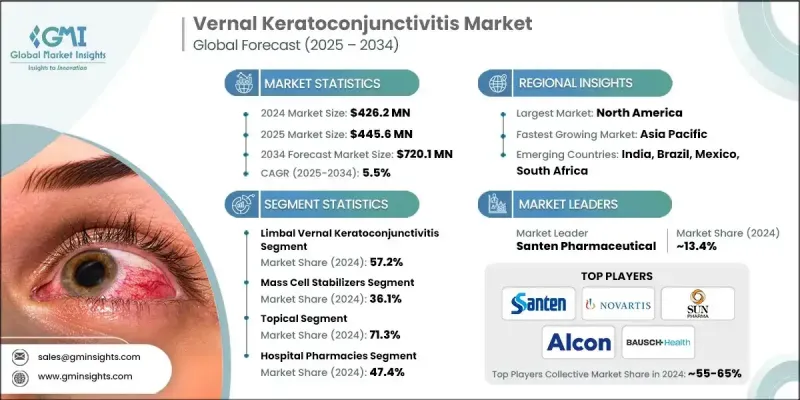
VKC 主要影響兒童和青少年,尤其是在溫暖氣候地區。隨著該族群對過敏性眼部疾病的認知和診斷不斷提高,全球對有效的 VKC 治療的需求不斷成長。
| 市場範圍 | |
|---|---|
| 起始年份 | 2024 |
| 預測年份 | 2025-2034 |
| 起始值 | 4.262億美元 |
| 預測值 | 7.201億美元 |
| 複合年成長率 | 5.5% |
角膜緣春季角結膜炎盛行率不斷上升
2024年,角膜緣春季角膜結膜炎佔了相當大的佔有率,其特徵是膠狀角膜緣浸潤和潛在的角膜上皮損傷。由於此病若不及時治療,容易引發長期併發症,因此正受到臨床關注。該病在溫暖乾燥氣候條件下的兒童中尤其常見,這增加了流行地區對標靶治療的需求。
肥大細胞穩定器獲得牽引力
2024年,肥大細胞穩定劑領域為輕度至中度症狀患者帶來了強勁的收入。這些藥物透過抑制組織胺和其他發炎介質的釋放來發揮作用,有助於減輕搔癢、發紅和腫脹。雖然它們通常需要數週時間才能完全起效,但其良好的安全性使其成為首選的第一線治療方案。為了保持競爭力,製藥公司正在改進配方以加快起效速度,將肥大細胞穩定劑與抗組織胺結合使用,並提高給藥便利性,以支持患者依從性。
局部治療的採用率不斷上升
局部治療領域在2024年佔據了相當大的佔有率,這得益於其直接的作用方式和極低的全身暴露。含有皮質類固醇、環孢素、他克莫司和抗組織胺的眼藥水被廣泛用於治療急性發作和慢性發炎。該領域受益於藥物傳輸技術的持續創新,例如緩釋製劑和無防腐劑製劑。
北美將成為推動力地區
2024年,北美春季角結膜炎市場佔據了強勁的佔有率,這得益於診斷率的提高、眼科護理專業人員意識的增強以及與氣候變遷和過敏原相關的病例的增加。該地區還受益於成熟的眼科藥物行業和支持兒科護理創新的監管途徑。
春季角結膜炎市場的主要參與者有參天製藥、梯瓦製藥、Meda Pharmaceuticals、諾華、博士倫、千壽藥、艾爾建、太陽製藥、羅氏製藥、Thea實驗室、艾伯維、愛爾康和雅培實驗室。
為了在春季角結膜炎市場佔據強勢地位,各公司正在部署以產品差異化、臨床驗證和精準推廣為中心的多層次策略。關鍵措施包括投資兒科臨床試驗、確保罕見疾病適應症的監管專營權以及進行早期診斷的教育活動。
目錄
第1章:方法論與範圍
第2章:執行摘要
第3章:行業洞察
- 產業生態系統分析
- 供應商格局
- 每個階段的增值
- 影響價值鏈的因素
- 產業衝擊力
- 成長動力
- 全球春季角結膜炎盛行率上升
- 人口老化加劇,過敏敏感性上升
- 遠距眼科和電子藥局的擴展
- 政府和機構意識計劃
- 產業陷阱與挑戰
- 品牌免疫調節劑和生物製劑成本高
- 農村地區認知與診斷能力有限
- 市場機會
- 聯合療法和類固醇減量療法的開發
- 醫療保健投資不斷增加的新興市場
- 成長動力
- 成長潛力分析
- 監管格局
- 北美洲
- 美國
- 加拿大
- 歐洲
- 亞太地區
- 北美洲
- 未來市場趨勢
- 技術格局
- 定價分析
- 管道分析
- 波特的分析
- PESTEL分析
第4章:競爭格局
- 介紹
- 公司市佔率分析
- 全球的
- 北美洲
- 歐洲
- 公司矩陣分析
- 主要市場參與者的競爭分析
- 競爭定位矩陣
- 關鍵進展
- 併購
- 夥伴關係與協作
- 新產品發布
- 擴張計劃
第5章:市場估計與預測:按疾病類型,2021 - 2034 年
- 主要趨勢
- 角膜緣春季角結膜炎
- 瞼板春季角結膜炎
- 混合性春季角結膜炎
第6章:市場估計與預測:依治療方式,2021 - 2034
- 主要趨勢
- 肥大細胞穩定劑
- 抗組織胺藥
- 皮質類固醇
- 非類固醇類抗發炎藥
- 其他治療
第7章:市場估計與預測:按管理路線,2021 - 2034 年
- 主要趨勢
- 口服
- 外用
- 腸外
第8章:市場估計與預測:按性別,2021 - 2034 年
- 主要趨勢
- 男性
- 女性
第9章:市場估計與預測:按配銷通路,2021 - 2034 年
- 主要趨勢
- 醫院藥房
- 零售藥局
- 網路藥局
第 10 章:市場估計與預測:按地區,2021 年至 2034 年
- 主要趨勢
- 北美洲
- 美國
- 加拿大
- 歐洲
- 德國
- 英國
- 法國
- 西班牙
- 義大利
- 荷蘭
- 亞太地區
- 中國
- 日本
- 印度
- 澳洲
- 韓國
- 拉丁美洲
- 巴西
- 墨西哥
- 阿根廷
- 中東和非洲
- 南非
- 沙烏地阿拉伯
- 阿拉伯聯合大公國
第 11 章:公司簡介
- Abbott Laboratories
- AbbVie
- Alcon
- Allergan
- Bausch Health
- F Hoffmann La Roche
- Laboratoires Thea
- Meda Pharmaceuticals
- Novartis
- Santen Pharmaceutical
- Senju Pharmaceutical
- Sun Pharmaceutical
The Global Vernal Keratoconjunctivitis Market was valued at USD 426.2 million in 2024 and is estimated to grow at a CAGR of 5.5% to reach USD 720.1 million by 2034.
VKC primarily affects children and adolescents, particularly in warm climates. The growing awareness and diagnosis of allergic ocular conditions in this demographic are driving demand for effective VKC treatments globally.
| Market Scope | |
|---|---|
| Start Year | 2024 |
| Forecast Year | 2025-2034 |
| Start Value | $426.2 Million |
| Forecast Value | $720.1 Million |
| CAGR | 5.5% |
Increasing Prevalence of Limbal Vernal Keratoconjunctivitis
The limbal vernal keratoconjunctivitis segment held a sizeable share in2024, backed by gelatinous limbal infiltrates and potential damage to the corneal epithelium. This segment is gaining clinical attention due to its tendency to cause long-term complications if left untreated. It is particularly common in children living in warm, dry climates, which heightens the demand for targeted therapies in endemic regions.
Mast Cell Stabilizers to Gain Traction
The mast cell stabilizers segment generated robust revenues in 2024 for patients with mild to moderate symptoms. These agents work by preventing the release of histamines and other inflammatory mediators, helping to reduce itching, redness, and swelling. Though they often require several weeks to reach full efficacy, their favorable safety profile makes them a preferred first-line option. To stay competitive, pharmaceutical companies are enhancing formulations for faster onset of action, combining mast cell stabilizers with antihistamines, and improving dosing convenience to support patient adherence.
Rising Adoption of Topical Treatments
The topical treatments segment held a significant share in 2024, owing to their direct mode of action and minimal systemic exposure. Eye drops containing corticosteroids, cyclosporine, tacrolimus, and antihistamines are widely prescribed to manage acute flare-ups and chronic inflammation. This segment benefits from continuous innovation in drug delivery technologies, such as sustained-release formulations and preservative-free options.
North America to Emerge as a Propelling Region
North America vernal keratoconjunctivitis market held a robust share in 2024 owing to improved diagnostic rates, heightened awareness among eye care professionals, and increasing cases linked to climate shifts and allergens. The region also benefits from a well-established ophthalmic drug industry and regulatory pathways that support innovation in pediatric care.
Major players in the vernal keratoconjunctivitis market are Santen Pharmaceutical, Teva Pharmaceuticals, Meda Pharmaceuticals, Novartis, Bausch Health, Senju Pharmaceutical, Allergan, Sun Pharma, F Hoffmann La Roche, Laboratoires Thea, AbbVie, Alcon, and Abbott Laboratories.
To build a strong presence in the vernal keratoconjunctivitis market, companies are deploying multi-layered strategies centered around product differentiation, clinical validation, and targeted outreach. Key initiatives include investing in pediatric clinical trials, securing regulatory exclusivity for rare disease indications, and launching educational campaigns for early diagnosis.
Table of Contents
Chapter 1 Methodology and Scope
- 1.1 Market scope and definitions
- 1.2 Research design
- 1.2.1 Research approach
- 1.2.2 Data collection methods
- 1.3 Data mining sources
- 1.3.1 Global
- 1.3.2 Regional/country
- 1.4 Base estimates and calculations
- 1.4.1 Base year calculation
- 1.4.2 Key trends for market estimation
- 1.5 Primary research and validation
- 1.5.1 Primary sources
- 1.6 Forecast model
- 1.7 Research assumption and limitations
Chapter 2 Executive Summary
- 2.1 Industry 3600 synopsis
- 2.2 Key market trends
- 2.2.1 Regional trends
- 2.2.2 Disease type trends
- 2.2.3 Treatment trends
- 2.2.4 Route of administration trends
- 2.2.5 Gender trends
- 2.2.6 Distribution channel trends
- 2.3 CXO perspectives: Strategic imperatives
- 2.3.1 Key decision points for industry executives
- 2.3.2 Critical success factors for market players
- 2.4 Future outlook and strategic recommendations
Chapter 3 Industry Insights
- 3.1 Industry ecosystem analysis
- 3.1.1 Supplier landscape
- 3.1.2 Value addition at each stage
- 3.1.3 Factor affecting the value chain
- 3.2 Industry impact forces
- 3.2.1 Growth drivers
- 3.2.1.1 Rising global prevalence of vernal keratoconjunctivitis
- 3.2.1.2 Growing aging population and rising allergy sensitivity
- 3.2.1.3 Expansion of tele-ophthalmology and e-pharmacy
- 3.2.1.4 Government and institutional awareness programs
- 3.2.2 Industry pitfalls and challenges
- 3.2.2.1 High cost of branded immunomodulators and biologics
- 3.2.2.2 Limited awareness and diagnostic capabilities in rural areas
- 3.2.3 Market opportunities
- 3.2.3.1 Development of combination and steroid-sparing therapies
- 3.2.3.2 Emerging markets with rising healthcare investment
- 3.2.1 Growth drivers
- 3.3 Growth potential analysis
- 3.4 Regulatory landscape
- 3.4.1 North America
- 3.4.1.1 U.S.
- 3.4.1.2 Canada
- 3.4.2 Europe
- 3.4.3 Asia Pacific
- 3.4.1 North America
- 3.5 Future market trends
- 3.6 Technology landscape
- 3.7 Pricing analysis
- 3.8 Pipeline analysis
- 3.9 Porter's analysis
- 3.10 PESTEL analysis
Chapter 4 Competitive Landscape, 2024
- 4.1 Introduction
- 4.2 Company market share analysis
- 4.2.1 Global
- 4.2.2 North America
- 4.2.3 Europe
- 4.3 Company matrix analysis
- 4.4 Competitive analysis of major market players
- 4.5 Competitive positioning matrix
- 4.6 Key developments
- 4.6.1 Merger and acquisition
- 4.6.2 Partnership and collaboration
- 4.6.3 New product launches
- 4.6.4 Expansion plans
Chapter 5 Market Estimates and Forecast, By Disease Type, 2021 - 2034 ($ Mn)
- 5.1 Key trends
- 5.2 Limbal vernal keratoconjunctivitis
- 5.3 Tarsal vernal keratoconjunctivitis
- 5.4 Mixed vernal keratoconjunctivitis
Chapter 6 Market Estimates and Forecast, By Treatment, 2021 - 2034 ($ Mn)
- 6.1 Key trends
- 6.2 Mast cell stabilizers
- 6.3 Antihistamines
- 6.4 Corticosteroids
- 6.5 Nonsteroidal anti-inflammatory drugs
- 6.6 Other treatments
Chapter 7 Market Estimates and Forecast, By Route of Administration, 2021 - 2034 ($ Mn)
- 7.1 Key trends
- 7.2 Oral
- 7.3 Topical
- 7.4 Parenteral
Chapter 8 Market Estimates and Forecast, By Gender, 2021 - 2034 ($ Mn)
- 8.1 Key trends
- 8.2 Male
- 8.3 Female
Chapter 9 Market Estimates and Forecast, By Distribution Channel, 2021 - 2034 ($ Mn)
- 9.1 Key trends
- 9.2 Hospital pharmacies
- 9.3 Retail pharmacies
- 9.4 Online pharmacies
Chapter 10 Market Estimates and Forecast, By Region, 2021 - 2034 ($ Mn)
- 10.1 Key trends
- 10.2 North America
- 10.2.1 U.S.
- 10.2.2 Canada
- 10.3 Europe
- 10.3.1 Germany
- 10.3.2 UK
- 10.3.3 France
- 10.3.4 Spain
- 10.3.5 Italy
- 10.3.6 Netherlands
- 10.4 Asia Pacific
- 10.4.1 China
- 10.4.2 Japan
- 10.4.3 India
- 10.4.4 Australia
- 10.4.5 South Korea
- 10.5 Latin America
- 10.5.1 Brazil
- 10.5.2 Mexico
- 10.5.3 Argentina
- 10.6 Middle East and Africa
- 10.6.1 South Africa
- 10.6.2 Saudi Arabia
- 10.6.3 UAE
Chapter 11 Company Profiles
- 11.1 Abbott Laboratories
- 11.2 AbbVie
- 11.3 Alcon
- 11.4 Allergan
- 11.5 Bausch Health
- 11.6 F Hoffmann La Roche
- 11.7 Laboratoires Thea
- 11.8 Meda Pharmaceuticals
- 11.9 Novartis
- 11.10 Santen Pharmaceutical
- 11.11 Senju Pharmaceutical
- 11.12 Sun Pharmaceutical


