


 |
市場調查報告書
商品編碼
1801829
專用及客製化機械市場機會、成長動力、產業趨勢分析及 2025 - 2034 年預測Special and Custom Machinery Market Opportunity, Growth Drivers, Industry Trend Analysis, and Forecast 2025 - 2034 |
||||||

2024年,全球專用及客製化機械市場規模達211億美元,預計到2034年將以4.7%的複合年成長率成長,達到334億美元。受工業4.0技術的快速整合、數位化程度的提高以及各行業對自動化日益成長的需求的推動,該市場正穩步成長。專用及客製化機械是指專為執行標準機械無法高效執行的高度專業化任務而設計的設備。隨著汽車、航太、製藥、食品加工和電子等行業的製造商致力於提高生產力並降低誤差幅度,他們擴大轉向針對特定營運挑戰而量身定做的系統。
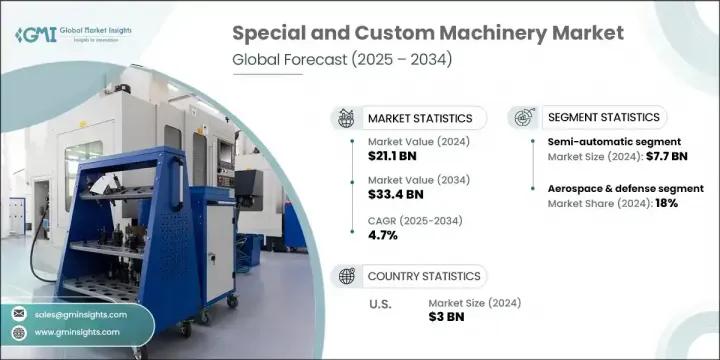
這些客製化機器是透過機械供應商和最終用戶之間的密切合作開發的,通常涉及針對單一應用的專門研究和工程設計。向更智慧、更有效率的生產流程轉變,正在提升物聯網、預測分析和機器人技術在客製化機械配置的應用。這種轉變不僅提高了產量和安全性,還實現了早期缺陷檢測和遠端維護。隨著製造業變得越來越複雜和專業化,客製化解決方案不再是小眾產品——它們正成為注重創新、品質控制和靈活性的工業環境中營運成功不可或缺的一部分。
| 市場範圍 | |
|---|---|
| 起始年份 | 2024 |
| 預測年份 | 2025-2034 |
| 起始值 | 211億美元 |
| 預測值 | 334億美元 |
| 複合年成長率 | 4.7% |
2024年,半自動機器市場規模達77億美元。這些機器在手動操作和自動化之間取得平衡,能夠高度適應不斷變化的生產需求。其多功能性,加上較低的資本投資和維護成本,使其成為尋求客製化功能且無需承擔全自動化成本的中小型企業的理想選擇。其可重構特性在規格頻繁變化的專業化生產中尤其重要。
2024年,航太和國防領域佔18%,總額達39億美元。這些行業對高精度和安全的要求使得客製化機械對於製造導航系統、引擎部件和輕型國防級組件等複雜部件至關重要。這些機器通常採用數控系統、雷射切割工具和積層製造單元等技術,並根據嚴格的標準進行客製化,能夠處理先進材料和複雜的幾何形狀。
2024年,美國專用及客製化機械市場產值達30億美元,鞏固了其在全球專用及客製化機械領域的領導地位。憑藉著高度發展的工業基礎設施、對研發的高度重視以及完善的航空航太和國防航太系統,美國持續推動該領域的創新。電子、汽車和醫療設備等行業日益成長的需求,正推動對滿足特定生產需求的高精度、靈活且數位化的機械解決方案的投資。
推動成長和創新的知名市場參與者包括 Marel hf.、三菱電機株式會社、博世力士樂股份公司、德昌電機控股有限公司、ABB 有限公司、庫卡股份公司、SPXFLOW 公司、霍夫曼工程公司、發那科公司、施耐德電氣、西門子股份公司、丹佛斯集團、伊頓公司、Harms Equipment 和安川電機公司。為了在專用和客製化機械領域獲得競爭優勢,各公司正透過大量研發投資來優先進行創新,旨在開發高度專業化的智慧設備。許多公司正在採用數位孿生技術、物聯網整合和自動化,以滿足客戶對效能、靈活性和遠端診斷不斷變化的需求。與最終用戶的策略合作夥伴關係使公司能夠共同創造與獨特生產目標完美契合的機械。全球參與者正在向新興市場擴張,建立本地製造或服務中心,以便更好地支援區域客戶。客製化和服務差異化仍然是核心,各公司提供量身定做的安裝後支援、預測性維護和模組化機械升級。
目錄
第1章:方法論與範圍
第2章:執行摘要
第3章:行業洞察
- 產業生態系統分析
- 供應商格局
- 利潤率
- 每個階段的增值
- 影響價值鏈的因素
- 產業衝擊力
- 成長動力
- 提高工業自動化程度
- 利基應用的客製化需求不斷成長
- 技術進步
- 產業陷阱與挑戰
- 製造成本高
- 技術複雜性
- 機會
- 先進技術的融合
- 新興產業的採用
- 成長動力
- 成長潛力分析
- 未來市場趨勢
- 技術和創新格局
- 當前的技術趨勢
- 新興技術
- 價格趨勢
- 按地區
- 按機器類型
- 監管格局
- 標準和合規性要求
- 區域監理框架
- 認證標準
- 波特的分析
- PESTEL分析
第4章:競爭格局
- 介紹
- 公司市佔率分析
- 按地區
- 公司矩陣分析
- 主要市場參與者的競爭分析
- 競爭定位矩陣
- 關鍵進展
- 併購
- 夥伴關係與合作
- 新產品發布
- 擴張計劃
第5章:市場估計與預測:按機器類型,2021 - 2034 年
- 主要趨勢
- 自動的
- 半自動
- 手動的
第6章:市場估計與預測:按技術,2021 - 2034 年
- 主要趨勢
- 氣動
- 油壓
- 電的
- 機器人
第7章:市場估計與預測:按應用,2021 - 2034 年
- 主要趨勢
- 物料處理和輸送系統
- 包裝機械
- 製造機械
- 切割和鑽孔機械
- 焊接和連接機械
- 檢驗檢測設備
- 標記和貼標機
- 其他
第8章:市場估計與預測:按最終用途產業,2021 - 2034 年
- 主要趨勢
- 汽車與運輸
- 航太與國防
- 電子和半導體
- 食品和飲料
- 建造
- 電力與能源
- 紡織品
- 礦業
- 其他
第9章:市場估計與預測:按配銷通路,2021 - 2034 年
- 主要趨勢
- 直接的
- 間接
第10章:市場估計與預測:按地區,2021 - 2034 年
- 主要趨勢
- 北美洲
- 美國
- 加拿大
- 歐洲
- 德國
- 英國
- 法國
- 西班牙
- 義大利
- 亞太地區
- 中國
- 日本
- 印度
- 澳洲
- 韓國
- 拉丁美洲
- 巴西
- 墨西哥
- 阿根廷
- 中東和非洲
- 南非
- 沙烏地阿拉伯
- 阿拉伯聯合大公國
第 11 章:公司簡介
- ABB Ltd.
- Bosch Rexroth AG
- Danfoss Group
- Eaton Corporation
- FANUC Corporation
- Harms Equipment
- Hofmann Engineering
- Johnson Electric Holdings Limited
- KUKA AG
- Marel hf.
- Mitsubishi Electric Corporation
- Schneider Electric
- Siemens AG
- SPXFLOW, Inc.
- Yaskawa Electric Corporation
The Global Special and Custom Machinery Market was valued at USD 21.1 billion in 2024 and is estimated to grow at a CAGR of 4.7% to reach USD 33.4 billion by 2034. This market is witnessing steady growth fueled by the rapid integration of Industry 4.0 technologies, increased digitalization, and the rising demand for automation across multiple sectors. Special and custom machinery refers to equipment engineered to perform highly specific tasks that standard machinery cannot execute efficiently. As manufacturers across sectors such as automotive, aerospace, pharmaceuticals, food processing, and electronics aim to boost productivity and reduce error margins, they are increasingly turning to customized systems tailored to unique operational challenges.
These custom machines are developed through close collaboration between machinery providers and end users, often involving dedicated research and engineering for a single application. The shift toward smarter, more efficient production processes is elevating the use of IoT, predictive analytics, and robotics within tailored machinery setups. This transition is not only enhancing output and safety but also enabling early defect detection and remote maintenance. With manufacturing becoming more complex and specialized, custom solutions are no longer niche-they are becoming an integral part of operational success in industrial environments focused on innovation, quality control, and flexibility.
| Market Scope | |
|---|---|
| Start Year | 2024 |
| Forecast Year | 2025-2034 |
| Start Value | $21.1 Billion |
| Forecast Value | $33.4 Billion |
| CAGR | 4.7% |
The semi-automatic machines segment generated USD 7.7 billion in 2024. These machines strike a balance between manual operation and automation, making them highly adaptable for changing production requirements. Their versatility, combined with lower capital investment and maintenance expenses, positions them as an ideal choice for small to mid-sized businesses seeking custom functionality without the cost of full automation. Their reconfigurable nature is especially valuable in specialized production where specifications frequently evolve.
In 2024, the aerospace and defense segment accounted for an 18% share, totaling USD 3.9 billion. High-precision and safety-critical requirements in these industries make custom-built machinery essential for fabricating complex parts such as navigation systems, engine components, and lightweight defense-grade assemblies. These machines are typically designed to work with advanced materials and intricate geometries using technologies like CNC systems, laser cutting tools, and additive manufacturing units customized to meet rigorous standards.
United States Special and Custom Machinery Market generated USD 3 billion in 2024, solidifying its leadership role in the global special and custom machinery sector. With its highly developed industrial infrastructure, strong focus on R&D, and established aerospace and defense ecosystems, the U.S. continues to push innovation in this space. Rising demand from industries such as electronics, automotive, and medical devices is fueling investment in high-precision, flexible, and digitally enabled machinery solutions tailored to niche production needs.
Prominent market players driving growth and innovation include Marel hf., Mitsubishi Electric Corporation, Bosch Rexroth AG, Johnson Electric Holdings Limited, ABB Ltd., KUKA AG, SPXFLOW, Inc., Hofmann Engineering, FANUC Corporation, Schneider Electric, Siemens AG, Danfoss Group, Eaton Corporation, Harms Equipment, and Yaskawa Electric Corporation. To gain a competitive advantage in the special and custom machinery space, companies are prioritizing innovation through heavy R&D investments aimed at developing highly specialized, smart equipment. Many are embracing digital twin technology, IoT integration, and automation to meet evolving customer needs for performance, flexibility, and remote diagnostics. Strategic partnerships with end users enable firms to co-create machinery that aligns perfectly with unique production goals. Global players are expanding into emerging markets, setting up local manufacturing or service hubs to better support regional clients. Customization and service differentiation remain central, with companies offering tailored post-installation support, predictive maintenance, and modular machinery upgrades.
Table of Contents
Chapter 1 Methodology and Scope
- 1.1 Market scope and definition
- 1.2 Research design
- 1.2.1 Research approach
- 1.2.2 Data collection methods
- 1.3 Data mining sources
- 1.3.1 Global
- 1.3.2 Regional/Country
- 1.4 Base estimates and calculations
- 1.4.1 Base year calculation
- 1.4.2 Key trends for market estimation
- 1.5 Primary research and validation
- 1.5.1 Primary sources
- 1.6 Forecast model
- 1.7 Research assumptions and limitations
Chapter 2 Executive Summary
- 2.1 Industry 3600 synopsis
- 2.2 Key market trends
- 2.2.1 Regional
- 2.2.2 Machine type
- 2.2.3 Technology
- 2.2.4 Application
- 2.2.5 End use industry
- 2.2.6 Distribution channel
- 2.3 CXO perspectives: Strategic imperatives
- 2.3.1 Key decision points for industry executives
- 2.3.2 Critical success factors for market players
- 2.4 Future outlook and strategic recommendations
Chapter 3 Industry Insights
- 3.1 Industry ecosystem analysis
- 3.1.1 Supplier landscape
- 3.1.2 Profit margin
- 3.1.3 Value addition at each stage
- 3.1.4 Factor affecting the value chain
- 3.2 Industry impact forces
- 3.2.1 Growth drivers
- 3.2.1.1 Increasing industrial automation
- 3.2.1.2 Growing customization demand for niche applications
- 3.2.1.3 Technological advancements
- 3.2.2 Industry pitfalls & challenges
- 3.2.2.1 High manufacturing costs
- 3.2.2.2 Technical complexity
- 3.2.3 Opportunities
- 3.2.3.1 Integration of advanced technologies
- 3.2.3.2 Adoption in emerging sectors
- 3.2.1 Growth drivers
- 3.3 Growth potential analysis
- 3.4 Future market trends
- 3.5 Technology and innovation landscape
- 3.5.1 Current technological trends
- 3.5.2 Emerging technologies
- 3.6 Price trends
- 3.6.1 By region
- 3.6.2 By machine type
- 3.7 Regulatory landscape
- 3.7.1 Standards and compliance requirements
- 3.7.2 Regional regulatory frameworks
- 3.7.3 Certification standards
- 3.8 Porter’s analysis
- 3.9 PESTEL analysis
Chapter 4 Competitive Landscape, 2024
- 4.1 Introduction
- 4.2 Company market share analysis
- 4.2.1 By region
- 4.2.1.1 North America
- 4.2.1.2 Europe
- 4.2.1.3 Asia Pacific
- 4.2.1.4 Latin America
- 4.2.1.5 Middle East and Africa
- 4.2.1 By region
- 4.3 Company matrix analysis
- 4.4 Competitive analysis of major market players
- 4.5 Competitive positioning matrix
- 4.6 Key developments
- 4.6.1 Mergers & acquisitions
- 4.6.2 Partnerships & collaborations
- 4.6.3 New product launches
- 4.6.4 Expansion plans
Chapter 5 Market Estimates and Forecast, By Machine Type, 2021 - 2034 (USD Billion) (Thousand Units)
- 5.1 Key trends
- 5.2 Automatic
- 5.3 Semi-automatic
- 5.4 Manual
Chapter 6 Market Estimates and Forecast, By Technology, 2021 - 2034 (USD Billion) (Thousand Units)
- 6.1 Key trends
- 6.2 Pneumatic
- 6.3 Hydraulic
- 6.4 Electric
- 6.5 Robotic
Chapter 7 Market Estimates and Forecast, By Application, 2021 - 2034 (USD Billion) (Thousand Units)
- 7.1 Key trends
- 7.2 Material handling & conveying systems
- 7.3 Packaging machinery
- 7.4 Fabrication machinery
- 7.5 Cutting & drilling machinery
- 7.6 Welding & joining machinery
- 7.7 Inspection & testing equipment
- 7.8 Marking & labeling machines
- 7.9 Others
Chapter 8 Market Estimates and Forecast, By End Use Industry, 2021 - 2034 (USD Billion) (Thousand Units)
- 8.1 Key trends
- 8.2 Automotive & transportation
- 8.3 Aerospace & defense
- 8.4 Electronics & semiconductors
- 8.5 Food & beverages
- 8.6 Construction
- 8.7 Power & energy
- 8.8 Textiles
- 8.9 Mining
- 8.10 Others
Chapter 9 Market Estimates and Forecast, By Distribution Channel, 2021 - 2034 (USD Billion) (Thousand Units)
- 9.1 Key trends
- 9.2 Direct
- 9.3 Indirect
Chapter 10 Market Estimates and Forecast, By Region, 2021 - 2034 (USD Billion) (Thousand Units)
- 10.1 Key trends
- 10.2 North America
- 10.2.1 U.S.
- 10.2.2 Canada
- 10.3 Europe
- 10.3.1 Germany
- 10.3.2 UK
- 10.3.3 France
- 10.3.4 Spain
- 10.3.5 Italy
- 10.4 Asia Pacific
- 10.4.1 China
- 10.4.2 Japan
- 10.4.3 India
- 10.4.4 Australia
- 10.4.5 South Korea
- 10.5 Latin America
- 10.5.1 Brazil
- 10.5.2 Mexico
- 10.5.3 Argentina
- 10.6 Middle East and Africa
- 10.6.1 South Africa
- 10.6.2 Saudi Arabia
- 10.6.3 UAE
Chapter 11 Company Profiles
- 11.1 ABB Ltd.
- 11.2 Bosch Rexroth AG
- 11.3 Danfoss Group
- 11.4 Eaton Corporation
- 11.5 FANUC Corporation
- 11.6 Harms Equipment
- 11.7 Hofmann Engineering
- 11.8 Johnson Electric Holdings Limited
- 11.9 KUKA AG
- 11.10 Marel hf.
- 11.11 Mitsubishi Electric Corporation
- 11.12 Schneider Electric
- 11.13 Siemens AG
- 11.14 SPXFLOW, Inc.
- 11.15 Yaskawa Electric Corporation

