


 |
市場調查報告書
商品編碼
1773269
合約採礦服務市場機會、成長動力、產業趨勢分析及 2025 - 2034 年預測Contract Mining Services Market Opportunity, Growth Drivers, Industry Trend Analysis, and Forecast 2025 - 2034 |
||||||

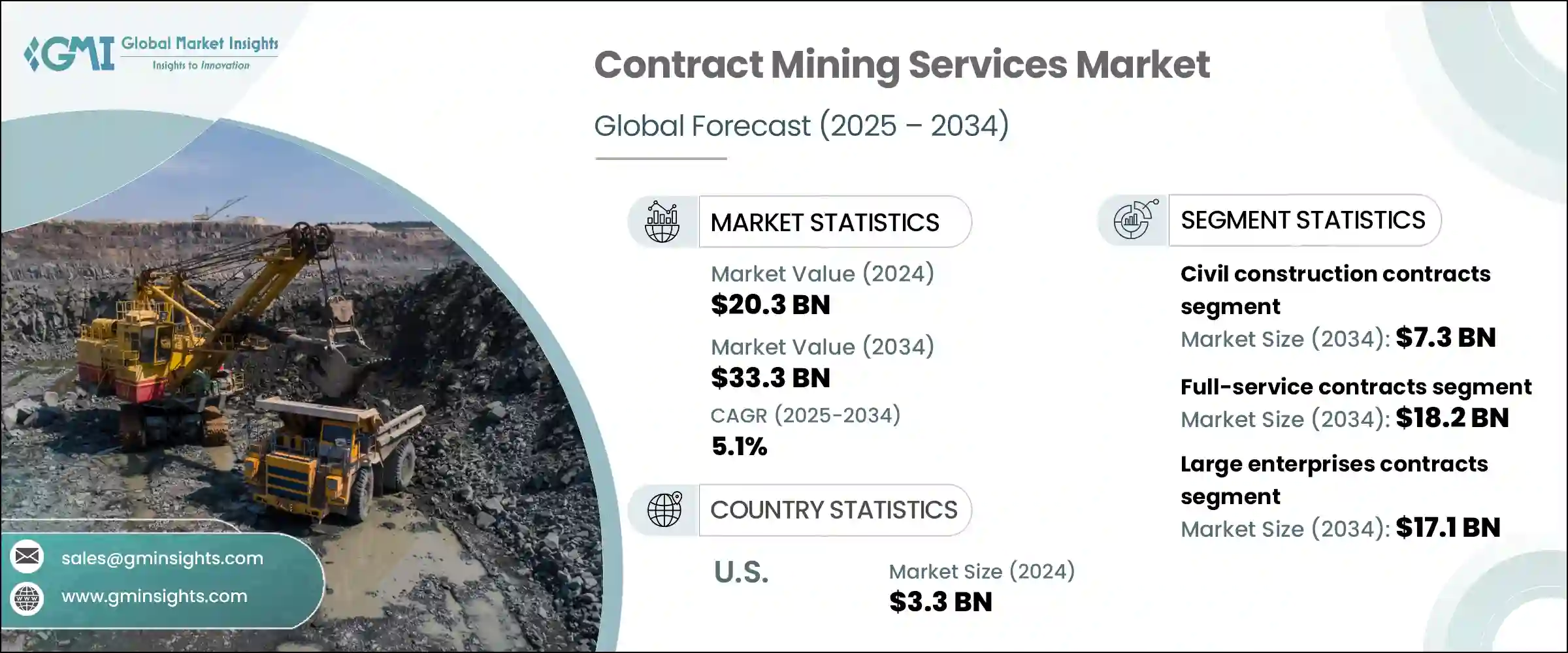
2024年,全球合約採礦服務市場規模達203億美元,預計到2034年將以5.1%的複合年成長率成長,達到333億美元。快速城鎮化和工業產出擴張推動全球對礦產和金屬的需求不斷成長,這正推動主要地區採礦活動的復甦。為了在管理營運效率和成本的同時實現不斷成長的生產目標,礦業公司擴大將核心職能委託給專業承包商。這些外包服務供應商帶來了技術專長和現代化採礦技術,使公司能夠精簡營運並降低資本支出。在自動化、人工智慧和物聯網 (IoT) 應用的推動下,合約採礦在提高安全性和產量的同時,最大限度地降低了勞動力風險。最近的報告表明,自動化操作的效果顯著優於傳統的手動設置,預計將廣泛採用。
不斷發展的永續發展法規和來自環境監管機構的壓力也推動了這一轉變,促使礦業營運商採取更環保、更注重合規的做法,尤其是在美國環保署等機構的政策強化下。這些監管變化正在推動更負責任的資源開採方式,促使企業減少排放,負責任地管理廢棄物,並改善土地復墾工作。世界各國政府也正在引入更嚴格的環境審計和永續採礦技術的誘因,加速低影響機械和再生能源在現場的整合。
| 市場範圍 | |
|---|---|
| 起始年份 | 2024 |
| 預測年份 | 2025-2034 |
| 起始值 | 203億美元 |
| 預測值 | 333億美元 |
| 複合年成長率 | 5.1% |
2024年,土木工程合約領域產值達45億美元,預計2034年將達73億美元。這些合約對採礦作業至關重要,涵蓋初期基礎設施建設,例如挖掘、場地清理、道路建設和加工廠設置。承包商正在整合新一代施工工具,例如3D視覺化、基於人工智慧的調度軟體和配備GPS的機械設備,以加快交付進度並減少低效環節。隨著基礎設施複雜性的增加,這些高科技解決方案能夠更好地控制成本,並提高專案執行的順暢度。
全方位服務合約領域佔據55.8%的佔有率,到2034年將達到182億美元。這些綜合解決方案因其能夠處理採礦的各個階段(從場地分析到開採以及採礦後土地復墾)而日益受到歡迎。由於礦業公司面臨限制營運風險和資本支出的壓力,全方位服務透過將探勘、鑽井、物流和場地管理捆綁成一個統一、緊密結合的解決方案,提供交鑰匙價值。此外,預測性維護平台、智慧車隊追蹤和環境監測技術等數位工具的整合,進一步提高了營運透明度和ESG合規性。
美國合約採礦服務市場在2024年創收33億美元,預計2034年將以4.4%的複合年成長率成長。這一成長得益於成熟的採礦業,該行業專注於銅、煤、金和建築骨料等大宗商品。近期聯邦政府推出的旨在促進鋰和稀土元素等關鍵礦產開採的激勵措施,鼓勵更多礦業業者尋求專業服務提供者的協助。由美國礦山安全與健康管理局 (MSHA) 領導制定的監管框架進一步強化了高品質合規承包商的角色。在環境敏感度較高的地區,擁有完善的ESG專案和現代技術的服務提供者的需求正在成長。
影響全球合約採礦服務市場的關鍵參與者包括 Thiess、Macmahon、Barminco、Master Drilling、Downer、Redpath、Orica、Moolmans、Perenti、CIMIC、Turner、Byrnecut、NRW、Murray & Roberts 和 JCHX。為了鞏固市場地位,領先的合約採礦公司正在利用一系列策略性舉措。其中包括透過部署人工智慧驅動的分析和遠端操作平台來擴展數位轉型計劃,以改善決策能力和生產力。公司也正在實現服務組合多樣化,包括環境修復和碳減排解決方案,以符合日益嚴格的全球永續發展要求。與礦業營運商的合作與合資企業使承包商能夠更快地進入區域市場並提高專案能力。此外,員工技能提升、車隊現代化和即時資料系統的採用正在幫助承包商保持競爭優勢和法規遵循,同時為客戶提供增值服務。
目錄
第1章:方法論與範圍
第2章:執行摘要
第3章:行業洞察
- 產業生態系統分析
- 供應商概況
- 利潤率
- 每個階段的增值
- 影響價值鏈的因素
- 產業衝擊力
- 成長動力
- 產業陷阱與挑戰
- 機會
- 成長潛力分析
- 未來市場趨勢
- 技術和創新格局
- 當前的技術趨勢
- 新興技術
- 價格趨勢
- 按地區
- 依技術
- 監管格局
- 標準和合規要求
- 區域監理框架
- 認證標準
- 波特的分析
- PESTEL分析
第4章:競爭格局
- 介紹
- 公司市佔率分析
- 按地區
- 北美洲
- 歐洲
- 亞太地區
- 拉丁美洲
- MEA
- 按地區
- 公司矩陣分析
- 主要市場參與者的競爭分析
- 競爭定位矩陣
- 關鍵進展
- 併購
- 夥伴關係與合作
- 新產品發布
- 擴張計劃
第5章:市場估計與預測:依服務類型,2021 年至 2034 年
- 主要趨勢
- 設備供應和供應鏈管理
- 勞動力供應
- 諮詢與顧問服務
- 生產和礦山開發服務
- 裝載和運輸
- 鑽孔和爆破
- 破碎和篩分
- 礦山開發
- 其他(土方工程等)
- 維護和維修服務
- 土木工程合約
- 其他(環境管理、安全與健康服務等)
第6章:市場估計與預測:依服務涵蓋範圍,2021 年至 2034 年
- 主要趨勢
- 全方位服務合約
- 部分服務合約/建設-營運-移交(BOT)契約
第7章:市場估計與預測:按服務供應商,2021 年至 2034 年
- 主要趨勢
- 大型企業
- 中小型企業
第 8 章:市場估計與預測:按應用,2021 年至 2034 年
- 主要趨勢
- 採煤
- 石油和天然氣開採
- 冶金採礦
- 其他
第9章:市場估計與預測:按地區,2021 年至 2034 年
- 主要趨勢
- 北美洲
- 美國
- 加拿大
- 歐洲
- 德國
- 英國
- 法國
- 義大利
- 西班牙
- 亞太地區
- 中國
- 印度
- 日本
- 韓國
- 澳洲
- 拉丁美洲
- 巴西
- 墨西哥
- 阿根廷
- MEA
- 沙烏地阿拉伯
- 阿拉伯聯合大公國
- 南非
第10章:公司簡介
- Barminco
- Byrnecut
- CIMIC
- Downer
- JCHX
- Macmahon
- Master Drilling
- Moolmans
- Murray & Roberts
- NRW
- Orica
- Perenti
- Redpath
- Thiess
- Turner
The Global Contract Mining Services Market was valued at USD 20.3 billion in 2024 and is estimated to grow at a CAGR of 5.1% to reach USD 33.3 billion by 2034. The increasing global demand for minerals and metals-driven by rapid urbanization and expanding industrial output-is fueling a resurgence in mining activity across key regions. To meet rising production targets while managing operational efficiency and costs, mining companies are increasingly delegating core functions to specialized contractors. These outsourced service providers bring technical expertise and modern mining technologies, enabling companies to streamline operations and reduce CapEx. Enhanced by automation, artificial intelligence, and Internet of Things (IoT) applications, contract mining boosts safety and output while minimizing labor risks. Recent reports suggest that automated operations significantly outperform traditional manual setups, leading to widespread adoption.
This shift is also supported by evolving sustainability regulations and pressure from environmental watchdogs, prompting mining operators to adopt greener, compliance-focused practices, especially with policy reinforcements from agencies like the U.S. Environmental Protection Agency. These regulatory changes are driving a more accountable approach to resource extraction, pushing companies to reduce emissions, manage waste responsibly, and improve land rehabilitation efforts. Governments worldwide are also introducing stricter environmental audits and incentives for sustainable mining technologies, accelerating the integration of low-impact machinery and renewable energy sources on-site.
| Market Scope | |
|---|---|
| Start Year | 2024 |
| Forecast Year | 2025-2034 |
| Start Value | $20.3 Billion |
| Forecast Value | $33.3 Billion |
| CAGR | 5.1% |
The civil construction contracts segment generated USD 4.5 billion in 2024 and is projected to reach USD 7.3 billion by 2034. These contracts are vital to mining operations, covering initial infrastructure development such as excavation, site clearance, road construction, and processing plant setup. Contractors are integrating next-gen construction tools like 3D visualization, AI-based scheduling software, and GPS-equipped machinery to fast-track delivery timelines and cut inefficiencies. As infrastructure complexity increases, these high-tech solutions support greater cost control and smoother execution.
Full-service contracts segment held 55.8% share and will reach USD 18.2 billion by 2034. These comprehensive solutions are increasingly popular for their ability to handle all phases of mining, from site analysis to extraction and post-mining land rehabilitation. With mining companies under pressure to limit operational exposure and capital expenditure, full-service offerings provide turnkey value by bundling exploration, drilling, logistics, and site management into a single, cohesive solution. In addition, the integration of digital tools such as predictive maintenance platforms, intelligent fleet tracking, and environmental monitoring technology further enhances operational transparency and ESG compliance.
United States Contract Mining Services Market generated USD 3.3 billion in 2024 and is expected to grow at a CAGR of 4.4% through 2034. This growth is supported by a well-established mining industry focused on commodities like copper, coal, gold, and construction aggregates. Recent federal incentives aimed at boosting critical mineral extraction, such as lithium and rare earth elements, have encouraged more mining operators to turn to specialized service providers. Regulatory frameworks led by the Mine Safety and Health Administration (MSHA) further reinforce the role of high-quality, compliant contractors. In regions with high environmental sensitivity, service providers with robust ESG programs and modern technologies are seeing increased demand.
Key players shaping the Global Contract Mining Services Market include Thiess, Macmahon, Barminco, Master Drilling, Downer, Redpath, Orica, Moolmans, Perenti, CIMIC, Turner, Byrnecut, NRW, Murray & Roberts, and JCHX. To solidify their market position, leading contract mining companies are leveraging a mix of strategic initiatives. These include expanding digital transformation programs through the deployment of AI-driven analytics and remote operations platforms to improve decision-making and productivity. Companies are also diversifying service portfolios to include environmental restoration and carbon-reduction solutions, aligning with tightening global sustainability mandates. Collaborations and joint ventures with mining operators have enabled faster access to regional markets and advanced project capabilities. Additionally, workforce upskilling, fleet modernization, and adoption of real-time data systems are helping contractors maintain competitive advantage and regulatory compliance while offering value-added services to their clients.
Table of Contents
Chapter 1 Methodology and Scope
- 1.1 Market scope and definition
- 1.2 Research design
- 1.2.1 Research approach
- 1.2.2 Data collection methods
- 1.3 Data mining sources
- 1.3.1 Global
- 1.3.2 Regional/Country
- 1.4 Base estimates and calculations
- 1.4.1 Base year calculation
- 1.4.2 Key trends for market estimation
- 1.5 Primary research and validation
- 1.5.1 Primary sources
- 1.6 Forecast model
- 1.7 Research assumptions and limitations
Chapter 2 Executive Summary
- 2.1 Industry 3600 synopsis
- 2.2 Key market trends
- 2.2.1 Regional
- 2.2.2 Service type
- 2.2.3 Service coverage
- 2.2.4 Service provider
- 2.2.5 Application
- 2.3 CXO perspectives: Strategic imperatives
- 2.3.1 Key decision points for industry executives
- 2.3.2 Critical success factors for market players
- 2.4 Future Outlook and Strategic Recommendations
Chapter 3 Industry Insights
- 3.1 Industry ecosystem analysis
- 3.1.1 Supplier Landscape
- 3.1.2 Profit Margin
- 3.1.3 Value addition at each stage
- 3.1.4 Factor affecting the value chain
- 3.2 Industry impact forces
- 3.2.1 Growth drivers
- 3.2.2 Industry pitfalls & challenges
- 3.3 Opportunities
- 3.4 Growth potential analysis
- 3.5 Future market trends
- 3.6 Technology and Innovation landscape
- 3.6.1 Current technological trends
- 3.6.2 Emerging technologies
- 3.7 Price trends
- 3.7.1 By region
- 3.7.2 By technology
- 3.8 Regulatory landscape
- 3.8.1 standards and compliance requirements
- 3.8.2 Regional regulatory frameworks
- 3.8.3 Certification standards
- 3.9 Porter's analysis
- 3.10 PESTEL analysis
Chapter 4 Competitive Landscape, 2024
- 4.1 Introduction
- 4.2 Company market share analysis
- 4.2.1 By region
- 4.2.1.1 North America
- 4.2.1.2 Europe
- 4.2.1.3 Asia Pacific
- 4.2.1.4 LATAM
- 4.2.1.5 MEA
- 4.2.1 By region
- 4.3 Company matrix analysis
- 4.4 Competitive analysis of major market players
- 4.5 Competitive positioning matrix
- 4.6 Key developments
- 4.6.1 Mergers & acquisitions
- 4.6.2 Partnerships & collaborations
- 4.6.3 New Product Launches
- 4.6.4 Expansion Plans
Chapter 5 Market Estimates & Forecast, By Service Type, 2021 – 2034, (USD Billion)
- 5.1 Key trends
- 5.2 Equipment Supply & SCM
- 5.3 Workforce supply
- 5.4 Consulting & advisory services
- 5.5 Production & mine development services
- 5.5.1 Load & Haul
- 5.5.2 Drill & blast
- 5.5.3 Crushing and screening
- 5.5.4 Mine development
- 5.5.5 Others (bulk earthworks, etc.)
- 5.6 Maintenance & repair services
- 5.7 Civil Construction contracts
- 5.8 Others (environmental management, safety & health services, etc.)
Chapter 6 Market Estimates & Forecast, By Service Coverage, 2021 – 2034, (USD Billion)
- 6.1 Key trends
- 6.2 Full-service contract
- 6.3 Partial service contract/Build-Operate-Transfer (BOT) contract
Chapter 7 Market Estimates & Forecast, By Service Provider, 2021 – 2034, (USD Billion)
- 7.1 Key trends
- 7.2 Large enterprises
- 7.3 Small and medium sized enterprises (SMEs)
Chapter 8 Market Estimates & Forecast, By Application, 2021 – 2034, (USD Billion)
- 8.1 Key trends
- 8.2 Coal mining
- 8.3 Oil & gas extraction
- 8.4 Metallurgical mining
- 8.5 Others
Chapter 9 Market Estimates & Forecast, By Region, 2021 – 2034, (USD Billion)
- 9.1 Key trends
- 9.2 North America
- 9.2.1 U.S.
- 9.2.2 Canada
- 9.3 Europe
- 9.3.1 Germany
- 9.3.2 UK
- 9.3.3 France
- 9.3.4 Italy
- 9.3.5 Spain
- 9.4 Asia Pacific
- 9.4.1 China
- 9.4.2 India
- 9.4.3 Japan
- 9.4.4 South Korea
- 9.4.5 Australia
- 9.5 Latin America
- 9.5.1 Brazil
- 9.5.2 Mexico
- 9.5.3 Argentina
- 9.6 MEA
- 9.6.1 Saudi Arabia
- 9.6.2 UAE
- 9.6.3 South Africa
Chapter 10 Company Profiles (Business Overview, Financial Data, Product Landscape, Strategic Outlook, SWOT Analysis)
- 10.1 Barminco
- 10.2 Byrnecut
- 10.3 CIMIC
- 10.4 Downer
- 10.5 JCHX
- 10.6 Macmahon
- 10.7 Master Drilling
- 10.8 Moolmans
- 10.9 Murray & Roberts
- 10.10 NRW
- 10.11 Orica
- 10.12 Perenti
- 10.13 Redpath
- 10.14 Thiess
- 10.15 Turner

 2034 年採礦承包服務市場分析與預測:類型、產品、服務、技術、組件、應用、流程、最終用戶、設備
 全球採礦承包服務市場
 採礦承包服務市場至2030年的預測:按服務類型、服務範圍、採礦方法、營運規模、最終用戶和地區的全球分析