


 |
市場調查報告書
商品編碼
1716685
水力幫浦市場機會、成長動力、產業趨勢分析及 2025 - 2034 年預測Hydronic Pumps Market Opportunity, Growth Drivers, Industry Trend Analysis, and Forecast 2025 - 2034 |
||||||

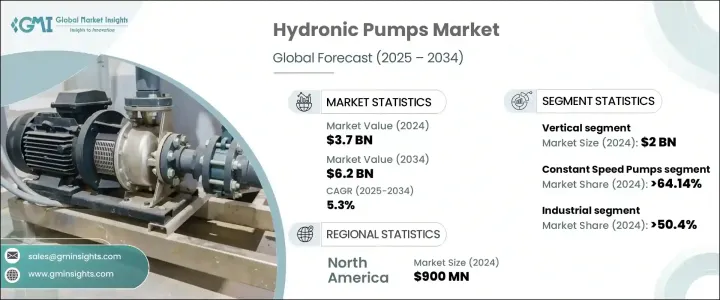
2024 年全球水力幫浦市場價值為 37 億美元,預計 2025 年至 2034 年期間的複合年成長率為 5.3%。對能源效率和永續性的不斷成長的需求推動了水力泵的採用,特別是在暖氣、通風和空調 (HVAC) 系統中。隨著政府和監管機構執行嚴格的環境標準,例如美國的「能源之星」和歐盟的類似指令,對節能技術的推動力度不斷增加。人們越來越重視減少碳排放和營運成本,這鼓勵各行各業將水力泵系統整合到住宅和商業基礎設施中。
這些泵浦透過確保高效的熱量和流體循環在最佳化能源消耗方面發揮至關重要的作用,使其成為現代建築系統的重要組成部分。此外,泵浦設計方面的技術進步,例如具有物聯網功能的智慧泵,正在透過提供即時監控和預測性維護來改變格局,從而提高系統效率並減少停機時間。全球範圍內綠色建築計劃的不斷採用進一步推動了市場的成長。隨著房地產開發商注重節能設計,水力泵對於實現永續發展目標變得至關重要。人們對氣候變遷的認知不斷增強以及實施節能解決方案的必要性正在推動市場的長期前景。
| 市場範圍 | |
|---|---|
| 起始年份 | 2024 |
| 預測年份 | 2025-2034 |
| 起始值 | 37億美元 |
| 預測值 | 62億美元 |
| 複合年成長率 | 5.3% |
立式水暖泵市場在 2024 年的市場規模為 20 億美元,預計到 2034 年的複合年成長率將達到 5.4%。立式泵浦因其能夠處理高壓系統且佔用空間較小而越來越受歡迎。其緊湊的設計使其非常適合空間受限的商業、工業和 HVAC 環境中的應用。這些泵浦在密閉迴路境中高效循環水或其他流體進行加熱和冷卻,使其成為需要可靠高壓性能的各個行業的首選。隨著城市化進程的加速和建築設計優先考慮空間最佳化,對立式水力泵的需求將大幅增加。
恆速泵浦在 2024 年佔據了 64% 的市場佔有率,預計到 2034 年將保持 5% 的穩定成長率。這些泵浦通常用於需要恆定流量的系統,例如住宅和商業供暖和冷卻系統。恆速泵浦設計為以固定速度運行,提供可預測且可靠的流體循環,使其成為低需求環境的理想選擇。它們的運作穩定性和效率繼續推動其採用,特別是隨著住宅和商業領域對可靠 HVAC 系統的需求不斷成長。
北美水力幫浦市場佔 26.4% 的佔有率,2024 年產值達 9 億美元。該地區更嚴格的能源效率法規正在推動建築業採用節能技術,包括高性能水力泵。建築專案對永續性的持續重視繼續推動對這些泵浦的需求,確保符合不斷發展的能源標準。此外,亞太地區也經歷了顯著的成長,特別是在農業領域,農業實踐的現代化和機械化增加了水力泵的使用。水力泵在不同行業的應用範圍不斷擴大,預計將在未來幾年推動全球市場的成長軌跡。
目錄
第1章:方法論與範圍
第2章:執行摘要
第3章:行業洞察
- 產業生態系統分析
- 供應商格局
- 定價分析
- 技術與創新格局
- 重要新聞和舉措
- 監管格局
- 製造商
- 經銷商
- 零售商
- 衝擊力
- 成長動力
- 能源效率法規和標準
- 建築業活動不斷成長
- 再生能源整合
- 都市化和基礎設施發展
- 產業陷阱與挑戰
- 市場飽和,競爭激烈
- 初期投資高
- 成長動力
- 成長潛力分析
- 波特的分析
- PESTEL分析
第4章:競爭格局
- 介紹
- 公司市佔率分析
- 競爭定位矩陣
- 戰略展望矩陣
第5章:市場估計與預測:依類型,2021-2034
- 主要趨勢
- 垂直的
- 水平的
第6章:市場估計與預測:按速度,2021-2034 年
- 主要趨勢
- 恆速泵浦
- 變速泵
第7章:市場估計與預測:依 GPM 流量,2021 年至 2034 年
- 主要趨勢
- 低於 1GPM
- 1-2 加侖/分鐘
- 2-5 加侖/分鐘
- 5-10 加侖/分鐘
- 10-15 加侖/分鐘
- 高於 15 GPM
第8章:市場估計與預測:按功率,2021-2034
- 主要趨勢
- 高達 100W
- 100-500瓦
- 500W以上
第9章:市場估計與預測:依用途,2021-2034
- 主要趨勢
- 熱水
- 冷凍水
- 蒸氣
第 10 章:市場估計與預測:按最終用途,2021-2034 年
- 主要趨勢
- 住宅
- 商業的
- 工業的
第 11 章:市場估計與預測:按配銷通路,2021-2034 年
- 主要趨勢
- 直接的
- 間接
第 12 章:市場估計與預測:按地區,2021 年至 2034 年
- 主要趨勢
- 北美洲
- 美國
- 加拿大
- 歐洲
- 英國
- 德國
- 法國
- 義大利
- 西班牙
- 俄羅斯
- 亞太地區
- 中國
- 印度
- 日本
- 韓國
- 澳洲
- 拉丁美洲
- 巴西
- 墨西哥
- MEA
- 南非
- 沙烏地阿拉伯
- 阿拉伯聯合大公國
第13章:公司簡介
- Armstrong Fluid Technology
- Biral AG
- DAB Pumps
- Danfoss
- Flowserve Corporation
- Franklin Electric
- Grundfos
- ITT Inc.
- KSB Group
- Pentair plc
- Sulzer Ltd.
- Taco Comfort Solutions
- Uponor Corporation
- Wilo
- Xylem Inc.
The Global Hydronic Pumps Market was valued at USD 3.7 billion in 2024 and is projected to grow at a CAGR of 5.3% between 2025 and 2034. Increasing demand for energy efficiency and sustainability is driving the adoption of hydronic pumps, particularly in heating, ventilation, and air conditioning (HVAC) systems. As governments and regulatory bodies enforce stringent environmental standards, such as Energy Star in the United States and similar directives in the European Union, the push for energy-efficient technologies continues to intensify. The growing emphasis on reducing carbon emissions and operational costs is encouraging industries to integrate hydronic pump systems into both residential and commercial infrastructure.
These pumps play a crucial role in optimizing energy consumption by ensuring efficient heat and fluid circulation, making them a vital component in modern building systems. Additionally, technological advancements in pump designs, such as smart pumps with IoT capabilities, are transforming the landscape by offering real-time monitoring and predictive maintenance, which enhances system efficiency and reduces downtime. The rising adoption of green building initiatives across the globe is further propelling market growth. As property developers focus on energy-conscious designs, hydronic pumps are becoming essential in meeting sustainability goals. The growing awareness about climate change and the need to implement energy-saving solutions is boosting the market's long-term prospects.
| Market Scope | |
|---|---|
| Start Year | 2024 |
| Forecast Year | 2025-2034 |
| Start Value | $3.7 Billion |
| Forecast Value | $6.2 Billion |
| CAGR | 5.3% |
The vertical hydronic pump segment accounted for USD 2 billion in 2024 and is expected to grow at a CAGR of 5.4% through 2034. Vertical pumps are gaining traction due to their ability to handle high-pressure systems while occupying less space. Their compact design makes them ideal for applications in commercial, industrial, and HVAC settings where space constraints are a concern. These pumps are highly efficient in circulating water or other fluids for heating and cooling in confined environments, which makes them a preferred choice in various industries that require reliable, high-pressure performance. As urbanization accelerates and building designs prioritize space optimization, the demand for vertical hydronic pumps is set to increase significantly.
Constant speed pumps held a 64% market share in 2024 and are expected to maintain a steady growth rate of 5% through 2034. These pumps are commonly used in systems requiring a consistent flow rate, such as residential and commercial heating and cooling systems. Designed to operate at a fixed speed, constant-speed pumps provide predictable and reliable fluid circulation, making them ideal for low-demand environments. Their operational stability and efficiency continue to drive their adoption, particularly as the need for reliable HVAC systems grows in both residential and commercial sectors.
North America hydronic pumps market accounted for a 26.4% share and generated USD 900 million in 2024. Stricter energy efficiency regulations in the region are driving the construction sector to adopt energy-saving technologies, including high-performance hydronic pumps. The ongoing emphasis on sustainability in building projects continues to fuel demand for these pumps, ensuring compliance with evolving energy standards. In addition, the Asia Pacific region has witnessed remarkable growth, particularly in the agricultural sector, where modernization and mechanization of farming practices have increased the use of hydronic pumps. The expanding scope of hydronic pump applications in diverse industries is expected to bolster the global market's growth trajectory over the coming years.
Table of Contents
Chapter 1 Methodology & Scope
- 1.1 Research design
- 1.1.1 Research approach
- 1.1.2 Data collection methods
- 1.2 Base estimates and calculations
- 1.2.1 Base year calculation
- 1.2.2 Key trends for market estimates
- 1.3 Forecast model
- 1.4 Primary research & validation
- 1.4.1 Primary sources
- 1.4.2 Data mining sources
- 1.4.2.1 Market definitions
Chapter 2 Executive Summary
- 2.1 Industry 3600 synopsis, 2021-2034
Chapter 3 Industry Insights
- 3.1 Industry ecosystem analysis
- 3.2 Supplier landscape
- 3.3 Pricing analysis
- 3.4 Technology & innovation landscape
- 3.5 Key news & initiatives
- 3.6 Regulatory landscape
- 3.7 Manufacturers
- 3.8 Distributors
- 3.9 Retailers
- 3.10 Impact forces
- 3.10.1 Growth drivers
- 3.10.1.1 Energy efficiency regulations and standards
- 3.10.1.2 Growing construction activities
- 3.10.1.3 Renewable energy integration
- 3.10.1.4 Urbanization and infrastructure development
- 3.10.2 Industry pitfalls & challenges
- 3.10.2.1 Market saturation and intense competition
- 3.10.2.2 High initial investment
- 3.10.1 Growth drivers
- 3.11 Growth potential analysis
- 3.12 Porter's analysis
- 3.13 PESTEL analysis
Chapter 4 Competitive Landscape, 2024
- 4.1 Introduction
- 4.2 Company market share analysis
- 4.3 Competitive positioning matrix
- 4.4 Strategic outlook matrix
Chapter 5 Market Estimates & Forecast, By Type, 2021-2034 (USD Billion) (Million Units)
- 5.1 Key trends
- 5.2 Vertical
- 5.3 Horizontal
Chapter 6 Market Estimates & Forecast, By Speed, 2021-2034 (USD Billion) (Million Units)
- 6.1 Key trends
- 6.2 Constant speed pumps
- 6.3 Variable speed pumps
Chapter 7 Market Estimates & Forecast, By GPM Flow, 2021-2034 (USD Billion) (Million Units)
- 7.1 Key trends
- 7.2 Below 1GPM
- 7.3 1-2 GPM
- 7.4 2-5 GPM
- 7.5 5-10 GPM
- 7.6 10-15 GPM
- 7.7 Above 15 GPM
Chapter 8 Market Estimates & Forecast, By Power, 2021-2034 (USD Billion) (Million Units)
- 8.1 Key trends
- 8.2 Upto 100W
- 8.3 100-500W
- 8.4 Above 500W
Chapter 9 Market Estimates & Forecast, By Usage, 2021-2034 (USD Billion) (Million Units)
- 9.1 Key trends
- 9.2 Heated water
- 9.3 Chilled water
- 9.4 Steam
Chapter 10 Market Estimates & Forecast, By End Use, 2021-2034 (USD Billion) (Million Units)
- 10.1 Key trends
- 10.2 Residential
- 10.3 Commercial
- 10.4 Industrial
Chapter 11 Market Estimates & Forecast, By Distribution Channel, 2021-2034 (USD Billion) (Million Units)
- 11.1 Key trends
- 11.2 Direct
- 11.3 Indirect
Chapter 12 Market Estimates & Forecast, By Region, 2021-2034 (USD Billion) (Million Units)
- 12.1 Key trends
- 12.2 North America
- 12.2.1 U.S.
- 12.2.2 Canada
- 12.3 Europe
- 12.3.1 UK
- 12.3.2 Germany
- 12.3.3 France
- 12.3.4 Italy
- 12.3.5 Spain
- 12.3.6 Russia
- 12.4 Asia Pacific
- 12.4.1 China
- 12.4.2 India
- 12.4.3 Japan
- 12.4.4 South Korea
- 12.4.5 Australia
- 12.5 Latin America
- 12.5.1 Brazil
- 12.5.2 Mexico
- 12.6 MEA
- 12.6.1 South Africa
- 12.6.2 Saudi Arabia
- 12.6.3 UAE
Chapter 13 Company Profiles
- 13.1 Armstrong Fluid Technology
- 13.2 Biral AG
- 13.3 DAB Pumps
- 13.4 Danfoss
- 13.5 Flowserve Corporation
- 13.6 Franklin Electric
- 13.7 Grundfos
- 13.8 ITT Inc.
- 13.9 KSB Group
- 13.10 Pentair plc
- 13.11 Sulzer Ltd.
- 13.12 Taco Comfort Solutions
- 13.13 Uponor Corporation
- 13.14 Wilo
- 13.15 Xylem Inc.

 2025年全球微型活塞幫浦市場報告
 磁力驅動幫浦市場規模、佔有率和趨勢分析報告:按產品類型、流量、材料、應用、地區和細分市場預測(2025-2033 年)
 地熱流體幫浦市場按泵浦類型、能源來源、應用、部署類型、最終用戶、功率輸出和材質分類-2025-2032年全球預測泵浦市場按泵浦類型、技術、動力來源、最終用戶和分銷管道分類-2025-2032 年全球預測農業泵浦市場按泵浦類型、驅動類型、額定功率、材質、應用、最終用戶和分銷管道分類-2025-2032年全球預測重型幫浦市場按泵浦類型、終端用戶產業、動力來源和泵浦材質分類-2025-2032年全球預測
 一次性泵浦市場-全球產業規模、佔有率、趨勢、機會和預測(按材料、應用、滅菌、地區和競爭細分,2020-2030 年)2025年全球校準幫浦市場報告2025年全球農業幫浦市場報告浴室幫浦市場按產品類型、容量、材料、應用、最終用戶和分銷管道分類-2025-2030 年全球預測