


 |
市場調查報告書
商品編碼
1666994
軟性電氣導管市場機會、成長動力、產業趨勢分析與 2025 - 2034 年預測Flexible Electrical Conduit Market Opportunity, Growth Drivers, Industry Trend Analysis, and Forecast 2025 - 2034 |
||||||

2024 年全球軟性電氣導管市場規模將達到 21 億美元,預計 2025-2034 年期間的複合年成長率為 7.5%。這種成長歸因於建築、汽車和電信等行業不斷成長的需求,這些行業對耐用且適應性強的解決方案至關重要。城市化進程加快、基礎設施進步和自動化應用進一步推動了對軟性導管的需求,以有效保護佈線系統。
受對多功能、易於安裝的解決方案的需求推動,軟性金屬管 (FMT) 領域預計到 2034 年將創收 11 億美元。隨著客戶尋求適合工業自動化的耐火或高靈活性導管等專業化選擇,客製化已成為關鍵趨勢。模組化和預組裝配置的出現簡化了安裝過程,減少了勞動成本並提高了整體效率。此外,人們對安全和法規遵從性的日益關注刺激了對符合嚴格行業標準的創新設計的投資。
| 市場範圍 | |
|---|---|
| 起始年份 | 2024 |
| 預測年份 | 2025-2034 |
| 起始值 | 21億美元 |
| 預測值 | 44億美元 |
| 複合年成長率 | 7.5% |
能源產業預計將在軟性電線管市場實現大幅成長,到 2034 年複合年成長率將達到 6%。此外,智慧電網基礎設施的擴張和節能技術的日益融合,正在推動能源分配網路中對軟性導管的需求。為了滿足這些需求,製造商正在開發優先考慮安全性、合規性和環境永續性的先進導管解決方案。
預計到 2034 年,美國軟性電線管市場將創收 5.5 億美元。建築物中智慧技術和自動化的整合增加了對耐用且防火的軟性導管的需求。此外,以安全和環境合規為重點的不斷發展的監管要求正在推動製造商創造環保、高性能的導管解決方案。
總體而言,由於各行業對可靠、安全、高效的佈線解決方案的需求不斷增加,軟性電線管市場正在穩步成長。預計對客製化、法規遵守和創新的重視將進一步推動市場發展,滿足快速發展的全球基礎設施格局的需求。
目錄
第 1 章:方法論與範圍
- 市場定義
- 基礎估算與計算
- 預測計算
- 資料來源
- 基本的
- 次要
- 有薪資的
- 民眾
第 2 章:執行摘要
第 3 章:產業洞察
- 產業生態系統分析
- 監管格局
- 產業衝擊力
- 成長動力
- 產業陷阱與挑戰
- 成長潛力分析
- 波特的分析
- 供應商的議價能力
- 買家的議價能力
- 新進入者的威脅
- 替代品的威脅
- PESTEL 分析
第4章:競爭格局
- 戰略儀表板
- 創新與永續發展格局
第 5 章:市場規模及預測:依貿易規模,2021 年至 2034 年
- 主要趨勢
- ½ 至 1
- 1 ¼ 至 2
- 2.5 至 3
- 3至4
- 5 至 6
- 其他
第6章:市場規模及預測:依配置,2021 – 2034 年
- 主要趨勢
- 軟性金屬 (FMC)
- 液密軟性金屬 (LFMC)
- 軟性金屬管 (FMT)
- 防液體擴散軟性非金屬 (LFNC)
第 7 章:市場規模與預測:按應用,2021 – 2034 年
- 主要趨勢
- 鐵路基礎設施
- 軍事航太
- 醫療設施
- 加工廠
- 能源
- 其他
第 8 章:市場規模與預測:依最終用途,2021 – 2034 年
- 主要趨勢
- 住宅
- 商業的
- 工業的
- 公用事業
第 9 章:市場規模與預測:按地區,2021 – 2034 年
- 主要趨勢
- 北美洲
- 美國
- 加拿大
- 墨西哥
- 歐洲
- 法國
- 德國
- 義大利
- 英國
- 俄羅斯
- 亞太地區
- 中國
- 印度
- 日本
- 韓國
- 澳洲
- 中東和非洲
- 沙烏地阿拉伯
- 阿拉伯聯合大公國
- 卡達
- 南非
- 拉丁美洲
- 巴西
- 阿根廷
第10章:公司簡介
- ABB
- Anamet Electrical
- Atkore
- CANTEX
- Dongguan FlexGlory Machinery Accessories
- Electri-Flex Company
- Hubbell
- HellermannTyton
- Kaiphone Technology
- Legrand
- Schneider Electric
- Southwire Company
- Wienerberger
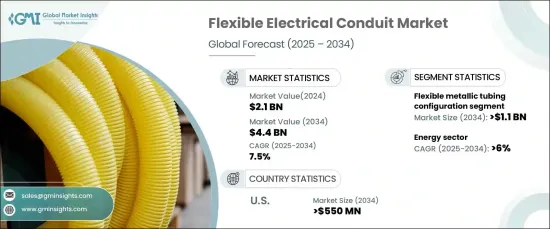
The Global Flexible Electrical Conduit Market reached USD 2.1 billion in 2024 and is projected to grow at a CAGR of 7.5% during 2025-2034. This growth is attributed to rising demand across industries such as construction, automotive, and telecommunications, where durable and adaptable solutions are essential. Increasing urbanization, infrastructure advancements, and the adoption of automation are further driving the need for flexible conduits to safeguard wiring systems effectively.
The flexible metallic tubing (FMT) segment is expected to generate USD 1.1 billion through 2034, fueled by the demand for versatile, easy-to-install solutions. Customization has become a pivotal trend as clients seek specialized options like fire-resistant or high-flexibility conduits tailored for industrial automation. The emergence of modular and pre-assembled configurations is simplifying installation processes, reducing labor expenses, and enhancing overall efficiency. Moreover, growing attention to safety and regulatory compliance has spurred investments in innovative designs that meet stringent industry standards.
| Market Scope | |
|---|---|
| Start Year | 2024 |
| Forecast Year | 2025-2034 |
| Start Value | $2.1 Billion |
| Forecast Value | $4.4 Billion |
| CAGR | 7.5% |
The energy sector is poised for significant growth in the flexible electrical conduit market, with a CAGR of 6% through 2034. The rising focus on renewable energy projects, including wind and solar installations, is driving the adoption of flexible conduits for efficient and secure wiring systems. Additionally, the expansion of smart grid infrastructure and the increasing integration of energy-efficient technologies are boosting demand for flexible conduits in energy distribution networks. To address these needs, manufacturers are developing advanced conduit solutions that prioritize safety, compliance, and environmental sustainability.
U.S. flexible electrical conduit market is projected to generate USD 550 million by 2034. Growth is being driven by robust demand from industries such as construction, manufacturing, and energy. The integration of smart technologies and automation in buildings has heightened the need for durable and fire-resistant flexible conduits. Furthermore, evolving regulatory requirements focused on safety and environmental compliance are pushing manufacturers to create environment-friendly, high-performance conduit solutions.
Overall, the flexible electrical conduit market is experiencing steady growth due to the increasing need for reliable, safe, and efficient wiring solutions across diverse sectors. Emphasis on customization, regulatory adherence, and innovation is expected to further propel the market, catering to the demands of a rapidly evolving global infrastructure landscape.
Table of Contents
Chapter 1 Methodology & Scope
- 1.1 Market definitions
- 1.2 Base estimates & calculations
- 1.3 Forecast calculation
- 1.4 Data sources
- 1.4.1 Primary
- 1.4.2 Secondary
- 1.4.2.1 Paid
- 1.4.2.2 Public
Chapter 2 Executive Summary
- 2.1 Industry synopsis, 2021 - 2034
Chapter 3 Industry Insights
- 3.1 Industry ecosystem analysis
- 3.2 Regulatory landscape
- 3.3 Industry impact forces
- 3.3.1 Growth drivers
- 3.3.2 Industry pitfalls & challenges
- 3.4 Growth potential analysis
- 3.5 Porter's analysis
- 3.5.1 Bargaining power of suppliers
- 3.5.2 Bargaining power of buyers
- 3.5.3 Threat of new entrants
- 3.5.4 Threat of substitutes
- 3.6 PESTEL analysis
Chapter 4 Competitive Landscape, 2024
- 4.1 Strategic dashboard
- 4.2 Innovation & sustainability landscape
Chapter 5 Market Size and Forecast, By Trade Size, 2021 – 2034 (USD Million)
- 5.1 Key trends
- 5.2 ½ to 1
- 5.3 1 ¼ to 2
- 5.4 2 ½ to 3
- 5.5 3 to 4
- 5.6 5 to 6
- 5.7 Others
Chapter 6 Market Size and Forecast, By Configuration, 2021 – 2034 (USD Million)
- 6.1 Key trends
- 6.2 Flexible Metallic (FMC)
- 6.3 Liquid-Tight Flexible Metal (LFMC)
- 6.4 Flexible Metallic Tubing (FMT)
- 6.5 Liquid-Tight Flexible Non-Metallic (LFNC)
Chapter 7 Market Size and Forecast, By Application, 2021 – 2034 (USD Million)
- 7.1 Key trends
- 7.2 Rail infrastructure
- 7.3 Military aerospace
- 7.4 Healthcare facilities
- 7.5 Process plants
- 7.6 Energy
- 7.7 Others
Chapter 8 Market Size and Forecast, By End Use, 2021 – 2034 (USD Million)
- 8.1 Key trends
- 8.2 Residential
- 8.3 Commercial
- 8.4 Industrial
- 8.5 Utility
Chapter 9 Market Size and Forecast, By Region, 2021 – 2034 (USD Million)
- 9.1 Key trends
- 9.2 North America
- 9.2.1 U.S.
- 9.2.2 Canada
- 9.2.3 Mexico
- 9.3 Europe
- 9.3.1 France
- 9.3.2 Germany
- 9.3.3 Italy
- 9.3.4 UK
- 9.3.5 Russia
- 9.4 Asia Pacific
- 9.4.1 China
- 9.4.2 India
- 9.4.3 Japan
- 9.4.4 South Korea
- 9.4.5 Australia
- 9.5 Middle East & Africa
- 9.5.1 Saudi Arabia
- 9.5.2 UAE
- 9.5.3 Qatar
- 9.5.4 South Africa
- 9.6 Latin America
- 9.6.1 Brazil
- 9.6.2 Argentina
Chapter 10 Company Profiles
- 10.1 ABB
- 10.2 Anamet Electrical
- 10.3 Atkore
- 10.4 CANTEX
- 10.5 Dongguan FlexGlory Machinery Accessories
- 10.6 Electri-Flex Company
- 10.7 Hubbell
- 10.8 HellermannTyton
- 10.9 Kaiphone Technology
- 10.10 Legrand
- 10.11 Schneider Electric
- 10.12 Southwire Company
- 10.13 Wienerberger


