

 |
市場調查報告書
商品編碼
2038368
2026 年至 2035 年替代蛋白的市場機會、成長要素、產業趨勢與預測。Alternative Protein Market Opportunity, Growth Drivers, Industry Trend Analysis, and Forecast 2026 - 2035 |
||||||

2025年全球替代蛋白市場價值為1,076億美元,預計2035年將以10.7%的複合年成長率成長至3,184億美元。
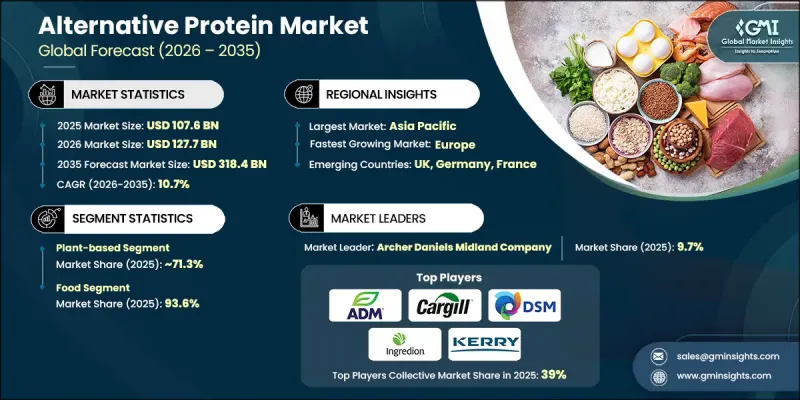
市場成長的驅動力來自消費者行為的改變、對永續性的需求以及生物技術的不斷進步。替代蛋白正成為未來食品生態系統的重要組成部分,在保障全球蛋白質安全的同時,也能減少傳統肉類和乳製品產業對環境的影響。監管支持的加強、創業投資投資的增加以及零售分銷網路的擴張正在加速市場成長。植物來源蛋白質、培養肉和發酵蛋白合計約佔整個市場的85%。結合多種生產平台的混合技術的興起,正在改善產品的質地、營養價值和價格。此外,人工智慧驅動的分子農業和3D食品列印等創新技術正在提高製程效率、擴充性和客製化程度,為更廣泛的商業性應用鋪平道路。微發酵技術透過實現功能性、動物性蛋白質的大規模生產,不斷重新定義蛋白質生產。這進一步豐富了永續蛋白質替代選擇,並有助於全球食品供應鏈的轉型。
| 市場範圍 | |
|---|---|
| 開始年份 | 2025 |
| 預測期 | 2026-2035 |
| 上市時的市場規模 | 1076億美元 |
| 預測金額 | 3184億美元 |
| 複合年成長率 | 10.7% |
到2025年,植物來源蛋白市佔率將達到71.3%。這主要得益於質地改良、萃取和擠壓技術的顯著進步,這些技術能夠複製肉類的纖維質地。培養蛋白技術利用先進的細胞培養系統和可控制的生長環境,無需使用牲畜即可生產類似肉類的替代品。這些生產方法因其擴充性和資源效率而日益受到認可,有助於解決與畜牧業相關的倫理和環境挑戰。
到2025年,食品領域將佔據93.6%的市場。製造商正在採用替代蛋白來重新配製現有產品,並提供新的、永續的食品。隨著消費者對環保飲食的關注度不斷提高,食品製造商和餐廳正在將植物來源和細胞培養蛋白納入其主要菜單,以迎合現代飲食偏好和全球永續性目標。
預計到2025年,北美替代蛋白市佔率將達到16.8%。該地區受益於強大的研發基礎設施、充足的投資支援以及消費者對替代蛋白來源的廣泛接受。美國在北美市場佔據領先地位,這得益於其完善的法規結構、尖端的技術進步以及成熟的食品加工業。政府機構已推出相關指導方針,以促進植物來源、發酵和培養蛋白的創新,從而推動該地區替代蛋白的商業化和產品多樣化。
目錄
第1章:調查方法和範圍
第2章執行摘要
第3章業界考察
- 生態系分析
- 供應商情況
- 利潤率
- 每個階段增加的價值
- 影響價值鏈的因素
- 中斷
- 影響產業的因素
- 促進因素
- 由於人口成長,全球蛋白質需求正在擴大。
- 環境永續性和減緩氣候變遷的迫切性
- 加速政府投資和政策支持
- 產業潛在風險與挑戰
- 生產成本高昂,且難以擴大生產規模。
- 消費者接受度與口味感知差距
- 市場機遇
- 進入新興市場和在中低收入國家擴張的潛力
- B2B原料市場與食品服務業的合作
- 促進因素
- 成長潛力分析
- 監理情勢
- 波特五力分析
- PESTEL 分析
- 價格趨勢
- 按地區
- 來源
- 未來市場趨勢
- 科技與創新趨勢
- 當前技術趨勢
- 新興技術
- 專利趨勢
- 貿易統計(HS編碼)
- 主要進口國
- 主要出口國
- 永續性和環境方面
- 永續計劃
- 減少廢棄物策略
- 生產中的能源效率
- 環保意識的舉措
- 考慮碳足跡
第4章 競爭情勢
- 介紹
- 企業市佔率分析
- 按地區
- 北美洲
- 歐洲
- 亞太地區
- 拉丁美洲
- 中東和非洲(MEA)
- 按地區
- 企業矩陣分析
- 主要市場公司的競爭分析
- 競爭定位矩陣
- 主要進展
- 併購
- 夥伴關係與合作
- 新產品發布
- 業務拓展計劃
第5章 市場估計與預測:依來源分類,2022-2035年
- 植物來源
- 大豆分離蛋白
- 大豆蛋白濃縮物
- 發酵大豆蛋白
- 浮萍蛋白
- 其他
- 昆蟲來源的
- 微生物來源
- 細菌
- 酵母菌
- 藻類
- 真菌
- 其他
第6章 市場估計與預測:依應用領域分類,2022-2035年
- 食物
- 肉類替代品
- 麵包店
- 乳製品替代品
- 穀物和零食
- 飲料
- 其他
- 動物飼料
- 家禽
- 肉雞
- 產蛋母雞
- 土耳其
- 其他
- 豬
- 起動機
- 發展期
- 母豬
- 牛
- 乳製品
- 牛
- 其他
- 水產養殖
- 鮭魚
- 鱒魚
- 蝦
- 鯉魚
- 其他
- 寵物食品
- 馬
- 其他
- 家禽
第7章 市場估計與預測:依地區分類,2022-2035年
- 北美洲
- 美國
- 加拿大
- 歐洲
- 德國
- 英國
- 法國
- 西班牙
- 義大利
- 其他歐洲地區
- 亞太地區
- 中國
- 印度
- 日本
- 澳洲
- 韓國
- 亞太其他地區
- 拉丁美洲
- 巴西
- 墨西哥
- 阿根廷
- 其他拉丁美洲地區
- 中東和非洲
- 沙烏地阿拉伯
- 南非
- 阿拉伯聯合大公國
- 其他中東和非洲地區
第8章:公司簡介
- Hamlet Protein A/S
- EI Du Pont De Nemours and Company
- Archer Daniels Midland Company
- Nordic Soya Oy
- Deep Branch Biotechnology
- CHS Inc.
- Agriprotein GmbH
- Darling Ingredients
- Innovafeed
- Ynsect
- Angel Yeast
- Calysta Inc.
- Lallemand, Inc.
- AB Mauri
- Ingredion
- Beneo GmbH
- Roquette Freres
- Kerry Group
- DuPont Nutrition Biosciences
- Puris
The Global Alternative Protein Market was valued at USD 107.6 billion in 2025 and is estimated to grow at a CAGR of 10.7% to reach USD 318.4 billion by 2035.
Market growth is driven by shifting consumer behavior, sustainability imperatives, and continuous biotechnological advancements. Alternative proteins are emerging as a crucial component of the future food ecosystem, addressing global protein security while reducing the environmental footprint of traditional meat and dairy industries. Increasing regulatory support, growing venture capital investments, and stronger retail distribution are accelerating the market's expansion. Together, plant-based proteins, cultivated meat, and fermentation-derived proteins represent approximately 85% of the overall market. The rise of hybrid technologies that combine multiple production platforms is improving product texture, nutritional quality, and affordability. In addition, emerging innovations such as AI-assisted molecular farming and 3D food printing are enhancing process efficiency, scalability, and customization, paving the way for wider commercial adoption. Precision fermentation continues to redefine protein manufacturing by producing functional, animal-identical proteins at scale, further diversifying options for sustainable protein alternatives and contributing to the ongoing transformation of the global food supply chain.
| Market Scope | |
|---|---|
| Start Year | 2025 |
| Forecast Year | 2026-2035 |
| Start Value | $107.6 Billion |
| Forecast Value | $318.4 Billion |
| CAGR | 10.7% |
The plant-based proteins segment held a 71.3% share in 2025, supported by major progress in texturization, extraction, and extrusion technologies that mimic the fibrous texture of meat. Cultivated protein technologies utilize advanced cell culture systems and controlled growth environments to produce authentic meat analogues without the use of livestock. These production methods are increasingly recognized as scalable and resource-efficient, addressing ethical and environmental challenges associated with animal agriculture.
The food segment held 93.6% share in 2025. Manufacturers are adopting alternative proteins to reformulate existing products and create new, sustainable food offerings. As consumer interest in environmentally responsible dining continues to grow, food producers and restaurants are incorporating plant and cell-based proteins into mainstream menus to align with modern dietary preferences and global sustainability goals.
North America Alternative Protein Market held 16.8% share in 2025. The region benefits from robust research infrastructure, strong investment backing, and widespread consumer acceptance of alternative protein sources. The U.S. leads the North American market, driven by supportive regulatory frameworks, cutting-edge technological advancements, and a mature food processing industry. Governmental agencies have introduced guidelines that promote innovation in plant-based, fermentation, and cultivated proteins, encouraging broader commercialization and product diversity in the region.
Key companies operating in the Global Alternative Protein Market include Oatly Group AB, Beyond Meat Inc., Impossible Foods Inc., Perfect Day Inc., Tyson Foods Inc., Eat Just Inc., Nestle S.A., Aleph Farms Ltd., Mosa Meat B.V., Unilever PLC, Quorn Foods, Givaudan S.A., The EVERY Company, Ingredion Incorporated, Nature's Fynd Inc., Planted Foods AG, Roquette Freres S.A., Danone S.A., Upside Foods Inc., and Wilmar International Limited. Companies in the Alternative Protein Market are leveraging advanced biotechnology, partnerships, and portfolio diversification to strengthen their market position. Many are investing heavily in R&D to enhance the taste, texture, and nutritional profiles of protein alternatives, making them competitive with animal-derived options. Strategic collaborations between startups and large food manufacturers are fostering innovation and accelerating commercialization. Firms are scaling production through fermentation and cell-based technologies while optimizing costs with hybrid manufacturing models. Expansion into new regional markets through retail channels and quick-service restaurants is further increasing consumer accessibility.
Table of Contents
Chapter 1 Methodology & Scope
- 1.1 Market scope and definition
- 1.2 Research design
- 1.2.1 Research approach
- 1.2.2 Data collection methods
- 1.3 Data mining sources
- 1.3.1 Global
- 1.3.2 Regional/Country
- 1.4 Base estimates and calculations
- 1.4.1 Base year calculation
- 1.4.2 Key trends for market estimation
- 1.5 Primary research and validation
- 1.5.1 Primary sources
- 1.6 Forecast model
- 1.7 Research assumptions and limitations
Chapter 2 Executive Summary
- 2.1 Industry 360° synopsis
- 2.2 Key market trends
- 2.2.1 Regional
- 2.2.2 Source
- 2.2.3 Application
- 2.3 TAM Analysis, 2026-2035
- 2.4 CXO perspectives: Strategic imperatives
- 2.4.1 Executive decision points
- 2.4.2 Critical success factors
- 2.5 Future Outlook and Strategic Recommendations
Chapter 3 Industry Insights
- 3.1 Industry ecosystem analysis
- 3.1.1 Supplier landscape
- 3.1.2 Profit margin
- 3.1.3 Value addition at each stage
- 3.1.4 Factor affecting the value chain
- 3.1.5 Disruptions
- 3.2 Industry impact forces
- 3.2.1 Growth drivers
- 3.2.1.1 Growing global protein demand amid population growth
- 3.2.1.2 Environmental sustainability & climate change mitigation urgency
- 3.2.1.3 Government investment & policy support acceleration
- 3.2.2 Industry pitfalls and challenges
- 3.2.2.1 High production costs & manufacturing scale-up barriers
- 3.2.2.2 Consumer acceptance & taste perception gaps
- 3.2.3 Market opportunities
- 3.2.3.1 Emerging market penetration & LMIC expansion potential
- 3.2.3.2 B2B ingredient market & food service integration
- 3.2.1 Growth drivers
- 3.3 Growth potential analysis
- 3.4 Regulatory landscape
- 3.4.1 North America
- 3.4.2 Europe
- 3.4.3 Asia Pacific
- 3.4.4 Latin America
- 3.4.5 Middle East & Africa
- 3.5 Porter's analysis
- 3.6 PESTEL analysis
- 3.7 Price trends
- 3.7.1 By region
- 3.7.2 By source
- 3.8 Future market trends
- 3.9 Technology and Innovation landscape
- 3.9.1 Current technological trends
- 3.9.2 Emerging technologies
- 3.10 Patent Landscape
- 3.11 Trade statistics (HS code)
- 3.11.1 Major importing countries
- 3.11.2 Major exporting countries
- 3.12 Sustainability and environmental aspects
- 3.12.1 Sustainable practices
- 3.12.2 Waste reduction strategies
- 3.12.3 Energy efficiency in production
- 3.12.4 Eco-friendly initiatives
- 3.13 Carbon footprint consideration
Chapter 4 Competitive Landscape, 2025
- 4.1 Introduction
- 4.2 Company market share analysis
- 4.2.1 By region
- 4.2.1.1 North America
- 4.2.1.2 Europe
- 4.2.1.3 Asia Pacific
- 4.2.1.4 LATAM
- 4.2.1.5 MEA
- 4.2.1 By region
- 4.3 Company matrix analysis
- 4.4 Competitive analysis of major market players
- 4.5 Competitive positioning matrix
- 4.6 Key developments
- 4.6.1 Mergers & acquisitions
- 4.6.2 Partnerships & collaborations
- 4.6.3 New Product Launches
- 4.6.4 Expansion Plans
Chapter 5 Market Estimates and Forecast, By Source, 2022-2035 (USD Billion) (Kilo Tons)
- 5.1 Key trends
- 5.2 Plant-Based
- 5.2.1 Soy Protein Isolates
- 5.2.2 Soy Protein Concentrates
- 5.2.3 Fermented Soy Protein
- 5.2.4 Duckweed Protein
- 5.2.5 Others
- 5.3 Insect-Based
- 5.4 Microbial-Based
- 5.4.1 Bacteria
- 5.4.2 Yeast
- 5.4.3 Algae
- 5.4.4 Fungi
- 5.5 Others
Chapter 6 Market Estimates and Forecast, By Application, 2022-2035 (USD Billion) (Kilo Tons)
- 6.1 Key trends
- 6.2 Food
- 6.2.1 Meat analogs
- 6.2.2 Bakery
- 6.2.3 Dairy alternatives
- 6.2.4 Cereals & snacks
- 6.2.5 Beverages
- 6.2.6 Others
- 6.3 Animal Feed
- 6.3.1 Poultry
- 6.3.1.1 Broiler
- 6.3.1.2 Layer
- 6.3.1.3 Turkey
- 6.3.1.4 Others
- 6.3.2 Swine
- 6.3.2.1 Starter
- 6.3.2.2 Grower
- 6.3.2.3 Sow
- 6.3.3 Cattle
- 6.3.3.1 Dairy
- 6.3.3.2 Calf
- 6.3.3.3 Others
- 6.3.4 Aquaculture
- 6.3.4.1 Salmon
- 6.3.4.2 Trout's
- 6.3.4.3 Shrimps
- 6.3.4.4 Carp
- 6.3.4.5 Others
- 6.3.5 Petfood
- 6.3.6 Equine
- 6.3.7 Others
- 6.3.1 Poultry
Chapter 7 Market Estimates and Forecast, By Region, 2022-2035 (USD Billion) (Kilo Tons)
- 7.1 Key trends
- 7.2 North America
- 7.2.1 U.S.
- 7.2.2 Canada
- 7.3 Europe
- 7.3.1 Germany
- 7.3.2 UK
- 7.3.3 France
- 7.3.4 Spain
- 7.3.5 Italy
- 7.3.6 Rest of Europe
- 7.4 Asia Pacific
- 7.4.1 China
- 7.4.2 India
- 7.4.3 Japan
- 7.4.4 Australia
- 7.4.5 South Korea
- 7.4.6 Rest of Asia Pacific
- 7.5 Latin America
- 7.5.1 Brazil
- 7.5.2 Mexico
- 7.5.3 Argentina
- 7.5.4 Rest of Latin America
- 7.6 Middle East and Africa
- 7.6.1 Saudi Arabia
- 7.6.2 South Africa
- 7.6.3 UAE
- 7.6.4 Rest of Middle East and Africa
Chapter 8 Company Profiles
- 8.1 Hamlet Protein A/S
- 8.2 E.I. Du Pont De Nemours and Company
- 8.3 Archer Daniels Midland Company
- 8.4 Nordic Soya Oy
- 8.5 Deep Branch Biotechnology
- 8.6 CHS Inc.
- 8.7 Agriprotein GmbH
- 8.8 Darling Ingredients
- 8.9 Innovafeed
- 8.10 Ynsect
- 8.11 Angel Yeast
- 8.12 Calysta Inc.
- 8.13 Lallemand, Inc.
- 8.14 AB Mauri
- 8.15 Ingredion
- 8.16 Beneo GmbH
- 8.17 Roquette Freres
- 8.18 Kerry Group
- 8.19 DuPont Nutrition Biosciences
- 8.20 Puris

 全球蛋白質替代品市場規模、佔有率、趨勢和成長分析報告(2026-2034年)
 替代蛋白市場:按來源、形式、應用和地區分類
 替代蛋白市場-全球產業規模、佔有率、趨勢、機會、預測:按產品類型、應用、地區和競爭格局分類,2021-2031年替代飼料蛋白市場-2026-2031年預測
 下一代乳製品替代品市場預測至2032年:按產品類型、配方、特性、分銷管道、成分、應用和地區分類的全球分析植物來源和替代蛋白食品市場預測至2032年:按蛋白質來源、產品類型、形式、分銷管道、應用、最終用戶和地區分類的全球分析食用昆蟲及替代蛋白來源市場預測至2032年:全球原料、昆蟲種類、產品形態、通路、應用、最終用戶及區域分析替代海鮮市場預測至2032年:按產品類型、產品形態、來源、物種、分銷管道和地區分類的全球分析植物性和替代蛋白市場預測至2032年:按產品類型、蛋白質類型、形態、分銷管道和地區分類的全球分析
 替代蛋白質的全球市場(~2035年):各類型原料,各用途類型,各性質類型,各形態類型,各地區,產業趨勢,預測